
Click Here to See Our Most Recent Review for a Real Gold Label Stereo Pressing of Forever Changes
The one person we can say for sure who must have absolutely no idea what a vintage pressing of the album is supposed to sound like is Chris Bellman. Allow us to make the case.
Below you can see our notes for the Rhino Heavy Vinyl pressing of Forever Changes cut by Chris for Bernie Grundman Mastering in 2012.
We recently got hold of a copy locally and figured why not give it a spin and see how one of the most respected mastering engineers of the day, CB, fared with this apparently difficult to master title. (Others have tried and failed. See here and here.)
The Gold Label pressings are the only ones we buy these days. The Big Red E Elektras are passable at best, and everything after them is terrible, including imports and all the Heavy Vinyl reissues that we’ve had the misfortune to play over the years. We hope to be posting some of the stampers to avoid (we call them bad stamps) before too long.
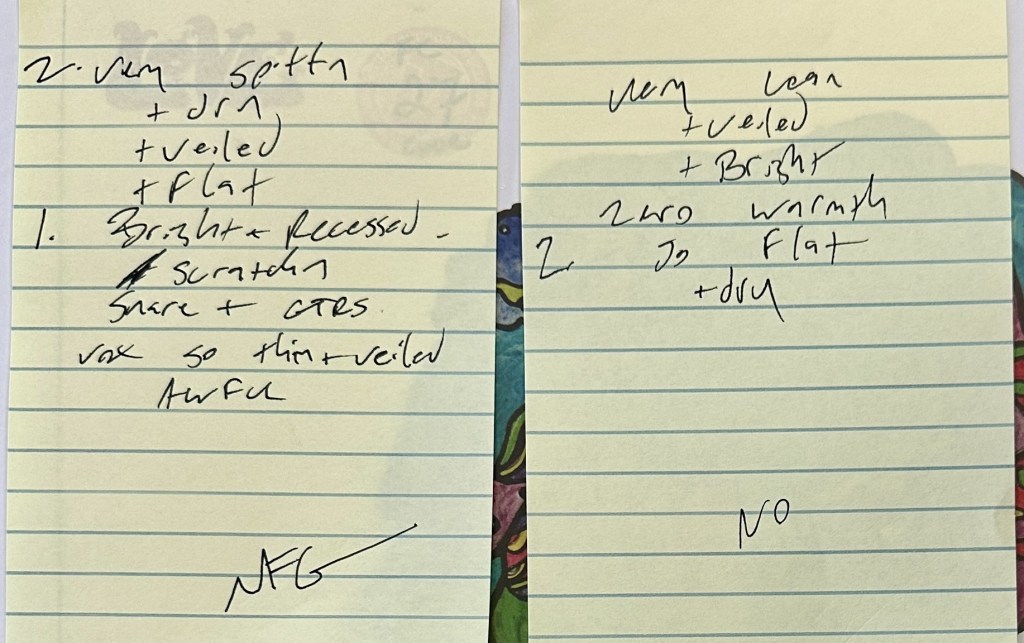
Let’s get right into the sound of this 2012 remaster. We played the two tracks on each side that we’re most familiar with from doing shootouts for the title.
As the record played, to the best of our ability we made notes of the sound we were hearing:
Side One
Track Two (A House Is Not A Motel)
- Very spitty and dry and veiled and flat
Track One (Alone Again Or)
- Bright and recessed
- Scratchy snare and guitars
- Vocals so thin and veiled
- Awful
Side Two
Track One (Between Clark And Hilldale)
- Very lean and veiled and bright
- Zero warmth
Track Two (Live And Let Live)
- So flat and dry
Conclusion: Side one is overall NFG and side two earns a grade of No.
If Chris Bellman is such a talented engineer, why does this record sound nothing like the good original pressings?
Here is our description of the sound you will find on the pressings we sell:
If you’re looking to demonstrate just how good 1967 All Tube Analog sound can be, this outstanding copy will do the trick.
This Gold Label pressing is spacious, sweet and positively dripping with ambience. Talk about Tubey Magic, the liquidity of the sound here is positively uncanny. This is vintage analog at its best, so full-bodied and relaxed you’ll wonder how it ever came to be that anyone seriously contemplated trying to improve it.
This IS the sound of Tubey Magic. No recordings will ever be made like this again, and no CD will ever capture what is in the grooves of this record. Of course there’s a CD of this album, but those of us in possession of a working turntable and a good collection of vintage vinyl have no need of it.
As engineered by Bruce Botnick, the right pressings give you the kind of low-end punch and midrange presence you hear on The Doors’ first album (when you play the right Gold Label originals). Botnick engineered them both, and they are two amazing sounding recordings that put to shame most of what was recorded in 1966 (not Revolver, obviously).
All tube from start to finish, the energy captured on these Hot Stamper pressings has to be heard to be believed. Not to mention the fact that the live-in-the-studio musicians are swimming in natural ambience, with instruments leaking from one mic to another, and most of them bouncing back and forth off the studio walls to boot.
But the thing that impresses us most is how much life there is in the performances. Of course, unless you have a very special pressing there is almost no chance you have ever heard the band exhibit the kind of raw power that’s on this album. Not many rock albums recorded in 1966 can compete with it, not for energy and live-in-your-listening-room presence anyway.
 Some audiophiles seem adamant in defending Chris Bellman‘s work, but we find it hard to find anything good to say about it except that he did excellent work cutting Brothers in Arms on two discs (review coming, I swear).
7 — No, Make That 8
In 2024 we reviewed seven awful sounding Heavy Vinyl pressings (here is the link), and we’re starting off 2025 with this piece of vinyl trash.
Is there no pressing with sound so bad that audiophiles will not call it out and admit that the current state of remastering has been a disaster since it first came on the scene in the early 90s?
I am not aware of one. If you know of any, please drop me a line.
And if you are still buying this Heavy Vinyl junk, do yourself a favor and stop. If on your system this record doesn’t sound as bad as we say it does, take the money you are currently wasting on these records and buy yourself some better equipment.
We give out plenty of audio advice on this blog precisely in order to help audiophiles improve the quality of their reproduction. Better playback will help you recognize how bad these modern records sound relative to good vintage pressings.
Robert Brook has some good advice along these lines as well, so check out his blog when you have time.
Still More Advice
If you are still buying these modern remastered pressings, take the advice of some of our customers and stop throwing your money away on Heavy Vinyl and Half-Speed mastered LPs
At the very least let us send you a Hot Stamper pressing — of any album you choose — that can show you what is wrong with your copy. of the album.
And if for some reason you believe that the pressing you own sounds better than the Hot Stamper we send you , we will happily give you all your money back and wish you the very best.
Below you will find our reviews and commentaries for the hundreds of Heavy Vinyl pressings we’ve played over the years.
We confess that even as recently as the early 2000s we were still impressed with some of the better Heavy Vinyl pressings. If we’d never made the progress we’ve worked so hard to make over the course of the last twenty or more years, perhaps we would find more merit in the Heavy Vinyl reissues many audiophiles are impressed by these days.
We’ll never know of course; that’s a bell that can be unrung. We did the work, we can’t undo it, and the system that resulted from it is merciless in revealing the truth — that these newer pressings are second-rate at best and much more often than not third-rate or even worse.
Some audiophile records sound so bad, I was so pissed off I created a unique circle of vinyl hell to put them in.
Setting higher standards — no, being able to set higher standards — in our minds is a clear mark of progress. Judging by the hundreds of letters we’ve received, we know that our customers see — and hear — things the same way.