*Bad Audiophile LPs

Linked below are a group of audiophile records numbering more than 275 as of 2026. Most of them are here because these particular pressings have awful sound, awful enough to make us want to create this special list for them.

If you have any of this junk hiding in your collection, pull some of them out, play them and see if what we’ve said about them is true. If your stereo is any good at all, it should not take long to hear their many faults.

They do not deserve a place in any audiophile’s home. Sell them to those who collect audiophile records and remain ignorant of their poor sound quality. (You should have no trouble finding buyers.)

This MoFi Makes My Head Hurt

Hot Stamper Pressings of the Music of Richard Strauss Available Now

Is the painting on the cover that of a man whose head is suffering from the ridiculously shrill string tone of this MoFi?

Doubtful. Impossible actually. But that’s exactly how my head feels when I play one of these awful MoFi classical LPs.

Their rock, pop and jazz remasters were hit and miss in the old days, with some real winners hidden amongst the junk, but their classical releases that I’ve played, without exception, was a dog.

Want a good way to know you’re dealing with bad records and collector mentality?

When you find one of these records in your local used record store, it is almost guaranteed to be pristine.

Good records get played. MoFi’s classical releases, like plenty of other classical records audiophiles found attractive, got collected and spent most of their days sitting on a shelf, out to pasture so to speak.

(more…)

Sticky Fingers – Worst Version Ever!

Hot Stamper Pressing of the Music of The Rolling Stones Available Now

Mastered by Robert Ludwig. (Scroll down to find links to more of Robert Ludwig’s work.)

Digitally remastered using UV22 Super CD encoding by Apogee Electronics, Santa Monica, California.

This RTI 180g copy (with the zipper cover) is one of a series of five titles Bob Ludwig cut in the 90s. According to the man, after cutting the record he chanced upon a consumer copy and was shocked to hear how bad it sounded.   

It sounded, according to him, nothing like the record he had cut. Somehow they had botched the pressings and ruined the sound. How this could happen I can’t imagine.

Bob says that’s what they did and we’ll take him at his word, out of respect for one of the all-time great mastering engineers, RL himself. He promptly sold off all his analog mastering equipment and got out of the game.

Can you blame him? According to him they put his name all over a record the sound of which they had ruined. Guess I would stop making records too if that were the case.

By the way, the sound was dismal on every title from that series we played except for Heart’s, which was okay, certainly better than the average pressing out there, but no Hot Stamper by any stretch of the imagination. 

(more…)

Tea for the Tillerman – This Is Your Idea of Analog?

Dear Record Loving Audiophiles of Earth,

I’m afraid we have some bad news. [This was written back in 2011 when the record came out so it’s hard to imagine that what I am about to say is news to anyone after all these years.]

Regrettably we must inform you that the 2011 edition of Tea for the Tillerman pressed by Analogue Productions on Heavy Vinyl doesn’t sound very good. We know you were all hoping for the best. We also know that you must be very disappointed to hear this unwelcome news.

But the record is what it is, and what it is is not very good. Its specific shortcomings are many and will be considered at length in our review below.

Yes, we know, the folks over at Acoustic Sounds, in consultation with the late George Marino at Sterling Sound, supposedly with the real master tape in hand, and supposedly with access to the best mastering equipment money can buy, labored mightily, doing their level best to master and press the Definitive Audiophile Tea for the Tillerman on Vinyl of All Time.

It just didn’t come out very good, no matter what the reviewers say. And what do they say? Allow me to quote one.

…superbly dynamic, spacious and detailed…The attack of the pick on the guitar strings is astonishingly clean and detailed.

Depth is pronounced…

…the resolution of low level detail reveals a host of details that are either buried or glossed over on the other versions I’ve heard…

Uh-oh, wait a minute, here’s a blindingly red flag:

If you have the edition, you’ll find this similar in one way: there’s nothing “mellow” about the overall production and when the music gets loud (and Marino lets it get so) it can get a bit hard, but better that than to soften it and lose the clarity, focus and detail of this superb recording, especially in the quieter passages where the resolution of low level detail is astonishing.

More about that later.

(more…)

Sgt. Peppers on Heavy Vinyl – The Reviewers from 1982 Blow It Again

beatlessgtHot Stamper Pressings of Sgt. Peppers Available Now

You might agree with some reviewers that EMI’s engineers did a pretty good job with the new Pepper.

In the March 2013 issue of Stereophile, Art Dudley weighed in, finding little to fault on this title but being less impressed with most of the others in the new box set.

His reference disc? The MoFi UHQR. Gadzooks!

Oh, and he also has some old mono pressings and a domestic Let It Be. Now there’s a man who knows his Beatles. Fanatical? Who can blame him? We’re talkin’ The Beatles for Chrissake!

When I read the reviews by writers such as these I often get the sense that I must’ve fallen through some sort of Audio Time Warp and landed back in 1982.

How is it that our so-called experts evince so little understanding of how records are made, how variable the pressings can be, and, more importantly, how absolutely crucial it is to understand and implement rigorous protocols when attempting to carry out comparisons among pressings.

Critically comparing LPs is difficult and time-consuming.

It requires highly developed listening skills that I could not possibly have had because I had no clue as to what they were or how to go about acquiring them.

I see no evidence that the audiophile reviewers of today are better at it than I was in 1982, and I was terrible.

What does one well-known reviewer have to say, keeping in mind that he’s using his original British pressing for comparison? I quote at length — without prejudice so to speak — so there can be no misunderstanding. (Emphasis added.)

(more…)

MoFi Sure Added Plenty of Sparkle to These Acoustic Guitars

Hot Stamper Pressing of the Music of Ry Cooder Available Now

This review is from many years ago. Hard to imagine I would not still agree with it though.

As you probably know, the MoFi of Jazz goes for big bucks nowadays — $500 and up. Is it worth it? 

You’ve got to be kidding. It’s a nice record as far as it goes, but it suffers from the same shortcomings as just about every Mobile Fidelity pressing we bother to play these days (with some obvious exceptions of course).

We have a test pressing, and knowing that the MoFi is the standard against which many audiophiles prefer to judge our Hot Stampers, we listened to it first before going about our comparison test.

Our MoFi copy is actually tonally correct, which was a bit of a surprise. (Yours of course could very well be otherwise.)

Right away we could hear exactly what people like about it, the same thing that has always impressed audiophiles about half-speed mastered records: their often outstanding transparency.

Jazz on MoFi has zero-distortion, utterly clear, spacious, see-through sound.

But listen past that and what do you hear?

Don’t those guitars seem to have that MoFi Tea-for-the-Tillerman “sparkly” quality you hate: all pluck and no body, all detail and no substance?

Nothing has any weight.

Nothing has any solidity.

Nothing has any real life.

It’s pretty, maybe, but it sure ain’t right.

It’s the kind of sound that shouts out to the world “Hey, look at me, I’m an audiophile record! See how I sound? So clear! So clean!”

Which isn’t bad for about two minutes, and then it’s positively insufferable.

(more…)

This Craft Pressing Was Definitely Born Under a Bad Sign

Hot Stamper Pressings of Electric Blues Albums Available Now

About a year ago we played the Craft pressing (CR00513) that had come out in 2023.

We have audition notes for lots of these dreadful Heavy Vinyl pressings sitting around. Sometimes they sit around for years. Obviously we are in no hurry to put them up.

The notes I took for the Craft pressing of Lush Life that Geoff Edgers played me still has not been posted, and he played me that record all the way back in 2022. For those of you who can’t wait for the complete review, I told him it sounded like a CD and proceeded to take it off the turntable.

At the time, I don’t think he understood how that could even be possible. He’d visited Bernie Grundman and read all the rave reviews for his work in the audiophile press. What do you mean his record sounds like a CD? Who the hell do you think you are anyway?

Geoff knows what that means now. I will leave it at that.

We were not surprised to find that the sound of this Craft pressing was terrible. Whoever this Jeff Powell is, I admit I’ve never heard of him, if you see his name on a remastered record, you might want to consider that if he can make a record that sounds this bad, he may not know what he is doing.

This strikes us as a safe bet.

Our notes for the album comprise all of five words. They read:

  • Not good
  • Blurry and congested

As you can see, we didn’t feel the need to spend too much time with it. When a record shows you right off the bat how badly mastered it is, we move on pretty quickly.

We admitted to having liked the Sundazed pressing when it came out in the late-90s, something that you can imagine embarrasses us no end now. In our defense, let me just say 1998 was a long time ago, before we had ever heard a properly cleaned, really good sounding original pressing.

We know how good the originals can sound. We’ve played them. What we have not been able to do is to find enough quiet, good sounding copies to do a shootout. Even at more than a hundred bucks a pop, it’s the rare copy that does not go back to the seller for excessive noise and groove damage. This record was not bought by audiophiles to play on expensive equipment.  The opposite of that demographic cohort would be closer to the truth.

As for the record collecting public, one guy on Discogs thought it didn’t sound good, but for some reason he gave it three stars anyway. Our review would have been one star out of five, assuming that even the worst sounding record must get at least one star. The other three who reviewed the album seemed to really like it.

(more…)

It’s Official – The Audiophile World Has Lost Its Mind

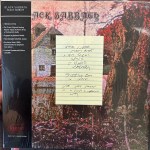
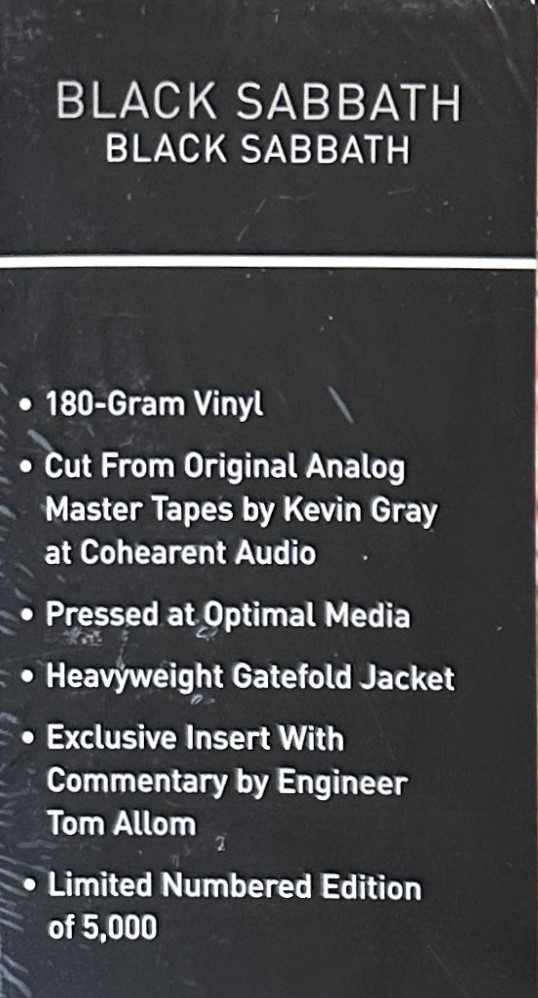
Hot Stamper Pressings of the Music of Black Sabbath Available Now

A little more than a year ago, back in June of 2023, we reviewed The Cars first album Rhino released on Heavy Vinyl. Here is our review.

We didn’t see the point in pulling our punches — when a record sounds as bad as that Cars album, somebody should stand up and say so, so we did.

We said it was possibly the worst version of the album ever made, its only competition being the Nautilus pressing from 1980, one of those bottom-of-the-barrel I-hope-we-all-learned-our-lesson Half-Speeds from back in the salad days of the remastered audiophile record craze.

(Yes, I admit I bought plenty of that crap back then, and I can’t even say for sure that I could tell how awful the remastered Nautilus pressing sounded. I believed what I was told — that the original pressings needed the ministrations of some guys with a lathe who thought they knew more than the engineers at Sterling when it came to cutting good sounding records. I must have been completely clueless to believe any of it, and now that I look back on those days, it’s obvious I was.)

But enough about me. Let’s talk about the hack who cut this godawful record. If you will allow me to quote myself from my Cars review:

Kevin Gray has struck again. He’s a modern one-man demolition crew, taking exceptionally well recorded analog albums and turning them into the vinyl equivalent of CDs, and bad CDs at that.

What we heard on side one of the new Black Sabbath remaster can be seen from our notes as reproduced below.

  • Nasal, upper midrange boost
  • No real space
  • Hard and smeary
  • Sizzly rain intro
  • Vocals are very present in a harsh and unpleasant way

(more…)

Add Made in Japan to the List of Ridiculously Bad DCC Titles

Hot Stamper Pressings of the Music of Deep Purple Available Now

What a murky mess. The sound is dead as a doornail.

It’s yet another audiophile record hall of shame pressing, a Heavy Vinyl disaster if there ever was one.

Is it the worst version of the album ever made?

That’s hard to say. But it is the worst sounding version of the album we’ve ever played, and that should be good enough for any audiophile contemplating spending money on this kind of trash. Take our advice and don’t do it.

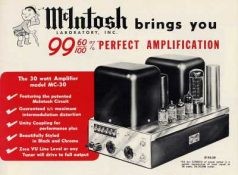
If you like the sound of old McIntosh tube equipment such as the Mac 30s shown here, a sound Steve Hoffman apparently cannot get enough of, DCC is the label for you.

We don’t sell junk like this, but every other audiophile record dealer does, because most of the current group of mastering engineers making records for audiophiles have somehow gotten into their heads that this is the way records should sound.

We’ve been telling them they are wrong about that for years now, that good records have never sounded this way, but the collectors and audiophiles of the world keep buying their wares, so why should they listen to us?

What a Fool Believes

I used to like some of the DCC vinyl titles just fine too. Didn’t play them very often, but I liked what I heard when I did.

Then my stereo got a lot better. Eventually it became obvious to me what was wrong with practically all of the Heavy Vinyl pressings put out by that label. (That story from 1998 gets told in some detail here.)

Heavy Vinyl

The good Heavy Vinyls can be found in this group, along with other Heavy Vinyl pressings we liked or used to like.

The bad Heavy Vinyls can be found in this group. And those in the middle end up in this group.

Audio and record collecting (they go hand in hand) are hard. If you think either one is easy you are very likely not doing it right, but what makes our twin hobbies compelling enough to keep us involved over the course of a lifetime is one simple fact, which is this: Although we know so little at the start, and we have so much to learn, the journey itself into the world of music and sound turns out to be both addictive and a great deal of fun.

(more…)

What to Think When a New Version of Graceland Is Completely Unrecognizable?

Hot Stamper Pressings of the Music of Paul Simon Available Now

Where did this thick, dull, bloated, opaque turd come from?

Having played at least 50-75 copies of the album over the last ten years, I can honestly say I have never heard one that sounded like this new version (maybe some record club copy we picked up by accident did, can’t say it never happened).

Can that possibly be a good thing?

Well, in favor of that proposition, I guess you could say it sounds less like a CD now.

On the other side of the ledger, it now sounds a great deal more like a bad LP.

We listen to piles of pressings of Graceland regularly. We know what the album generally sounds like, the range from bad to good, and we know what qualities the very best copies must have in order to win one of our shootouts.

Above all the one thing Graceland has going for it sonically is CLARITY. It can be open and spacious, tonally correct, with punchy, tight bass and present, breathy vocals. The best of the best copies have all these qualities, but the one quality any good copy must have is clarity, because that’s what’s good about the sound of the record. Without clarity the music doesn’t even work.

The new version has been “fixed.” It got rid of all that pesky grit and grain and CD-like sound from the original digital mix by simply equalizing them away.

Cut the top, cut the upper mids, boost the lower mids and upper bass and voila – now it’s what Graceland would have sounded like had it been all analog from the start, AAA baby!

Or at least analog for those who don’t know what good analog sounds like.

But it never was all analog, and trying to make it sound that way just ruins the one quality that it actually had going for it — clarity.

VTA

You can adjust your VTA and other table settings until you’re blue in the face, you’ll never get this pressing to sound right, and you’ll certainly never get it to sound very much like any Sterling original pressing I’ve ever heard.

The digital spit and grit is still there, under the darker EQ. And now it’s even worse — Simon’s voice has a thick, dull blanket over it, but you can still hear the spit underneath it.

You could probably take the CD and equalize it to sound like this record. But what would be the point?

The Bright Side

Well, perhaps there is a point to this equalization madness.

The CD already exists. It has a sound.

The original record has a sound too, and it’s a fairly common LP in the used bins. You could buy two or three for not that much money and try to find one you like better than the vinyl version you probably already own.

(more…)

So at 45 RPM – One Side Bad, Another Awful, What’s a Mother to Do?

Hot Stamper Pressings of the Music of Peter Gabriel Available Now

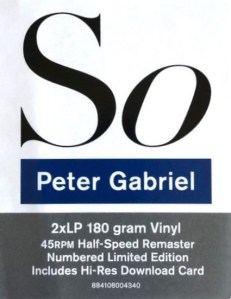
In 2016 a version of So came out using this currently popular vinyl format:

2 180g discs / 45 RPM / Deluxe, Numbered, Limited Edition /Half Speed mastered

As of this writing, there are 15 copies on Discogs, the cheapest of them starting at $139.77.

Sounds like it must be pretty good for that kind of money!

This So release was mastered by a fellow named Matt Colton, who has been doing this kind of work for a very long time, judging by the fact that he has 3,775 technical credits under his name on Discogs.

That did not stop this particular 2 LP set from being one of the worst sounding albums we have played in quite a while.

Let’s take a closer look at the specifics. We played sides one and four of the two-disc, four-sided album. That was more than enough to evaluate the sound quality.

(more…)