Month: March 2025

Buffalo Springfield – These PR Stampers Are NFG and Then Some

Hot Stamper Pressings of Country and Country Rock Available Now

Note to customers: We rarely have Hot Stamper pressings of the music of Buffalo Springfield available on the site, so albums with Stephen Stills or Neil Young performing are about the best we can do for the fans of this groundbreaking band at present.

We regret we must go many years between shootouts for this band’s albums, two of which are personal favorites and have been since they were released, 1968’s (Again) and 1969’s (Last Time Around).


We love the album but not when it sounds like this!

Want to find your own killer copy?

Consider taking our moderately helpful advice concerning the pressings that tend to win our shootouts.

(more…)

Michel Legrand – After the Rain

More Jazz Recordings of Interest
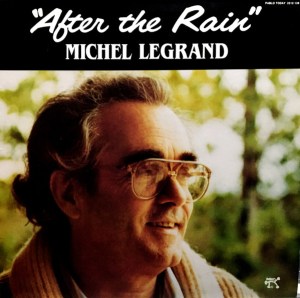
  • After the Rain returns to the site for the first time in years, here with solid Double Plus (A++) sound throughout this original Pablo pressing
  • Both of these sides are open and spacious with real depth to the soundfield and lots of separation between the various instruments
  • Rich, solid bass; you-are-there immediacy; energy and drive; instruments that are positively jumping out of the speakers – add it all up and you can see that this copy had the sound we were looking for
  • 4 stars: “This high-quality outing features composer Michel Legrand faring quite well as a jazz pianist. He performs six of his compositions with a lyrical septet also including altoist Phil Woods (doubling on clarinet), tenor saxophonist Zoot Sims, trumpeter Joe Wilder, guitarist Gene Bertoncini, bassist Ron Carter, and drummer Grady Tate.”

This album is pure magic! I know of no other jazz album like it. It’s lyrical and moody, yet comes to life at a moment’s notice when the horn players start to feel the spirit. If you’re familiar with the music he wrote for The Thomas Crown Affair (he won an Academy Award for “Windmills of Your Mind”), you may have a good feel for subtle, impressionistic, often moody quality of After the Rain. Or check it out on YouTube (while trying to imagine the sound being at least one million times better).

Michel’s idea was to assemble a group of his favorite musicians, especially those who were ordained in the lyrical persuasion, to record his next album.

With Zoot Sims and Phil Woods trading off stylistically opposed solos within the gentle, subtly ‘French’ atmosphere, aided by guitar, trumpet, Michel’s piano, and rhythm, you have something new, even unique.

Phil Woods doubles on clarinet, and his lead work on “Martina” is the one of the finest examples of jazz clarinet I’ve ever heard. (Art Pepper is another guy who can really swing on the clarinet without sounding dated.)

(more…)

What Does Neutral in Audio Really Mean?

Robert Brook runs a blog called The Broken Record, with a subtitle explaining that his blog is:

A GUIDE FOR THE DEDICATED ANALOG AUDIOPHILE

Here is Robert’s latest posting.

What Does NEUTRAL in Audio REALLY MEAN?

I wrote about this very subject in one of Robert’s postings from 2024, this one. Here is most of what I had to say at the time:

Dramatic limitations and massive amounts of colorations are endemic to home audio systems.

The only way to get rid of them is by doing the unimaginably difficult work it takes to learn how to identify them and then figure out practical ways to root them out.

This, in my experience, is a process that will rarely be accomplished, even by the truly dedicated. It unfolds slowly, over the course of decades, and only for a very small percentage of audiophiles. Most will simply give up at some point and choose to enjoy whatever sound quality they have managed to achieve up to that time. To attempt to go further feels like banging your head against a wall.

Regrettably, to push on in this devilishly difficult hobby we have chosen for ourselves is for the few, not the many.

(Of course it didn’t hurt that we got paid to do it. An undiagnosed but all-too-real obsessive personality disorder also played a part, as did certain records that I fell in love with a long time ago.)

Pass/Not-Yet

In our opinion, some of those who gave up the fight did so prematurely.

They thought they’d come a long way, and perhaps they had, but there was still plenty of potentially life-changing improvement possible.

Can you blame them? Devoting the seemingly endless amounts of time and money necessary to climb the greased ladder leading to better sound is not a choice most audiophiles are in a position to make.

Wives, children, jobs, mortgages, and a great deal more — especially the lack of a dedicated listening room — all conspire to limit the efforts of even the most committed audiophile.

Not to pile on, but there is an easy way to spot these folks, the ones who could only take it so far:

    1. By the records they own (many of which are on Heavy Vinyl),
    2. Or want to buy (ditto),
    3. Or have nice things to say about (ditto again, read the posts found on every audiophile forum).

We’ve made a partial list of the records that best identify this group, and it can be found here.

It should be noted that bad records, the kind being made by audiophile labels of every stripe these days, are no good for any of this work. The goal is to figure out how to make top quality vintage pressings sound right. (More on that subject here.)

Most new pressings will only sound enjoyable if the system playing them is good at hiding their flaws. We hope it goes without saying that no right-thinking audiophile should want anything to do with such a system, or such records.

And with his latest post, Robert Brook proves once again that he is an audiophile who knows what the goal of playing music in the home should be — to make it sound as natural and lifelike as possible — and, even more importantly, he recognized that it would take years of work to make that sound a reality, and knowing all that, committed himself to the task.

And why has he done all this work?

Because he is the one who gets all the benefits.

He gets to hear the greatest music ever recorded in a more powerfully immersive way than 99% of the audiophiles who share neither his approach nor his ambition. (You can add work ethic for the trifecta.)

If you want easy answers and quick fixes, Robert (and I) will tell you there are no such things in the world of audio. Until you’ve done the work, this way of thinking may seem counterintuitive and confusing, especially if you’ve spent much time on audiophile forums.

(more…)

Joe Pass and Paulinho Da Costa – Tudo Beni!

More Jazz Recordings Featuring the Guitar

  • Tudo Bem! appears on the site for only the second time ever, here with STUNNING Shootout Winning Triple Plus (A+++) sound or close to it throughout this original Pablo pressing
  • Both of these sides are rich, full, open, and spacious, conveying a sense of the amazing performances of these great musicians
  • Val Valentin engineered, one of the greats in our world – he’s responsible for an awful lot of our favorite audiophile quality recordings
  • 4 stars: “After countless solo guitar albums for Pablo, Joe Pass performed this welcome change of pace, a set of Brazilian tunes. Highlights include three songs by Antonio Carlos Jobim (including ‘Corcovado’ and ‘Wave’), Deodato’s ‘Tears,’ and Luiz Bonfa’s ‘The Gentle Rain.'”

(more…)

The MHS Recording of Chopin’s First Piano Concerto Had the Most Natural Piano of Them All

Hot Stamper Pressings of the Music of Frederic Chopin Available Now

There are some wonderful Musical Heritage Society records sitting in the bins of your local record store or Goodwill, and this one is worth picking up just to hear how well recorded the piano is.

We described it this way:

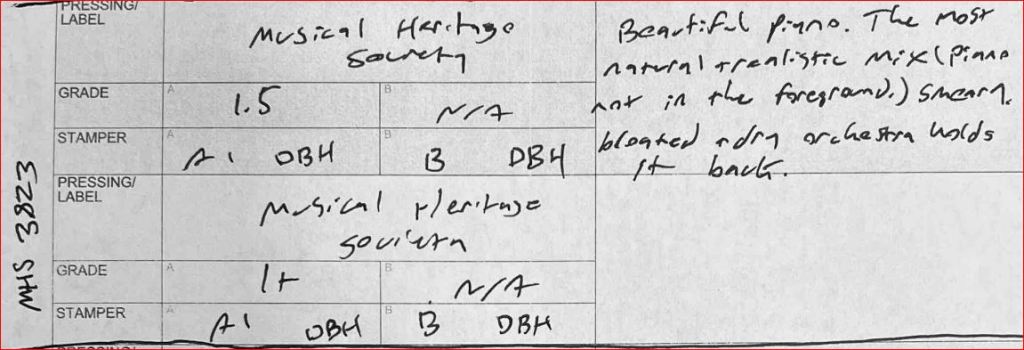
Beautiful piano. The most natural and realistic mix with the piano not in the foreground.

But there is more to the recording than the sound of the piano.

Smeary, bloated and dry orchestra holds it back.

Well, at least we tried. (Note that side two was deemed not worth grading.)

Our favorite recording for performance and sound is the Living Stereo from 1961, LSC 2575, with Rubinstein at the piano and Skrowaczewski conducting the New Symphony Orchestra of London.

This is what we had to say about the sound of our Shootout Winner:

We love the huge, solid and powerful sound of the piano on this recording. This piano has weight and heft. As a result, it sounds like a real piano.

For some reason, a great many Rubinstein recordings are not capable of reproducing those seemingly all-important qualities in the sound of the piano.

Those are, as I hope everyone understands by now, the ones we don’t sell. If the piano in a piano concerto recording doesn’t sound solid and powerful, what is the point of playing such a record?

Or, to be more accurate, what is the point of an audiophile playing such a record? (Those of you who would like to avoid bad sounding vintage classical and orchestral records have come to the right place. We’ve compiled a very long list of them for precisely that purpose, and we add to it regularly.)

(more…)

The Abbey Road Remix on Vinyl

Hot Stamper Pressings of the Music of The Beatles Available Now

We got a copy of the Abbey Road remix in, cleaned it and played it. Now we can officially report the results of our investigation into this modern marvel. Imagine, The Beatles with a new mix! Just what it needed, right?

So what did we hear?

The Half-Speed mastered remixed Abbey Road has to be one of the worst sounding Beatles records we have ever had the misfortune to play.

Hard to imagine you could make Abbey Road sound any worse. It’s absolutely disgraceful.

Is it the worst version of the album ever made? Hard to imagine it would have much competition.

I will be writing more about its specific shortcomings down the road, but for now let this serve as a warning that you are throwing your money away if you buy this newly remixed LP.


UPDATE 2022

As you may have guessed by now, I have completely lost interest in detailing the abundant shortcomings of this awful record. Do yourself a favor and don’t buy one.

If you did buy one, do yourself a different favor: order any UK pressing from 1970-1986 off the web and play that one head to head with it so you can hear how badly they screwed with and screwed up the new mix.

When the remastering is this incompetent, you do not need a Hot Stamper pressing to beat it. Almost any record will do.

Remastering a well-known title and creating a new sound for it is a huge bête noire for us here at Better Records.

Half-Speed mastered disasters that sound as bad as this record does go directly into our audiophile record hall of shame.

If this isn’t the perfect example of a pass/not-yet record, I don’t know what would be.

Some records are so wrong, or are so lacking in qualities that are critically important to their sound — qualities typically found in abundance on the right vintage pressings — that the defenders of these records are fundamentally failing to judge them properly. We call these records Pass/Not-Yet, implying that the supporters of these kinds of records are not where they need to be in audio yet, but that there is still hope. If they target their resources (time and money) well, there is no reason they can’t get to where they need to be, the same way we did. Our audio advice section may be of help in that regard.

(more…)

This Mystery Mercury May Have the Same Stampers on Both Sides, But the Sound Is Very, Very Different

Hot Stamper Pressings of Mercury Classical Recordings Available Now

For Mercury classical and orchestral recordings, the original FR pressings (when there are such pressings), in stereo, on the original plum label are the best way to go, right? 

In many cases, yes. We talk about how much better the FR pressings for The Firebird are compared to the much more common, and still quite good, M2 reissue pressings here. (Both beat the pants off the awful Classic Records pressing.

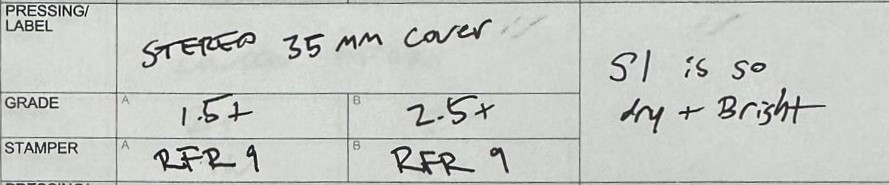
But sometimes the RFR pressings — which, as I am sure you know, can be the earliest stampers for some titles — are nothing special on one side or the other. That is exactly the case here.

Keep in mind that the stamper numbers you see above belong to a different album.

We’ve lately been giving out much more stamper information than we used to, but for now we are keeping the identify of this title close to the vest.

We are not able to predict what stampers will win a shootout before we actually sit down to play all our copies.
It turns out that the FR pressings did not sound as good as some of other pressings. The RFR stampers came in somewhere in the middle of the pack, an average of 2+, but a hard record to sell with such very different sounding sides.

This is why we do shootouts, and why you must do them too, if owning the highest quality pressings is important to you.

Fortunately for readers of this blog, our methods are explained in detail, free of charge.

We’ve also written quite a few commentaries to help audiophiles improve the way they think about records.

I implore everyone who wants to make progress in this hobby to learn from the mistakes we’ve made. There are 146 “we were wrong” listings on the site as of this writing, and we learned something from every damn one of them, painful and costly as those experiences may have been.

(more…)

Rachmaninoff – Symphony No. 1 / Previn

More of the Music of Sergei Rachmaninoff

  • Rachmaninoff’s Symphony No. 1 returns to the the site with outstanding sound throughout this original British EMI pressing
  • These sides are clear, full-bodied and present, with plenty of space around the players, the unmistakable sonic hallmark of the properly mastered, properly pressed vintage analog LP
  • The only Rachmaninoff symphonies we know of with the potential for audiophile sound are the ones Andre Previn made for EMI in the 70s
  • However, we have quite a large number of reviews and commentaries for Rachmaninoff’s piano concertos

(more…)

So Long So Wrong – Still So Wrong in the Vocal Department

Hot Stamper Pressings of Jazz and Pop Vocals Available Now

Most audiophiles have a soft spot for female vocals. It’s a sound that a high end stereo — practically any high end stereo — reproduces well.

But why do some audiophiles listen to the artificial-sounding junk that Patricia Barber and Diana Krall put out on album after album?

Their recordings are drenched in digital reverb. Who is his right mind likes the sound of digital reverb?

Rickie Lee Jones may not be my favorite female vocal of all time, but at least you can make the case for it as a Well Recorded Album. It’s worlds better than anything either of the above-mentioned artists have ever done.

The MoFi pressing of Alison Krauss (5276) is a disaster in the vocal department too.

Audiophiles for some reason never seem to notice how bad she sounds on that record. Can’t make sense of it. Any of the good Sergio Mendes records will show you female vocals that are hard to beat. Our best Hot Stampers bring the exquisite vocal harmonies of Lani Hall (aka Mrs. Herb Alpert) and Janis Hansen (and others) right into your living room.

Why bother with trash like this Mobile Fidelity?

(more…)

Van Cliburn’s Live Rachmaninoff Piano Concerto No. 3 Can Be Very Good But…

Hot Stamper Pressings of the Music of Rachmaninoff Available Now

The Shaded Dog pressings of Van Cliburn’s live performance of Rachmaninoff’s Piano Concerto No. 3 (LSC 2355) we’ve played recently tend to have very good sound.

The problem is that the famous Byron Janis recording of the work for Mercury (SR 90283) has the potential for amazingly good sound.

For a recent shootout winning copy, we had this to say:

The sound is rich and natural, with lovely transparency and virtually no smear to the strings, horns or piano. What an amazing recording! What an amazing piece of music.

The recording is explosively dynamic and on this copy, the sound was positively jumping out of the speakers. In addition, the brass and strings are full-bodied, with practically no stridency, an unusual feat the Mercury engineers seem to have accomplished while in Russia.

Big, rich sound can sometimes present problems for piano recordings. You want to hear the percussive qualities of the instrument, but few copies pull off that trick without sounding thin. This one showed us a piano that was both clear and full-bodied.

With huge amounts of hall space, weight and energy, this is Demo Disco quality sound by any standard. Once the needle has dropped you will quickly forget about the sound (and all the money you paid to get it) and simply find yourself in the presence of some of the greatest musicians of their generation, captured on the greatest analog recordings of all time.

The RCA recording, good as it is, is simply not in the same league as the better pressings of the Mercury.

For that reason we do not feel the need to offer any copies of the Living Stereo record to our customers.

(more…)