sheet

These listings have portions of our notes reproduced for those who want to learn more about stamper numbers and pressings variations.

The Earliest Stampers Often Just Cannot Be Beat

Hot Stamper Pressings on Decca & London Available Now

We recently posted a lengthy commentary about conventional wisdom, attempting to make the case that, although the most common record collecting approaches are more often right than wrong, there is simply no way to know what approach will produce the best results for any given title.

Rather than post one exception after another — easily done, since we know literally hundreds of them — we are happy to admit that the generally accepted record collecting rules of thumb* work well for most records, with the definition of “most” being “more than half the time.”

In the case of this Mystery London, the received wisdom turns out to be right on the money. (As per our policy, please note that the Mahler album you see pictured is not the record we are discussing in this post.)
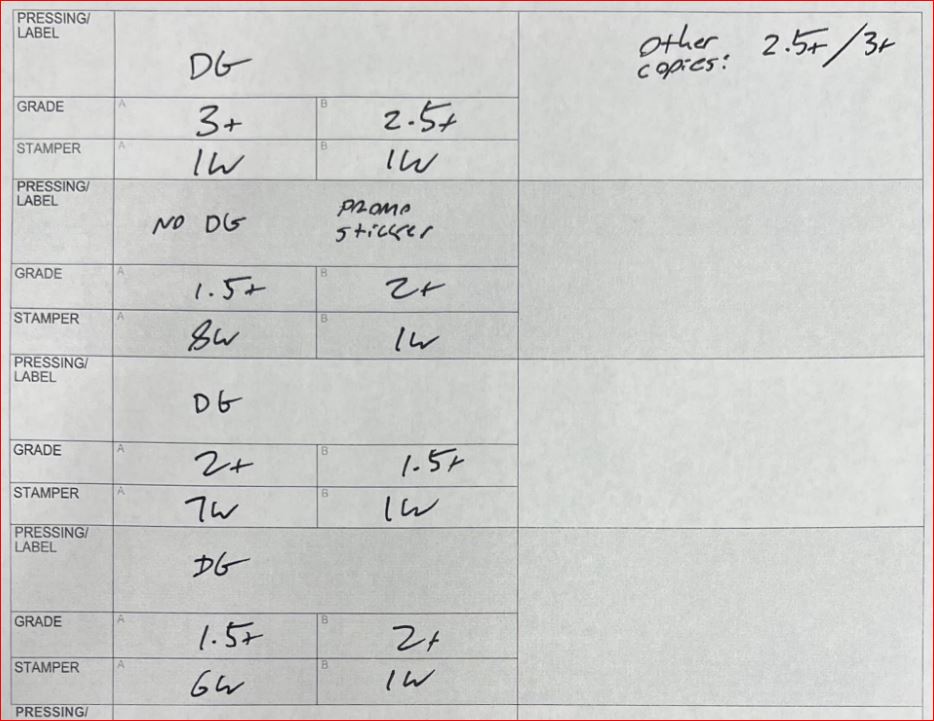
What conclusions can we draw from this information?

We would be very surprised if the earlierst pressings cut by Harry Fisher (1W/1W) can be beaten for sound. It’s possible, of course, and we will naturally continue to buy pressings with other stampers, if for no other reason than the fact that they are far more plentiful than the first pressings.

But if a 1W/1W gets offered to us at a high price, you can be sure we will jump at the opportunity to buy it and put it into a shootout.

The second one that comes to mind is that some vintage originals are not particularly well-mastered or pressed. (The 1W side twos should have sounded better than the 2+ grades they earned, but my guess is that the metal work by then was older and morn worn and just could not compete with the fresher, earlier copies, the ones with 1W side ones.)

All three of the early Deep Groove pressings with stampers other than 1W/1W did not earn Super Hot stamper grades (2+) on both sides. The only way to get top quality sound for this title is with the first pressing. And both of our 1W/1W pressings had Shootout Winning sides. (Here are some of the other albums we’ve discovered in which one set of stampers consistently win our shootouts.)

Now imagine that some company has come along and remastered the album on Heavy Vinyl for the benefit of audiophiles and music lovers alike.

If the vintage pressing you own just happens to have anything but 1W/1W stampers — you picked it up years ago because it’s an original on the Deep Groove early label and appears to be as vintage as vintage can be — you would be jumping for joy that finally the sound of the master tape has been transferred to vinyl properly after all these years.

Thank god for Kevin Gray / Bernie Grundman / Krieg Wunderlich / Chris Bellman or somebody else — pick any name you like — for the wonderful mastering work they do, bringing old records back to life.

What a service they do for the audiophile community!

Their critics must be idiots.

Sample Sizes and One Man Bands

Those of us who play a variety of pressings of the same album know where judgments of this kind come from.

They are mostly the result of sample sizes that are too small.

If you’re an audiophile reviewer operating as a one man band, which, as far as we know, is the only way any of them currently operate, your chances of getting it wrong are fairly high indeed. Here is one obvious example from a long time ago, but there are plenty more to be found under the heading of shootout malpractice here on the blog.

Just as an aside, please note that many of our customers do their own shootouts and seem to come to much more accurate assessments of the various pressings they play than any reviewers we’ve encountered. Perhaps we can take some small credit for showing them the way? I would like to think so.

How Did We Figure All of This Out?

(more…)

Do The Original Domestic KC Pressings Always Beat the Later PC LPs?

Hot Stamper Pressings of Psychedelic Rock Recordings Available Now

Here is our description for the Super Hot (2+) copy that is currently on the site:

One of the most important records in my growth as an audiophile from 1971 to the present – my stereo was forced to evolve in order to play this kind of big production rock at the loud levels that the album needs in order to work its magic.

No matter how many times you play it, you will most likely hear – or at least gain more of an appreciation for – something new in the exceptionally dense, sophisticated soundfield Chris Kimsey creates for these songs.

And each time you make an improvement in the quality of your playback, this is the album that will show you exactly what you have just accomplished.


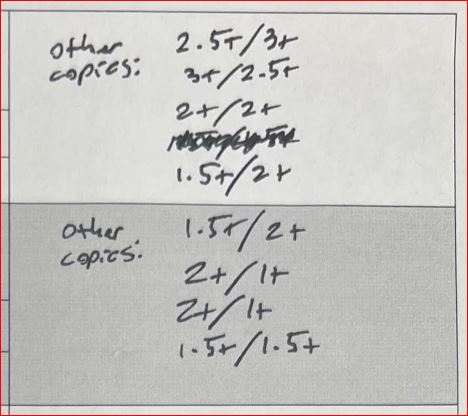
Overall, the best performers in our most recent shootout were UK pressings. They ranged in sound from the 3/3 Shootout Winning pressing (not shown) to the lowest graded British copy which earned grades of 1.5+/2+ (at the bottom of the top box).
On the left is a portion of the breakdown, minus the actual stamper numbers that earned the highest grades (for obvious reasons.)

We had six UK pressings, all with the same stampers — the five you see graded and the one hidden to the left that actually won the shootout. (Three sides earned White Hot Stamper grades, an unusual outcome and a good one for the bottom line.)

Note that with the “right stampers” you could have ended up with an incredible Demo Disc (copy #1) or just a very good sounding copy on side two mated to a passable side one (copy #6).

Finding six clean UK pressings is, as you can well imagine, neither cheap nor easy. We probably bought close to twice that many to end up with six that we’re in something close to audiophile playing condition.

As you can see from the grades, two of them were clearly inferior to the other four. In the case of this title, a small sample size could have been very misleading. Fortunately for us, we spent the money and the time it takes to track down a good-sized batch of UK pressings in order to avoid that possibility.

Next come the better domestic pressings. There was a 2+/2+ that outscored all the other domestic pressings, and four others that came in behind it, all with the same stampers.

Of the five copies that had those stampers, two had side two’s that scored sub-Hot Stamper grades, which marked them as unsaleable. (Perhaps we will offer them as one-sided records since their side one’s are so good.)

KC VS PC

We rarely have good luck with PC reissue copies when the originals come with the KC prefix, rarely meaning we find a PC winner maybe once out of every ten titles we play.

(more…)

VICS 1069 – In 2004 We Mistaked Finlandia on VICS for a Demo Disc

Hot Stamper Pressings of the Music of Sibelius Available Now

UPDATE 2024

We played a 4S/1S copy of this record, VICS 1069, and thought it sounded terrible.

It was flat and bright with splashy cymbals and crude brass.

Even if we assume the copy we played many years ago could have been much better than this latest pressing — which is doubtful but certainly possible — there is no reason to pursue this version of the album when there are known top quality pressings of this very same performance on Decca.


Our Old Review

DEMO QUALITY SOUND and quiet surfaces too.

I don’t know when I’ve heard this album with better sound. This one may be better than the best Shaded Dog for all I know — it’s that good.

You’ll notice that there is a copy of this very same record on the website for $1.99. That one sounds dull. I don’t think you’ll be able to find a better sounding copy of this record than the pressing we are selling here, because it really is an exceptionally good sounding record. If it weren’t, it would be more like $1.99.

(more…)

The Dutch Pressings Can Sound Good, Sure, But Great? Not a Chance

Hot Stamper Pressings of British Blues Rock Albums Available Now

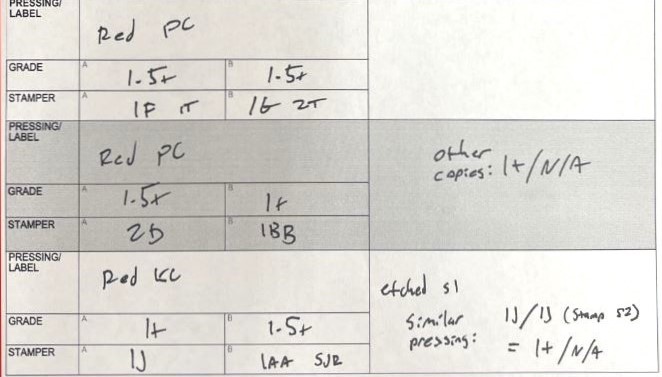
Below you will see part of a stamper sheet that was generated for a shootout we did recently.

Please note that the album you see pictured — Cream’s Goodbye — is not the one we are discussing here. What it has in common with the mystery record we are writing about is both albums were made by British rock bands, both were recorded in England, and both sound their best on the pressings that were made in the UK.

For years we would buy any and all copies of this album on the early Polydor label as long as they looked original and had TML in the dead wax. The band was British, the production was British, but for some reason all the early pressings were mastered by The Mastering Lab right here in the states. Apparently somebody involved in the production thought they could do the best job, and they were probably right.

(The Mastering Lab was one of the great mastering houses in the 70s and 80s. There is no one alive today who can make a record remotely as good sounding as the ones they produced by the thousands in those days. If you know of any, please contact me at tom@better-records.com.)

Woops

Then we noticed that some of the Red Polydor pressings said “Made in Holland” on the label. We also noticed that the Holland pressings were never the winners of our shootouts.

It’s not as if they weren’t very good sounding pressings. They could earn grades of 2+ on both sides, as two of the seven copies shown below did, but most of the time their grades were a bit lower than those, and never as good as the best Brits.

Our appreciation of these facts, facts that had been staring us in the face for a decade or more, was lacking. We didn’t connect dots that were so obvious it was hard to miss them. Why I have no idea.

Eventually, after more shootouts had shown us again and again the limitations of the Dutch pressings, the penny dropped and we finally saw the labels for what they were: a clue to what pressings could win and what pressings couldn’t. Mind you: Every record still had to go through a shootout, and the person hearing and evaluating the record had no idea which of the two countries it might have been made in. But now we knew to pay a premium for the Brit-pressed records and only buy the Dutch at the right price.

Why did we keep at it until we had if figured out? Because we get paid to.

(more…)

When All the Stampers Are the Same, What’s a Mother to Do?

Hot Stamper Pressings of Blue Note Albums Available Now
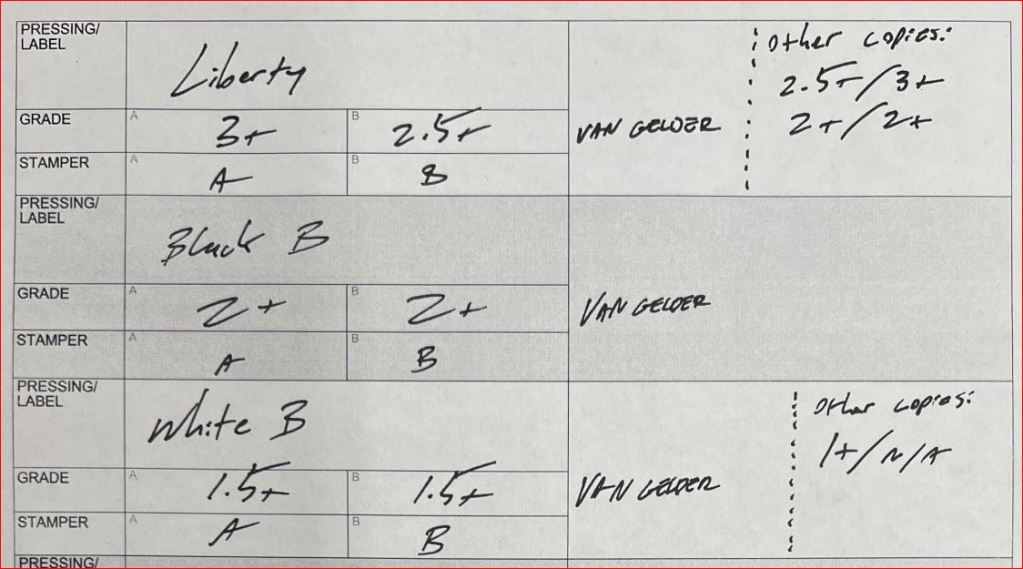

What happens when all the stampers are A and B and every one of them is cut by Rudy Van Gelder?

This is precisely the problem we were faced with on the mystery Blue Note album whose stampers can be seen below.

It’s not Cornbread — those are really hard to find! We did a shootout last year and hope to have another one coming before long, but most of what we buy ends up going back to the seller for noise issues, so it may be a while before we can get it going.

In the meantime, whatever you do, don’t waste your money on the Tone Poets reissue — it’s ridiculously bad.

What information can you rely on when trying to find the best sounding pressings?

The stamper numbers are no help.

And you can’t look for the VAN GELDER stamp in the deadwax since they all have it.

Of course, now that we’ve done the shootout, we know to buy the Liberty label pressings, but that could hardly have been predicted beforehand. Plenty of later labels beat the early label pressings on Blue Note’s albums.

But readers of this blog surely know that we are being facetious when we say we faced a lack of stamper information with the title above.

We have no way of knowing what the label is for any copy that is playing on our turntable, so how could the stamper information possibly matter, ever, under any circumstances?

We judge records by their sound quality, then grade them on that single metric, ignoring all others.

Only later do we learn which labels and stamper numbers correspond with which sonic grades, assuming they actually correspond at all. (Some don’t.)

If you are buying certain pressings because they have earlier labels, rather than pressings with later labels, predicated on the theory that the earlier labels should have better sound, this blog will be a godsend — because it will prove to you that the approach you are taking is not a particularly good one.

You are only fooling yourself if you think it is. It might work more often than not, but do you really want to be wrong about four records out of ten? Forty out of a hundred. Four hundred out of a thousand? With no way of knowing which group — good or bad — any given title happens to fall into?

A record collection of a thousand records is a decent sized collection. But with four hundred titles having second-rate or worse sound? Nobody wants that.

Buying originals is just not a good way to insure your collection will have top quality sound. Fortunately we know of a way that does.

(more…)

Most of the Time the Conventional Wisdom Turns Out to Be Right

Hot Stamper Pressings of Contemporary Jazz Albums Available Now

Recently we conducted a shootout for yet another superb Contemporary title. We’d played quite a collection of copies of this particular album over the years, on every label, starting back in the 90s when we first discovered how amazing sounding Contemporary records could be when you get hold of a good one.

We felt we had a solid understanding of both the music and the key aspects of the sound we might expect to hear — Tubey Magic, space, dead-on tonality, top end extension, all the stuff we’ve come to love in these live-in-the-studio, all-tube-chain Contemporary jazz recordings from their heydey throughout the 50s and 60s.

However, it’s not the record you see pictured. For now, the title of this album will have to remain a mystery, along with a great many others for which we’ve been reprinting our shootout stamper sheets so as to discuss their meaning on the blog.

As you can see, the original first pressings earned White Hot Stamper grades and were declared the winner of our shootout. With Nearly White Hot Stamper grades, the early Green second label did very well, followed by an OJC with respectable sound overall.

We recently posted a lengthy post discussing the pros and cons of conventional wisdom. In it we attempted to make the case that, although the most common record collecting tenets are more often right than wrong, there is simply no way to know which standard approach will work for the specific title at hand.

Rather than post one exception after another — easily done, since we have documented literally hundreds of them — we are happy to admit that the standard record collecting rules of thumb work well for most records, with the definition of “most” being “more than half the time.”

That leaves a lot of room for misses, and if those misses happen to be favorite albums of yours, tough luck. Unless…

Unless you know how to test records properly.

(more…)

Born Under a Bad Sign in Mono – Maybe Passable, Maybe Not

Hot Stamper Pressings of Electric Blues Albums Available Now

The Shootout Winning early stereo pressing that we played recently was indeed a very special record. Everything we said about it in our review was true:

These are just a few of the the things we had to say in our notes: “big and tubey and 3D”…”jumping out of the speakers”…”very full vox”…”weighty and rich”…”great energy”…”so much room and detail.”

No other copy came close to this one, and we had a bunch, many of which earned minimal grades of 1.5+ because,  on this record, you really have to know what to look for in the dead wax.

But nothing of the sort can be said of the early Blue Label mono pressing we played. It was barely passable on side one, and we didn’t even bother to play side two since no pressing that earns a grade of 1+ on either side can be considered a Hot Stamper.

Here is what we heard on side one:

  • Hard and dark
  • Vocals get lost
  • Sounds a little faster (sped up)

And that was enough. Who wants to play a record with that kind of sound? Or one that’s been sped up?

If you’re one of those music lovers who’s still holding a torch for mono, Born Under a Bad Sign is not a hill you want to die on.

We personally don’t care one way or the other if any particular mono record has good sound or bad. We just play them and call them as we hear them. We called this one “meh” and recommend you steer clear of it if you are looking for good sound.

(more…)

These Stampers Can Be Good, But They Sure Don’t Win Shootouts

Hot Stamper Pressings of Classic Rock Albums Available Now

This is how we described a recent Hot Stamper pressing that we put up on the site:

Surprisingly rich and full-bodied, particularly on side one, the best copies really ROCK with big bass and punchy drums – just the right Alice Cooper sound.

The beloved title track remains the most-performed song in his concert history, and the presence on this copy will put the band right there in your listening room.

Yet another impossible-to-find record — impossible to find in clean condition, with good sound — has made it to the site, and those of you who are fans should scoop it up. It takes us about four years to find enough copies to do this shootout.

We had poor luck with the second and third label copies on this AC title. It seems that, unlike so many records we play, the originals are the only way to go on School’s Out.

The stampers you see above belong to a Green Label early pressing. It earned good, not great Hot Stamper grades.

1.5+ is four grades down from the top copy. That’s a steep dropoff as far as we’re concerned. 1.5+ only hints at how good the best copies can sound.

To see more records that earned the 1.5+ grade, please click here. (Incidentally, some of them are even on Heavy Vinyl. The better modern pressings have sometimes, if rarely, been known to earn Hot Stamper grades, and one shocked the hell out of us by actually winning a shootout. Wouldn’t you like to know which one!)

For those who might be interested, there’s more on our grading scale here.

(more…)

When Fisher Took Over from Goodall, He Really Let the Side Down

Hot Stamper Pressings of Recordings by Decca Available Now

Please keep in mind that, as per our usual, the record you see pictured is not the record we are discussing in this posting.

The stamper numbers you see below belong to a different album.

The quick takeaway: Stan Goodall (“E”) cut the Shootout Winning early pressings.

Then, for reasons known only to the folks at Decca, Harry Fisher (“W”) took the reins and managed to cut some side twos that were very good. Not as good, but still very good: 2+ most of the time, some slightly worse. They were not as weighty or rich, and we take a lot of points off for records that are not as weighty or rich as they should be.

By the time Decca had changed its label to the Decca in a Box design, Mr. Fisher was cutting all the pressings, and, in our experience, not doing an especially good job. We do not even offer records with grades that low.

The sound might be passable, and would probably still be better than whatever Heavy Vinyl pressings might have been made from the tapes in the last twenty years, but that’s not good enough for us here at Better Records, not at the prices we charge anyway.

We described Fisher’s sound as dry and hot on side one, and thin and very small on side two of the 5W-stamped pressing we played. We only had the one, and the reason we had even one after having heard other Boxed Decca pressings do poorly, is that it’s a good way to stay honest and to have a better baseline to work with.

If we played nothing but 3E/1E originals, most of those 1E side twos would have earned a 2+ grade, but they would have sounded much better than the 2W-graded copies, and that seriously screws up the grading scale, especially when clean originals cost us a hundred bucks or more these days.

(more…)

Sure, 1s Wins, But Why Does 2s Do So Much Worse?

Hot Stamper Living Stereo Classical and Orchestral Titles Available Now

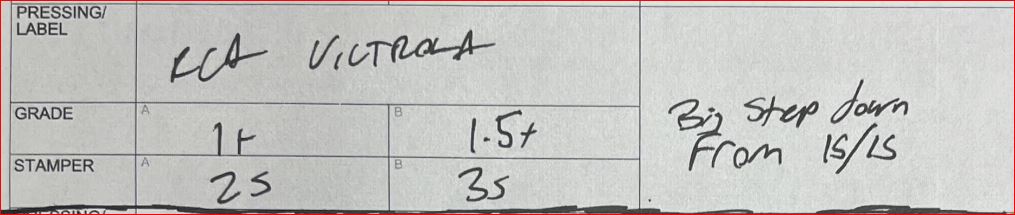
Below you will see a section of the stamper sheet for a shootout we did recently.

Keep in mind that, as usual, the album you see pictured is not the record we did the shootout for.

In the case of this mystery record, the 1s stamper was by far the best, with the Plum Label copies having later stampers (2s) earning a sub-Hot Stamper grade on side one.

The 1+ grade found on this side one means it’s simply not very good, the kind of sound we consider to be no better than passable, We do offer records with 1+ grades as Hot Stamper pressings.

What would be the point? You can find them on your own. The world is full of mediocre records. They sit in the bins of every record store you walk into and make up the bulk of record collections of both audiophiles and music lovers alike.

How Come?

Since, as we discovered recently, 1s wins, and wins handily, why does 2s/3s do so much worse?

I could guess, but that would violate our policy against pretending to know what cannot be known.

Something in the range of five to ten per cent of the major label Golden Age recordings we play will eventually make it to the site. The vast majority just don’t sound all that good to us. (Many have second- and third-rate performances and those get tossed without ever making it to a shootout.)

(more…)