don’t-win

Kind of Blue on a Killer 70s Red Label Pressing

More of the Music of Miles Davis
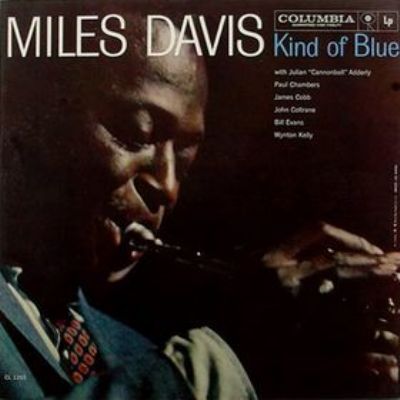
  • With two solid Double Plus (A++) sides or close to them, this Red Label pressing has Demo Disc sound – sound that’s guaranteed to make you want to take all of your remastered pressings and dump them off at the Goodwill
  • After auditioning a Hot Stamper Kind of Blue like this one – a pressing that captures the sound of this amazing group like nothing you have ever heard – you may be motivated to add a hearty, “Good riddance to bad audiophile rubbish!”
  • KOB is the embodiment of the big-as-life, spacious and timbrally accurate 30th Street Studio sound Fred Plaut was justly famous for (particularly on this side two)
  • Space, clarity, transparency, and in-the-room immediacy are some of the qualities to be found on this pressing (also particularly on side two)
  • It’s guaranteed to beat any copy you’ve ever played, and if you have the new MoFi pressing, please, please, please order this copy so that you can hear just how screwy the sound of the remaster is
  • Marks in the vinyl are sometimes the nature of the beast with these vintage LPs – there simply is no way around them if the superior sound of vintage analog is important to you
  • 5 stars: “KOB isn’t merely an artistic highlight for Miles Davis, it’s an album that towers above its peers, a record generally considered as the definitive jazz album, a universally acknowledged standard of excellence.”
  • If you’re a fan of the music Davis, Adderley and Coltrane were playing circa 1959, this album clearly belongs in your collection

The Labels of Kind of Blue

The 6 Eye label domestic stereo pressings win our shootouts, in the case of Kind of Blue without exception.
The 360 label pressings, black print (1962-63) or white print (1963-70), as well as the occasional 70s red label (1970-?), can sound very good, but they never win shootouts.

We’ve identified a select group of reissues with the potential to do well in shootouts, typically earning a grade of Super Hot (A++) when up against the best originals, which earn our top grade, White Hot (A+++). Kind of Blue is one of those recordings.

Scores of differently mastered versions have been cut over the years, but to find one that’s lively and dynamic yet still communicates the relaxed nature of this music is a trick that few of them can pull off. These sides did just that.

When the band really starts cutting loose on “So What,” you’re going to lose your mind! The sound is open and spacious with a wonderful three-dimensional quality that gives each musician a defined space. You can easily tune in to one player or another and follow their contribution as the band stretches out.

Quick Listening Tests

This is an easy one. Just listen to the trumpet at the start of Freddie Freeloader. Most copies do not properly reproduce the transient information of Miles’ horn, causing it to have an easily recognizable quality we talk about all the time on the site: smear. No two pressings will have precisely the same amount of smear on his trumpet, so look for the least smeary copy that does everything else right too. (Meaning simply that smear is important, but not all-important.)

On All Blues (track one, side two), the drums in the right channel are key to evaluating the sound of the better copies. The snare should sound solid and fat — like a real snare — and if there is space in the recording on your copy you will have no trouble hearing the room around the kit.

[The drums are precisely where one of the major faults of the disastrous MoFi 2 LP 45 RPM pressing can be heard. A fuller review is coming, soon I hope!}

Next check the cymbals. No two copies will get the cymbals to sound the same, so play a few and see which ones sound the most natural to you. The most natural will be the one with the best top end.

When Adderley comes in hard left, his alto should not be thin, squawky or stuck in the speaker. The best of the best copies have the instrument sounding full-bodied (for an alto) and reedy. The reedy quality tells you that your pressing is highly resolving and not smeared.

(more…)

The 2002 OJC Pressings Can Be Very Good but They Don’t Win Shootouts

Hot Stamper Pressings of the Music of Bill Evans Available Now
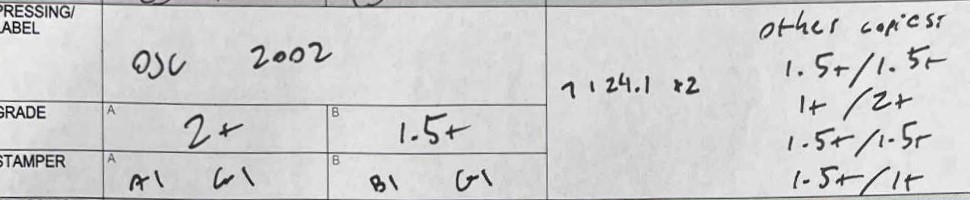
For a Hot Stamper pressing we put up recently, we noted:

Moon Beams is one of the best sounding Bill Evans records we’ve ever played. You can see why we chose it to be the first OJC Hot Stamper of his work to hit the site back in 2015. Play “It Might As Well Be Spring” for the kind of sublime musical experience you only find on 20th century analog recordings.

All of that is true for the best of the 20th century pressings we played. (Which, by the way, does not include any originals as those are consistently inferior to the later pressings we’ve auditioned.)

As for the 21st century, the sound of the best 2002 pressings on OJC are somewhat opaque and dry compared to the best that came before. This is something we rarely point out in the listings we have on sale on the site. You generally have to come to the blog to get a fuller picture of the specific shortcomings we might have of some of our Hot Stamper pressings.

We know both dry sound and opaque sound well, having played hundreds of pressings that suffer from such conditions.

The sound may be decent on most of these 2002 pressings, and fairly good on the best of them, but that’s not really what we were hoping to find. We spent a lot of money and we spent a lot of time, to quote a famous line by a famous rock band, but the six 2002 pressings we cleaned and played nevertheless came up a bit short. That’s just how it goes sometimes. (And sometimes it goes completely off the tracks.)

The way we approach a shootout such as this typically involves playing a copy or two some pressing, the 2002 OJC in this case, and hearing sound good enough to make us think it might have the potential for greatness. As you can see by the marks we gave out, the average copy earned a grade of 1.5+, which is a good, not great Hot Stamper grade.  Greatness was just not in the cards.

These Stampers Can Be Good, But They Sure Don’t Win Shootouts

Hot Stamper Pressings of Classic Rock Albums Available Now

This is how we described a recent Hot Stamper pressing that we put up on the site:

Surprisingly rich and full-bodied, particularly on side one, the best copies really ROCK with big bass and punchy drums – just the right Alice Cooper sound.

The beloved title track remains the most-performed song in his concert history, and the presence on this copy will put the band right there in your listening room.

Yet another impossible-to-find record — impossible to find in clean condition, with good sound — has made it to the site, and those of you who are fans should scoop it up. It takes us about four years to find enough copies to do this shootout.

We had poor luck with the second and third label copies on this AC title. It seems that, unlike so many records we play, the originals are the only way to go on School’s Out.

The stampers you see above belong to a Green Label early pressing. It earned good, not great Hot Stamper grades.

1.5+ is four grades down from the top copy. That’s a steep dropoff as far as we’re concerned. 1.5+ only hints at how good the best copies can sound.

To see more records that earned the 1.5+ grade, please click here. (Incidentally, some of them are even on Heavy Vinyl. The better modern pressings have sometimes, if rarely, been known to earn Hot Stamper grades, and one shocked the hell out of us by actually winning a shootout. Wouldn’t you like to know which one!)

For those who might be interested, there’s more on our grading scale here.

(more…)