smeary-sound

Smear, a blurring or loss of sharpness of individual notes, refers to missing transient information, the kind most often associated with tube gear.

However, smear occurs with every kind of gear, especially high-powered amps, the kind typically required to power the inefficient speakers audiophiles seem to favor these days.

When we got rid of our tube equipment and high-powered amps, some of the smear in our records disappeared with them.

Once that happened, the smear that is commonly heard on modern Heavy Vinyl repressings became much more noticeable and, as might be expected, even more annoying.

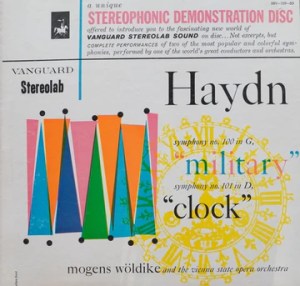
Haydn / Symphonies 100 & 101 – Reviewed in 2010

More of the Music of Joseph Haydn

The New York Times review for these performances called them “matchless” and we see no reason to disagree! With Super Hot Stamper sound for No. 100, “Military”, we’re confident you will have a very hard time finding better sound and music from Haydn than is found on this original Black Label Vanguard Stereophonic Demonstration Disc.

Side one, containing Symphony No. 100, “Military,” is smooth and rich and full of tubey magic, the kind of analog sound that has not been recorded for more than thirty years. Because the top end is not boosted and phony like most audiophile pressings, you can play a record like this at much more realistic levels without fatigue or harshness.

Try that with the average Reference or Telarc.

The sound is a bit distant, mid-hall we would call it, but wide and full of depth the way these vintage recordings often are.

Side two has Symphony No. 101, “Clock”, another famous work from the master of the form and well-played by Mogens Woldike and the Vienna State Opera Orchestra.

This side suffers from a problem endemic to vintage pressings from all eras: smear. There is a notable loss of texture to the strings on side two compared to side one. 

(more…)

Coppelia and Sylvia / London Vs. Decca – Updated 2025

Hot Stamper Pressings of Music Conducted by Ernest Ansermet Available Now

Once again, the right Decca reissue blows the doors off the original London we played. This has lately become a pattern, but keep in mind it’s a pattern that’s reliable less than half the time, if memory is any guide. Many of the Decca reissues we’ve played over the last few years have failed badly in a head to head with their earlier-mastered and -pressed counterparts.

But the ones that beat all comers are the ones that stick in our minds and show up on our site.


UPDATE 2025

A copy of one of the SPA reissues we used to like shown above made it to our latest shootout and did not do nearly as well as a copy did years ago.

We don’t have those copies anymore and cannot say whether they actually did sound as good as we thought they did.

Our advice would be to assume that this is not the best way to buy this album. But neither is the original, as you will read below.
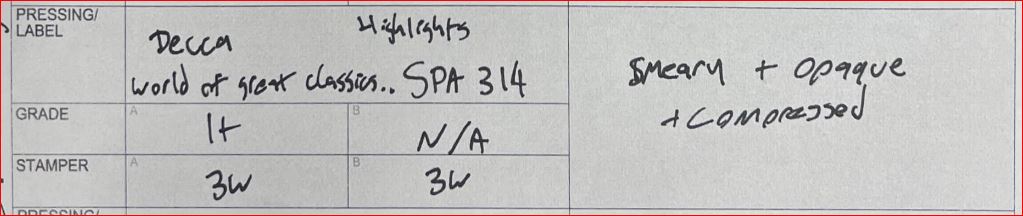

Clearly a case of confirmation bias, but at least we know something about our own biases, and that puts us well ahead of the audiophile pack.

Record collectors and record collecting audiophiles will tell you it shouldn’t happen, but fools like us, who refuse to accept the prognostications of those supposedly “in the know,” have done the work and come up with the experimental data that’s proven them wrong again and again.

Sort of. We had one, and only one, pressing of the original London (CS 6185), and boy was it a mess — crude as crude can be.

It sounded like an “old London record,” not the Decca engineered and mastered vintage collectible we know it to be.

We’ve played them by the hundreds, so we know that sound fairly well by now.

Are there copies that sound better? Surely there are, but how are you going to find them? Are you going to shell out the going rate of $25-50 on ebay for one (or more) clean copies, only to find that it/they sound every bit as bad as the one we auditioned? The question answers itself.

If, however, you are one of the lucky few who has a nice London or Decca original of this recording, please let us send you this copy so that you can do the shootout for yourself. You may be shocked at how good this music can sound on the right pressing. And if your copy sounds better than ours we will be very shocked indeed. [This offer was only good while we had the record, and it is long gone at this point. We still remember the sound though!]

Production and Engineering

James Walker was the producer, Roy Wallace the engineer for these sessions from April of 1959 in Geneva’s glorious Victoria Hall. It’s yet another remarkable disc from the Golden Age of Vacuum Tube Recording.

The hall the Suisse Romande recorded in was possibly the best recording venue of its day, possibly of all time. More amazing sounding recordings were made there than in any other hall we know of. There is a solidity and richness to the sound beyond all others, yet clarity and transparency are not sacrificed in the least.

It’s as wide, deep and three-dimensional as any, which is of course all to the good, but what makes the sound of these recordings so special is the weight and power of the brass, combined with unerring timbral accuracy of the instruments in every section of the orchestra.

(more…)

More Bad Tube Mastering from the Formerly Brilliant Doug Sax

Audiophile Quality Pressings of Orchestral Music Available Now

Sonic Grade: F

The sound is smeary, thick and opaque because, among other things, the record was mastered by Doug Sax on tube equipment from a copy tape, and not all that well either.

It is yet another murky audiophile piece of trash from the mastering lathe of the formerly brilliant Doug Sax. Back in the day he cut some the best sounding records ever made.

Then he started working for Analogue Productions and never cut a good sounding record again as far as I know. (Obviously I cannot have played everything he worked on from the mid-90s on. Who would have the time? Who would even want to?)

On this Offenbach record, in Doug’s defense it’s only fair to point out that he had dub tapes to work with, which is neither here nor there as these pressings are not worth the dime’s worth of vinyl used to make them.

Should you buy a record because it was made this way?

According to the back of the jacket:

Mastering by Doug Sax at The Mastering Lab using an all vacuum tube system.

Single Step processing was used for this “Limited Edition” release. The stamper was made from the first generation master and not more than 500 were pressed from each stamper. This process allows all records to be of “test pressing quality.” Klavier records are used by many manufacturers and audio specialty shops for demonstrating their equipment.

Maybe the notoriously hearing-challenged Chad Kassem wanted this sound — almost all his remastered titles have the same faults — and simply asked that Doug cut it to sound real good like analog spossed ta sound in the mind of this kingpin, which meant smooth, fat, thick and smeary. (Back in the 70s, if you had a fairly typical stereo system — Japanese receiver and three-way box speakers with a 12″ woofer — you surely know the sound I am talking about. Record stores are one of the few places one can go to hear that sound these days. If you’re old like me, it can really take you back.)

This Is Analog?

Apparently, even in our modern era this is what some folks think analog should sound like.

(more…)

One Flight Up Is a Dubby Mess on Cisco Heavy Vinyl

Hot Stamper Pressings of Blue Note Recordings Available Now

Sonic Grade: D

An audiophile hall of shame pressing from Cisco / Impex / Boxstar.

You will have a hard time finding any pressing that doesn’t sound better than this “dubby” Cisco LP.

The DMM reissues are worse — no Blue Note pressings could possibly be so ridiculously bad as they are — but I can’t think of any others offhand that would be.

The CDs, maybe, who really knows, but that’s a case of apples and oranges.

If smeared transients and zero ambience are your idea of good sound, this is the record for you! 

Clair de Lune – Compare and Contrast Sides One and Two

More of the Music of Claude Debussy

This Shaded Dog LP has DEMONSTRATION QUALITY SOUND, if what you’re demonstrating is not a Hi-Fi spectacular, but rather a sublime presentation of an exceptionally sweet and natural string section in an orchestra, presented here on analog disc pressed more than sixty years ago.  

I can’t imagine a more beautiful record, both in terms of the program and the sound. This record is a wonderful example of what the Decca recording engineers were able to capture on tape, and the RCA mastering engineers were able to master from that tape.

Even though the album was recorded by Decca, it’s a superb example of Living Stereo Tubey Magic at its best. There will never be a reissue of this record that even remotely captures the space, transparency, sweetness and richness of the sound here.

Side Two

A++ to A+++ or better! Without more copies in hand it’s hard to know how good the sound can get, but we found it Hard To Fault (HTF).

This side has more extension up top and down low and more texture to the strings.

Side One

A++, although it starts out a bit weaker than that and only really gets good a few minutes into the side. (We hear this effect fairly often on the records we play. Noticing things like this is what we do for a living.)

There is some smear and it is slightly opaque as well.

You will hear what we mean when you flip it over and those two problems disappear.

(more…)

Gaite Parisienne Is Just More Smeary Dreck from Classic Records

More of the Music of Jacques Offenbach (1819-1880)

Sonic Grade: F

The last time I played the Classic I thought it was nothing but a smeary mess, as awful as their awful Scheherazade. If I were to play it today, I’m guessing it would join the other Classic Records entries in our audiophile hall of shame.

Here are some other records we played and found had smeary strings. They did not last long on our turntable.

I love Arthur Fiedler‘s performance with the Boston Pops and the 1954 two track RCA Living Stereo sound, but finding an original Shaded Dog pressing in clean condition under $500 with the right stampers is all but impossible nowadays.

If you want to go that way, more power to you. 

This 1954 2-track recording is RCA’s first stereo recording of the work. 1954. Can you believe it? A few mics and two channels and it blows away most of the classical recordings ever done! Some old record collectors and tube lovers say classical recording quality ain’t what it used to be. This record proves it.

Click on this link to read more reviews and commentaries for Gaite Parisienne.

(more…)

Scheherazade Is a Classic Records Disaster

Hot Stamper Pressings of the Music of Rimsky-Korsakov Available Now

An audiophile record hall of shame pressing and a Heavy Vinyl disaster poorly mastered for the benefit of audiophiles looking for easy answers and quick fixes.

In 2009 or 2010, during our testing of the TT Weights turntable products, the record I played again and again — close to a hundred times over the course of two days — was a wonderful White Dog pressing of LSC 2446. The sound was glorious, some of the finest reproduction of a large orchestral work I have ever heard.  

(Late in life, Harry Pearson disgraced himself by putting this Classic Record on his TAS list of Super Discs.)

A week later I was still testing the system, and again using Scheherazade. A friend brought over his Classic pressing, probably the same one I would have sold him in the mid-90s. Now we could compare the two.

It was a massacre. The sound on the reissue is simply AWFUL.

There is no transient information anywhere on that Heavy Vinyl pressing whatsoever.

No instruments have any texture — not the strings, not the woodwinds, nothing.

There is no air going through the flutes.

There is no rosin on the bow of the solo violin.

The tympani are a blurry mess.

Triangle: okay.

Bass drum: okay.

Everything else: FAIL.

Not having played it in years, I could not believe how much worse the record sounded than I remember. The gulf between the real thing and the Classic wannabe was now so huge that the reissue was nothing less than positively UNPLEASANT to listen to.

Enjoyment? Out of the question.

TAS List? The original is, but the Classic is too. Now how messed up is that?

Disgraceful, that’s all I have to say about it.

If I were in charge of the TAS Super Disc list, obviously I would not have put this record on it.

Here are some others that we do not think qualify as Super Discs.

Here are some Hot Stamper pressings of TAS List titles that actually have audiophile sound quality, guaranteed.

And if for some reason you disagree with us about how good they sound, we will be happy to give you your money back.

Our favorite performance of Scheherazade is Ansermet’s with the Suisse Romande from 1961.

(more…)

Audiophile Reviewers Raved About This Doug Sax Tube-Mastered Mess

User comments

More of the music of Sergei Rachmaninoff (1873-1943)

The reviews below will sound depressingly familiar to you if you have been in audio for as long as I have.

Sonic Grade: F

This Athena LP is now long out of print, but it received rave reviews when it was released. (We quote many of them below.) This album is a member of the TAS Super Disc list, but we found the sound awfully opaque, smeary, slow and compressed, the kind of bad “analog” sound that Doug Sax brought to the early AP releases. 

The sticker on the shrink wrap of a previous copy had these quotes:

“…for this is the definitive symphonic recording to date.” – J. Gordon Holt/ Stereophile

“Wins ‘Best Record of the Year’ award against tough competition.” – Joe Hart/High End Audio Press & Music Review

“HP heard the Athena remastering of the Rachmaninoff and found it stunning. He could recommend it without reservation.” – Harry Pearson/The Absolute Sound #57

I guess things never change.

And doubtlessly he continued to refer to himself in the third person until the end.

Reviewer malpractice? We’ve been writing about it for more than 25 years.

(more…)

Violin Recordings and the Problem of Smear

Hot Stamper Pressings of Living Stereo Titles Available Now

This Shaded Dog pressing of LSC 2129 had practically no smear on either the violin or the orchestra.

Try to find a violin concerto record with no smear.

We often say that Shaded Dogs, being vintage All Tube recordings, tend to have tube smear.

But what about the 70s transistor mastered Red Label pressings – where does their smear come from?

Let’s face it: records from every era more often than not have some amount of smear.

And we can never really know what accounts for it.

The key thing is to be able to recognize it for what it is.

(We find modern records, especially those pressed at RTI, to be quite smeary as a rule. They also tend to be congested, blurry, thick, veiled, and ambience-challenged. For some reason most audiophiles — and the reviewers who write for them — rarely seem to notice these shortcomings.)

Of course, if your system itself has smear it becomes that much harder to hear the smear on your records.  Practically every tube system I have ever heard had more smear than I could tolerate – it comes with the territory. And high-powered transistor amps are notoriously smeary, opaque and ambience-challenged. Our low-powered, all-transistor rig has no trouble showing us the amount of smear on records, including those that have virtually none.

Keep in mind that one thing live music never has is smear of any kind. Live music is smear-free. It can be harmonically distorted, hard, edgy, thin, fat, dark, and all the rest, but one thing it can never be is smeary.

That is a shortcoming unique to the reproduction of music, and one which causes many of the pressings we sell to have their sonic grades lowered.

(more…)

How Do You Like Your Sky Dive – Blurry, Thick, Veiled, Dull or Slow?

Hot Stamper Pressings of the Music of Freddie Hubbard Available Now

That’s too often the sound we hear on the Heavy Vinyl records being pressed these days. From time to time we get hold of some to audition just to see what they’ve done with (to?) the titles we know well.

We sure don’t have any intention of selling them. That would violate our principles. And the very name of our operation: Better Records. It’s rare for anything pressed on Heavy Vinyl to qualify as a Better Record, which is why so many of them can be found in our Heavy Vinyl disasters section.

Not sure why so few reviewers and audiophiles notice these rather obvious shortcomings, but we sure do, and we don’t like it when records sound that way.

But that sound can be found on plenty of vintage pressings too. We should know, we’ve played them by the tens of thousands!

Smear is by far the most common problem with the copies we played. When the transient bite of the trumpet is correctly reproduced, maintaining its full-bodied tone and harmonic structures, you know you have a very special copy of Sky Dive (or First Light or Red Clay, etc., etc.).

When the sound is blurry, thick, veiled, dull or slow, you have what might be considered something more like the average copy.

Rudy gets one hell of a lively trumpet sound in this period of his career. If you have a good pressing of one of his early ’70s jazz recordings the sound can be positively EXPLOSIVE, with what feels like all the size and power of live music.

If you don’t have a hot copy of Red Clay, get one. It’s some of the best funky jazz ever recorded. No collection should be without it.