shootout-advice

Our advice for conducting record shootouts if you want better sounding pressings in a nutshell.

If you have five or ten copies of a record and play them over and over against each other, the process itself teaches you what’s right and what’s wrong with the sound of the album.

Once your ears are completely tuned to what the best pressings do well that the others do not do as well, using a few specific passages of music, it will quickly become obvious how well any given pressing reproduces those passages.

It may be a lot of work, but it sure ain’t rocket science, and we’ve never contended it was. From the start we’ve explained how to go about finding Hot Stampers for yourself. If you follow our lead, the quality of your collection is almost certain to improve.

Learning the Record, Any Record

More of the Music of the Traveling Wilburys

Many of the pressings we played of Volume One suffered from too much compression and a phony hi-fi-ish quality on the vocals. We knew there had to be better sounding copies out there somewhere, so we kept dropping the needle on every pressing we could get our hands on until we found one. Here is how we described a killer copy we ran into during that process.

We heard a lot of copies with a spitty, gritty top end, but this one is smooth like butter.

Side two is nearly as good but doesn’t have quiet the same energy factor. It’s still dramatically better than most copies out there.

Now that we’ve discovered these Hot Stampers, the sound is finally where we want it to be. Until this week, we were convinced that these songs sounded better on the radio. (That’s what tons of compression and FM bass boost will do for you.)

Learning the Record

For our recent shootout we had at our disposal a variety of pressings we thought would have the potential for Hot Stamper sound. We cleaned them carefully, then unplugged everything in the house we could, warmed up the system, Talisman’d it, found the right VTA for our Triplanar arm (by ear of course) and proceeded to spend the next hour or so playing copy after copy on side one, after which we repeated the process for side two.

(more…)

A Simple Listening Test Makes It Easy to Judge Pressings of Scheherazade

Hot Stamper Orchestral Pressings Available Now

The Classic reissue of LSC 2446, as well as the Analogue Productions version from 2013 (the original 33 is the only one I have played, mastered by Ryan Smith at Sterling), are both disasters for many reasons, but they do have one specific failing that is easy to recognize.

Both pressings are worth further discussion and analysis because they provide an easy test that can show you how wrong they are.

When reading the commentary below, keep in mind that what is bad about the Classic Records reissue from 1995 is what is bad about the Analogue Productions remaster put out many years later.

As I noted for some of the Classic Heifetz titles a while back, for all I know the CDs for his Living Stereo recordings may have better sound. That’s probably the first place to go, considering Classic’s rather poor track record regarding the remastering of his music.

Case in point: The Living Stereo CDs I own (both the CD and the SACD) of Scheherazade are dramatically better than the awful Classic Records pressing of it.

Audiophiles who don’t notice what is wrong with the Classic pressing need to get hold of a nice RCA White Dog pressing to see just how poorly the Classic stacks up. (They could even find one that’s not so nice and listen through the surface noise. The difference would still be obvious.)


UPDATE 2025

It has been many years since a White Dog pressing won a shootout. In our last listing for a Hot Stamper White Dog pressing in 2024, we noted:

Now that we know which stampers have the potential to win our shootouts, the right Shaded Dog originals have lately been coming out on top, although the White Dog pressings can still sound quite good, just not as good.

No White Dog earned a higher grade than 2+, and none of the three WD pressings we had on hand earned 2+ on both sides.

Our notes for the various sides of the WD pressings read: “a bit brash, sometimes squawky, dry and bright,” and the like.

Those of you looking for the best sound should stick to the Shaded Dog label originals. They are rich and lush in a way that the WD reissues in our experience never are. I used to swear by the WD reissues, but I see now how wrong I was. My judgments were colored by a darker, less revealing stereo than the one we use now, and that makes all the difference in the world.


Back to LSC 2446

The solo violin in the left channel at the opening of the first movement should be all it takes to hear what is wrong with the modern remastered pressings.

Anyone has ever attended a classical music concert will have no trouble recognizing that the violin on any of the Heavy Vinyl pressings, including the Analogue Productions pressing, is completely wrong and sounds nothing like a violin in a concert hall would ever sound.

And I mean ever.

No matter where you might be sitting.

No matter how good or bad the hall’s acoustics.

The violin on these Heavy Vinyl pressings is dark, it’s veiled, and it’s overly rich, as well as lacking in overtones.

Solo violins in live performance never sound like that.

They are clear, clean and present. You have no trouble at all “seeing” them, no matter where you sit.

(more…)

Listening For the Spirit and Enthusiasm of the Musicians

Hot Stamper Pressings of Revolver Available Now

The discussion below, brought about by a Hot Stamper shootout we conducted for Revolver quite a number of years ago (2007!), touches on many issues near and dear to us here at Better Records.

Some of the things we learned about Revolver all those years ago are important to our Hot Stamper shootouts to this very day, including, but not limited to:

  • Pressing variations,
  • System upgrades,
  • Dead wax secrets,

and the quality we prize most in a recording:

  • LIFE, or, if you prefer, energy.

At the end of the commentary we of course take the opportunity to bash the MoFi pressing of the album, a regular feature of our Beatles Hot Stamper shootouts. We’re not saying the MoFi Beatles records are bad; in the overall scheme of things they are mostly pretty decent. What we are saying is that, with our help, you can do a helluva lot better.

Our help doesn’t come cheap, as anyone on our mailing list will tell you. You may have to pay a lot, but with us you get what you pay for, and we gladly back up that claim with a 100% money back guarantee for every Hot Stamper pressing we sell.


The Story of Revolver, Dateline October 2007

(Incidentally, 2007 turns out to have been a milestone year for us here at Better Records.)

White Hot Stampers for Revolver are finally HERE! Let the celebrations begin! Seriously, this is a very special day for us here at Better Records. The Toughest Nut to Crack in the Beatles’ catalog has officially been cracked. Yowza!

(more…)

The Said and the Unsaid – The Firebird on Mercury

Hot Stamper Pressings of the Music of Igor Stravinsky Available Now

For our shootout years ago of The Firebird we had three minty, potentially hot copies of the Mercury with Dorati, as well as our noisy ref. (We have a noisy reference copy for just about every major title now. We have been doing these shootouts for a very long time. After thirty years in the record business we have accumulated a World Class collection of great sounding records that are just too noisy to sell.)


UPDATE 2024 

This is no longer true. Our customers seem to be able to put up with surface noise on the records we offer if the price is low enough. Not actually low, just low enough. We have a section for records with condition issues, and there are 175 entries in it as of today, which turns out to be more than a quarter of all the Hot Stamper pressings on the site as a matter of fact.


We had one FR pressing and two of the later pressings with the lighter label, the ones that most often come with Philips M2 stampers. This is how we described the winner:

So clear and ALIVE. Transparent, with huge hall space extending wall to wall and floor to ceiling. Zero compression.

Lifelike, immediate, front row center sound like few records you have ever heard.

Rich, sweet strings, especially for a Mercury. This side really gets quiet in places, a sure sign that all the dynamics of the master tape were protected in the mastering of this copy.

What we didn’t say — and what we never say in the listings — is what the second tier copies didn’t do as well as the shootout winner.

We used to. When you read the older entries, most of the time they mention the shortcomings that caused one side or another to be downgraded by some amount, usually something like a half to a full plus.

Not all the top end, not all the bass, not as present, slightly smeary, slightly congested — the list of potential faults for any given pressing is long indeed. These are all the problems we listen for and it’s the rare copy that doesn’t suffer from one or more of them.

We decided years ago that it was better just to let you hear the two sides of the record for yourself and make your own judgments about the sound, rather than make clear to you what areas we felt needed improvement.

Consider this example. If on our system the bass was lacking compared to the very best, perhaps on your system the bass was fine, not an issue, good enough. Without the top copy to compare yours to, how would you know how much better the bass could possibly be?

A classic case of “compared to what?

Shootouts are the only way to answer that question, which, as we never tire of saying, is THE most important question in all of audio. This is why we do shootouts, and why you must do them too, if owning the highest quality pressings is important to you.

Click on the following link to see more records for which we’ve detailed the strengths and weaknesses of a specific copy.

What We Heard on The Firebird

With all that in mind, only the Triple Plus (A+++) copy, as described above, did everything right.

There were two Double Plus (A++) copies, and each of them fell short in different ways.

(more…)

The Warm Moods – The Reissue Is So Good, How Can the Original Be Better?

Our review from years ago for the Discovery reissue of The Warm Moods can be found below.

We loved the sound, so much so that we found it hard to fault.

Imagine our surprise when we discoverd that that the original was clearly better.

Much better. At least a full grade better.

When we did the shootout again, a rare (in stereo anyway) original Reprise showed us just how wrong we were.

The best original pressing we found took the sound of The Warm Moods to another level, and a pretty high one at that.

It’s yet another example in which the most important question in all of audio had been overlooked: compared to what?

Who knew the recording could sound any better than the wonderful Discovery pressing we’d played?

(more…)

Hot Stamper Note Taking – Here Is What You Need to Know

Basic Concepts and Realities Explained 

Finding Hot Stampers is all about doing shootouts for as many different pressings of the same title as you can lay your hands on, the more the merrier.

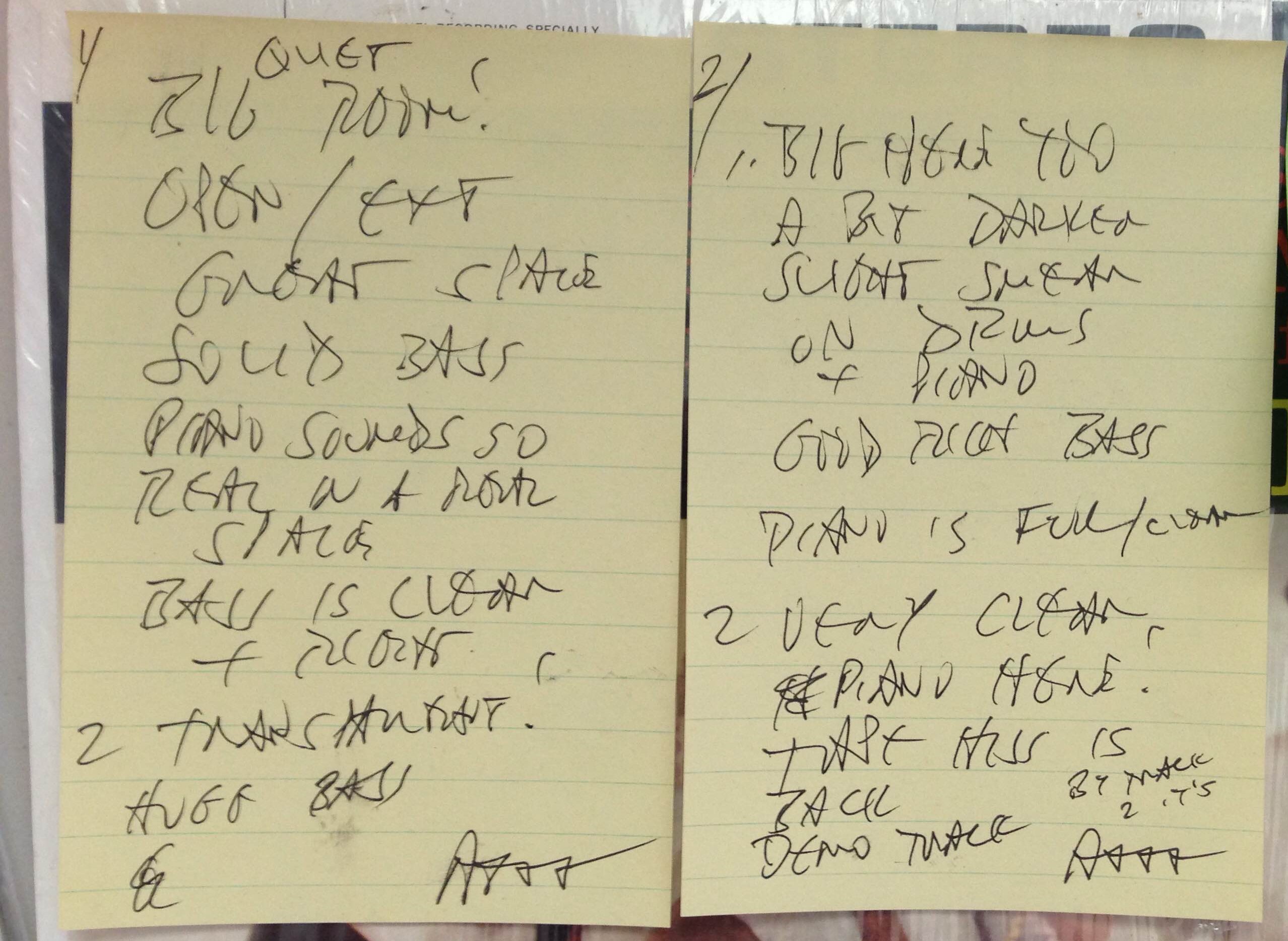
The kind of notes we take can be seen below. 4×6 Post-its work great for this purpose, using one per side.

We go through thousands of them every year.

Without specific notes on your records about exactly what you heard as you played them, you cannot possibly keep track of which pressings have the qualities you were listening for, and to what degree.

Extensive notes like the ones you see below are a must.

Other reviews with post-its can be found here.

We also make every effort to be very specific about the shortcomings of the audiophile pressings we review, which is why we started to reproduce our notes for their reviews when they are available.


(more…)

Who Can’t Hear Differences in Sound from Side to Side on Most Records?

rimskscheh_2446Hot Stamper Pressings of the Music of Rimsky-Korsakov Available Now

Both the Chesky [1] and Classic reissue pressings of LSC 2446 are just plain terrible. Embarrassingly, the latter is found on the TAS List.

There is a newly [2013, time flies!] remastered 33 RPM pressing of the album garnering rave reviews in the audiophile press. We didn’t like it either. It fails the violin test that we wrote about here.

Please note that in many of the reviews for the new pressing, the original vinyl used for comparison is a Shaded Dog pressing. In our experience almost no Shaded Dog pressings are competitive with the later White Dog pressings, and many of them are just plain awful, as we have noted previously on the site.


UPDATE 2024: Now that we know which stampers have the potential to sound the best in our shootouts, the Shaded Dog originals have lately been winning top honors, although the White Dog pressings can still sound quite good, just not as good.


rimskscheh_chesky

The “original is better” premise of most reviewers renders the work they do practically worthless, at least to those of us who take the time to play a wide variety of pressings and judge them on the merits of their sound, not the color of their labels.

[A fairly embarrassing example of live and learn.]

Missing the Obvious

The RCA White Dog with the best side two in our shootout had a very unmusical side one. Since reviewers virtually never discuss the sonic differences between the two (or more) sides of the albums they audition, how critically can they be listening? Under the circumstances how can we take anything they have to say about the sound of the record seriously?

The sound is obviously different from side to side on most of the records we play, often dramatically so (as in the case of Scheherazade), yet audiophile reviewers practically never seem to notice these obvious, common, unmistakable differences in sound, the kind that we discuss in every listing on the site. If they can’t hear the clear differences in sound from side to side, doesn’t that call into question their abilities at the most basic level?

(more…)

The Original Pressings of The Beatles Albums Are the Best Sounding, Right?

beatles help labelHot Stamper Pressings of the Music of The Beatles Available Now

No they are not. At least the ones on the label you see pictured are not (with the exceptions noted below).

We think it’s just another example of mistaken audiophile thinking.

Back in 2005 we compared the MFSL pressing of Help to a British Parlophone LP and were — mistakenly, as you may have already surmised — impressed by the MoFi. We wrote:

Mobile Fidelity did a GREAT JOB with Help!. Help! is a famously dull sounding record. I don’t know of a single original pressing that has the top end mastered properly. Mobile Fidelity restored the highs that are missing from most copies.

The source of the error in our commentary above is in this sentence, see if you can spot it:

I don’t know of a single original pressing that has the top end mastered properly.

Did you figure it out? If you’ve spent much time on our site of course you did.

Original pressing?

Is that the standard?

Why? Who said so? Where is it written?

(more…)

An Extraordinary Recording of the Beethoven Septet – This Is Why You Must Do Shootouts

Hot Stamper Pressings of the Music ofBeethoven Available Now

My first note on side one is “HTF” — Hard To Fault, for the sound was both rich and sweet, with easily recognized, unerringly correct timbres for all seven of the instruments which are heard in the work. The legendary 1959 Decca Tree microphone setup had worked its magic once again.

And, as good as it was, we were surprised to discover that side two was actually even better! The sound was more spacious and more transparent; we asked ourselves, how is this even possible?

Hard to believe but side two had the sound that was TRULY Hard To Fault.

This is precisely what careful shootouts and critical listening are all about.

If you like Heavy Vinyl, what exactly is your frame of reference? How many good early pressings could you possibly own, and how were they cleaned?

Without the best pressings around to compare, Heavy Vinyl can sound fine. It’s only when you have something better that its faults come into focus. (We, of course, have something much, much better, and we like to call them Hot Stampers!)

Side One

A++, so good, yet in comparison to side two we realized that it was not as present, spacious and transparent as it SEEMED.

Side Two

A+++, White Hot!

Ah, here was the sound we didn’t know we were missing. So big and open, with space for every player, each clearly laid out across the stage. This is Hi-Fi at its best.

(more…)