piano-test-class

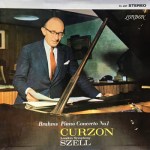
Brahms / Piano Concerto No. 1 – What to Listen For

Hot Stamper Pressings of of the Music of Brahms Available Now

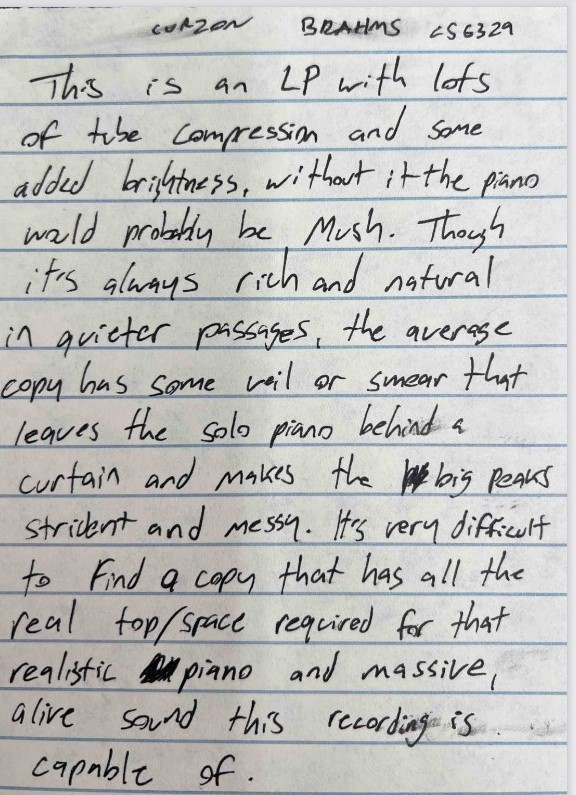
Our general notes for the recording seen below explain why the typical copy in our shootout fell short.

This is an LP with lots of tube compression, and some added brightness.

Without the added brightness, the piano would probably be mud.

The added brightness and compression results in a piano that always sounds rich and natural in the quieter passages.

The average copy also has some veiling or smearing that make the solo piano parts sound like they are coming fom behind a curtain. On these copies, the big peaks can often get strident and very messy.

It’s difficult to find a copy that has all the top end extension and space required to reproduce both a realistic piano and the massive live sound the orchestra is capable of.


All of which adds up to a difficult shootout in which relatively few copies had the sound we were looking for.

Production and Enginneering

(more…)

Where Cheap Turntables Fall Flat – The Music of Franz Liszt

Hot Stamper Pressings of Classical Music Available Now

Classical music is unquestionably the ultimate test for proper turntable/arm/cartridge setup.

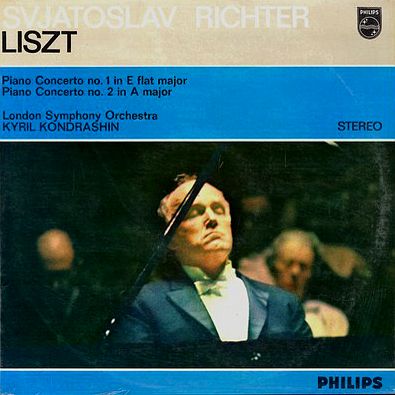
The Liszt Piano Concerto record you see pictured is a superb choice for making small adjustments to your setup in order to improve the playback of these very difficult to reproduce orchestral recordings.

Here are some other reviews and commentaries touching on these areas of turntable setup.

One of the reasons $10,000+ front ends exist is to play large scale, complex, difficult-to-reproduce music such as Liszt’s two piano concertos. You don’t need to spend that kind of money to play this record, but if you choose to, it would surely be the kind of record that could help you recognize the sound quality your tens of thousands of dollars has paid for.

It has been my experience that cheap tables more often than not collapse completely under the weight of a mighty record such as this.

(more…)

On This Recording of Concerto No. 1, Transparency and Piano Weight Are Key

More of the Music of Ludwig van Beethoven

Notes from a recent shootout.

This pressing has the real Living Stereo magic in spades, but unlike most of the RCA concerto recordings, Richter, the brilliant soloist featured here, is not overly spotlighted, hence the much more immersive “concert hall” sound.

The piano is part of the orchestra, and properly sized, allowing the contributions of the other musicians in the orchestra to be heard more clearly, laid out as they are elegantly across a huge and deep Boston Symphony Hall stage.

All of which adds up to a top quality piano concerto recording in every way.

When it comes to clarity in orchestral music, there is nothing that comes close to the sound of a live performance.

However, some records, this one especially, give you the sense that you are hearing it all.

Audio may be an illusion but it can be a very convincing one.

The spaciousness and three-dimensionality of the recording are also exceptional. Through the efforts and skill of the RCA engineers, that striking openness in the recording is somehow combined with an electrifying immediacy in the sound of the piano, no mean feat. One rarely hears both, except of course live (and not always even then).

There may be other performances of merit, but I know of no recording of this music with better sound. If you are demonstrating naturalistic sound, not bombastic Hi-Fi spectacularity, this pressing more than qualifies as a DEMO DISC.

What to Listen For

What typically separates the killer copies from the merely good ones are qualities that we often look for in the records we play: transparency. Transparency allows you to hear into the recording, reproducing the ambience and subtle musical cues and details that high-resolution analog is known for.

(Note that most Heavy Vinyl pressings being produced these days seem to be seriously Transparency Challenged. Lots of important musical information — the kind we hear on even second-rate standard-weight pressings — is simply not to be found.)

Solid weighty sound for a piano concerto recording is critically important as well. The piano has to be big, powerful, and solid, as massive as a boulder, just the way it can be in the concert hall. In this respect it helps to have Sviatoslav Richter pounding away on the instrument of course.

Side One

Amazing – big and rich without a touch of smear on the strings or the percussive piano. The piano is right sized and that is unusual indeed in our experience.

Dynamic as all get out, with lively horns and a piano that is clear and present. Tonally correct, in a big hall, the sound is Hard To Fault.

The piano is so clear, yet the orchestra is as rich and smooth as one could possibly ask for. No smear, no congestion, no bandwidth limitations – this is the sound of the master tape. No modern reissue — digital or analog — will ever be able to reproduce more than a fraction of the sound found on this pressing.

Side Two

Big, lively and less congested that most of the copies we played. Side one had no smear, this side has a touch, but the sound is wonderful nevertheless.

Listen to the woodwinds on this side; they are glorious. You will have a hard time finding better sound for that section of the orchestra on other recordings.

An Exceptionally Natural Piano Recording of Pictures at an Exhibition

More of the music of Modest Mussorgsky (1839-1881)

This original London pressing of the solo piano version of Pictures has uncannily natural piano reproduction, which is why we are awarding this side one our highest sonic grade, A Triple Plus.

The fact that the recording takes place in Kingsway Hall in 1967 no doubt plays a large part in the natural sound. The hall is bigger here than on other copies, the piano even more solidly weighted, yet none of this comes at the expense of the clarity of the playing.

The piano has no smear, allowing both the percussive aspects of the instrument and the extended harmonics of the notes to be heard clearly and appreciated fully.

Pianos are very good for testing your system, room, tweaks, electricity and all the rest, not to mention turntable setup and adjustment. More records that are good for testing and improving your playback can be found here.


Side two has Mehta’s performance of the orchestrated work squeezed onto side two, which is never a good idea if one is looking for high quality orchestral sound. The performance itself is mediocre as well.

We are not, and never have been, big fans of Mehta’s work with the Los Angeles Philharmonic on London Records.

The exceptionally rare copy of Mehta’s Planets can sound good, but 90% of them do not — just don’t make the mistake of telling that to the average audiophile who owns one. Harry told him it was the best, he paid good money for it, and until someone tells him otherwise it had better be “the one Planets to own.” (Why audiophiles need someone to tell them what recordings are the best is a mystery. Can’t they just play them and listen for themselves?)

We see one of our roles here at Better Records as being the guys who actually will “tell you different,” and, more importantly, can back up our opinions with the records that make our case for us.

(more…)

Mozart – Quintet / Trio Is a Great VTA Test Disc

Hot Stamper Pressings of the Music of Mozart Available Now

CS 6109 is a handy record for VTA adjustment

Listen for fullness and solidity, especially in the piano, although a rich, full sounding clarinet is a joy here as well. 

Some of the copies we played in our shootout lacked the weight and solidity to balance out the qualities of transparency and clarity.

The resulting sound is less natural, with the kind of forced detail that CDs do so well, and live music never does. There is a balance to be found.

The right VTA will be critical in this regard. When you have all the space; the clearest, most extended harmonics; AND good weight and richness in the lower registers of the piano, you are where you need to be (keeping in mind that it can always get better if you have the patience and drive to tweak further).

(more…)

Britten / Debussy / Schumann / Cello Sonatas / Rostropovich – Reviewed in 2011

Hot Stamper Pressings of the Music of Claude Debussy Available Now

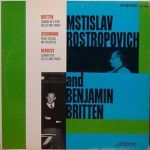
Both sides of this promo London Blueback pressing (CS 6237) of piano and cello music have SUPERB sound. If you’re a fan of the cello, the piano, or chamber works in general, you will have a hard time finding a better sounding recording than this.

Notice especially that there is practically no smear on the piano — the notes are clear, with their transients fully intact, something one rarely hears anywhere but in a live setting. The tonality of the piano is also correct from top to bottom.

Lately we have been writing quite a bit about how pianos are good for testing your system, room, tweaks, electricity and all the rest, not to mention turntable setup and adjustment.

  • We like our pianos to sound natural (however one chooses to define the term).
  • We like them to be solidly weighted.
  • We like them to be free of smear, a quality that is rarely mentioned in the audiophile record reviews we read.

This is an Older Classical/Orchestral Review

Most of the older reviews you see are for records that did not go through the shootout process, the revolutionary approach to finding better sounding pressings we started developing in the early 2000s and have since turned into a veritable science.

We found the records you see in these older listings by cleaning and playing a pressing or two of the album, which we then described and priced based on how good the sound and surfaces were. (For out Hot Stamper listings, the Sonic Grades and Vinyl Playgrades are listed separately.)

We were often wrong back in those days, something we have no reason to hide. Audio equipment and record cleaning technologies have come a long way since those darker days, a subject we discuss here.

Currently, 99% (or more!) of the records we sell are cleaned, then auditioned under rigorously controlled conditions, up against a number of other pressings. We award them sonic grades, and then condition check them for surface noise.

As you may imagine, this approach requires a great deal of time, effort and skill, which is why we currently have a highly trained staff of about ten. No individual or business without the aid of such a committed group could possibly dig as deep into the sound of records as we have, and it is unlikely that anyone besides us could ever come along to do the kind of work we do.

The term “Hot Stampers” gets thrown around a lot these days, but to us it means only one thing: a record that has been through the shootout process and found to be of exceptionally high quality.

The result of our labor is the hundreds of titles seen here, every one of which is unique and guaranteed to be the best sounding copy of the album you have ever heard or you get your money back.


Side One

Britten – Sonata in C for Cello and Piano
Schumann – Funf Stucke Im Volkston

Side Two

Schumann – Funf Stucke Im Volkston
Debussy – Sonata for Cello and Piano

Benjamin Britten

Britten was an accomplished pianist, frequently performing chamber music and accompanying lieder and song recitals. However, apart from the Holiday Diary (1934), Piano Concerto (1938), Young Apollo (1939), Diversions (written for Paul Wittgenstein in 1940), Scottish Ballad (1941), he wrote relatively little music that puts the piano in the spotlight, and in a 1963 interview for the BBC said that he thought of it as “a background instrument”.

One of Britten’s best known works is The Young Person’s Guide to the Orchestra (1946), which was composed to accompany Instruments of the Orchestra, an educational film produced by the British government, narrated and conducted by Malcolm Sargent. Its subtitle is Variations and Fugue on a Theme of Purcell, the theme is a melody from Henry Purcell’s Abdelazar. Britten gives individual variations to each of the sections of the orchestra, starting with the woodwind, then the string instruments, the brass instruments and finally the percussion. Britten then brings the whole orchestra together again in a fugue before restating the theme to close the work. The original film’s spoken commentary is often omitted in concert performances and recordings.

Britten’s church music is also considerable: it contains frequently performed ‘classics’ such as Rejoice in the Lamb, composed for St Matthew’s Northampton (where the Vicar was Revd Walter Hussey), as well as A Hymn to the Virgin, and Missa Brevis for boys’ voices and organ.

As a conductor, Britten performed the music of many composers, as well as his own. Among his celebrated recordings are versions of Mozart’s 40th Symphony and Elgar’s The Dream of Gerontius (with Pears as Gerontius), and an album of works by Grainger in which Britten features as pianist as well as conductor.

Early in his career, Britten made a conscious effort to set himself apart from the English musical mainstream, which he regarded as complacent, insular and amateurish. Many contemporary critics distrusted his facility, cosmopolitanism and admiration for composers such as Mahler, Berg, and Stravinsky, not at the time considered appropriate models for a young English musician.

Britten’s status as one of the greatest composers of the 20th century is now secure among professional critics.

Wikipedia

Beethoven / Piano Sonatas / Backhaus – Reviewed in 2008

Hot Stamper Classical and Orchestral Imports on Decca & London

Reviews and Commentaries for Recordings by Decca

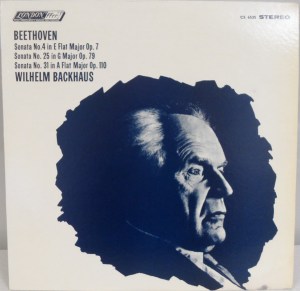
CS 6535. This is the best sounding Backhaus LP I’ve ever heard.

The piano is natural and full-bodied, with solid weight, as would be expected from the Decca engineers of the day.

Decca was still making good records in 1967, long after RCA had gone Dynagroove.

(more…)

Liszt / Sonata in B Minor & Other Pieces / Curzon

More of the music of Franz Liszt (1811-1880)

Hot Stamper Classical LPs on Decca & London

This Super Hot Stamper solo piano record is 1963 Decca recording technology at its finest (or would be if we had ten copies to shoot out and could find the White Hot Stamper pressing hidden among them).

As it is, we are happy to have found this one, Super Hot on both sides, an amazingly realistic representation of a piano. You will have a hard time finding better. 

And the music, especially on side two, is compelling and wonderful. This is classical music that will engage you at the deepest and most serious level. Widely considered Liszt’s masterpiece, in Curzon’s forceful hands it is not hard to understand why.

Side One

A++ Super Hot Stamper sound, with a clear piano surrounded in space. Present and dynamic, there is little to fault here, save a touch of smear and a slight lack of weight.

Real pianos in live recitals have weight that I have never heard reproduced by any stereo system, so “real weight” is a relative term, one that applies more to recordings than to the live instrument itself. (more…)

Liszt / Piano Concertos – An Early Outlier

More of the music of Franz Liszt (1811-1880)

More Top Quality Classical Piano Recordings

This Beyond White Hot Stamper 2-pack has sound that must be experienced to be believed! The finest Liszt 1st & 2nd Concertos we know of for performance and unquestionably for sound when they sound like this. More like LIVE MUSIC than any classical recording I have played in longer than I care to remember – both sides are so big, rich and transparent we guarantee you have never heard a better piano concerto.

  • Our lengthy commentary entitled Outliers & Out-of-This-World Sound talks about how rare these kinds of pressings are and how to go about finding them.
  • We no longer give Four Pluses out as a matter of policy, but that doesn’t mean we don’t come across records that deserve them from time to time.

Richter and Kondrashin deliver the finest Liszt 1st & 2nd Piano Concertos I know of, musically, sonically and in every other way. Richter’s performance here is alternately energetic and lyrical, precisely as the work demands. The recording itself is explosively dynamic. The brass is unbelievably full, rich and powerful. You won’t find a better recording of this music anywhere, and on side two this pressing just cannot be beat. It’s BEYOND White Hot (A++++). There was simply no other copy on any side that was close to it. 

Both Sides Now

Big and rich (always a problem with piano recordings: you want to hear the percussive qualities of the instrument, but few copies can pull it off without sounding thin). We love the BIG, FAT, Tubey Magical sound of this recording! The piano is HUGE and powerful — like a real piano.

Huge hall, weight and energy, this is DEMO DISC QUALITY SOUND by any standard.

(more…)