
mystery-decca/london

Sometimes the Earliest Stampers Just Cannot Be Beat

Hot Stamper Pressings on Decca & London Available Now

We recently posted a lengthy commentary about conventional wisdom, attempting to make the case that, although the most common record collecting approaches are more often right than wrong, there is simply no way to know what approach will produce the best results for any given title.

Rather than post one exception after another — easily done, since we know literally hundreds of them — we are happy to admit that the generally accepted record collecting rules of thumb* work well for most records, with the definition of “most” being “more than half the time.”

In the case of this Mystery London, the received wisdom turns out to be right on the money. (As per our policy, please note that the Mahler album you see pictured is not the record we are discussing in this post.)
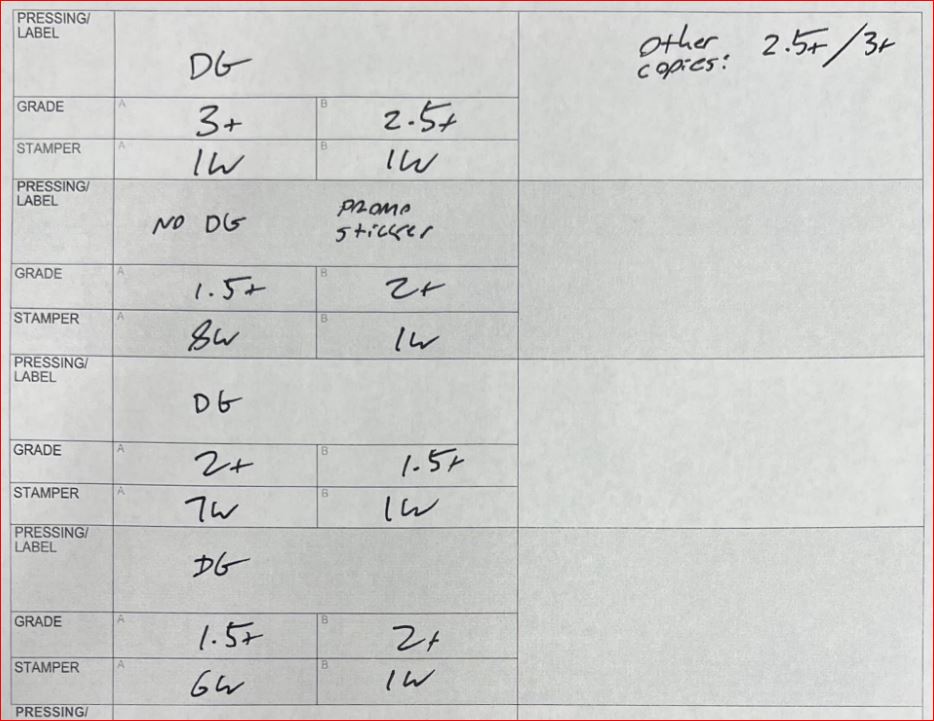
What conclusions can we draw from this information?

We would be very surprised if the earlierst pressings cut by Harry Fisher (1W/1W) can be beaten for sound. It’s possible, of course, and we will naturally continue to buy pressings with other stampers, if for no other reason than the fact that they are far more plentiful than the first pressings.

But if a 1W/1W gets offered to us at a high price, you can be sure we will jump at the opportunity to buy it and put it into a shootout.

The second one that comes to mind is that some vintage originals are not particularly well-mastered or pressed. (The 1W side twos should have sounded better than the 2+ grades they earned, but my guess is that the metal work by then was older and morn worn and just could not compete with the fresher, earlier copies, the ones with 1W side ones.)

All three of the early Deep Groove pressings with stampers other than 1W/1W did not earn Super Hot stamper grades (2+) on both sides. The only way to get top quality sound for this title is with the first pressing. And both of our 1W/1W pressings had Shootout Winning sides. (Here are some of the other albums we’ve discovered in which one set of stampers consistently win our shootouts.)

Now imagine that some company has come along and remastered the album on Heavy Vinyl for the benefit of audiophiles and music lovers alike.

If the vintage pressing you own just happens to have anything but 1W/1W stampers — you picked it up years ago because it’s an original on the Deep Groove early label and appears to be as vintage as vintage can be — you would be jumping for joy that finally the sound of the master tape has been transferred to vinyl properly after all these years.

Thank god for Kevin Gray / Bernie Grundman / Krieg Wunderlich / Chris Bellman or somebody else — pick any name you like — for the wonderful mastering work they do, bringing old records back to life.

What a service they do for the audiophile community!

Their critics must be idiots.

Sample Sizes and One Man Bands

Those of us who play a variety of pressings of the same album know where judgments of this kind come from.

They are mostly the result of sample sizes that are too small.

If you’re an audiophile reviewer operating as a one man band, which, as far as we know, is the only way any of them currently operate, your chances of getting it wrong are fairly high indeed. Here is one obvious example from a long time ago, but there are plenty more to be found under the heading of shootout malpractice here on the blog.

Just as an aside, please note that many of our customers do their own shootouts and seem to come to much more accurate assessments of the various pressings they play than any reviewers we’ve encountered. Perhaps we can take some small credit for showing them the way? I would like to think so.

How Did We Figure All of This Out?

(more…)

When Fisher Took Over from Goodall, He Really Let the Side Down

Hot Stamper Pressings of Recordings by Decca Available Now
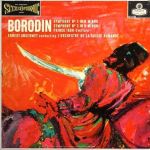
Please keep in mind that, as per our usual, the record you see pictured is not the record we are discussing in this posting.

The stamper numbers you see below belong to a different album.

The quick takeaway: Stan Goodall (“E”) cut the Shootout Winning early pressings.

Then, for reasons known only to the folks at Decca, Harry Fisher (“W”) took the reins and managed to cut some side twos that were very good. Not as good, but still very good: 2+ most of the time, some slightly worse. They were not as weighty or rich, and we take a lot of points off for records that are not as weighty or rich as they should be.

By the time Decca had changed its label to the Decca in a Box design, Mr. Fisher was cutting all the pressings, and, in our experience, not doing an especially good job. We do not even offer records with grades that low.

The sound might be passable, and would probably still be better than whatever Heavy Vinyl pressings might have been made from the tapes in the last twenty years, but that’s not good enough for us here at Better Records, not at the prices we charge anyway.

We described Fisher’s sound as dry and hot on side one, and thin and very small on side two of the 5W-stamped pressing we played. We only had the one, and the reason we had even one after having heard other Boxed Decca pressings do poorly, is that it’s a good way to stay honest and to have a better baseline to work with.

If we played nothing but 3E/1E originals, most of those 1E side twos would have earned a 2+ grade, but they would have sounded much better than the 2W-graded copies, and that seriously screws up the grading scale, especially when clean originals cost us a hundred bucks or more these days.

(more…)

Why are the First Pressings of this Title the Worst Sounding?

Hot Stamper Pressings of Recordings by Decca Available Now
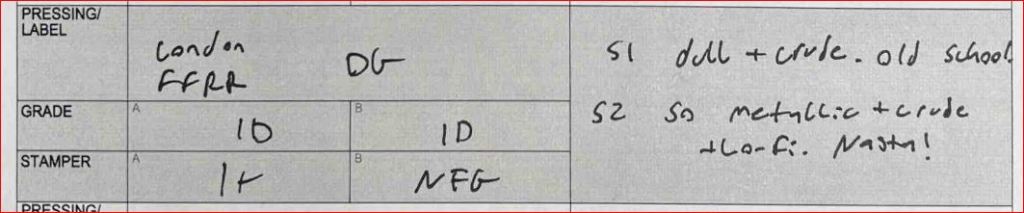
The record you see pictured is not the record we are discussing in this posting. The stamper numbers you see below belong to a different album.

We’ve lately been giving out much more stamper information than we used to, but for now we are keeping this title close to the vest.

We happen to know the best stampers for this album, but somehow a copy with the “bad” stampers ended up in our shootout. It did about as badly as they usually do.

Of course, the person sitting in the listening chair had no idea that a copy with the worst stampers was playing. The jackets and labels of this pressing are identical to the copies with the good stampers.

He simply heard what the recording actually sounds like when it’s mastered badly and registered his complaints.

Side One

  • Dull and crude. Old school.
  • 1+

Side Two

  • So metallic and crude and lo-fi. Nasty!
  • NFG

Apparently Mr. D, real name: Jack Law, did a piss-poor job mastering this album. Another engineer would come along sooner or later and master the record right, so right that it became one of our favorite Demo Discs for sound and performance.

How did this pig’s ear eventually manage to become a silk purse?

Simple. It was always a great recording, it just needed to be mastered right, and whoever got the job to remaster it knocked it out of the park the first time through.

(more…)

On this Wonderful Sounding London, Is Ted Burkett’s 2G the Way to Go?

Hot Stamper Pressings of Recordings by Decca Available Now

Before we go any further, let me say that the record you see pictured is not the record whose shootout and stampers we are about to discuss.

Yes, that’s right, the stamper numbers you see below belong to a different album.

We’ve lately been giving out much more stamper information than we used to, but for now we are keeping this title close to the vest.

What can we learn about the best sounding pressings of this vintage Decca recording, mastered by Mr. E and Mr. G, both outstanding mastering engineers?

It seems that Mr. G cut the better sounding pressing, our shootout winner as a matter of fact, but I can’t say whether the pressing that won was an original, since there were two differently-mastered Blueback pressings in the shootout, and one of them came in tied for last.

It was actually beaten by two copies of the Whiteback reissue. Those seem to be made from the same stampers as the winning pressing, but are those stampers the earliest or did they come later? Who knows?

Mr E. cut a version of the record that was quite a bit less impressive than most of the others, earning grades of 1.5 on side one and 2+ on side two.

Side one was dry and flat, side two rich but hard. We hear a lot of records with these shortcomings. If you play lots of classical music on vintage vinyl, you should be hearing them too.

And Your Point Is?

(more…)

On this Mystery London, The Reissues Have Lately Been Letting Us Down

Hot Stamper Pressings of Recordings by Decca Available Now

The record you see pictured is not the record we will be discussing in this post.

The stamper numbers and grades you see below belong to a different album.

We’ve lately been giving out much more stamper information than we used to, in some cases including the actual stamper sheets compiled from the shootout — winners, losers, and everything in between — but for now we are keeping this title close to the vest.

This pressing was not as bad as many of the golden age classical titles we play. Although it has the potential to sound amazingly good on the early labels, the second label London pressings never seem to do much better than 1.5+, a barely passing Hot Stamper grade.

It’s small, stuck in the speakers, and had no real top end. We judge it to have middling sound quality.

1.5+ is four grades down from the top copy. That’s a steep dropoff as far as we’re concerned. 1.5+ only hints at how good a recording this London can be on the best early pressings.

To see more records that earned the 1.5+ grade, please click here. (Incidentally, some of them are even on Heavy Vinyl. The better modern pressings have sometimes, if rarely, been known to earn Hot Stamper grades, and one shocked the hell out of us by actually winning a shootout. Wouldn’t you like to know which one!)

For those who might be interested, there’s more on our grading scale here.


Here are reviews for some of the titles we’ve auditioned, broken down into the three major labels that account for most of the best classical and orchestral titles we’ve had the pleasure to play.

  • London/Decca records with weak sound or performances
  • Mercury records with weak sound or performances
  • RCA records with weak sound or performances

We’ve auditioned countless pressings in the 37 years we’ve been in business — buying, cleaning and playing them by the thousands.

(more…)

Decca’s Violin Concerto Recordings on the Early Label Are Hard to Beat

Hot Stamper Pressings Featuring the Violin Available Now
Lately we’ve been having exceptionally good luck with the early label pressings of many of the London violin concerto records we’ve done shootouts for.

The notes you see below are fairly typical. However, the notes you see below do not belong to the wonderful Sibelius record pictured here.

They belong to another London record. We give out lots of bad stampers on this blog, but almost never do we give out the good ones. (When we do give out the best stampers, we keep the title a mystery, as is the case of the record here.)

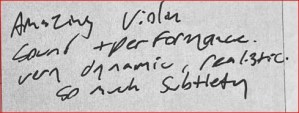
The amazingly good sounding pressing on the early label took the recording to another level. Our shootout notes read:

  • Amazing violin sound and performance.
  • Very dynamic and realistic.
  • So much subtlety.

Key Takeaways

  • The top four copies all had the same stampers, yet the sound varied noticeably from side to side, from Super Hot (A++) to White Hot (A+++), with one earning the grade between, Nearly White Hot (A++ to A+++).
  • We’ve done this shootout a few times before. Since we know that the best copies are going to be on the early label, those are mostly the copies we’ve been stocking up on whenever possible.
  • We also buy the second label copies if the price is right, and in this case we had a couple on hand to play, both of which earned a Super Hot stamper grade on one side and something slightly lower on the other.
  • They aren’t as big as the best, nor do they extend as much up high or down low.
  • Keep in mind that even worst of the second label copies are still very good sounding records, beating practicallly any orchestral recording that can be found on Heavy Vinyl (with only two exceptions we know of, one of which is this lovely title).
  • The second labels are fairly impressive, but it is unlikely you would find yourself calling them amazing.
  • Amazing is what you say when you play that one very special original pressing out of four and can hardly believe what your ears are telling you.
  • How many audiophiles will go to the trouble of finding, buying, cleaning and playing four original copies in order to find the one with sound that soars above the rest? Let’s just say we only know of one, and he writes a blog very much like this one.

What It Takes

If you have big speakers and you play them at loud levels in a large enough room, on the highest quality equipment, tweaked and tuned to within an inch of its life, you can get a lot closer to the sound of live music in the home than most audiophiles will ever be able to experience for themselves.

(more…)