multi

Two of the Worst Mistakes You Can Make Collecting Records

Our Guide to Record Collecting for Audiophiles

To be clear, it’s only a mistake if you are looking for top quality sound.

If, however, you are a record collector who doesn’t care about the sound of your records and is just looking for music to play, you may want to consider the very real possibility that you are on the wrong site. At the very least you are probably wasting your time.

Do you know many audiophiles who own multiple copies of the same album?

Some? Sure, okay. How many of them are still hunting around for more? Not many, right?

I’ve been buying duplicate copies of my favorite albums for more than three decades, but I’m not exactly your average audiophile record collector.

Fortunately for me, with the advent of Better Records in 1987, I’ve had an outlet for the second- and third-rate pressings I choose not to keep. (What’s left of my audiophile pressings are being sold on ebay these days. Good riddance!)

A few audiophile friends have multiple copies, but most audiophiles I know usually stop after one, or at most two or three.

At least they know not to make the worst mistake of them all: buying an audiophile pressing and figuring that that’s the one to keep.

Tossing out their vintage pressings, or never bothering to buy vintage pressings in the first place guarantees you will never have an especially good sounding collection of records to play.

Those of you who take the time to read our Hot Stamper commentary, whether you buy any of our special pressings or not, no doubt know better. At least I hope you do.

Hearing Is Believing

The only way to understand this Hot Stamper thing is to hear it for yourself, and that means having multiple copies of your favorite albums, cleaning them all up and shooting them all out on a good stereo.

Nobody, and we mean nobody, who takes the time to perform this little exercise can fail to hear exactly what we are on about.

If that’s too much trouble, you can join the other 99% of the audiophiles in the world, the ones who don’t know just how dramatic pressing variations for records and CDs can be. Probably a fairly large percentage of that group also doesn’t want to know about any such pressing variations and will happily supply you with all sorts of specious reasoning as to why such variations can’t really amount to much — this without ever doing a single shootout!.

Such is the world of audiophiles. Some audiophiles believe in anything — you know the kind — and some audiophiles believe in nothing, not even their own two ears.

(more…)

Outliers & Out-of-This-World Sound

More Outlier Pressings We’ve Discovered

This commentary was written about ten twenty years ago and has been updated more than a few times since.

A while back we did a monster-sized shootout for Blood, Sweat and Tears’ second release, an album we consider THE Best Sounding Rock Record of All Time.

In the midst of the discussion of a particular pressing that completely blew our minds — a copy we gave a Hot Stamper grade of A with Four Pluses, the highest honor we can bestow upon it — various issues arose, issues such as: How did this copy get to be so good? and What does it take to find such a copy? and, to paraphrase David Byrne, How did it get here?


  • We no longer give Four Pluses out as a matter of policy, but that doesn’t mean we don’t come across records that deserve them from time to time.
  • Nowadays we usually place them under the general heading of breakthrough pressings. These are records that, out of the blue, reveal to us sound that fundamentally changes what we thought we knew about these familiar recordings.
  • When this pressing (or pressings) landed on our turntable, we found ourselves asking “Who knew?
  • Perhaps an even better question would have been “How high is up?”

Which brings us to this commentary, which centers around the concept of outliers.

Wikipedia defines an outlier this way:

In statistics, an outlier is an observation that is numerically distant from the rest of the data.

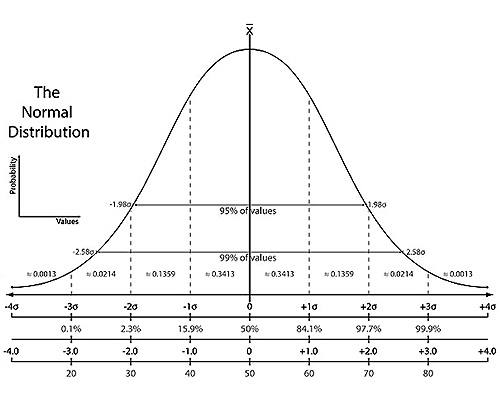
In other words, it’s something that is very far from normal. In the standard bell curve distribution pictured below, the outliers are at the far left and far right, far from the vast majority of the data which is in the middle.

In the world of records, most copies of any title you care to name would be average sounding. The vertical line in the center of the graph shows probability; the highest probability is that any single copy of a record will be at the top of the curve near the middle, which means it will simply be average. The closer to the vertical line it is, the more average it will be. As you move away from the vertical line, the data point — the record — becomes less and less average. As you move away from the center, to the left or the right, the record is either better sounding or worse sounding than average.

Hot Stampers are simply those copies that, for whatever reason, are far to the right of center, far “better” than the average. And as the curve above demonstrates, there are a lot fewer of them than there are copies in the middle. 


Measuring the Record

Malcolm Gladwell has a bestselling and highly entertaining book about outliers which I recommend to all. Last year I read The Black Swan (or as much of it as I could stand given how poorly written it is) which talks about some of these same issues. Hot Stampers can be understood to a large degree by understanding statistical distributions. Why statistics you ask? Simple. We can’t tell what a record is going to sound like until we play it. For all practical purposes we are buying them randomly and “measuring” them to see where they fall on the curve. We may be measuring them using a turntable and registering the data aurally, but it’s still very much measurement and it’s still very much data that we are recording.

No Theory, Just Data

Many of these ideas were addressed in the recent shootout we did for BS&T’s second album. We played a large number of copies (the data), we found a few amazing ones (the outliers), and we tried to determine how many copies it really takes to find those records that sound so amazing they defy not only conventional wisdom, but our understanding of records per se.

We don’t know what causes these records to sound so good. We know ’em when we hear ’em and that’s pretty much all we can say we really know. Everything else is speculation and guesswork.

We have data. What we don’t have is a theory that explains that data.

And it simply won’t do to ignore the data because we can’t explain it. Hot Stamper Deniers are those members of the audiophile community who, when faced with something they don’t want to be true, simply manufacture reasons why it can’t or shouldn’t be true.

That’s not science. Practicing science means following the data wherever it leads. The truth is found in the record’s grooves and nowhere else. If you don’t think record collecting is a science, you’re not doing it right.

Ignoring Outliers

Wikipedia has a good line about ignoring outliers. Under the heading of Caution they write: “… it is ill-advised to ignore the presence of outliers. Outliers that cannot be readily explained demand special attention.” Hear hear.

Now let’s see where the grooves for Blood, Sweat and Tears’ second album led us. They demanded special attention and by god we gave it to them.

The Grooves

We noted some new qualities to the sound that we would like to discuss; they’re what separated the men from the boys this time around. What we learned can be summed up in a few short words: it’s all about the brass. Let me give you just one example of how big a role the brass plays in our understanding of this recording. The best copies present a huge wall of sound that seems to extend beyond the outside edges of the speakers, as well as above them, by quite a significant amount. If you closed your eyes and drew a rectangle in the air marking the boundary of the soundscape, it would easily be 20 or 25% larger than the boundary of sound for the typically good sounding original pressing, the kind that might earn an A or A Plus rating.

Size Matters

The effect of this size differential is ENORMOUS. The power of the music ramps up beyond all understanding — how could this recording possibly be this BIG and POWERFUL? How did it achieve this kind of scale? You may need 50 copies to find one like this, which prompts the question: why don’t the other 49 sound the way this one does?

The sound we heard on the Four Plus copy has to be on the master tape in some sense, doesn’t it? Mastering clearly contributes to the sound, but can it really be a factor of this magnitude?

Intuition says no. More likely it’s the mastering of the other copies that is one of the many factors holding them back, along with worn stampers, bad stampers, bad metal mothers, bad plating, bad vinyl, bad needles and all the rest — all of the above and more contributing to the fact that the average copy of this album is just plain bad news.

Conventional Wisdom

Any reason you like for why a record doesn’t sound good is as valid as any other, so you might as well pick one you are comfortable with; they’re all equally meaningless. Of course the reverse of this is just as true: why a record sounds good is anyone’s guess, and a guess is all it can ever be.

People like having answers, and audiophiles are no different from other people in this respect. Since there are no answers to any of these questions, answers in this case being defined as demonstrable conclusions based on evidence gained through the use of the scientific method, most people, audiophiles included, are happy — if not better off — making up the answers with which they are most comfortable.

This is precisely why the term “conventional wisdom” was coined, to describe the easy answers people readily adopt in order to avoid doing the hard work of actually finding out the truth.

(more…)

Two Minutes that Shook My World – “But I Might Die Tonight”

After building our new studio a few years ago, we soon found out we had a whole host of problems.

We needed to work on electrical issues. We needed to work on our room treatments. We needed to work on speaker placement.

We initially thought the room was doing everything right, because our Go To setup disc, Bob and Ray, sounded super spacious and clear, bigger and more lively than we’d ever heard it. That’s what a 12 foot high ceiling can do for a large group of musicians playing live in a huge studio, in 1959, on an All Tube Chain Living Stereo recording. The sound just soared.

But Cat Stevens wasn’t sounding right, and if Cat Stevens isn’t sounding right, we knew we had a huge problem.

Some stereos play some kinds of records well and others not so well. Our stereo has to play every kind of record well because we sell every kind of record there is. You name the kind of music, we probably sell it.

And if we offer it for sale, we had to have played it and liked the sound, because no record makes it to our site without being auditioned and found to have excellent sound.

But I Might Die Tonight

The one song we played over and over again, easily a hundred times or more, was But I Might Die Tonight, the leadoff track for side two. It’s short, less than two minutes long, but a lot happens in those two minutes. More importantly, getting everything that happens in those two minutes to sound not just right, but as good as you have ever heard it, turned out to be a tall order indeed.

I could write for days about what to listen for in the song, but for now let me just point the reader to one of the most difficult parts to reproduce.

At about 50 seconds into the track, Cat repeats the first verse:

I don’t want to work away
Doing just what they all say
Work hard boy and you’ll find
One day you’ll have a job like mine, job like mine, a job like mine

Only this time he now has a multi-tracked harmony vocal singing along with him, his own of course, and he himself is also singing the lead part louder and more passionately. Getting the regular vocal, call it the “lower part,” to be in balance with the multi-tracked backing vocal, call it the “higher part,” turned out to be the key to getting the bottom, middle and top of the midrange right.

When doing this kind of critical listening we play our records very loud. Live Performance level loud. As loud as Cat could sing, that’s how loud it should be when he is singing his loudest toward the end of the song for the final “But I might die tonight!” If he is going to sing loudly, I want my stereo to be able to reproduce him singing as loud as he is actually singing on the record.

No compression.

No distortion.

All the energy.

Yes, that’s the way I want to hear it!

The last fifteen seconds or so of the song has the pianist (Cat himself) banging out some heavy chords on the piano. If you have your levels right it should sound like there is a real piano at the back of the room and that someone is really banging on it, a powerful coda perfectly fitting for such an emotionally stirring song.

(more…)

Finding Good Companies to Invest In Is a Lot Like Finding Good Sounding Records to Play

Important Lessons We Learned from Record Experiments

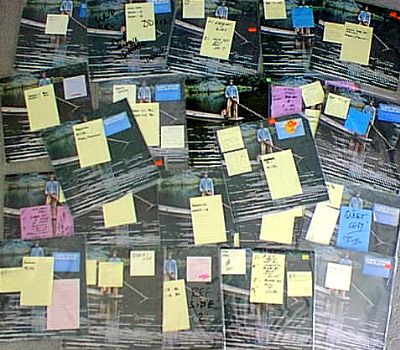
Which of the copies pictured below sound good and which ones don’t?

If you turn over enough of these “rocks,” you — and you alone — will know.

There are some amazing sounding winners in this pile. If you conduct your shootouts following the  tried and true methods we lay out here on the blog, you will be able to hear One Man Dog and every other album you love sound better than you ever dreamed possible.

Pictured below are just a small fraction of the rocks we’ve turned over in the 20 years since we began doing shootouts.

(more…)

What Kind of (Audio) Fool Was I?

Thinking Critically About Records Is Key to Understanding Them

This commentary was written in 2007 or thereabouts.


Today’s audiophile seems to be making the same mistakes I was making as a budding audiophile more than thirty forty five years ago.

Heavy Vinyl, the 45 RPM 2 LP pressing, the Half-Speed Limited Edition — aren’t these all just the latest audiophile fads, each with a track record more dismal than the last?

And isn’t it every bit as true today as it was in the past that the audiophiles who buy these “special” pressings rarely seem to notice that many of them don’t actually sound very good?

Was Devo right? Is everything in audio getting worse?

Our Story Begins

One Man Dog has long been a favorite James Taylor album of mine. It didn’t catch on too well with the general public when it came out but it caught on just fine with me. I used to play it all the time. As a budding but misguided audiophile back in the early ’70s, I foolishly bought the import pressing at my local record store, The Wherehouse, assuming it would sound better and be pressed on quieter vinyl. The latter may have been true, probably was true, but the former sure wasn’t. Turns out even the average domestic original is far better sounding, but how was I to know?

Compare and Contrast? What For?

Back in those days it would never have occurred to me to buy more than one copy of a record and do a head to head comparison to see which one sounded better. I approached the subject Platonically, not scientifically: the record that should sound better would of course sound better, so what is the point of testing?

Later on in the decade a label by the name of Mobile Fidelity would come along claiming to actually make better sounding pressings than the ones the major labels put out, and — cluelessly — I bought into that nonsense too.

(To be fair, sometimes they did — Touch, Waiting for Columbus and American Beauty come to mind, but my god, Katy Lied, Year of the Cat and Sundown have to be three of the worst sounding records I’ve ever played in my life.)


UPDATE 2015

Obviously, we no longer agree with much of that except for the one MoFi record that has stood the test of time, Touch.


The Learning Curve Is Looking Awfully Flat

Pardon my pessimism, but it seems to me the learning curve these days is looking awfully flat. There doesn’t seem to be a whole lot of learning going on. If such learning were actually going on, how would most of these audiophile labels still be in business?

Don’t get me wrong: some progress has been made. Reference, Chesky and Audioquest thankfully no longer burden us with their awful LPs. But is the new Blue or Fragile really any better than the average MoFi from 1979? Different yes, but better? I know one thing: I couldn’t sit through an entire side of either of them on the remastered pressings. And I love both of those albums.

Compared to the real thing, can any of these records pretend to compete sonically? A few, I guess, but too few, and they seem to be pretty darn far between.

(more…)

Lee Hulko Cut All the Best Sounding Cat Stevens Albums, Regardless of Label

Hot Stamper Pressings of the Music of Cat Stevens Available Now

UPDATE 2020

This commentary was written many years ago, circa 2005 I would guess.

Way back then, doing Hot Stamper shootouts was much more difficult than it is now. We didn’t have the right cleaning machine, and we hadn’t discovered the Prelude Record Cleaning System.


Is the Pink Label Island original pressing THE way to go? That’s what Harry Pearson — not to mention most audiophile record dealers — would have you believe.

But it’s just not true. And that’s good news for you, Dear (Record Loving Audiophile) Reader.

Hot Stamper Commentary for John Barleycorn

Since Barleycorn is a Lee Hulko cutting just like Tea here, the same insights, if you can call them that, apply.

Here’s what we wrote:

Lee Hulko, who cut all the Sterling originals, of which this is one, cut this record many times and most of them are wrong in some way. A very similar situation occurred with the early Cat Stevens stuff that he cut, like Tea & Teaser, where most copies don’t sound right but every once in a while you get a magical one.

Lee Hulko cut all the original versions of this album, on the same cutter, from the same tape, at the same time.

(more…)

Making Mistakes and Other Advice from Better Records

New to the Blog? Start Here

Record shootouts are the fastest and easiest way to hone your listening skills. We believe that the only way to really learn about records is to gather a big pile of them together, clean them up and listen to them one by one, as critically as you can.

Wise men and women throughout the ages have commented on the value of making mistakes. Here is one of our favorite quotes on the subject.

“Making a different mistake every day is not only acceptable, it is the definition of progress.” Robert Brault

If you have twenty copies of Bridge of Sighs, and most of them are British, you are definitely going to find a Hot Stamper pressing or two, assuming you clean them right and listen to them critically.

Keep in mind that having British pressings in your shootout is absolutely crucial to your success, because those are the only ones that ever win our shootouts, for obvious reasons: they’re made from the master tapes.

The domestic pressings are made from dubs, and yes, I suppose you could shootout twenty of those, but you would only be trying to find the best second-rate pressing of the album out of your twenty, since practically any British pressing will beat even the best domestic pressing.

(more…)

Our Planets Shootout Was Years in the Making, and We Got It Wrong Anyway

Hot Stamper Pressings of Orchestral Spectaculars Available Now

This is a VERY old commentary providing the evidence for just how wrong we were about the sound of Steinberg’s 1971 recording for DG.

We did the shootout in 2008 and picked a winner, the Steinberg.

Somewhere in the neighborhood of five years later we picked a new winner, the Previn on EMI, and we have never wavered from that choice. It’s still our favorite.

In fact, the Previn gets better with every improvement we make to our system. That’s one of the ways you can be sure that it’s good: the better your system gets, the better your good records get. The inverse of that effect occurs right alongside your good records. Now your not-so-good records start to show you how not-so-good they always were. (For you fans of Heavy Vinyl and Half-Speeds, this can be painful, but we all have to go through it, so, looking on the bright side, the sooner your system can show you what’s wrong with those audiophile records, the less money you will have wasted on them.)


In July of 2005 we noted on the site that Hot Stampers for this album were discovered, and interested parties should watch the site for killer copies in the coming months. Obviously we didn’t know at the time that the number of coming months would be THIRTY TWO. That’s how long it would be before we could offer our loyal customers truly Hot Stampers, but hey, good things come to those who wait, right?

We had to wait for two things: the revolutionary cleaning techniques that we developed during that time (the heart of which is our $7000 record cleaning machine) which allowed us to get these records to sound better and play quieter, and, secondly, better equipment. 

One Long Shootout

This was one long shootout, two and a half years in the making. And I spent at least ten years before that collecting enough copies to be able to find some pattern in the stampers that clued me in as to what to look for. It was a long time coming but we expect you will find it was all worth it in the end. This music is so important and moving; it belongs in every audiophile’s collection. To get Steinberg’s version into your collection has not been easy, until now. This is the one. 

The Story from 2005

Below you will find an example of a title that will show up on the site someday (I hope): Holst’s The Planets with Steinberg and the BSO on DG. My favorite performance of all time.

But the copies you see pictured above all sound different! If you could read my post-its on the covers you would see that each of them has strengths and weaknesses. Some are quite good, some are quite awful. Some are noisy, some are quiet. Some are grainy, some are sweet, some have powerful bass, some are bass shy. They all sound different, and they all sound different in their own way.

So what we need to do now is winnow this group down to the best 4 or 5 copies, and then shoot them out. First all the side ones, then all the side twos.

This is a big job. A job that will take more than one day. I could probably spend a week playing these records. You can only do so many until fatigue sets in.

I regret to say I just haven’t felt sufficiently inspired to take on a project of this size. What will probably get me going is the next copy I pick up that really sounds good. It will make me want to hear how good it sounds compared to the other copies I like. I have 3 or 4 pretty good sounding copies in my own collection . But which is the best?

Someday I hope to find out.

And when I do I’ll be sure to let you know. It will be my pleasure. Finding really good records is a thrill. Especially when they have music like this on them.

(more…)

Extreme Record Collecting – There’s Only One Way to Find Better Records

What You Can Learn from Experimenting with Records

A while back, Richard Metzger posted on the Dangerous Minds website a story recounting his lifelong search for better sounding pressings of his favorite albums.

By the third paragraph, it was clear that Richard had the right perspective on this hobby of ours, as he understood all too well how few people are interested in finding great records:

Please allow me to state the obvious right here at the outset: Most people WILL NOT GIVE A SHIT about what follows. One out of a hundred maybe, no, make that one out of a thousand. Almost none of you who have read this far will care about this stuff. If you are that one in a thousand person, read on, this was written especially for you. Everyone else, I won’t blame you a bit if you want to bail.

The story of my life! You could say the same about this blog. Why should anyone care about any of this stuff?

Just because I’m obsessed with records and their sound — even a record as completely forgotten as this one — doesn’t mean that anyone else in his right mind, dangerous or otherwise, should be.

On this subject, it’s best to let Richard speak for himself. Part One of his record obsession can be found here.

Gadzooks – Now there’s a Part Two!

After reading Richard’s post, I contacted him and offered to send him a Hot Stamper pressing of a record of his choosing, about which he was of course free to say anything he liked.

That record turned out to be Aja. It seems he was pretty pleased with the copy we sent him.


Speaking of Aja, I’ve been playing the band’s fifth album since the day it came out in 1977. (I’d been a huge fan for years by then.)

We started doing shootouts for it around 2006, and in the ensuing years a great deal has been written about the album, by us as well as our customers.

(more…)