lacks-rez

The records linked here are lacking in resolution.

The Cisco Pressing of Beethoven’s Kreutzer Sonata

Hot Stamper Pressings of Recordings with Heifetz Performing

An audiophile hall of shame pressing from Cisco / Impex / Boxstar / whatever.

The Cisco pressing of LSC 2577 should not have sound that is acceptable to any person who considers himself an audiophile.

There is no violinist in front of you when you play their pressing.

There is someone back behind your speakers under a thick blanket, and his violin sure doesn’t sound very much like a real violin — no rosiny texture, no extended harmonics, no real body.

In short, the sound of this reissue is much too smearyveiled, and lacking in presence to be taken seriously.

Unfortunately for those of us who love good music with good sound, Cisco’s releases from this era (as well as DCC’s) had to fight their way through Kevin Gray’s transistory, opaque, airless, low-resolution cutting system. We discuss that subject in more depth here.

(more…)

DCC + RTI = Audio Enervation

Hot Stamper Pressings of the Music of Bonnie Raitt Available Now

UPDATE 2025

This commentary was the first one I wrote criticizing the sound of DCC vinyl, probably around 2008 or so. There would be many to follow.

A well-known Joni Mitchell album we played the year before didn’t exactly set us on a different path, but it did have the effect of kicking us up into a higher gear, and Bonnie’s album was one of the early fruits of that change.

During our shootout for Bonnie’s first Capitol album, we found that the DCC pressing was lacking in so many ways that I felt compelled to spell out for our customers what its shortcomings were.

I had enthusiastically recommended the album in 1996 when it came out, but our first big shootout had shown me how wrong that judgment would turn out to be. Our complete commentary from 2008 is reproduced below.


The no-longer-surprising thing about our Hot Stamper pressings of Nick Of Time is how completely they MURDER the DCC LP. Folks, it’s really no contest.

Yes, the DCC is tonally balanced and can sound very good, but it can’t compete with the best original pressings. It’s missing too much of the presence, intimacy, immediacy and transparency that we’ve discovered on the better original pressings. 

As is the case with practically every record pressed on Heavy Vinyl over the last twenty years, there is a suffocating loss of ambience throughout, a pronounced sterility to the sound.

Modern remastered records just do not BREATHE like the real thing.

Good EQ or Bad EQ, they all suffer to one degree or another from a bad case of audio enervation. Where is the life of the music? You can try turning up the volume on these remastered LPs all you want; they simply refuse to come to life.

We play albums like this VERY LOUD. I’ve seen Bonnie Raitt live a number of times and although I can’t begin to get her to play as loud in my listening room as she did on stage, I can try. To do less is to do her a disservice.

The DCC Approach

The DCC, like a lot of modern remastered titles we”ve played, is too damn smooth.

(more…)

I Have to Admit: the Cisco Pressing of Home Again! Had Me Vexed

Reviews and Commentaries for the Music of Doc Watson

Folks, if you made the mistake of buying the Cisco Heavy Vinyl reissue of this album, and you manage to grab one of our Hot Stamper pressings, you are really in for a treat.

I have to confess that when this record came out in 2003 I had a hard time coming to grips with what was wrong with it. I knew I didn’t like it, but I wasn’t sure exactly why. I wasn’t sure exactly what it was doing wrong, if anything. It seemed tonally correct and natural sounding. Why didn’t I like it?

It wasn’t phony up top with sloppy bass like a MoFi.

It wasn’t hard and transistory like so many of the Classic Records pressings back then.

I didn’t know the record at all so I really had nothing to judge it by.

But there was definitely something lacking in the sound that had me confused. Eventually I figured it out. Looking back on it now, the problems with the Cisco I could not identify were these:

  • The Cisco lacks presence. It puts Doc Watson further back than he should be, assuming that he is where he should be on the good vintage pressings, which sound right to me — some better, some worse, of course. Moving him back in the sound field does him no favors.
  • The Cisco lacks intimacy, which is key to the best pressings. The shootout winners remove all the veils and put you in the presence of the living, breathing Doc Watson. The Cisco adds veils and takes the intimacy right out of the record.
  • The Cisco lacks transparency. It frustrates your efforts to hear into the recording.
  • Doc is in a studio, surrounded by the air and ambience that would naturally be found there. The Cisco is airless and ambience-free, with Doc performing in a heavily damped booth of some kind. At least that’s what it sounds like.
  • And the last thing you notice is the lovely guitar harmonics on the originals and early reissues, harmonics that are attenuated and dulled on the Cisco.

As my stereo got better and better, and my critical listening skills improved in tandem, it became more and more obvious to me what was wrong with the Cisco. When we play modern Heavy Vinyl pressings these days, especially albums we know well, it usually doesn’t take us two minutes to hear what they are doing wrong.

(more…)

Oh, So That’s Who Butchered Neil Young’s Greatest Hits

Hot Stamper Pressings of the Music of Neil Young Available Now

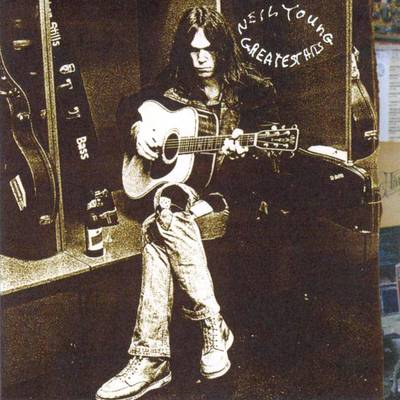
When I reviewed the Classic Records pressing of Neil Young’s Greatest Hits in 2005, I had never heard of Chris Bellman. As it turns out, he’s the guy who cut this piece of crap. I had no idea. And why would I care anyway?


UPDATE 2025

The median price the album sells for on Discogs as of 10/2025 is $142.92, and it has sold for as much as $288 and change in the past. There are bigger wastes of money in the world of records — this guy can be counted on to produce more than his share, some at prices that even make us blush — but it is hard to imagine how anyone could get less for his $142 than by buying this 2 disc set.


The most shocking thing about the fact that he cut the album is not how awful it sounds.

No, there are plenty of awful sounding Heavy Vinyl pressings in the world, enough to fill up the glossy-paged catalogs of every mail order audiophile record dealer from here to Timbuktu.

What is shocking is that there are audiophiles — self-identified lovers of sound, who are undoubtedly believe themselves capable of telling a good sounding record from a bad one — that defend this man’s work.


How does anyone take this guy’s records seriously?

To be fair, it should be said that I actually like one of the records Mr Bellman has cut, the 45 of Brothers in Arms, discussed here. An excerpt:

[In this video] I’m asked if I like any modern mastering engineers, and the only one I can think of is Chris Bellman, because he mastered one of the few Heavy Vinyl pressings I know of that sounds any good, Brothers in Arms, released in 2021. I played it when Edgers [Geoff Edgers from WAPO] brought it by the studio when he first visited me in preparation for his article.

My best copy was clearly better in some important ways, but Bellman’s mostly sounds right, and that surprised me because most of these modern records sound funny and weird and almost never sound right.

(Geoff brought over three records that day: Brothers in Arms, the remastered Zep II, and a ridiculously bad sounding Craft pressing of Lush Life, which was mastered by Kevin Gray, and one which I have not had time to review yet. It was my introduction to the Craft series, and let’s just say we got off on the wrong foot. I told Geoff it sounded like a bad CD, and that’s pretty much all I remember of it. The average price for that pressing on Discogs is roughly $69 these days. The CD is cheaper and there is very little doubt in my mind that it would be better sounding to boot.)

I stand by my admiration for Brothers in Arms, a very good reissue, something that might give one of our lowest level Hot Stamper pressings a run for its money.

But he has a lot of explaining to do when it comes to the other records of his we (and Robert Brook) have played. Reviews are coming, late as always, but for now here is what we’ve written about the records he’s credited with remastering.

(more…)

Carnival of the Animals on Klavier Is Another Doug Sax-Mastered Disaster

Hot Stamper Pressings of the Music of Saint-Saens Available Now

Yet another murky, smeary audiophile piece of vinyl trash from the mastering lathe of the formerly brilliant Doug Sax. He used to cut the best sounding records in the world. (Exhibit A: this one.)

Then he started working for perhaps the worst record label of all time and to my knowledge never cut a good sounding record again.

This record may be on the TAS Super Disc list, but we don’t think it belongs there. Instead, it belongs on the bad TAS list that we created specifically for these far-from-super records.

To be fair, the real EMI is on there as well, ASD 2753. However, including the Klavier on the list brings into doubt the compentence of whoever is curating it these days.
This Klavier pressing, along with all the Classic Records titles, as well as other modern reissues, renders the advice found there all but useless. Is anyone calling attention to all the bad sounding records that have lately been recommended by The Absolute Sound? I think we might just be the only ones. If you know of any others, please email me at tom@better-records.com.

Doug Sax

For those of us who remember the consistently superb work Doug Sax was doing in the 70s, we sadly note that he passed away in 2015. I was honored to have met him a few years before then at a Chopin concert with Lincoln Mayorga performing on the piano. (Impressively performing, I might add. He played the complete Chopin Preludes from memory, all 24 of them.)

Both he and Lincoln were gentlemen and artists of the highest caliber. Needless to say, I hope this awful sounding Klavier is not the kind of record that he would want to be remembered by.

On this record, in Doug’s defense it should be noted that he had only second generation tapes to work with, which is neither here nor there as these pressings are not worth the dime’s worth of vinyl used to make them and should never have seen the light of day.

Can this dubbysmeary sound possibly be what EMI engineer Stuart Eltham was after?

Hard to believe. We’ve played plenty of his recordings and we cannot ever remember any of the non-audiophile pressings having this kind of sound.

But isn’t that just the way? The mainstream labels mass produce the good sounding pressings and the audiophile labels produce the limited edition junk.

Now there’s a rule of thumb you might want to keep in mind, especially if you’ve made the mistake of buying any of the Heavy Vinyl pressings we reviewed in 2024 and 2025, a parade of horribles that defy understanding.

Actually, if we understand that there is a need for vinyl product for the lo- to mid-fi record collector market, it makes perfect sense. That’s what Klavier was in the business of producing, and now everybody wants in on the action, hence the proliferation of crap Heavy Vinyl pressings coming to market, practically every one even worse sounding than the last.

(more…)

Kevin Gray Returns to the Scene of the Crime for One Flight Up

Hot Stamper Pressings of Blue Note Recordings Available Now
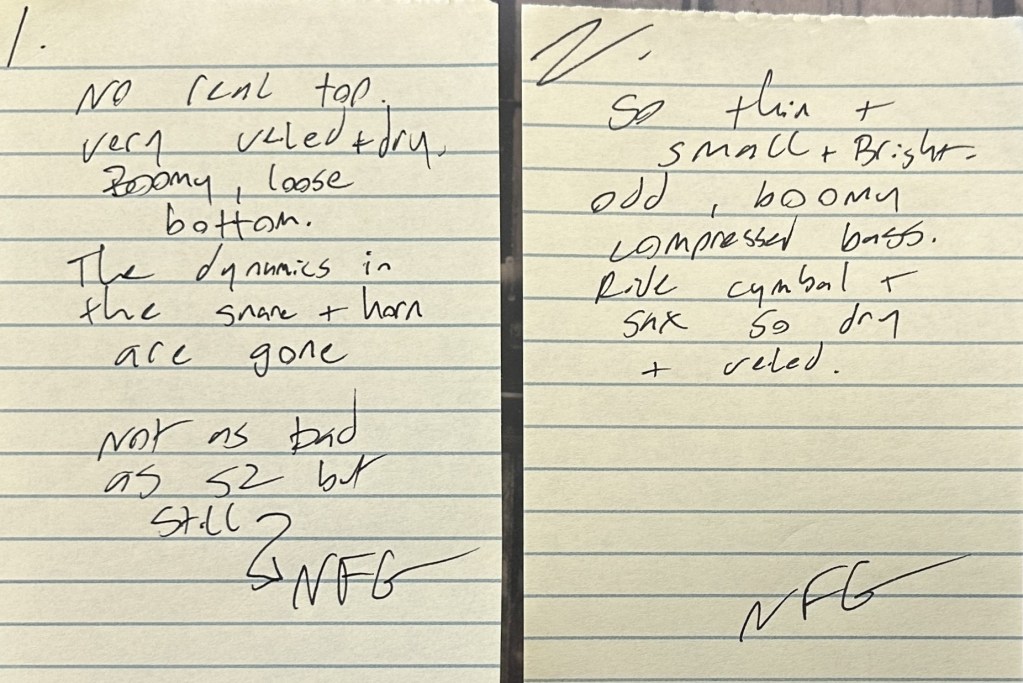
Robert Brook wrote about the Tone Poets remastered pressing of One Flight Up a few year back. We noted at the time:

We have never heard the Tone Poets pressing that Robert played against the Van Gelder cutting he discusses in his commentary.

We have one in stock and are just waiting to do the shootout for the album so that we can compare it to the better pressings we know we will find.

You may have read that we were knocked out by a killer copy way back in 2007. We expect to be no less knocked out in 2023.

Make that 2025. (Clean Blue Note pressings are hard to come by.)

Robert concludes with the strengths and weaknesses of the two pressings. Here is an excerpt:

Overall, the Tone Poet is closed, distant and frankly boring to listen to. Where is the energy of the music? Where is the presence of these musicians? Where is the studio space?

Now that we’ve played the Tone Poets pressing against the best Blue Notes we could find, we know exactly what he means!

Kevin Gray had previously cut the record for Cisco and made a real mess of it, so we are not the least bit surprised that this newer version is every bit as bad sounding as that one.

Why anyone is hiring this hack to make records is a mystery to those of us who play them, and if for some reason it isn’t a mystery to you, it should be.

How inaccurate and unrevealing does a stereo have to be in order to hide the shortcomings of this incompetently mastered record? If you have such a stereo — and there seem to be plenty of them out there in audio land, judging by the fact that Tone Poets is still in business — now is the time to get rid of it, or, at the very least, start making major improvements.

You might want to consider taking some audio advice from us along those lines.

Robert Brook has plenty to say on that subject as well.

Here are the notes we took while playing the Tone Poets pressing after completing our shootout. We had already heard some killer copies, the White Hot shootout winners, so we knew just how good the record could sound.

Side One

(more…)

Kevin Gray’s Version of Waltz for Debby Is Really Something

Hot Stamper Pressings of the Music of Bill Evans Available Now
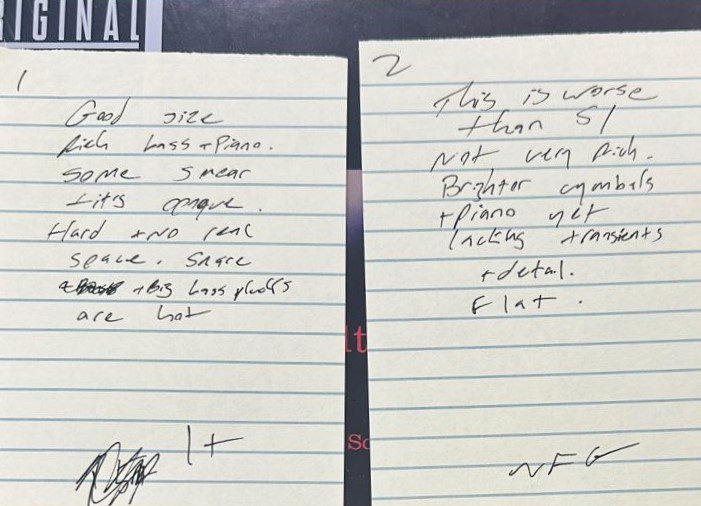
During our most recent shootout for Waltz for Debby we took the opportunity to play the 2023 Craft pressing cut by Kevin Gray.

It seems to have a nice list of features, among them AAA mastering using the Original Master Tape.

What could go wrong?

  • Craft Original Jazz Classics Series
  • 180g Vinyl LP
  • (AAA) Lacquers Cut from the Original Tapes by Kevin Gray at Cohearent Audio
  • Pressed at RTI
  • Tip-On Jacket with OBI

Plenty could go wrong, and did, especially on side two.

Nice features apparently are not enough to make a good sounding record.

Below are our listening notes cataloging the problems with this remastered pressing. If you own this version of the album, listen for the shortcomings we describe. The better your stereo and room, the more obvious they will be.

And of course the opposite is true for those of you who have trouble hearing them.

Now, if you already bought this sorry excuse for an audiophile pressing and just like collecting records, and don’t really care what they sound like, you can stop reading right here, put the record on and just enjoy the music.

(more…)

On the Concerto in F, String Tone Is Key

Hot Stamper Pressings of the Music of George Gershwin Available Now

I must admit Classic Records did a passable job with LSC 2586, RCA’s recording of Gershwin’s Concerto in F, with Fiedler conducting the Boston Pops.

The two things that separate the good originals from the Classic reissue are in some ways related.

Classic’s standard operating procedure is to boost the upper midrange, and that, coupled with their transistory mastering equipment, results in strings that are brighter, grittier, and yet somehow lacking in texture and sheen compared to the originals,

This to us is a clear sign of a low-resolution cutting chain.

Once you recognize that shortcoming in a pressing, it’s hard to ignore, and I hear it on every Classic Record I play. (This commentary has more on the subject.)

RCA is more famous for its string tone than anything else.

If the strings on the Classic Records LPs don’t bother you, you can save yourself a lot of money by not buying authentic RCA pressings — and get quieter vinyl to boot.

Here are some other records that are good for testing string tone and texture.

(more…)

Jazz Impressions of Black Orpheus Is a Bloated Mess at 45 RPM from Hoffman, Gray and Kassem

Hot Stamper Pressings of Jazz Piano Recordings Available Now

We played an amazing Hot stamper copy that got the bottom end on this album as right as we’ve ever heard. The contribution of the bass player was clear and correctly balanced in the mix, which we soon learned to appreciate was fundamentally important to the rhythmic drive of the music.

The bass was so tight and note-like you could see right into the soundstage and practically picture Monte Budwig plucking and bowing away.

This is precisely where the 45 RPM pressing goes off the rails.

The bloated, much-too-heavy and poorly-defined bass of the Heavy Vinyl remaster makes a mess of the Brazilian and African rhythms inherent in the music. If you own that $50 waste of money, believe me, you will not be tapping your foot to Cast Your Fate to the Wind or Manha de Carnival.

Our rule of thumb: he better the system, the more second-rate Hoffman’s remastered records will sound when they aren’t just terrible.

Is this the worst version of the album ever made? That’s hard to say.

But it is the worst sounding version of the album we’ve ever played, and that should be good enough for any audiophile contemplating spending money on this kind of trash. Take our advice and don’t do it.

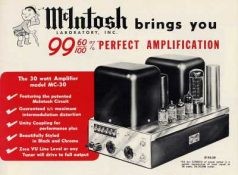
If you like the sound of old McIntosh tube equipment like the Mac 30s shown here, a sound Steve Hoffman apparently cannot get enough of, these remastered records have your name all over them.

We don’t sell junk like this, but every other audiophile record dealer does, because most of the current group of mastering engineers making records for audiophiles have somehow gotten into their heads that this is the way records should sound.

We’ve been telling them they are wrong about that for years now, that good records have never sounded this way, but the collectors and audiophiles of the world keep buying their wares, so why should they listen to us?

If you want to know what a properly-mastered, properly-pressed copy sounds like, we put the last one up in 2023.

(more…)

Music From Peer Gynt – Another Cisco Disaster

Hot Stamper Pressings of the Music of Edvard Grieg Available Now

An audiophile hall of shame pressing from Cisco / Impex /  Boxstar / Whatever.

Pretty bad, on a par with the transistory, shrill crap Classic Records had been dishing out for years, but in the opposite direction tonally: it’s dull and dead as a doornail.

I often mention on this blog that Cisco’s releases (as well as DCC’s) had to fight their way through Kevin Gray’s transistory, opaque, airless, low-resolution cutting system. We discuss that subject in more depth here.

Our favorite recording of Peer Gynt is the one by Otto Gruner-hegge and the Oslo Philharmonic from 1959.

(more…)