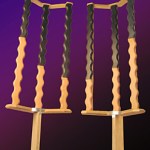
hallographs

Advances in Playback Technology Are More Than Blind Faith

More of the Music of Eric Clapton

In a 2007 commentary for a Hot Stamper pressing of Blind Faith we noted that:

When it finally all comes together for such a famously compromised recording, it’s nothing less than a THRILL. More than anything else, the sound is RIGHT. Like Layla or Surrealistic Pillow, this is no Demo Disc by any stretch of the imagination, but that should hardly keep us from enjoying the music. And now we have the record that lets us do it.

The Playback Technology Umbrella

Why did it take so long? Why does it sound good now, after decades of problems? For the same reason that so many great records are only now revealing their true potential: advances in playback technology.

Audio has finally reached the point where the magic in Blind Faith’s grooves is ready to be set free.

What exactly are we referring to? Why, all the stuff we talk about endlessly around here. These are the things that really do make a difference. They change the fundamentals. They break down the barriers.

You know the drill. Things like better cleaning techniques, top quality front end equipment, Aurios, better electricity, Hallographs and other room treatments, amazing phono stages like the EAR 324p, power cables; the list goes on and on.

If you want records like Blind Faith to sound good, we don’t think it can be done without bringing to bear all of these advanced technologies to the problem at hand, the problem at hand being a recording with its full share of problems and then some.

Without these improvements, why wouldn’t Blind Faith sound as dull and distorted as it always has? The best pressings were made more than thirty years ago [thirty? make that fifty] — they’re no different.

(more…)

Soundstaging At All Costs – A Flawed Approach to Audio

More on the Subject of Vague Imaging

The first thing I noticed about this system is that the Hallographs are in the wrong place, or at least they are in the wrong place if you are only using one pair. The first pair should be to the outside and just behind the speakers.

What this system screams out to those of us who have heard a lot of stereos, in my case having spent about fifty years in high-end audio, is “Soundstage Freak.”

The speakers are too far apart to create a proper center image.

The sound will be exceptionally spacious this way, but it is also very likely to be washed out and vague.

If you listen exclusively to orchestral music, and you like to sit toward the back of the hall when you go to live performances, then yes, you can almost justify having the speakers this far apart.

For most other music this is not a good approach.

A good vocal recording is all you would need to demonstrate the serious shortcomings of placing your speakers this wide apart.

If this were your setup, But I Might Die Tonight could show you the error of your ways, the way it showed me some of mine (albeit different ones) when I had initially finished the speaker setup at our new studio.

I worked on my speaker placement and room treatments for weeks and months after that, but I knew something was wrong well before that two minute song was over.

Stardust would also be a good choice. Most of Julie London‘s records would work. Some of the more intimate Ella records would be ideal of course, but we rarely have much stock. Blue would work, as would any early Joni Mitchell album.

The recordings of singer songwriters rarely place them anywhere but in the center of the stage, the best of them as prominently as possible. Many of our Hot Stamper pressings would make excellent test discs for getting this aspect of speaker placement dialed in better.

(more…)

Good Audio Advice and Critical Listening Skills

More on the Subject of Developing Critical Listening Skills

[This is an updated version of a commentary written many years ago.]

The latest Mapleshade catalog (Spring 09) has, along with hundreds of recommendations, this little piece of audio advice that caught my eye:

For much improved bass and huge soundstage, put your listening chair or sofa right against the wall behind you. Move your speakers in to 5’ in front of you and 7’ or more apart. No room treatments will yield this much bass improvement.

I literally had to read through it a couple of times to be sure I wasn’t hallucinating. But every time I read it, it still said the same thing, so I know I can’t have been dreaming. This is crazy talk. What the hell is wrong with these people?

Well, it’s not all crazy. There is actually a factually true statement at the end of that paragraph. Yes, it is true that no room treatments will yield as much bass as sitting up against a wall. But why stop there? Bass, regardless of its source, immediately seeks out the corners of the room. That’s where the most bass will always be: where the room boundaries are. If you want to hear the maximum amount of bass your speakers are producing, put your head in the corner of the room down at the floor, where three boundaries intersect. Like the sound now? Getting enough bass are ya?

Along the same lines, for a “huge soundstage” try putting one speaker at one end of the room and the other speaker at the opposite end. Why stop at seven feet? My listening room is twenty feet deep; I can get a soundstage that’s twenty feet across without any problem at all.

I would just have to be dumb enough to think that doing such a thing would be a good idea.

Fellow audiophiles and music lovers, it is not. Let’s talk about why.

Room Reflections

The closer you are to anything that the sound coming from your speakers can bounce off of, right before or right after it reaches your ears, the worse the sound. You want to be as far away from everything as you can be, and this includes not only the back wall of your listening room, but the heads of other persons who may be listening with you. This is easily demonstrated. Have a friend or loved one sit next to you and listen critically to some music you know well. Now have that person leave the room. The sound will always get better (unless something else is very wrong). I have done this experiment many, many times and it only comes out one way: fewer near reflections, better sound.

This is why we have three pair of Hallographs in our listening room. They help control room reflections. Reflections are the main cause of bad sound in most listening rooms. The louder you play your stereo, the worse the reflections get and the more they screw up the sound.

We like to play our stereo very loud — much of the music we like demands it — and we simply could not turn up the volume the way we do without effective room treatments. Your first pair of Hallographs, even just “roughed in,” not at all tuned precisely the way they can be, will immediately allow you to play your stereo louder than you could before you installed them. (Since the first pair reflect the sound waves directly back to the listener, Hallographs do actually increase the sound level at the listening position, adding energy and dynamics.)

This is a good thing. It’s a clear sign they work.

One obvious reason that our turn up your volume makes for such a great test is that the louder the problem, the harder it is to ignore.

(more…)

Letter of the Week – “Nothing I’ve done has ever offered a more DEEPLY SATISFYING audio improvement than Hallographs.””

Basic Audio Advice — These Are the Fundamentals of Good Sound

Many years ago one of our good customers had this to say about the Hallographs he had purchased.

They are no longer made, but if you have a chance to get hold of a pair, take it. You may find yourself as knocked out by the sound as Dan was.

Hey Tom, 

Man, you weren’t kidding. Hallographs, utilizing a process as comprehensible to me as voodoo magic, have got to be the most AMAZING sonic upgrade ever. Hallographs allow my stereo to induce not just pleasure, but euphoria. That’s not hyperbole.

I don’t know how these tall sticks of wood, albeit expertly crafted, do whatever it is they do, but the sound emanating from my speakers reached a whole new league of sonic reproduction.

Edginess to the highs? Gone.

Bass bloat? Gone.

High volume distortion? Gone.

Meanwhile, it adds rich tones, warmth, detail, clarity, dynamics, life-like three-dimensional sound, and a wonderful ease and naturalness to the overall sound. To top it off, I’ve been able to calibrate focus and immediacy vs. soundstaging and depth. Did I mention it adds a beautifully rich tone?

That I could achieve such wonderful sound with Hallographs in my mid-sized room should be an encouragement to any of your customers who, like me, are still working their way up to a large listening room. I was worried that I might not get much out of the Hallos in the absence of a full range of placement options, and nothing could be further from the truth.

Despite the tens of thousands of dollars of stereo equipment I’ve purchased, nothing I’ve done has ever offered a more DEEPLY SATISFYING audio improvement than Hallographs. When can I get a second pair?

Dan L.

Dan,

Thanks so much for your letter. We are as enthusiastic about the Hallograph’s ability to improve the sound of the stereo as anyone, as can be seen from the photo below. Three Hallos can be seen in the picture surrounding one old man, but we actually use a total of six of them, with two in the back corners of the room behind the listener.

Discovering these room treatments around 2004 completely changed audio for me.

(more…)

Diminishing Returns in Audio? Sez Who?

More of the Music of Sergio Mendes and Brasil ’66

UPDATE 2026

The commentary you see below was written in 2005 or thereabouts. Some changes have been made and links to newer commentaries added.


Thoughts from 2005

I often read about the idea of “diminishing returns” regarding the piece of equipment under review in an audio magazine, as if to say that we are so close to audio perfection that a gain of a few percent is the most we can hope for from this or that new megabuck amp or speaker.

In my experience, precisely the opposite is true. 

There are huge improvements to be made on a regular basis, even without spending all that much money (keeping in mind that this is not exactly a poor man’s hobby).

If you are actively involved in seeking out better equipment, trying new things, and tweaking the hell out of your system as much as time and patience permit, I think an improvement of 10-25% per year in perceived sound quality is not an unreasonable expectation.

The Hallographs, for example, can easily make a system improvement of that magnitude. I have heard it happen on a number of occasions. Is the system twice as good with the addition of the Hallographs? Technically, no. Is it twice as enjoyable? Is it twice as musically involving? Absolutely. Was the system fine before? Of course. Could you even listen to it after removing the Hallographs from the room? Not in a million years.

A similar situation occurred not that long ago with the Townshend Seismic Platter you may have read about on the site. I put a second and third unit under different pieces of equipment (integrated amp, VPI SDS) and the sound just soared. Same equipment, playing the same records, night and day more musically satisfying sound. For relatively small amounts of money. I’ve heard the same thing happen in other systems, so this is no fluke. It can be done.

Change What Exactly?

What specifically needs to be changed in a given system no one can really know. All you can do is take your best shot and hope for a good result.

There is simply no alternative to the ‘hard” work of experimentation and critical evaluation.

The results of these experiments cannot be predicted with much accuracy.

But one thing I can guarantee you: if you don’t change at least something in your system, you can be sure it will never sound any better than it does today. Why would it?

Sergio Mendes and James Taylor

Of course the same principle applies to records. A while back I stumbled upon two pressings that really changed my understanding of the recordings themselves. One was an original copy of Sweet Baby James (similar to this one). The sound was so tonally perfect I could hardly believe what I was hearing. This stamper was so hot it was on fire! No copy in my experience had ever gotten it this right. It was a singular thrill. I was still thinking about it weeks later.

The other amazing LP was a copy of Sergio Mendes and Brazil 66’s first album (similar to this one), with a side two that murdered my best copy. We’re talking here about an album that I have literally been collecting for over 20 years. An album that I have auditioned more than 50 pressings of, maybe even 100. An album that I would have said I know what the best stampers are and that’s that.

But I would have been dead wrong. This stamper for side two takes this familiar recording to a level heretofore unimagined by me. It not only had more smoothness that my best copy — a chronic problem with this title, as they are often tizzy and aggressive — but there was quite a bit more ambience than ever before.

Normally, brighter records appear to have more ambience, as ambience is heard mostly in the treble region. Here we have a copy with “less’ treble (actually more correct treble) that gives us more ambience. More ambience than I have ever heard. A lot more.

And with ambience comes resolution. For the first time ever I can clearly make out the Portuguese words the female vocalists are singing. I still don’t know what they mean, but I can clearly hear the words. Portuguese is a language that is often pronounced with a slur: all the sounds seem to run together. That’s the way I always heard it on this album, so I assumed that’s the way it was always going to sound. Wrong. This pressing showed me a recording I never knew existed — until last week.

This is a perfect example of the thrill one can only get through record collecting. There’s nothing like it.

Actually that’s not true. There is something like it: Making your stereo sound better. Then all your records become less familiar – in a good way.

(more…)

Revolutionary Changes in Audio – What Works for Us Can Work for You

Basic Audio Advice — These Are the Fundamentals of Good Sound

This listing, like the stereo itself (mine and yours), is a work in progress. It used to be on our website. Now it resides here on the blog.

When I first got started in audio in the early- to mid-70s, the following important elements of the modern stereo system did not exist:

  • Stand-alone phono stages.
  • Modern cabling and power cords.
  • Vibration controlling platforms for turntables and equipment.
  • Synchronous Drive Systems for turntable motors.
  • Carbon fiber mats for turntable platters.
  • Highly adjustable tonearms (for VTA, etc.) with extremely delicate adjustments and precision bearings.
  • Modern record cleaning machines and fluids.
  • And there wasn’t much in the way of innovative room treatments like the Hallographs we use.

Our reason for having this kind of commentary on a site ostensibly devoted to the selling of records is simple: the better your stereo sounds, the better our records sound, and, more importantly, the bigger the difference between our records and the copies you already own. That includes LPs recommended by “audiophile” record dealers, which tend to be on Heavy Vinyl, at 45 RPM, Half-Speed mastered or Japanese pressed.

We have no interest in any of them. Why?

On our system they rarely sound better than second-rate.

(more…)

Letter of the Week – “…going through all my Hot Stampers and taking it all in …”

Important Lessons We Learned from Record Experiments

This week’s letter comes from our good friend Franklin who was having some serious sound problems that were driving him crazy after moving his speakers from the long wall (not a good idea) to the short one (much better as a rule).

He already had one pair of Hallographs, which had helped his room problems quite a bit. We rely on three pair, and the second and third pair were a big improvement over the first, so we recommended another to Franklin, which, by the sound of this letter, seems to have worked miracles!

Hello Mr. Port,

Just to let you know what you already know about this LP. When I first received this ($500) LP and listened to it, I thought I had really messed up.

I didn’t hear all the nuances you described. I just put it away and forgot about it. What a BUMMER!!!!! But I decided to try it again after placing the new pair of Hallos. I moved them all over the place. I even have the floor marked all over with painter’s masking tape to remind me where the best spots are for the Hallos. Floor really looks funny.

Sometimes when you make a change, it seems to be better for some LPs but not others. But when a change impacts all the LPs positively, you know you are in the game. I am going through all my Hot Stampers and taking it all in. I will tweak some more but for now I’ll just enjoy.

Regards,
Franklin

Franklin,

Thanks so much for your letter. When your system is cookin’ and you’re hearing all your records sound better than ever, that’s when audio is FUN. You had to do a lot of work to get there and the good sound you are able to enjoy now is your reward.

(more…)