 More on the Subject of How to Go About Developing Your Critical Listening Skills
UPDATE 2024
This is an updated version of a commentary written many years ago.
The latest Mapleshade catalog (Spring 09) has, along with hundreds of recommendations, this little piece of audio advice that caught my eye:
For much improved bass and huge soundstage, put your listening chair or sofa right against the wall behind you. Move your speakers in to 5’ in front of you and 7’ or more apart. No room treatments will yield this much bass improvement.
I literally had to read through it a couple of times to be sure I wasn’t hallucinating. But every time I read it, it still said the same thing, so I know I can’t have been dreaming. This is crazy talk. What the hell is wrong with these people?
Well, it’s not all crazy. There is actually a factually true statement at the end of that paragraph. Yes, it is true that no room treatments will yield as much bass as sitting up against a wall. But why stop there? Bass, regardless of its source, immediately seeks out the corners of the room. That’s where the most bass will always be: where the room boundaries are. If you want to hear the maximum amount of bass your speakers are producing, put your head in the corner of the room down at the floor, where three boundaries intersect. Like the sound now? Getting enough bass are ya?
Along the same lines, for a “huge soundstage” try putting one speaker at one end of the room and the other speaker at the opposite end. Why stop at seven feet? My listening room is twenty feet deep; I can get a soundstage that’s twenty feet across without any problem at all.
I would just have to be dumb enough to think that doing such a thing would be a good idea.
Fellow audiophiles and music lovers, it is not. Let’s talk about why.
Room Reflections
The closer you are to anything that the sound coming from your speakers can bounce off of, right before or right after it reaches your ears, the worse the sound. You want to be as far away from everything as you can be, and this includes not only the back wall of your listening room, but the heads of other persons who may be listening with you. This is easily demonstrated. Have a friend or loved one sit next to you and listen critically to some music you know well. Now have that person leave the room. The sound will always get better (unless something else is very wrong). I have done this experiment many, many times and it only comes out one way: fewer near reflections, better sound.
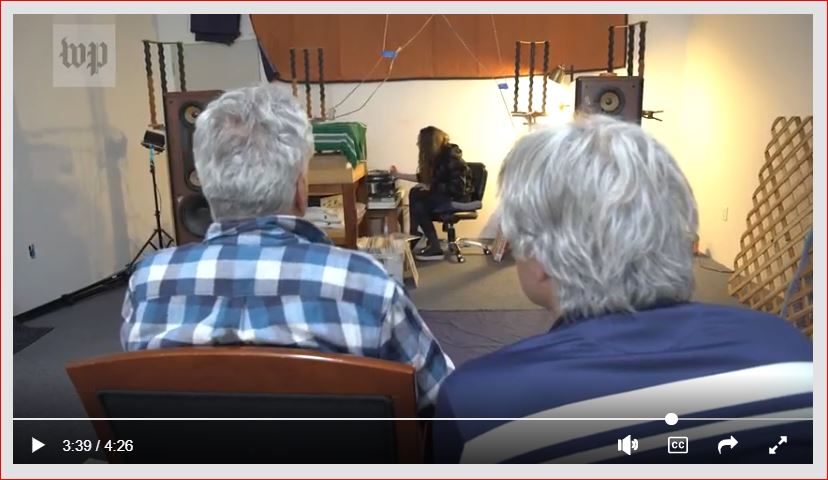
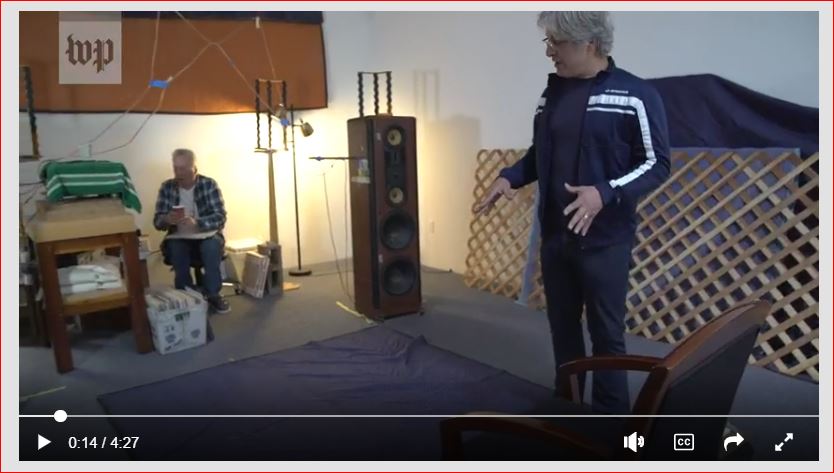
This is why we have three pair of Hallographs in our listening room. They help control room reflections. Reflections are the main cause of bad sound in most listening rooms. The louder you play your stereo, the worse the reflections get and the more they screw up the sound.
We like to play our stereo very loud — much of the music we like demands it — and we simply could not turn up the volume the way we do without effective room treatments. Your first pair of Hallographs, even just “roughed in,” not at all tuned precisely the way they can be, will immediately allow you to play your stereo louder than you could before you installed them. (Since the first pair reflect the sound waves directly back to the listener, Hallographs do actually increase the sound level at the listening position, adding energy and dynamics.)
This is a good thing. It’s a clear sign they work.
One obvious reason that our turn up your volume makes for such a great test is that the louder the problem, the harder it is to ignore.
Sitting Close
Sitting close to the speakers eliminates much of the effect of room reflections. So does wearing headphones. I have never liked either approach to listening; both seem very unnatural to me. And sitting too close is a bad idea from my experience. Now, I can only speak for the sound produced by large dynamic multi-driver speakers, since those are the only kinds of speakers I’ve owned for the last forty-odd years.
When you have multiple drivers there is a specific distance and height where the drivers blend correctly.
To be more precise, more correctly than any other distance and height.
Finding the correct height and distance one should sit from one’s speakers may sound easy, but in fact it is very tricky. It took scores of hours of intense listening over the course of months to figure both out in my listening room.
One thing that made it more difficult is the Hallographs themselves. You can tune them to achieve just the right sound, but when you move your listening position, you must retune them for that position. With six units that obviously became a complicated job. But progress was obvious from the start, so it was just a matter of keeping at it, playing as much challenging music as we could and testing testing testing.
Since we play all kinds of records, all day, practically every day as part of regular shootout regimen, this was much easier for us to do than it would be for most audiophiles. But as I have told many in this hobby over the years, if you don’t do the work the only person who doesn’t get to hear better sound is you. I can come home to my good sounding stereo — I’ve done the work — but you’re stuck listening to all the problems you haven’t solved, right?
Back to Mapleshade
And having done all that work, with the many stereos I’ve owned over the years as well as those of my friends, I can tell you categorically that the advice quoted above from the Mapleshade catalog is very, very bad advice.
Much of the advice in their catalog I found eminently sensible. If I had more time I would talk about some of it, but we have to spend our days playing and writing about records, not some company’s catalog, so that will probably never come to pass.
I will say this though: there is some real nutty stereo advice in there, so take whatever you read with a sizable grain of salt.
Further Reading