fix-up

Various / The Heifetz-Piatigorsky Concerts

Hot Stamper Pressings Featuring the Violin

Superb Recordings with Jascha Heifetz Performing

This is one of the pressings we’ve discovered with reversed polarity.

This IMMACULATE set has dry, edgy, screechy sound — until you reverse your absolute phase! Then it sounds pretty good! It certainly will never win any awards, but it’s practically unlistenable without the phase reversed. 

Now I can’t say that’s true for all six sides. I play graded all six sides — they range from M- to slightly worse, about as quiet as these Soria pressings ever are — but I only reversed the phase on side one after dropping the needle on the other sides and suffering through the brittle sound. (more…)

Liszt / Sonata in B Minor & Other Pieces / Curzon

More of the music of Franz Liszt (1811-1880)

Hot Stamper Classical LPs on Decca & London

This Super Hot Stamper solo piano record is 1963 Decca recording technology at its finest (or would be if we had ten copies to shoot out and could find the White Hot Stamper pressing hidden among them).

As it is, we are happy to have found this one, Super Hot on both sides, an amazingly realistic representation of a piano. You will have a hard time finding better. 

And the music, especially on side two, is compelling and wonderful. This is classical music that will engage you at the deepest and most serious level. Widely considered Liszt’s masterpiece, in Curzon’s forceful hands it is not hard to understand why.

Side One

A++ Super Hot Stamper sound, with a clear piano surrounded in space. Present and dynamic, there is little to fault here, save a touch of smear and a slight lack of weight.

Real pianos in live recitals have weight that I have never heard reproduced by any stereo system, so “real weight” is a relative term, one that applies more to recordings than to the live instrument itself. (more…)

Brahms / Trio & Beethoven / Sonata for Horn and Piano

This is an exceptionally good sounding chamber record on the RCA White Dog label, especially on side two, which earned a sonic grade of A++ to A+++. Side two has the Beethoven work for horn and piano, and it sounds about as real and natural as a chamber recording can. Side one is not quite up to the same sonic standards, but is quite good nevertheless, earning a very respectable grade of A+ to A++.

This title is so rare I had literally never seen one in my 25+ years as a dealer in audiophile-oriented recordings. The other bit of good news is that the vinyl is unusually quiet, playing as it does mostly Mint Minus. How many early RCA pressings can make such a claim? No more than five per cent I would think, if that. (more…)

Rachmaninoff / Concerto No. 2 – Reviewed in 2008

More of the music of Sergei Rachmaninoff (1873-1943)

Reviews and Commentaries for Rachmaninoff’s Piano Concertos

This is the earlier pressing of LSC 2068, which stretches the Rachmaninoff piece over both sides of the record, resulting in a more dynamic pressing.

The sound is tonally right on the money with the superb, rich, sweetly textured strings we have come to expect from RCA in this period.

The piano has exquisite tone as well.

This is a lovely, lyrical piece of music and the natural sound conveys the qualities of the work perfectly.

(more…)

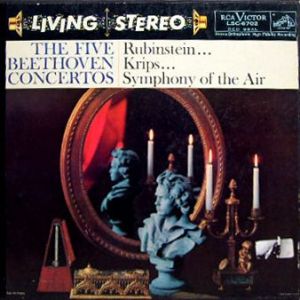
Beethoven / The Five Beethoven Concertos / Rubinstein – Reviewed in 2011

This original Shaded Dog Five Disc Box Set (LSC 6902) contains all five of Beethoven’s Piano Concertos, with sound that’s predictably all over the map, from White Hot to Not-So-Hot and every grade in between. Yes folks, we actually listened to every one of these sides in a shootout with other RCA, London and Mercury pressings of the same music.

The best sound in the set was clearly the Third Piano Concerto, which had sides that were Super Hot and White Hot. (more…)

Elgar/ Pomp & Circumstance / Solti – Reviewed in 2005

Near Demo Quality. Solti is magnificent here. This record has even better sound than the famous Barbarolli. Another Wilkinson/ Kingsway winner.

It would be demo quality if it were recorded in ’67 instead of ’77; it doesn’t quite hang together in the climaxes the way an earlier recording would.

(more…)

Prokofiev / Romeo and Juliet – Our Killer Copy from 2009

More of the music of Sergei Prokofiev (1891-1953)

Reviews and Commentaries for the Music of Sergei Prokofiev

Superb Sound on this Victrola pressing, with TRANSPARENCY, spaciousness and low level detail you will not believe.

And plenty of Living Stereo COLOR.  

DEMO QUALITY SOUND, if what you’re demonstrating is the three dimensional quality of Living Stereo recordings. Amazing space, depth and width can be heard on this side one. And the music is sublime.

The low level detail in the opening and the amount of ambience heard in the quieter sections is shockingly realistic Yes, the recording is compressed, which led me to think that the entire record was compressed, but that’s not completely true. In some parts it’s quite dynamic. The quiet portions are very quiet; in a couple of places there are just horns playing off in the deep distance, followed by some flutes, and they sound very natural, just as you would hear them in a concert hall. (more…)

Berlioz / Symphonie Fantastique / Fourestier – Reviewed in 2010

Hot Stamper Pressings of Well Recorded Classical Albums Available Now

More Classical “Sleeper” Records We’ve Discovered

This obscure French label stereo reissue of an original Omega recording from the 60s is SUPERB SOUNDING, without a doubt the best sound I have ever heard for the work. [The stereo is much better these days than it was years ago when we auditioned other pressings, so comparisons with those other, older records are practically pointless.]

And the performance is Top Notch as well; I know of none better.

This is a piece that is difficult to fit onto a single LP, clocking in at around 45 minutes, which means that the mastering engineer has three options when cutting the record: compress the dynamics, lower the level, or filter the deep bass. Fortunately it seems that none of those approaches were taken by the engineer who cut this record in the early ’80s — there’s plenty of punchy deep bass, as well as powerful dynamics, and the levels seem fine. How he do it? Beats me. Glad he did though!

Side One

A++ Super Hot Stamper sound from top to bottom. The strings are BIG, sweet, clear and textured — the kind of strings that one might hear on maybe one out of thirty or forty classical recordings.

We might prefer them a bit richer, and they can get a bit shrill when at their loudest, but considering how important the strings are to the success of this work, one must be thankful that they are as good as they are.

Side Two

Side two manages to convey more of that richness we were looking for in the strings on side one, but is a bit more recessed and not quite as wide in its soundstaging as we heard there. The sound is clear and open and wonderfully smooth.

And the bottom is BIG — the tympani and lower strings are powerful and dynamic. You will have a hard time finding better sound in the lower registers for this work, most of the pressings we’ve played were simply too anemic to take seriously. (Let’s face it: the average classical LP is hardly listenable.)

Super Hot Stampers again — a great Symphonie Fantastique played to perfection.

Symphonie Fantastique

Symphonie Fantastique: Épisode de la vie d’un Artiste…en cinq parties (Fantastic Symphony: An Episode in the Life of an Artist, in Five Parts), Op. 14, is a Program symphony written by the French composer Hector Berlioz in 1830. It is one of the most important and representative pieces of the early Romantic period, and is still very popular with concert audiences worldwide. The first performance took place at the Paris Conservatoire in December 1830. The work was repeatedly revised between 1831 and 1845 and subsequently became a favourite in Paris.

The symphony is a piece of program music which tells the story of “an artist gifted with a lively imagination” who has “poisoned himself with opium” in the “depths of despair” because of “hopeless love.” Berlioz provided his own program notes for each movement of the work (see below). He prefaces his notes with the following instructions:[1]

The composer’s intention has been to develop various episodes in the life of an artist, in so far as they lend themselves to musical treatment. As the work cannot rely on the assistance of speech, the plan of the instrumental drama needs to be set out in advance. The following programme must therefore be considered as the spoken text of an opera, which serves to introduce musical movements and to motivate their character and expression.

There are five movements, instead of the four movements which were conventional for symphonies at the time:

Rêveries – Passions (Daydreams – Passions)

Un bal (A ball)

Scène aux champs (Scene in the Country)

Marche au supplice (March to the Scaffold)

Songe d’une nuit de sabbat (Dream of a Witches’ Sabbath)

Wikipedia


This is an older classical/orchestral review

Most of the older reviews you see are for records that did not go through the shootout process, the revolutionary approach to finding better sounding pressings we started developing in the early 2000s and have since turned into a veritable science.

We found the records you see in these older listings by cleaning and playing a pressing or two of the album, which we then described and priced based on how good the sound and surfaces were. (For out Hot Stamper listings, the sonic grades and vinyl playgrades are listed separately.)

We were often wrong back in those days, something we have no reason to hide. Audio equipment and record cleaning technologies have come a long way since those darker days, a subject we discuss here.

Currently, 99% (or more!) of the records we sell are cleaned, then auditioned under rigorously controlled conditions, up against a number of other pressings. We award them sonic grades, and then condition check them for surface noise.

As you may imagine, this approach requires a great deal of time, effort and skill, which is why we currently have a highly trained staff of about ten. No individual or business without the aid of such a committed group could possibly dig as deep into the sound of records as we have, and it is unlikely that anyone besides us could ever come along to do the kind of work we do.

The term “Hot Stampers” gets thrown around a lot these days, but to us it means only one thing: a record that has been through the shootout process and found to be of exceptionally high quality.

The result of our labor is the hundreds of titles seen here, every one of which is unique and guaranteed to be the best sounding copy of the album you have ever heard or you get your money back.


Further Reading

Milstein / Masterpieces / Susskind – Reviewed in 2013


This is a RARE and WONDERFUL SOUNDING original Capitol pressing of Milstein playing pieces for violin and orchestra by Mozart, Beethoven, Stravinsky, Saint-Saens and others. The recording of the Mozart Rondo on side one boasts DEMO DISC quality sound. Side one is amazingly rich, sweet and tubey magical. The violin is tonally correct, with the kind of immediacy few violin records (in our experience) manage to capture as well, while still retaining the correct size of the instrument. (more…)

Prokofiev / Concerto No. 2 / Frager – A Top Performance

More of the music of Sergei Prokofiev (1891-1953)

This is a very nice looking RCA Living Stereo Shaded Dog LP. Some parts sound better than others but the real reason to buy this record is the performance. Frager is amazing here; he won awards for his performance of this piece in international competitions. The record also features Haydn – Sonata No. 35. The record is a member of HP’s TAS list.