beatl-com

Our thoughts regarding the recordings of The Beatles, a band whose music I have been playing for more than 60 years. That’s what we call “standing the test of time.”

Letter of the Week – “The same in what sense?”

beatlessgtHot Stamper Pressings of Sgt. Peppers Available Now

A potential customer asked about some Beatles pressings he saw on our site:

  Hey Tom, 

I have the Beatles collection UK box set from the time frame you mentioned. [Most of our Beatles albums are from the 70s and early 80s.] The albums have the black Parlophone EMI label. Do you think they are the same as the album that is for sale?

Edward

Edward,

The same in what sense? No two records have the same sound, so in that sense, no, they cannot ever be the same. They can have the same labels, even the same stamper numbers, but they will always sound different on very good equipment, and when properly cleaned they will sometimes sound VERY different.

And the better your system, the more different they will sound.

If you absolutely love your Pepper from the box set and have played five or ten other pressings and found that it is the best sounding of them all, then you probably don’t need ours. You’ve already done a shootout and you’ve already found a winner. If that is the case, congratulations are in order.

But if you did not do a shootout, did not clean and play five or ten other copies, then our pressing should be quite a bit better, maybe even night and day better. No one can know until you play our copy against yours.

Your judgment is the final say on the matter, but you need a bunch of cleaned copies in order to make that judgment, and it looks like you do not have more than the one Pepper from the box.

At this point you really don’t know how good your Sgt. Pepper sounds, because you need other copies to play against it in order to know that.

(more…)

An Overview of Beatles Oldies But Goldies

Hot Stamper Pressings of the Music of The Beatles Available Now

This is a Beatles album we think we know well.

We’ve done a number of shootouts for A Collection of Beatles Oldies over the last ten years or so, and our experimental approach using many dozens of copies provides us with strong evidence to support the following conclusions regarding the sound of the originals vis-a-vis the reissues:

  1. The best of the early pressings always win our shootouts. No reissue has ever earned our top grade of A+++ and it is unlikely any reissue ever will.
  2. The reissues can be quite good however. The best of them have earned grades of Double Plus (A++).
  3. The worst of the early pressings also earned grades of Double Plus (A++).
  4. Conclusion: if you have a bad original and a good reissue, you might be fooled into thinking the sound quality was comparable.

(more…)

Sgt. Pepper on Yellow and Black Parlophone

Hot Stamper Pressings of the Music of The Beatles Available Now

UPDATE 2026

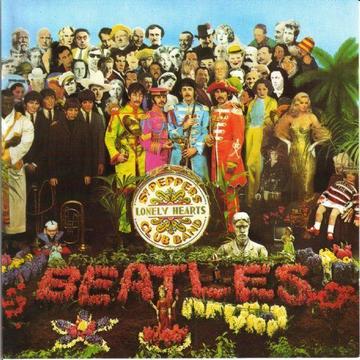
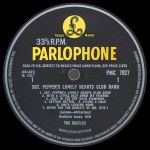
This commentary was written in 2010, prompted by our good fortune in finding a clean, -1/-1 original pressing of Sgt. Pepper, at a local record store, in stereo no less.

Since that time I believe we have played at least one other early pressing. We are unlikely to play another.

The originals have almost nothing in common with the amazing pressings that end up winning our shootouts, none of which have ever been mastered in the 60s to the best of my knowledge, although it is possible that ten or fifteen years ago, before we really got to know the record the way we know it now, there might have been one or two from that decade.

Since then the cutoff is somewhere in the mid-70s. We leave the specific years for you to figure out.

Of course, if you bought a White Hot Stamper copy from us, you know at least one of the stampers for at least one of the sides that wins a shootout, and perhaps both if you happened to have purchased a 3/3 Top Shelf copy. (At the time of this writing there are a total of seven on the site, out of about 500 records. Needless to say, they are very hard to find.)

Certainly nothing from 1967 and nothing on the original label.

And definitely nothing in mono.


We had the opportunity not long ago to audition a very clean original early pressing of the album and were frankly quite taken aback by how just plain AWFUL it was in every respect. No top end above 8k or so, flabby bass, muddy mids — this was as far from Hot Stamper sound as you could get.

To be fair, we have played exactly one copy on our current system. (Played an early copy or two long ago but on much different equipment, so any judgments we might have made are highly suspect.) Perhaps there are good ones. We have no way of knowing whether there are, and we are certainly not motivated to find out given the price that original Sgt. Pepper’s pressings on the Yellow and Black label in audiophile playing condition are fetching these days.

(more…)

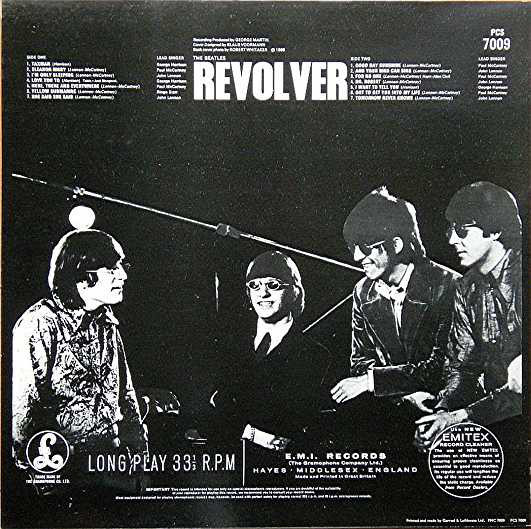
One of Our Best Sounding Pressings of Revolver Lacked Space on One Side

Hot Stamper Pressings of Revolver Available Now

On side one we played I’m Only Sleeping first, followed by Taxman.

On side two we started with And Your Bird Can Sing, followed by Good Day Sunshine.

You may notice that there seems to be a pattern in the way we pick which songs of each side to do first.

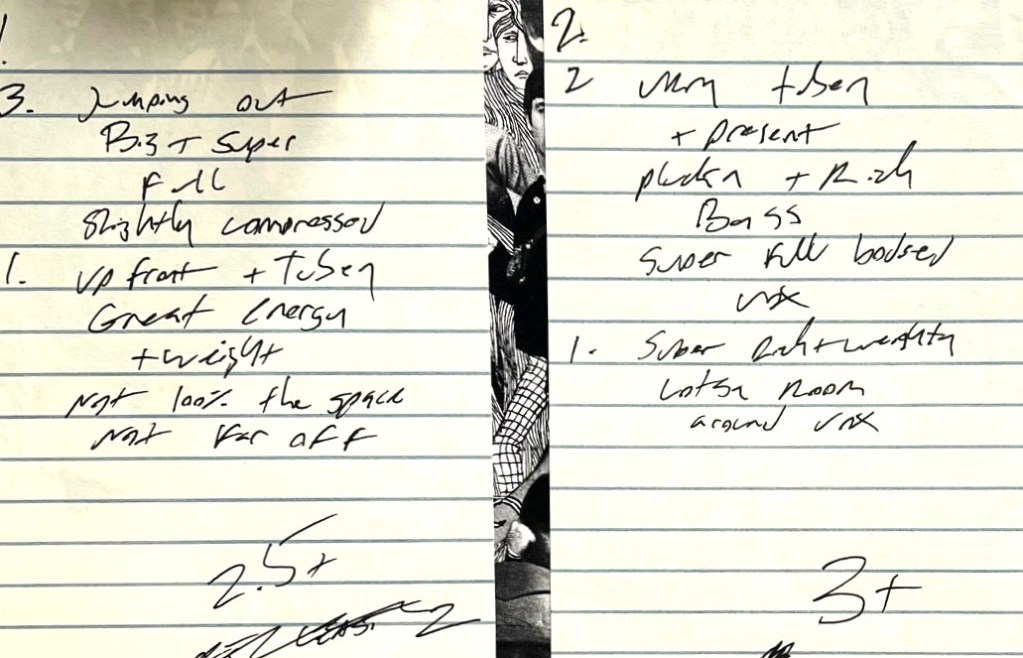
As you can see from the notes, side two of our most recent White Hot stamper Shootout Winner was doing everything right.

The second track was very tubey and present. Good Day Sunshine, the first track, was super rich and weighty, with lots of room around the vox. (I hope you can read our writing. If you can’t, just email me and I will try to find the time to transcribe the rest of the text.)

However, we had a side one that was slightly better than the side one you see here.

The Second Round

When we played the two best copies back to back, side two of this copy came out on top, earning a grade of 3+, but the side one of another pressing showed us there was even more space in the recording than we noticed the first time around.

(more…)

An RCA Direct Disc with Bad Music & Bad Sound, Like Most Audiophile Albums from the ’70s

Hot Stamper Pressings of the Music of The Beatles Available Now

The records being marketed to audiophiles these days may have second- and third-rate sound, but at least they now have good music. That’s progress, right?

It is progress, because this RCA direct to disc recording is the kind of crap that used to qualify as an “audiophile record” when I was starting out in the mid-70s. These records were displayed on the walls of all the hi-fi stores I used to frequent back in the day.

They cost a lot more than regular records did too. Many were pressed in Japan, and I vaguely recall that the retail prices were in the range of $15 to $18. That’s $77 to $92 in today’s money. Can you imagine paying that for a record with such poor sound and music?

The Beatles Medley is particularly misguided. These guys have no idea what to do with the music of The Beatles.

A record such as this clearly belongs in our audiophile hall of shame, which is a general catchall section for the many bad sounding records that have been marketed to audiophiles over the last fifty years. We’ve played and reviewed more than 300 to date, which of course is but a mere fraction of the many thousands of questionable pressings that have been produced since the 70s. There has always been a mid-fi collector market, and no shortage of enterprising types to take advantage of it.

It turns out that many of the most shameful offenders for sound are more recent releases that have only come our way in the last few years. Here are some of their stories.

(more…)

These Are the Stampers to Avoid on With The Beatles

Hot Stamper Pressings of the Music of The Beatles Available Now

In our experience, the stereo pressings with -2/-2 stampers are terrible sounding. We do not have any on hand, but we doubt that -1/-1 — the original, the first, the one approved by George Martin himself! — is any better.

With -2 stampers this is a hall of shame pressing, as well as another early LP reviewed and found wanting.

That Old Canard

The early pressings are consistently grittier, edgier and more crude than the later pressings we’ve played. So much for the idea that the “original is better.” When it comes to With The Beatles it just ain’t so, and it doesn’t take a state of the art system or a pair of golden ears to hear it.

The audiophile and record collecting community seems to have failed to reckon with the faults of the early Beatles pressings, but we here at Better Records are doing our best to correct their misperceptions, one Hot Stamper pressing at a time.

It may be a lot of work, but we don’t mind — we love The Beatles! We want to find the best sounding copies of ALL their records, and there is simply no other way to do it than to play them by the dozens, as you can see from the picture below.

(more…)

MoFi Mastering Variations – Will the Real Sgt. Pepper Please Stand Up?

Hot Stamper Pressings of the Music of The Beatles Available Now

Sgt. Pepper can be a pretty good sounding MoFi when it’s mastered by the right guy.

Say what?

Yes, dear reader, this album was mastered by two different engineers at Mobile Fidelity, and one of them, based on experiments we carried out years ago, did a much better job than the other.

This copy, which is far more rare by the way, has the better mastering — much less top end boost was added. As an aside, I used to like the other version better, but as I’ve gotten older and wiser, I realize that this pressing is superior, being noticeably less phony sounding.

It sounds much more like a good Parlophone and less like the typical Mobile Fidelity album.

(more…)

Letter of the Week – “… even my 65 year old father, with no musical background at all, was amazed when I play your Beatles stampers.”

Hot Stamper Pressings of the Music of The Beatles Available Now

One of our good customers had this to say about some Hot Stampers he purchased recently:

Hey Tom, 

I have enjoyed your records since I got a “Sgt. Peppers” hot stamper in 2011, and you guys have never disappointed me!

Every time I play one of the hot stampers for my musician friends, I don’t tell them “it’s a special pressing” but just play the record – they always comment on the sound quality, almost always saying “that’s so clear, so clean, etc…” – even my 65 year old father, with no musical background at all, was amazed when I play your Beatles stampers. He said, “in my time, records sounded scratchy and noisy.” What a revelation the Hot Stamper is.

(more…)

Listening In Depth to Let It Be

Hot Stamper Pressings of the Music of The Beatles Available Now

This is the first time we’ve discussed individual tracks on Let It Be.

Our recent shootout [now many years ago], in which we discovered a mind-boggling, rule-breaking side one, motivated us to sit down and explain what the best copies should do on each side of the album for the tracks we test with. Better late than never I suppose. 

These also happen to be the ones that we can stand to hear over and over, dozens of times in fact, which becomes an important consideration when doing shootouts, as we must do them for hours on end.

On the better pressings the natural rock n’ roll energy of a song such as Dig A Pony will blow your mind. There’s no studio wizardry, no heavy-handed mastering, no phony EQ — just the sound of the greatest pop/rock band of all time playing and singing their hearts out.

It’s the kind of thrill you really don’t get from the more psychedelic albums like Sgt. Pepper’s or Magical Mystery Tour. You have to go all the way back to Long Tall Sally and Roll Over Beethoven to find the Beatles consistently letting loose the way they do on Let It Be (or at least on the tracks that are more or less live, which make up about half the album).

Side One

Two of Us

Dig a Pony

On the heavy guitar intro for Dig a Pony, the sound should be full-bodied and Tubey Magical, with plenty of bass. If your copy is too lean, just forget it, it will never rock.

What blew our minds about the Shootout Winning side one we played recently was how outrageously big, open and transparent it was. As the song started up the studio space seemed to expand in every direction, creating more height, width and depth than we had ever experienced with this song before.

(more…)

On Please Please Me, Which Is More 3-Dimensional, Mono or Twin Track?

Hot Stamper Pressings of the Music of The Beatles Available Now

With all due respect to George Martin, we’ve played a number of mono pressings of Please Please Me in the past twenty or so years and have never been particularly impressed with any of them. The monos jam all the voices and instruments together in the middle, stacking them one in front of the other, and lots of musical information gets mashed together and simply disappears in the congestion. 

But is twin track stereo any better?

Yes, when you do it the way Norman Smith did on Please Please Me.

Twin Track stereo (which is actually not very much like two-track stereo, I’m sure Wikipedia must have a listing for it if you’re interested) is like two mono tracks running simultaneously. It allows the completely separate voices to occupy one channel and the completely separate instruments to occupy another, with no leakage between them.

On some stereos it may seem as though the musicians and the singers are not playing together the way they would if one were hearing them in mono. They are in fact recorded on two separate mono tracks, the instruments appearing in the left channel and the singers in the right, separated as much as is physically possible.

Stuck in their individual stereo speakers, so far apart from one another, the members of the band don’t even seem to be playing together in the same room.

That’s on some stereos, and by some stereos I mean stereos that need improvement. Here’s why.

Three-Dimensional Mono?

In the final mixing stage, Norman Smith added separate reverb to each of the two channels, sending the reverb for the sound recorded in each channel to the opposite channel. This has the effect of making the studio, the physical space that The Beatles appear to be in, seem to stretch all the way from the right channel, where the Beatles’ voices are heard, to the back left corner of the studio, where the reverb eventually trails off.

(more…)