11-2023

Manassas – A Classic Records Disaster

Hot Stamper Pressings of the Music of Stephen Stills Available Now

The Classic pressing was a disaster. Can you imagine adding the kind of grungy, gritty sound that Bernie’s mastering chain is known for (around these parts, anyway) to a recording with those problems already?

It was a match made in hell.

Back in the day when I was selling lots of Classic Heavy Vinyl, this was one of the titles I refused to have anything to do with. This and Stephen Stills’ first album — both were personal favorites of mine and both were awful on Classic Records.

Is it the worst version of the album ever made? Hard to imagine it would have much competition.

Lots of rave reviews for the two of them in the audiophile press at the time though. I guess nothing ever really changes, does it? Played a Sundazed record lately? Well, there you go. How are these people impressed with such bad sound?

Of course I know exactly how it is possible to be impressed by bad sound. I spent my first twenty years in audio being clueless. Why should I expect the audiophile of today to have figured things out in less time than it took me?

(more…)

Paraphrasing Hayek – Our Curious Task

F. A. Hayek summarized his views well when he noted that:

“The curious task of economics is to demonstrate to men how little they really know about what they imagine they can design.”

Our curious task has been to demonstrate to audiophiles and the reviewers who write for them how mistaken they are to think that they can understand the sound of a recording by playing a small number of pressings of it.

Similarly, the modern mastering engineer operates with the understanding that he can design and operate a cutting system that produces sound superior to that which was produced by the engineers of the past.

Based on the hundreds of remastered records we have auditioned, this is clearly a case of overpromising and underdelivering.

These assumptions, and the mistaken approach to record collecting that flows from them, are clearly unsupportable.

The scores of commentaries we have written on both subjects provide all the evidence required to falsify them, and — with a fair amount of effort, sorry for the trouble — can be found among the 5000+ postings on this blog.

The Hot Stamper pressings we offer, so much bigger, livelier, and more engaging than anything produced by these so-called audiophile mastering houses, are simply the physical evidence of our deeper and more correct understanding of the true nature of records and their mysterious and confounding properties.

Digging Deep

Everything we think we know about records is based on strictly empirical findings, findings that resulted from critically auditioning thousands and thousands of albums. Many of these albums we have played by the score. For some titles, such as the more popular Beatles’ albums, we have played more than a hundred copies.

No one else has ever dug as deep as we have into the mysteries of pressing variations, for the simple reasons that no individual or group would be motivated to do so and have the resources required to accomplish such a feat.

(more…)

Inner Secrets Is One of the Best Sounding Rock Records We’ve Ever Played

Hot Stamper Pressings of the Music of Santana Available Now

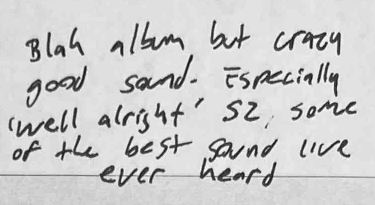
In our most recent shootout (11/2023), the first we’ve done in quite a few years, my main listening guy was blown away by the sound of the Shootout Winning copy. This warmed my heart no end, as I have been raving about the sound of this album for fifteen years or more.

We created a section for phenomenally good sounding records like Inner Secrets, and this link will take you to it.

His notes from the session can be seen below.

And he’s not wrong about much of the album being “blah.” There are really only about four top quality songs out of the nine on the album, but three of those four are killer, and, even at our prices, make the album a Must Own for those of you with big speakers that can play good and loud.

Phase One and Phase Two of a Shootout

Like other Hot Stampers you may have read about, sometimes the instruments and voices just jump out of the speakers. When that happens I usually write “It’s Alive!” on the post-it, and I know exactly what to do with it. I put it right in the Contender pile, to be compared with the other top contender copies at some point.

It’s definitely a crazy-good Hot Stamper; just how hot we still need to find out.

Which is what happens in Phase Two of these affairs. We go back through all the best copies to see in what areas they really shine and in what areas they may fall a bit short of the best.

Of course there’s no way to know what accounts for any of the sound we hear. Not for sure anyway. It’s just interesting to ponder what makes one record sound one way and the next record, with stampers as little as one letter off in the alphabet — sometimes with exactly the same stampers! — sound so different from one another.

Doug Sax Is The Man

All the originals (the only ones with the potential for good sound in our experience) are cut by The Mastering Lab, one of the greatest cutting houses to ever master records.

Doug Sax may or may not have had anything to do with the making of this record, but one thing we can be sure of: he knew how to keep his lathes and amplifiers working at state-of-the-art levels. The sound quality is unsurpassed.

And he did it all with tubes.

(more…)

Letter of the Week – “The Triplanar is bringing out more of the life and energy in the music than any other change I’ve made.”

Check Out Our New Audio Advice Section

When our customers ask for audio advice, we never hesitate to give it to them. (We also give out plenty of advice that nobody asked for.)

We want to help our customers pursue the kind of equipment that we know through decades of experience is probably superior to most of what is available in audiophile salons, regardless of price.

(In 1976, at the tender age of 22, I heard something at an audio salon that rocked my world: tube equipment. Everything changed that year.)

Robert Brook has taken our advice and ended up with much of the same equipment we currently use. He seems very happy with the analog sound he is getting these days, especially from his Triplanar tonearm.

And now Aaron B. has made a great leap forward into better sound. He wrote to tell me all about the differences he is hearing now that he has a system that is designed to reveal what’s actually on his records. His previous system was better at hiding the imperfections and shortcomings of many of the albums he was playing, but he’s decided he doesn’t want to go down that road anymore, and we couldn’t be happier for him. His letter:

I’m feeling another huge dose of gratitude for you, Tom.

I installed the Tri-Planar arm on Friday, and I could tell right away that things are sounding just wonderfully better.

My whole setup is getting really close to your full recommendation. Dynavector 17dx mounted in a Tri-Planar tonearm, mounted on a VPI Aries 1 table, going into an EAR 324, out to a [redacted] amp, driving Legacy speakers.

I managed to buy everything except the cartridge used and in good shape. The total cost for my current system is a hair above $10K, and it is sounding nearly as good as I’ve ever heard vinyl sound, or any recorded music for that matter.

The Triplanar tonearm is a game-changer. This is the most dramatic improvement since I first replaced my B&W bookshelf speakers with the Legacys. I’m frankly stunned by what a difference it makes.

The difference the tonearm makes is evident in nearly every aspect of the sound.

First, the problems I was having previously have cleared up. This includes vocal sibilance, occasional graininess to the sound, and what I mistook for groove wear, even on some hot stampers that otherwise sounded great.

Some that I returned to you, I now wish I could have back.
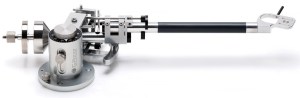
Beyond fixing the last of my playback problems, the Triplanar is bringing out more of the life and energy in the music than any other change I’ve made since you started advising me.

The attack on instruments is arresting. I’ve come to believe that the aspect of live music that’s hardest for any recording to capture is the attack. That’s where the energy of live music is to be found.

I am hearing more details and overtones to the music that I ordinarily needed to turn up the volume to hear. Also, there’s greater depth to the soundstage, even in my small room.

I’ve said this to you before, but it bears repeating. I love the records you sell. I’ve got 15 hot stampers now, and they are the crown jewels of my collection. But, it’s the education you’ve given me that’s truly transformed my music listening experience.

Today, for that, you have my deep gratitude.

Aaron

Aaron,

Thanks for taking the time to write and say all those nice things about our records and the equipment we have recommended you play them with. As you can clearly see now, it takes the right stereo to really bring our records to life. Glad to hear yours is working so well.

I have long held that the best way to do audio is to find a system in someone’s home that sounds amazing and just buy all the same stuff that person has and set it up the same way he did. If a stereo is sounding good, much of it has to be working right. Start there, then make your own improvements based on a proven model of success.

I did this to the extent it was possible back in the 80s, copying my friend George Louis’s system, comprising four 140 watt per channel transistor amps (four times the power I have now), an electronic crossover, two sets of adjustable electrostatic tweeter arrays (RTR for one and Janzen for the other), a large number of woofers in the main cabinet and a couple of dual 10″ subs thrown in for good measure.

(more…)

The King James Version – What to Listen For

Hot Stamper Pressings of Large Group Jazz Recordings Available Now

Unlike most Direct to Disc recordings, this album actually contains real music worth listening to — but only when the pressing lets the energy of the musicians through, with actual fidelity to the sounds of the real instruments. Brass without bite is boring. Drummers who are too delicate in their drumming will put you to sleep.

Many copies of this album will do exactly that, which is a real shame. During our shootout, the more we played the good copies, the more we appreciated the music these guys were making. They were swinging, a big group of top quality players totally in the groove. When it’s played well, and the sound is as good as it is here, there’s nothing boring about these Big Band Jazz Classics. The music works. It swings. If you like the kind of big band recordings Basie made — and who doesn’t — you will find much to like here.

What to Listen For

No matter what copy you have, when you play it notice how the brass in the center of the soundfiield sounds so different from the brass on either side, where, obviously, closer mics allow their solos to be picked up and mixed more easily. There are lovely trumpet solos in the left channel and a baritone sax solo in the right that have amazingly realistic fidelity. Close your eyes and those instruments are RIGHT THERE.

One thing Sheffield got right is tonally-correct, hi-fidelity brass in a real acoustic space. (The latter is where For Duke fails so miserably, although no one ever seems to notice or bother to write about it. To me that dead acoustic is like fingernails on a blackboard, completely inappropriate to the sound.)

What to Watch Out For

As a rule two areas are especially lacking: there is a noticeable lack of presence on most copies, causing the brass to get stuck in the speakers and lose its bite; and, every bit as bad, the sound is often just plain compressed, lacking energy and life.

The musicians on most copies just don’t seem to be giving it their all.

But wait a minute. This is a direct disc. How can it be compressed, or lack transients? Aren’t those tape recorder problems that are supposed to be eliminated by the direct to disc process? Maybe so, but there is some very strong evidence to the contrary, and this record is that evidence.

Even though the mastering is fixed at the live event, there are many other variables which no doubt affect the sound. The album is pressed in three different countries: the United States, Japan and Germany. Many mothers were pulled from the acetates and many, many stampers made from those mothers.

Bottom line? You got to play ’em, just like any other pressing. If no two records sound the same, it follows that no two audiophile records sound the same, a fact that became abundantly clear very early on in the listening.

Of course, not many audiophiles are in a position to shootout multiple copies of The King James Version, and I’m not sure most would even want to.

Here at Better Records we have a whole system set up to do exactly that, so we waited until we had a pile of them, got them all cleaned up, and off to the races we went.

(more…)

Led Zeppelin / II – A Top Ten Title

More of the Music of Led Zeppelin

Hot Stamper Pressings of Top Ten Titles Available Now

You may have seen our Top 100 list of the best sounding rock and pop records on the site.

We recently picked out a Top Ten from that list and you will not be surprised to learn that Led Zeppelin II made the cut. (It may in fact deserve to be at the top of the list. That’s how good the best copies are.)

The blog you are on, as well as our website, are dedicated to very special records such as these.

It is the very definition of a Demo Disc for big speakers that play at loud levels. The better pressings have the kind of ENERGY in their grooves that are sure to leave most audiophile systems begging for mercy.

This is the audio challenge that awaits you. If you don’t have a stereo designed to play records with this kind of sonic firepower, don’t expect to hear them the way the band, the engineers and everybody else involved in the production wanted you to.

This album wants to rock your world, and that’s exactly what our Hot Stamper pressings do best.

The Evolution of an Audiophile 

(more…)

Sonny Rollins Plus 4 – Defending the Indefensible

Hot Stamper Pressings of the Music of Sonny Rollins Available Now

We reviewed this album in 2014 or thereabouts.


I cannot recall hearing a more ridiculously thick, opaque and unnatural sounding pair of audiophile records than this 45 RPM Analogue Productions Heavy Vinyl release, and I’ve heard a ton of them. 

Surely someone must have noticed how awful these records sound.

So, being an enterprising sort, with a few idle moments to spare, I did a google search. To my surprise it came up pretty much empty. Sure, dealers are selling it, every last one of the bigger mail-order types.

But how is it that no reviewer has taken it to task for its oh-so-obvious shortcomings?

And no one on any forum seems to have anything bad to say about it either. How could that be?

We don’t feel it’s incumbent upon us to defend the sound of these pressings. We think that for the most part they are awful and want nothing to do with them.

But don’t those who DO think these remastered pressings sound good — the audiophile reviewers and the forum posters specifically — have at least some obligation to point out to the rest of the audiophile community that at least one of them is spectacularly bad, as is surely the case here.

Is it herd mentality? Is it that they don’t want to rock the boat? They can’t say something bad about even one of these Heavy Vinyl pressings because that might reflect badly on all of them?

I’m starting to feel like Mr. Jones: Something’s going on, but I don’t know what it is. Dear reader, this is the audiophile world we live in today. If you expect anyone to tell you the truth about the current crop of remastered vinyl, you are in for some real disappointment.

We don’t have the time to critique what’s out there, and it seems that the reviewers and forum posters lack the — what? desire, courage, or maybe just the basic critical listening skills — to do it properly.

Which means that in the world of Heavy Vinyl, it’s every man for himself.

And a very different world from the world of vintage vinyl, the kind we offer. In our world we are behind you all the way. We guarantee your satisfaction or your money back.

Now which world would you rather live in?


UPDATE 2025

Still not a single review on Discogs for this pressing.

(more…)