Lewis Layton, Engineer – Reviews and Commentaries

Debussy & Ravel – A Tale of Two Top Copies

Hot Stamper Pressings of the Music of Claude Debussy Available Now

Hot Stamper Pressings of the Music of Maurice Ravel Available Now

In 2024 we did a shootout for this recording of quartets, LSC 2413, our first in 19 years.

For the shootout winning pressing, we wrote the following:

Juilliard String Quartet’s performance of these wonderful classical works appears on the site for only the second time ever, here with INSANELY GOOD Shootout Winning Triple Plus (A+++) grades on both sides of this original Shaded Dog pressing.

Having just played some killer copies of Death and the Maiden, we’re tempted to say that this Debussy record has the potential for even better sound — it’s richer and sweeter, but every bit as real and immediate as any chamber recording we know of.

Here are the notes for the actual record we played. Side one really blew our minds, earning a grade of at least 3+.
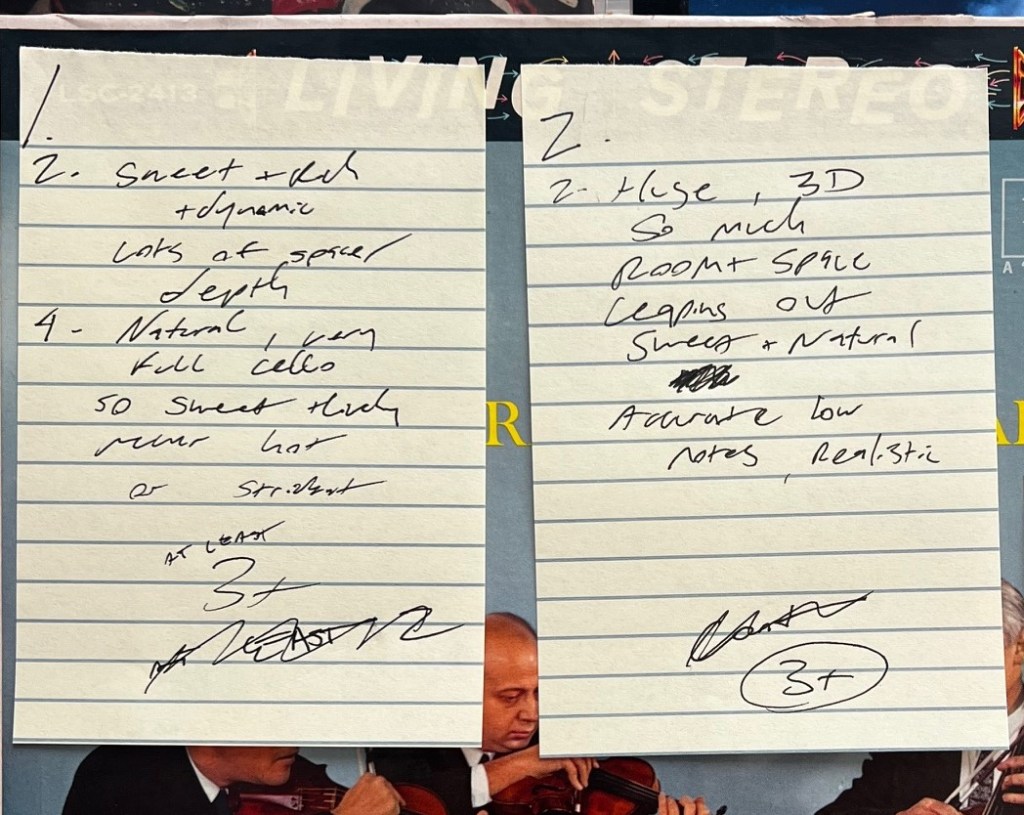
The second place finisher may not have been quite as good on side one, but it was still so good that it had no problem earning the full three pluses. It had the same stampers as the copy above by the way.

Side two however lacked the space of the very best pressings we played, and we marked it down one half plus for that shortcoming. Although it was “so tubey and 3-D” it did not have “all the space but not hot at all and natural and sweet.”

It’s very unlikely that the person who bought this copy would feel there was any problem with side two. We had two killer side two’s to play against each other back to back, and that’s about the only way these kinds of very subtle differences can be recognized, assuming you have a system that can resolve the space of the recording at an extremely high level to begin with.

The big rooms with high ceilings that systems like those require are not usually found in listening rooms that have not been custom built.

More on this wonderful record:

The Living Stereo sound here is Tubey Magical, lively and clear, with the kind of transparency that puts living, breathing musicians right in your listening room in the way that only the best vintage vinyl pressings can.

Lewis Layton engineered this recording (along with Ed Begley) and he nailed it, perfectly capturing the rich, textured sheen on the strings, the hallmark of Living Stereo sound in the 50s and 60s.

He recorded both the Schubert (LSC 2378) mentioned above and this wonderful Debussy/Ravel record for RCA in 1960 — it would be quite the understatement to say he had a gift for recordings of this kind.


Another superb recording from the 60s, brought to you by your vinyl-loving friends at Better Records.

It’s an exceptional Living Stereo all analog recording from 1960 – nothing else sounds like it.

When you’ve played as many Living Stereo titles as we have (250+ and counting), you’re bound to run into this kind of Demo Disc sound from time to time – it’s what makes record collecting fun.

It’s an amazing find, the kind of record we live for here at Better Records.

(more…)

Why Do So Few Living Stereo Pressings Sound as Good as This One?

Hot Stamper Pressings of Orchestral Spectaculars Available Now

We introduced our most recent shootout winning copy of The Reiner Sound from 1958 this way:

The Reiner Sound returns to the site for the first time in years, here with big, bold, dynamic Triple Plus (A+++) Living Stereo sound throughout this original Shaded Dog pressing.

These are just a few of the things we had to say about this amazing copy in our notes: “fully extended up top”…”sweet and rich”…”supremely dynamic and spacious!!!” (side one)…”massive and tubey and 3D”…”like no other” (side two)…”explosive finish.”

These sides are doing everything right – they’re rich, clear, undistorted, open, spacious, and have depth and transparency to rival the best recordings you may have heard.

This record will have you asking why so few Living Stereo pressings actually do what this one does.

The more critical listeners among you will recognize that this is a very special copy indeed.

Everyone else will just enjoy the hell out of it.

And here are the notes to prove it!

Side one was at least 3+.

(more…)

Skip the Living Stereo of Rachmaninoff’s Piano Concerto No. 2 with Cliburn

Hot Stamper Pressings of Living Stereo Recordings Available Now

We recently dropped the needle on a copy of LSC 2601 — the first one we’ve played in years — and found a great deal to fault in the sound. Our copy with 3s/3s stampers was awful sounding.

Rachmaninoff’s Piano Concerto No. 2 is a wonderful piano concerto, one that belongs in any serious record collection, but the sound on the pressing we played was definitely not up to our standards.

The piano was cranky, the overall sound a dry mess overall. It just sounded much too much like an old record.

A Shaded Dog pressing such as this might be passable on an old school audio system, but it was too unpleasant to be played on the high quality (mostly) modern equipment we use.

There are quite a number of other vintage classical releases that we’ve run into over the years with similar shortcomings. For fans of vintage Living Stereo pressings, here are some to avoid.

(more…)

Van Cliburn’s Live Rachmaninoff Piano Concerto No. 3 Can Be Very Good But…

Hot Stamper Pressings of the Music of Rachmaninoff Available Now

The Shaded Dog pressings of Van Cliburn’s live performance of Rachmaninoff’s Piano Concerto No. 3 (LSC 2355) we’ve played recently tend to have very good sound.

The problem is that the famous Byron Janis recording of the work for Mercury (SR 90283) has the potential for amazingly good sound.

For a recent shootout winning copy, we had this to say:

The sound is rich and natural, with lovely transparency and virtually no smear to the strings, horns or piano. What an amazing recording! What an amazing piece of music.

The recording is explosively dynamic and on this copy, the sound was positively jumping out of the speakers. In addition, the brass and strings are full-bodied, with practically no stridency, an unusual feat the Mercury engineers seem to have accomplished while in Russia.

Big, rich sound can sometimes present problems for piano recordings. You want to hear the percussive qualities of the instrument, but few copies pull off that trick without sounding thin. This one showed us a piano that was both clear and full-bodied.

With huge amounts of hall space, weight and energy, this is Demo Disco quality sound by any standard. Once the needle has dropped you will quickly forget about the sound (and all the money you paid to get it) and simply find yourself in the presence of some of the greatest musicians of their generation, captured on the greatest analog recordings of all time.

The RCA recording, good as it is, is simply not in the same league as the better pressings of the Mercury.

For that reason we do not feel the need to offer any copies of the Living Stereo record to our customers.

(more…)

LSC 2433 – Hard to Recommend on Living Stereo

Hot Stamper Pressings of Living Stereo Titles Available Now
I’ve never liked this recording of the Grand Canyon Suite, but not having played a copy in twenty years or so, I thought we should get one in and give it a spin before we give up on it entirely.

That was money down the drain. The sound was thick, bright and crude.

Definitely not our sound, and we hope not yours either.

Lots of Morton Gould’s recordings for RCA from this era have been disappointing. We’ll add this one to the list.

If you want to avoid records with these problems, click on any of the links below to see the titles we’ve found over the years to have the same issues.

There are quite a number of pressings that we’ve played with crude sound. It’s unlikely that anyone reading this blog would be happy with such crude sounding pressings.

Here are some with thick sound and here are some with bright sound. Audiophiles would do well to avoid all of them.

Lewis Layton is one of our favorite engineers, but this album is clearly not up to his usual standards, at least it isn’t on the copies we’ve played.

Waking Up a Dull Stereo

If your system is dull, dull, deadly dull, the way old school systems tend to be, this record has the hyped-up sound guaranteed to bring it to life in no time.

There are scores of commentaries on the site about the huge improvements in audio available to the discerning (and well-healed) audiophile. It’s the reason Hot Stampers can and do sound dramatically better than the average vintage pressing, or Heavy Vinyl counterpart: because your stereo is good enough to show you the difference.

With such a stereo you will continue to be fooled by bad records, just as I and all my audio buds were fooled thirty and forty years ago. Audio has improved immensely in that time. If you’re still playing Heavy Vinyl and audiophile pressings, as wall as vintage Golden Age classical records that don’t sound good, there’s a world of sound you’re missing. We discussed the issue in a commentary entitled: some stereos make it difficult to find the best sounding pressings

My advice is to get better equipment, and that will allow you to do a better job of recognizing bad records when you play them.

(more…)

Don’t Waste Your Money on this RCA from 1961

Hot Stamper Pressings of Living Stereo Recordings Available Now

These Beethoven “Appassionata” And “Funeral March” sonata recordings have never impressed us sonically.

On the Shaded Dog pressings of LSC 2545 that we’ve auditioned, the piano is too thin.

Who likes a thin sounding piano?

If you have big speakers that can move air with authority, the kind needed to reproduce the size and power of a concert piano, then check out some of the titles we’ve found to have especially weighty piano reproduction.

The sound is not awful — you could certainly do worse — but we do not see the value in this title considering it will be neither cheap nor quiet.

We say pass.

Lewis Layton is clearly one of our favorite engineers, but this album does not seem to be up to his usual standards, or ours.

(more…)

Rich, Rosiny Lower Strings in Living Stereo Like These Are to Die For

Hot Stamper Pressings of the Music of Franz Liszt Available Now

Find me a modern record with rich, rosiny lower strings and I will eat it.

And by “modern record” we hasten to include both modern recordings and modern remasterings of older recordings. No one alive today can make a record that sounds as good as this one.

To call it a lost art is to understand something that few vinyl-loving audiophiles appear to have fully grasped since the advent of the Modern Reissue, which is simply this: head to head they are simply not competitive.

After twenty years of trying and literally hundreds of failed examples, both the boutique and major labels of today have yet to make a record that sounds as powerful and lifelike as this RCA from the old days. 

Fortunately for record lovers and record collectors alike, we here at Better Records are not trying to make a record sound the way these sides do.

Our job is much easier than that. We’re just trying to find ones that do. When we find sides as good sounding as these, we call them Hot Stampers and charge a lot of money for them.

But you get what you pay for when you buy a record from us. And if you disagree, for any reason, you get your money back.

(more…)

Analogue Productions and Sterling Produce a Disastrous Scheherazade

Hot Stamper Pressings of the Music of Rimsky-Korsakov Available Now

Wikipedia has a nice entry for some of Rimsky-Korsakov’s ideas behind the final movement of the piece:

These [later] works resemble brightly colored mosaics, striking in their own right and often scored with a juxtaposition of pure orchestral groups. The final tutti of Scheherazade is a prime example of this scoring. The theme is assigned to trombones playing in unison, and is accompanied by a combination of string patterns. Meanwhile, another pattern alternates with chromatic scales in the woodwinds and a third pattern of rhythms is played by percussion.

Wikipedia

Could not have said it better myself!

We’ve written at length about the thrills to be had when playing the last movement of Scheherazade — not brilliantly, to be sure, as the writer for Wikipedia has done, but serviceably I hope. Unfortunately, not every pressing of Reiner’s performance is able to communicate the musical values of the work the way the best pressings can.

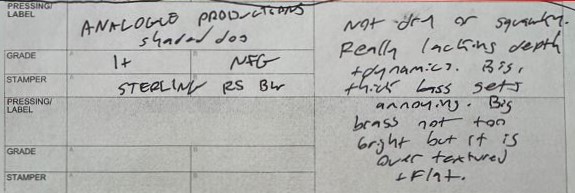
As you can see from our notes for the this Heavy Vinyl Analogue Productions pressing, the thrill was barely there on the first side, and by the second side it was completely gone.

The notes from our 2024 shootout read:

  • Not dry or squawky
  • Really lacking depth and dynamics.
  • Big, thick bass gets annoying.
  • Big brass not too bright but it is over-textured and flat.

Plenty of modern records suffer from these as well as lots of other shortcomings. For some reason, the writers for The Absolute Sound who put this crappy LP on their Super Disc list didn’t seem bothered by them the way we were.

If you own this pressing, here are the kinds of things you might want to listen for in order to recognize its many, and quite serious, failings.

When played head to head against any properly-mastered vintage vinyl LP, this pressing will fall short in a number of important areas. Linked below are titles we’ve found to be good for testing these same qualities in a recording.

(more…)

Azimuth – A Little Can Make a Lot of Difference

Robert Brook runs a blog called The Broken Record, with a subtitle explaining what the aim of his blog is:

A GUIDE FOR THE DEDICATED ANALOG AUDIOPHILE

We know of none better, outside of our own humble attempt to enlighten that portion of the audiophile community who love hearing music reproduced with higher fidelity and are willing to go the extra mile to make that happen.

Here is Robert’s latest posting. He recently spent some time with our favorite recording of the Beethoven First Piano Concerto, and needless to say, he’s glad he did.

AZIMUTH: A LITTLE Can Make A LOT of Difference!

You may enjoy our piece on azimuth and other aspects of turntable setup in this posting from many years ago.

Lately we have been writing quite a bit about how pianos are good for testing your system, room, tweaks, electricity and all the rest, not to mention turntable setup and adjustment.

(more…)

Our Pines of Rome Shootout Was Twenty Years in the Making

Hot Stamper Pressings of Classical and Orchestral Music Available Now

We did a monster shootout for this music in 2021, one we had been planning for more than twenty years. On hand were quite a few copies of the Reiner on RCA; the Ansermet on London; the Maazel on Decca and London (the Decca being on the TAS List), the Kempe on Readers Digest, and quite a few others we felt had at least the potential to sound good.

Allow me to back up a bit, as this story begins in the 70s.

When I first started paying attention to the TAS Super Disc list in the late-70s, I read about the famous Pines of Rome RCA pressing with 1S stampers that was supposedly so dynamic that it needed to be recut with more compression and less bass in order to play on the turntables of the day. I could never find one, and the Shaded Dogs and Red Seals that I did find never sounded all that good to me.

I know now that I did not have the stereo system back then (equipment, room, etc.) that could reproduce a recording of such difficulty.

In the 80s, the Mobile Fidelity pressing of the Pines of Rome came out, and it never sounded right to me either. This was true of all their classical releases, without exception. To me they epitomized the kind of bright, phony, “audiophile” sound commonly found in audio showrooms but rarely if ever heard in concert halls.

The Classic Records release from 1995 of the Reiner Pines was no better. That record was just too harsh sounding, with the shrill strings that Bernie Grundman was cutting on practically every title put out by that awful label.

I fell for some of them — I actually raved about Witches’ Brew on Classic back then, an endorsement that mortifies me to this day — but most of their classical records were junk that I was selling for cheap to the audiophiles who bought into the reviews written about them in the audio mags.

(more…)