Focus-R/P/S

Here you will find rock, pop, soul, etc. albums we think we know well, having cleaned and played them by the score over the course of many decades.

There are currently 160 or so entries, but the number could easily exceed 1000 considering how many records we play every week in our shootouts.

The Last Consistently Good Elvis Costello Album

Some reviewers think that this sprawling album with widely diverse musical styles lacks focus, but that’s precisely what makes it a work of genius.

On Spike, Elvis Costello tries his hand at every style of pop music he can think of and succeeds brilliantly with each and every one of them. This is one of the few compelling albums of the ’80s. I still play mine regularly on CD in the car.

Any King’s Shilling on side two with its authentic Irish instrumentation (fiddle, uilleann pipes, Irish harp, bodhran) has Demo Disc Quality sound of the highest order.

Another song on side two with top audiophile recording quality was Satellite. (For those of you who know Jellyfish, this has to be where they found some of the sound they would put to such good use on Bellybutton and Spilt Milk a few years later.

One side one God’s Comic is Demo Quality — so rich and natural. Where has this kind of sound gone? The way of the Dodo, baby, and it ain’t coming back. Mitchell Froom, the man who gave Crowded House such a polished pop sound, plays some wonderful keyboards here and elsewhere on the album. He’s joined by a slough of notables.

Elvis searched far and wide for this group and managed to find top players for every position on his team. The musicianship is top drawer all the way. Elvis clearly knows talent when he hears it.

(more…)

News of the World Was a Major Discovery We Made in 2007

Hot Stamper Pressings of the Music of Queen Available Now

We discovered a killer copy of News of the World in 2007. Our Hot Stamper review can be seen below.

It was a clearly a breakthrough for us, the kind of record that, out of the blue, revealed to us sound of such high quality that it dramatically changed our appreciation of the recording itself.

We found ourselves asking “Who knew?” Perhaps a better question would have been “How high is up?”

This was Demo Disc quality sound by any measure, especially on big speakers at loud levels.

2007 was the year we made many important breakthroughs. In fact, we made more breakthroughs in that year than in any other in the history of the company, including this singularly important break with the past.

News of the World is one of those records that helped me make real progress in audio.

(more…)

Abandoned Luncheonette – Remembering the Glorious Sound of Tubes

Hot Stamper Pressings of the Music of Hall and Oates Available Now

This record has the sound of TUBES. I’m sure it was recorded with transistors, judging by the fact that it was made after most recording studios had abandoned that “antiquated” technology, but there may be a reason why they were able to achieve such success with the new transistor equipment when, in the decades to come, they would produce nothing but one failure after another.

In other words, I have a theory.

They remember what things sounded like when they had tubes. Modern engineers appear to have forgotten that sound. They seem to have no reference for Tubey Magic. If they use tubes in their mastering chains, they sure don’t sound the way vintage tube-mastered records tend to sound.

Transistor Audio Equipment with Plenty of Tubey Magic

A similar syndrome was then operating with the home audio equipment manufacturers as well. Early transistor gear by the likes of Marantz, McIntosh and Sherwood, just to name three I happen to be familiar with, still retained much of the smooth, rich, natural, sweet, grain-free sound of the better tube equipment of the day.

I once owned a wonderful Sherwood receiver that you would swear had tubes in it. In fact it was simply an unusually well-designed transistor unit. Anyone listening to it would never know that it was solid state. It has none of the “sound” we associate with solid state, thank goodness.

Very low power, 15 watts a channel. No wonder it sounded so good.

Stick with the 4 Digit Originals (SD 7269)

If you’re looking for a big production pop record that jumps out of your speakers, is full of TUBEY MAGIC, and has consistently good music, look no further. Until I picked up one of these nice originals, I had no idea how good this record could sound. For an early ’70s multi-track pop recording, this is about as good as it gets (AGAIG as we like to say). It’s rich, sweet, open, natural, smooth most of the time — in short, it’s got all the stuff we audiophiles LOVE.   

(more…)

Listening for Energy and Rock and Roll Firepower on Bad Company’s Debut

Hot Stamper Pressings of Rock Classics Available Now

The drums on this album are so solid, punchy and present, they put to shame 99% of the rock records on the planet.

As well as having great drums, the overall sound of the best pressings is raw, real and wonderfully unprocessed.

Here you will find none of the glossy artificiality you might hear on many of the rock and pop records we sell.

There’s nothing wrong with that sound, mind you, but this recording captures much more of what the real instruments sound like in the studio.

And, if you’re playing this album good and loud, you’ll feel like you’re in the room with the boys as they kick out the jams. “Ready For Love” sounds great here — shocking clarity, tons of ambience, and silky sweet highs.

This album was one of Ron Nevison‘s early engineering jobs.

The year before (1973) he had been behind the board at Ronnie Lane’s Mobile Studio for Quadrophenia, one of the best sounding Who albums we know of, and a longtime member of our Top 100 (as is this album).

He also knocked it out of the park on Bad Company’s follow-up, 1975’s Straight Shooter.

He worked on the sprawling mess that turned into Physical Graffiti the same year.


Want to find your own killer copy?

Consider taking our moderately helpful advice concerning the pressings that tend to win our shootouts.

(more…)

The Who By Numbers – How Did We Know Side Two Was Slightly Veiled?

Hot Stamper Pressings of the Music of The Who Available Now

Here is how we might typically describe one of our Shootout Winning copies:

Who By Numbers returns to the site for only the second time in over three years, here with KILLER Shootout Winning Triple Plus (A+++) sound or close to it on both sides of this vintage Polydor import pressing – fairly quiet vinyl too.

Glyn Johns‘s magic is on display here, with open mics in a big studio space creating the 3D soundscapes we love.

Features two of their most iconic songs, “Slip Kid” and “Squeezebox,” and both sound incredible on this copy.

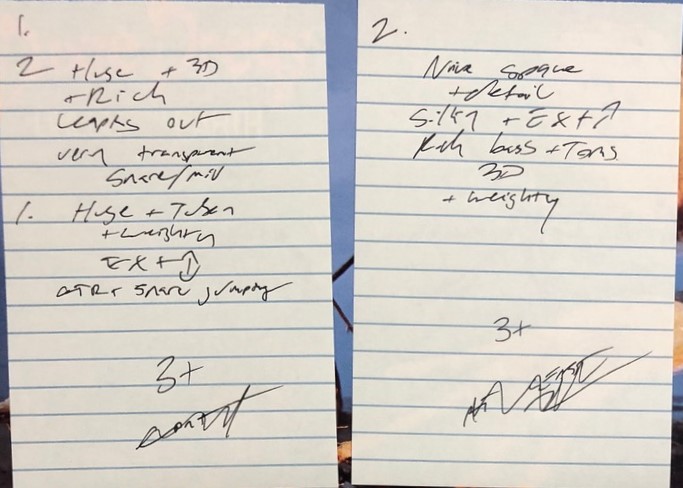
To back it all up, here are the notes for that very copy.

We started playing track three on side one, Squeeze Box, and returned to that track when we had two top copies to play against each other in the final round. Which one won? The one with “the most body and tubes.”

Note that side two of this copy was slightly veiled compared to the side two of the best copy we played, the one that would go on to earn 3+.

We don’t like veiled records — records where there is a curtain, no matter how transparent, in front of the musicians. Heavy Vinyl pressings are typically quite veiled and recessed in the midrange compared to their vintage vinyl counterparts, and that sound is simply not going to cut it with us. (Other folks may prefer a different sound it seems.)

Midrange presence is one of the most important qualities of any rock or pop recording we evaluate. You want Roger Daltry to be front and center, neither recessed nor behind a veil.

(more…)

One of The Most Tubey Magical Rock Recordings of All Time

Hot Stamper Pressings of Psychedelic Rock Recordings Available Now

This is some of the best High-Production-Value rock music of the 70s. The amount of effort that went into the recording of this album is comparable to that expended by the engineers and producers of bands like Supertramp, Yes, Jethro Tull, Ambrosia, Pink Floyd and too many others to list.

It seems that no effort or cost was spared in making the home listening experience as compelling as the recording technology of the day permitted. (Of course, as it turns out, recording technology only got worse as the decade wore on, and during the 80s the sound of most recordings went off the proverbial cliff.)

Big Production British Rock just doesn’t get much better than A Space in Time.

Just listen to the guitar solo on Let The Sky Fall. It comes complete with layer upon layer of guitars, acoustic and electric, with some backwards guitar thrown in for good measure. And that’s just the guitar parts. This kind of dense aural soundscape, presented with so many carefully placed elements from side to side and front to back, makes repeated listenings especially rewarding.

No matter how many times you play the album, you are likely to hear (and hopefully appreciate) something new in the mix. I’ve been playing ASIT for forty fifty years (bought my copy when I was still in high school) and I heard lots of things this time around I never knew were there. This is why we keep improving our systems, right? There is never going to be a time when these nearly forty more than fifty year old recordings have nothing new to offer.

Their Only Essential Album

By the way, this was the first Ten Years After record I bought, and I liked it so much I went out and bought many of their other albums, only to find that none of those albums are anything like this one. None of them sound particularly good; none of them are particularly well produced; and, worst of all, most of the music is fairly forgettable British Blues Rock.


Want to find your own killer copy?

Consider taking our moderately helpful advice concerning the pressings that tend to win our shootouts.

As of 2025, shootouts for this album should be carried out:

How else can you expect to hear this record at its best?

Based on our experience, Bad Company sounds its best:

(more…)

How Good Are the UK Original Unboxed Deccas of Satanic Majesties?

Hot Stamper Pressings of the Music of The Rolling Stones Available Now

How good are the original Unboxed Deccas on Satanic Majesties?

They can be very good.

But they are never as good as the right later pressings with the Decca in a box label, the ones produced from about 1970 on.

The Unboxed Decca pressing earned a Super Hot Stamper grade (A++). The later pressing, with the right stamper, showed us just how good the album can sound.

Since the originals are pricey and hard to find, and, as a rule, noisier than the later pressings, we don’t pick them up unless we find them for cheap, which rarely happens. They have not won any shootouts, and that is very unlikely to change.

There is one set of stampers for this album that always wins, and those stampers are not found on the early label.

(more…)

The Association Greatest Hits – Gold, Green or Palm Tree?

Hot Stamper Pressings of Sixties Pop Recordings Available Now

UPDATE 2025

This commentary was written way back in 2008. It appears to confirm much of the conventional wisdom we criticize when it comes to records and the sonic qualities of their various pressings, but sometimes the conventional wisdom turns out to be right.

Not just sometimes, but most of the time. That’s why rules of thumb seem to work more often than not.

It’s all the times that they don’t work that are the problem, the exceptions to the rule, especially if one of those exceptions just happens to be a favorite album of yours.

Then you’re really up a creek. You followed a general rule that sometimes works and sometimes fails and now you really don’t know of any other way to solve the problem. Fortunately for readers of this blog, we do.

For more on The Association, please click here.


The sound on this record is as good as this album gets. Don’t think you’re too cool to enjoy this 60s pop rock. These songs are still a blast and very enjoyable. The sound on this record is as good as this album gets. 

I did a shootout with this copy and a later pressing just now, after having just listed a Gold Label Original LP of Insight Out, which allowed me to compare the sound of three different generations of Warner Brothers records.

I heard pretty much what you would expect to hear. The best Gold Label pressings have the most sweetness, richness, the best bass (amazingly good for a ’60s pop recording) and the most Tubey Magic.

The Green Label Greatest Hits sounds very sweet and analog, but it’s obviously made from sub-generation copy tapes, as Greatest Hits albums usually are. Still the sound is very smooth and sweet. There is a loss of transparency but the tonality is correct.

The Palm Tree Label pressing, the best sounding one I’ve ever heard by the way, is brighter and more modern sounding. On some tracks that brightness helps cut through the murk, but most of the time it sounds more transistory and less musical.

So this Green Label copy has the best sound for all the hits. If you want better sound, you have to find the right pressings of the individual albums. Since most of those are full of filler, this is actually a pretty good way to go.

(more…)

Which Album by The Who Has the Best Sound?

Hot Stamper Pressings of the Music of The Who Available Now

We think Tommy has the best Who sound.

I don’t know of another Who album with such consistently good sound — song to song, not copy to copy of course. Just about every song on here can sound wonderful on the right UK pressing.

If you’re lucky enough to get hold of a killer copy, you’re going to be blown away by the Tubey Magical guitars, the rock-solid bottom end, the jumpin’-out-of-the-speakers presence and dynamics, and the silky vocals and top end.

Usually the best we can give you for The Who is big and rockin’ (Who’s Next, Live at Leeds), but on Tommy, we can give you 60s analog magic you will rarely find in the decades to follow.

Killer Acoustic Guitars

Acoustic guitar reproduction is key to this recording, and on the best copies the harmonic coherency, the richness, the body and the simply phenomenal amounts of Tubey Magic can be heard in every strum.

What do high grades give you for this album? Silky, sweet vocals; huge weight to the bottom end; “you are there” immediacy; BIG drums, off the charts rock and roll energy, and shocking clarity and transparency.

No other Who album in our experience has all these things in such abundance.

The Tubey Magic Top Ten

You don’t need tube equipment to hear the prodigious amount of Tubey Magic that exists on this recording. For those of you who’ve experienced top quality analog pressings of Meddle or Dark Side of the Moon, or practically any jazz album on Contemporary, whether played through tubes or transistors, that’s the luscious sound of Tubey Magic, and it is all over Tommy.

(more…)

English Settlement – A Sonic Tour de Force

More of the Music of XTC

This is an AMAZINGLY well-recorded album, with huge amounts of open studio space and that Tubey Magical, rich, fat, dense British Rock Sound. That sound isn’t easy to reproduce, but this copy absolutely nails it. Nothing else in our shootout came close to it!

If you have big speakers and the room to play them, this is quite the sonic tour de force. Credit Hugh Padgham, producer and engineer, who’s worked with the likes of Peter Gabriel, Genesis, The Police, Yes and Emerson, Lake and Palmer. Those bands make the kind of music that make good use of Padgham trademark sound: wall-to-wall, deep, layered, smooth, rich and stuffed to the gills. XTC with Padgham’s help have here produced a real steamroller of an album in English Settlement.

The big hit on this album is one that most audiophiles will probably know: Senses Working Overtime. Even over the radio you can hear how dense the production is. Imagine what it sounds like on an original British pressing with Hot Stampers, played on a modern audiophile rig. We can tell you: IT ROCKS. (more…)