*Mistaken Ideas

We used to refer to them as myths but we’ve come to the conclusion that mistaken ideas is more correct.

It’s also a less pejorative way of saying that some things audiophiles believe are lacking in the kind of hard evidence that one would think should be required to defend them.

The fact that good evidence is not required for audiophiles to believe practically anything they think they know about records and audio is one reason we write so much about these subjects on this blog.

Nirvana’s Nevermind – Live and Learn

More on the Subject of Record Collector Thinking

One of our good customers had this to say about some Hot Stampers he purchased recently: 

Hey Tom, 

I have purchased about 85 LPs from you in the past 10 years, many of the various types of hot stampers. I was looking at an 11/18/06 article of yours, which said you would verify if my Nirvana/Nevermind LP “is the good one” if I would send you the runout information of side 2.

Well here it is: A339124425S2 320. Hoping you could help me with this. Thanks!

Kind Regards,

Alex 

Alex,

That is not the pressing we like anymore I’m afraid. That’s the old import pressing we used to like, but now we know that those pressings can be very good but they won’t win a shootout against the right domestic original LP. We have no info about that stamper still around either, sorry!

TP

That’s a drag as this is the exact pressing that I purchased from you on 11/18/06 due to an article where you said the following: “The perfect recording, the best of it’s kind, ever. The bass is perfect, the guitars are perfect. The vocals are perfect. Now how in the world could that be you ask?! This import is the first and only version that sounds the way it should: Perfect”. What is the deal here, have things changed so dramatically since then.. Your comments please.

Regards,

Alex

Alex,

It would be great to always be right about which are the best sounding records, but that is simply not possible. We discover new and better pressings for famous albums all the time, once every month or two on average I would say, which means that since 2006 we have found newer, better pressings than our former reference pressings at least a hundred times.

We write about it here under the heading live and learn.

An excerpt: (more…)

Here Are the Shootout Winning Stampers for SR 90435

Hot Stamper Pressings of Mercury Living Presence Records Available Now

You may have noticed that when we give out the stampers for the top copies, we rarely identify the title of the record with those Shootout Winning stampers.

As you can well imagine, our sizable investments in research and development over the course of decades make up a big part of the costs we must pass on to our customers.

However, in the case of Mercury SR 90435, knowing the Shootout Winning stamper numbers is not going to get you very far (which is of course the only reason we can afford to give out this information).

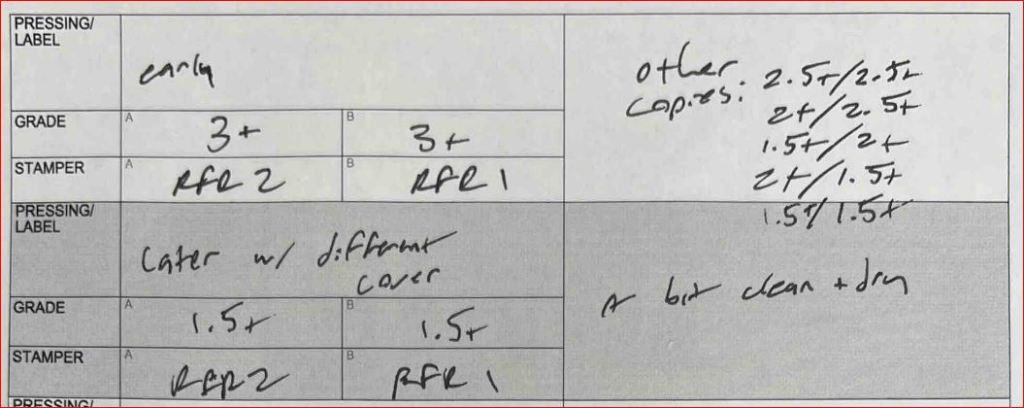
You will actually need a pile of copies with those stampers in order to find one worthy of a 3+ White Hot stamper grade.

Obviously, knowing the “right” stamper information in this case gets you in the ballpark, but it won’t help you hit the grand slam home run you were hoping for. To do that you have to clean and play at least five copies the way we did.

Hot Stamper shootouts may be expensive, they may be a lot of work, but our experience tells us there is simply no other way to find the highest quality pressings. They’re the ones that earn the 3+ grades, not the 1.5+ grades, regardless of their stamper numbers, labels, mastering engineer credits or country of origin.

As we have been saying for more than twenty years, for title after title, when you clean them right and play them right, they might all look the same, but rarely if ever will they sound the same.


Changes for 2024

Beginning in 2024 we decided to make available to our readers a great deal of the pressing information we’ve compiled over the last twenty years, under these headings:

(more…)

Which Art Pepper Today Is Better: Phil DeLancie Digital or George Horn Analog?

Hot Stamper Pressings of the Music of Art Pepper Available Now

UPDATE 2024

This commentary was written in 2010 or thereabouts.

There is new information about the album as of 2024, which can be found here.


We’d wanted to do Art Pepper Today for more than a decade, but the original Galaxy pressings were just too thick and dark to earn anything approaching a top sonic grade. Thirty years ago on a very different system I had one and liked it a lot, but there was no way I could get past the opaque sound I was now hearing on the more than half-dozen originals piled in front of me.

So, almost in desperation we tried an OJC reissue from the ’90s. You know, the ones that all the audiophiles on the web will tell you to steer clear of because it has been mastered by Phil DeLancie and might be sourced from digital tapes.

Or digitally remastered, or somehow was infected with something digital somehow.

Well, immediately the sound opened up dramatically, with presence, space, clarity and top end extension we simply could not hear on the originals. Moreover, the good news was that the richness and solidity of the originals was every bit as good. Some of the originals were less murky and veiled than others, so we culled the worst of them for trade and put the rest into the shootout with all the OJCs we could get our hands on.

Now, it’s indisputable that Phil DeLancie is credited on the jacket, but I see George Horn‘s writing in the dead wax of the actual record, so I really have no way of knowing whether in fact Mr Delancie had anything to do with the copies I was auditioning. They don’t sound digital to me, they’re just like other good George Horn-mastered records I’ve heard from this period.

And of course we here at Better Records never put much stock in what record jackets say; in our experience, the commentary on the jackets rarely has much to do with the sound of the records inside them.

And, one more surprise awaited us as we were plowing through our pile of copies.

When we got to side two we found that the sound of the Galaxy originals was often competitive with the best of the OJCs. Which means that there’s a good probability that some of the original pressings I tossed for having bad sound on side one had very good, perhaps even shootout winning sound, on side two.

This is a lesson I hope to take to heart in the future. I know very well that the sound of side one is independent of side two, but somehow in this case I let my prejudice against the first side color my thinking about the second.

Of all the people who should know better…

(more…)

How Good Are the UK Original Unboxed Deccas of Satanic Majesties?

Hot Stamper Pressings of the Music of The Rolling Stones Available Now

How good are the original Unboxed Deccas on Satanic Majesties?

They can be very good.

But they are never as good as the right later pressings with the Decca in a box label, the ones produced from about 1970 on.

The Unboxed Decca pressing earned a Super Hot Stamper grade (A++). The later pressing, with the right stamper, showed us just how good the album can sound.

Since the originals are pricey and hard to find, and, as a rule, noisier than the later pressings, we don’t pick them up unless we find them for cheap, which rarely happens. They have not won any shootouts, and that is very unlikely to change.

There is one set of stampers for this album that always wins, and those stampers are not found on the early label.

(more…)

The Difficulties of Being a Self-Taught Audiophile

What Kind of Audio Fool Was I?

When I was starting out in this hobby back in the 70s, some of the audiophiles I came in contact with preferred Half-Speed mastered LPs, others liked Japanese pressings, and almost everyone thought direct-to-disc recordings were the ne plus ultra of sound quality.

Now audiophiles appear to prefer SACDs, Heavy Vinyl and pressings mastered at 45 RPM on multi-disc sets. Same mediocre (at best!) wine, different bottle.

It is our opinion that none of these are the answer to finding and acquiring higher quality pressings.

They are relatively cheap and convenient temporary fixes, but as a solution to the actual problem facing the serious audiophile they are little more than stopgaps, and, worse than that, many will retard the progress you are hoping to make in this hobby.

For those of us who never wavered in our commitment to radical and revolutionary progress, they can be recognized in hindsight as the dead end they always were.

The path forward is exactly the path we have taken and charted for everyone.

With our approach to finding the best sounding records, cleaning them the way we do, playing them against each other the way we do, using the sound improving devices and equipment we recommend, we know you can succeed.

If we can do it, you can do it.

(more…)

The Originals Can Be Very Good, But the Right Reissues Never Fail to Beat Them

Hot Stamper Pressings of Blue Note Recordings Available Now

Warning: the record you see pictured is not the record we are discussing in this commentary.

For this mystery title our recent shootout involved two early New York Blue Note pressings.

We don’t need to tell you that those are the ones that take us years to find, and cost us a pretty penny (in audiophile playing condition) when we do find them.

One of them we’ve had on the shelf for years to use as a reference pressing. We knew it could be beaten, that it would never be able to win a shootout, but we also knew it had a lot of the qualities we were looking for on the album.

It sounds right, the way the best Blue Notes from this era usually do, regardless of what you may have read elsewhere.

Our Hot Stamper pressings are guaranteed to soundly beat (ahem) whichever versions of the album have been recommended by any of the self-described audiophile “experts” or your money back.

When those who produce Blue Note reissues and those who review them tell you Rudy did not know how to cut a record that sounds right on good equipment, you can easily prove to yourself how hard of hearing these people must be by simply buying one of our Hot Stamper pressings.

You can send it back — that’s up to you — but at least you will know how full of it these audiophile reviewers must be to write such nonsense. We love Rudy and make no bones about it.

Our notes for both early pressings are shown below.

Top copy:

This New York label pressing is very sweet and open. It lacks some warmth and depth in the midrange.

Lower copy:

This one is very tubey, big and bold, but it gets hot on the horns and needs space.

(more…)

Can the Brightness Problem on the UHQR of Tea for the Tillerman Be Fixed?

Hot Stamper Pressings of the Music of Cat Stevens Available Now

Can adjusting the VTA for the heavier weight vinyl of the UHQR fix its tonality problems?

[This subject also came up in a discussion of the remastered pressings of Scheherzade.]

Probably not. VTA is all about balance.

Adjusting for all the elements in a recording involve tradeoffs. When all the elements sound close to their best, and none of them are “wrong,” the VTA is mostly right.

Try as you might, you cannot fix bad mastering by changing your VTA.

Tea for the Tillerman on UHQR

When I first got into the audiophile record business back in the 80s, I had a customer tell me how much he liked the UHQR of Tea for the Tillerman.

This was a record I was selling sealed for $25. And you could buy as many as you liked at that price!

I was paying $9 for them and could order them by the hundreds if I’d wanted to. Yes, I admit I had no shame.

I replied to this fellow that “the MoFi is awfully bright, don’t you think?” (My old Fulton system may have been darker than ideal, but no serious audio system can play a UHQR as bright as this one without someone noticing the paint has started to peel.)

His reply: “Oh no, you just adjust your VTA until the sound is tonally correct.”

(more…)

Reposted in Honor of Ozzy’s Passing — Import or Domestic on Paranoid?

Hot Stamper Pressings of the Music of Black Sabbath Available Now

The domestic copies we’ve played over the years for all the Black Sabbath titles are clearly better sounding than any import we’ve ever auditioned. It may be counterintuitive, but these are exactly the kinds of things you find out when doing blinded shootouts.

We have little use for intuitions (UK recording, UK pressing) and rules of thumb (original = better sound). We call that way of approaching the search for better sounding pressings mistaken audiophile thinking. 

Hard data — the kind you get from actually playing the records — trumps them all.

(We recently posted a lengthy commentary about conventional wisdom, attempting to make the case that, although the most common record collecting approaches are more often right than wrong, there is simply no way to know when any given approach will work for any given title.)

Want to find your own killer copy?

Consider taking our moderately helpful advice for how to find your own shootout winners.

(more…)

Why are the First Pressings of this Title the Worst Sounding?

Hot Stamper Pressings of Recordings by Decca Available Now

The record you see pictured is not the record we are discussing in this posting. The stamper numbers you see below belong to a different album.

We’ve lately been giving out much more stamper information than we used to, but for now we are keeping this title close to the vest.

We happen to know the best stampers for this album, but somehow a copy with the “bad” stampers ended up in our shootout. It did about as badly as they usually do.

Of course, the person sitting in the listening chair had no idea that a copy with the worst stampers was playing. The jackets and labels of this pressing are identical to the copies with the good stampers.

He simply heard what the recording actually sounds like when it’s mastered badly and registered his complaints.

Side One

  • Dull and crude. Old school.
  • 1+

Side Two

  • So metallic and crude and lo-fi. Nasty!
  • NFG

Apparently Mr. D, real name: Jack Law, did a piss-poor job mastering this album. Another engineer would come along sooner or later and master the record right, so right that it became one of our favorite Demo Discs for sound and performance.

How did this pig’s ear eventually manage to become a silk purse?

Simple. It was always a great recording, it just needed to be mastered right, and whoever got the job to remaster it knocked it out of the park the first time through.

(more…)

Siren on Import Vinyl? Not So Fast

Hot Stamper Pressings of the Music of Roxy Music Available Now

Siren is one of our favorite Roxy albums, right up there with the first album and well ahead of the commercially appealing Avalon.

After reading a rave review in Rolling Stone of the album back in 1975, I took the plunge, bought a copy at my local Tower Records and instantly fell in love with it.

As is my wont, I then proceeded to work my way through their earlier catalog, which was quite an adventure. It takes scores of plays to understand where the band is coming from on the early albums and what it is they’re trying to do. Now I listen to each of the first five releases on a regular basis.

Somehow they never seem to get old, even after more than forty years.

Of all the Roxy albums (with the exception of Avalon) this is probably the best way “in” to the band’s music. The earlier albums are more raucous, the later ones more rhythmically driven — Siren catches them at their peak, with, as other reviewers have noted, all good songs and no bad ones.

Imports? Not So Fast

The British and German copies of Siren are clearly made from dub tapes and sound smeary, small and lifeless.

To be fair, Siren has never impressed us as an exceptionally good sounding recording. Like other middle period Roxy, records such as Country Life and Manifesto (the albums just before and after), it simply does not have Demo Disc analog sound the way Avalon, Stranded or the Self-Titled albums do (the latter two clearly being the best sounding in their catalog).

One would be tempted to assume that the import pressings of Siren would be better sounding, the way the imports of the first four Roxy albums are clearly better sounding. (There has never been a domestic Hot Stamper pressing of any of those titles and, since we never buy them or play them, there probably never will be.)

But in the case of Siren it’s the imports that are made from dubs. It may be a British band, recorded in British studios with a British producer, but the British pressed LPs are clearly made from sub-generation tapes, whereas the domestic copies sound like they’re made from the real masters.

Go Figure. And another thing: when it comes to records, never assume anything.

The typical domestic pressing is flat, bass-shy and opaque, sounding more like compressed cardboard than analog vinyl.

Unsurprisingly, the CD, whether imported or produced domestically, is clean and clear and tonally correct but lacks the warmth and richness of the better vinyl pressings.

(more…)