Stereo History

Starting way back in the dark ages of the early 1970s, a few of the high points as well as the low points of my stereo history are chronicled here.

To get where you are today — assuming your stereo is any good at all — no doubt required that you go through a great many changes, and probably in much the same way I have.

A list of any audiophile’s current equipment tells the lifelong enthusiast very little about the sound of his system.

What changes were made as a result of tweaking and tuning, what records were used in the process, and what effects these changes had on the sound — these are far more important than any tweak, or amp change, or new cartridge, although those can be dramatic too.

Robert Brook has a lot to say about these issues, and you can find his story by searching the site for “Robert Brook.”

For the Best Kinks Sound, Stick with the Tri-Tone Mono Pressings

Hot Stamper Pressings of the Music of The Kinks Available Now

This Pink and Green Reprise original MONO pressing is lively, balanced and vibrant, with a healthy dose of the Tubey Magical richness The Kinks’ recordings need in order to sound the way we want them to, which is less irritatingly bright, thin and harsh.

“Tired of Waiting For You” is the big hit here, and like most Kinks albums from back in the day, they put the hit at the end of the side, so you had better make sure whatever copy you find has not been played much or it will be full of inner groove distortion.

Inner Groove Distortion caused by the non-anti-skate-equipped turntables of the day is a chronic problem with rock and pop records from this era. We check all our records for Inner Groove Damage (IGD) as a matter of course when condition checking the surface quality of the vinyl.

The Poster Boy for Inner Groove Distortion is the song “Thank You” on this album from 1969. That record got played a lot back in the day, on the only turntables that we had available to us at the time, crappy ones.

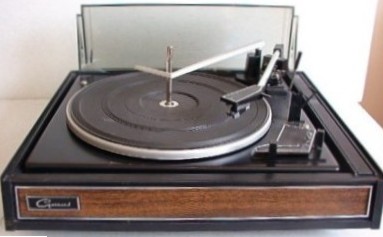
My first “audiophile” table was the extremely plasticky Garrard 40B. I think I bought mine in 1973  and I probably paid about $69 for it. As I recall, this was their entry level model. If any table had been cheaper I would have bought it, which shows you what my starving-college-student budget must have been. Sounded just fine to me, though. What did I know about sound in 1973?

By 1976 I would have some of the best audiophile electronics in the world and the massive speakers you see below. That’s some head-spinning progress if you ask me. Once I had heard how good all my favorite albums were sounding, I got very motivated. This is key: For real progress to occur, the music must do the driving.

(more…)

My Stereo from the 70s and the Audio Cult I Was In

Basic Audio Advice – These Are the Fundamentals of Good Sound

A somewhat strange coincidence occurred not long ago. I found an old commentary describing the speakers I used to own, part of a discussion explaining why I have never wanted to settle for small speakers.

At the same time, I saw that a fellow on Audiogon was selling the electrostatic tweeter array for the very same speaker I owned, the RTR 280DR.

Let me tell you, it really took me back; I haven’t seen a pair in over twenty years. The RTR 280DR you see pictured below plays full range, but there is an optional electrostatic tweeter array that is designed to sit on top of it, which provides a radical improvement in the mids and highs. 

The sound of the 280DR with the electrostatic array was dramatically better than any speaker I had ever heard up to that time.

Here is the story from the old listing talking about the RTRs, sparked by a discussion of Demo Discs.

Fooled Again

I was duped into buying my first real audiophile speaker, Infinity Monitors, when the clever salesman played Sheffield’s S9 through them. I desperately wanted sound that incredibly real in my playback system, and so I agreed to buy them then and there.

It was only later when I got home with them that none of my other records sounded as good, or even good for that matter. That was my first exposure to a Direct to Disc recording. To this day I can still picture the room the Infinity’s were playing in; it really was a watershed moment in my audiophile life.

And of course I couldn’t wait to get rid of them once I’d heard them in my own system with my own records. I quickly traded them in for a pair of RTR 280DR’s. Now that was a great speaker! A 15 panel RTR Electrostatic array for the highs; lots of woofers and mids and even a piezo tweeter for the rest. More than 5 feet tall and well over 100 pounds each, that speaker ROCKED.

(more…)

What Recordings Are Audiophile Writers Reviewing Now I Wonder?

More Pop and Jazz Vocal Albums Available Now

Reviews and Commentaries for Female Vocal Albums

In the early seventies, when I was first becoming seriously interested in audiophile equipment, this was a well-known Demo Disc at some high-end audio salons.

Five years later I would have speakers larger and more expensive in real dollars than the speakers I now own. At a tender age I acquired Stereophile’s cost no object, state-of-the-art speaker system from the mid-’70s, the Fulton J. I was the youngest person ever to own a pair of the behemoths, a record that has never and will never be broken I suspect.

The other monster speaker from that time was the Infinity Servo-Static 1A, which I auditioned before buying the Fultons. During the audition the electrostatic drivers kept blowing if the level got up too high, so that was the end of that. Who wants a speaker that can’t play at realistic sound levels?

Of course, many of you may never have heard of Carmen McRae’s The Great American Songbook album, because the heyday for this record was probably 30-40 years ago, back when the audiophile magazines were actually writing about exceptionally natural, realistic recordings such as this one.

I don’t know what they write about now; I stopped reading them years ago. But I doubt very much that they are still writing about recordings of this quality.

What’s striking about this album is how immediate and unprocessed everything sounds. It really gives you the feeling of being at a live show in a club. It helps that the performance was captured directly onto analog tape with minimal miking. Michael Cuscuna was the remix supervisor, by the way.

(more…)

The Townshend Seismic Isolation Platform Is Key to Better Orchestral Playback

Robert Brook has a blog which he calls

A GUIDE FOR THE DEDICATED ANALOG AUDIOPHILE

Below is a review Robert Brook wrote for one of our favorite tweaks. We have most — but not all — of our equipment sitting on one of these stands. We were big fans of the earlier model all the way back in the early 2000s, the kind that had three air bladders inside for isolation. You had to pump air into with a bicycle pump.

Those Cursed Bladders

The unfortunate aspect of that design was the fact that the amount of air in the bladders had a profound effect on the sound quality of the system. We would pump the thing up, and then listen, and if the sound wasn’t right we would let some air out. We would do this a couple of times, and if the sound refused to get better, we would pump the thing up and start the process all over again.

For every shootout.

The air pressure changed during the day with the heat, and the bladders did not hold air all that well, so you had to do a lot of pumping and air releasing if you wanted to get the best sound.

Crazy, huh? And that’s in combination with all the VTA adjustments that were needed for each title.

(more…)

The ARC SP3A-1 Tube Preamp – A Giant Leap Forward for Me, Circa 1975

Our Playback System (and Why You Shouldn’t Care)

Here’s a stereo blast from the past.

In the commentary below I talk about buying the Audio Research SP3A-1 tube preamp (with built-in phono stage, as was the rule in those days) and what a difference it made in the ability of my system to reproduce music at a much higher level.

Naturally, my ability to enjoy music increased dramatically as well.

I was running Crown gear at the time, the DC-300 amp and the IC-150 preamp, so you can imagine that this tube preamp was a real game changer for me.

We talk a lot about Tubey Magic on the site and on this blog. This preamp is the very definition of that sound.

You could call my old Crown system BTM (Before Tubey Magic) and my new Audio Research-based system WTM (With Tubey Magic), if you wanted to be cute about it.

The improvement in the sound was far greater than anything I could have imagined.

Now we provide the same effect to the audiophiles of the world through our Hot Stamper pressings. Better sound than you can imagine. It’s practically our credo.

(more…)

You Too Can Get an Old Buffalo Springfield Record to Sound This Good

More of the Music of Buffalo Springfield

This commentary is from 2005 or thereabouts.

Not long ago we found a White Hot Stamper pressing of Last Time Around that really blew our minds. We were surprised to hear some of the breathiest, silkiest vocals we’ve ever heard on ANY Buffalo Springfield album, with startling presence and immediacy to boot! Side two had BY FAR the most energy and life of any side of any copy we’ve ever played. Man, does it ROCK.

Even as recently as 2010 we would not have expected to find that kind of sound on a vintage ’60s pop/rock album. We know better now.

When you get hold of the right copy and know how to clean it and play it right, these vintage pressings (well, the White Hot ones anyway) are a damn sight better than the vast majority of audiophiles think they are. How is such apparently never-before-possible sound being heard now, 45 years after the record came out? Our answer can be found below. 

The kind of MIDRANGE MAGIC found on this pressing let us hear into the music in a way we (and you too I’m guessing) never imagined was possible.

Most copies have no bass, no real top, and are compressed so badly they sound more like cardboard than vinyl. But not this copy — it breaks the mold, revealing to the world (well, our world anyway, the world at Better Records) that those badly recorded Buffalo Springfield records from the ’60s weren’t so badly recorded after all. (more…)

Sometimes the Most Fundamental Questions in Audio Are Simply Overlooked

Hot Stamper Pressings that Sound Their Best on Big Speakers at Loud Levels

This post was written circa 2005.

This commentary is about two things — knowing the kind of music you like, and getting the kind of sound you want.

If you believe what you read on the various sites where audiophiles freely dispense advice about everything under the sun regarding music, recordings and equipment, you are asking for trouble and you are surely going to get it.

You will encounter an endless supply of half-truths, untruths and just plain nonsense, more often than not defended tooth and nail by those with impressive typing skills but not much enthusiasm for the tedium of tweaking and critical listening

big_speakersWhat kind of equipment are these people using?

How deep is their experience in audio?

Truth be told, I was pretty misguided myself during the first ten (or twenty, gulp) years I spent in audio, reading the magazines, (I still have my Stereophiles and Absolute Sounds from the 70s in boxes in the garage), traipsing from stereo store to stereo store, trying to figure out what constituted Good Sound so that I could manage to get my own equipment to produce something closer to the best of what I was hearing.

Questions

I sympathize with those who have trouble making sense of this hobby. It can be very confusing, especially to the neophyte. It takes a long time (with plenty of effort and money expended along the way) to be able to answer some of the most fundamental (and most often overlooked) questions in audio:

1.) What kind of music do you like?

2.) What aspects of sound quality are the most important to you?

Armed with answers to the above two, the next question to be asked is:

3.) What equipment will best be able to give you the sound you want on the music you like, within the limits of your budget, room, WFA (Wife Acceptance Factor), etc.

If you haven’t been doing this audio stuff for at least ten years, you probably don’t know the answers to those last two questions. In other words, you still have a lot to learn.

I may not have all the answers, but after being in audio for more than thirty years [now close to 50], about half of that full-time (full-time being sixty to seventy-plus hours a week), I can say without embarrassment that I have some of them.

And for the most part I got them the old-fashioned way: I earned them.

Do You Like Rock Music?

Then make sure you buy speakers that can play rock music.

Don’t buy screens, panels or little boxes. With subs or without, don’t buy them.

(more…)