Label Advice

Some of the titles listed here have better sound on labels that many record collectors would probably not assume would be the best.

Other titles have inferior sound based on the labels we’ve identified in these listings.

Keep in mind that all the practical advice you see here is based solely on the numerous experiments we’ve run and the data we’ve collected from them.

On Heroes, It Took Us Ages to Break the Sound Barrier

Hot Stamper Pressings of the Music of David Bowie Available Now

Because the conventional wisdom turned out to be so wrong.

Our intuition that the British originals of Heroes would sound the best was incorrect.

The experiments we carried out falsified that prediction.

In our world, intuitions have a bad track record, but more than a few audiophiles — many of whom are addicted to sharing their “record knowledge” on audiophile forums and youtube channels — seem unaware of the shortcomings of this approach.

Taking a page from one of the greatest minds of the 20th century, we’ve opted to use a more scientific approach in order to discover the record pressings that have by far the best soundi, and we encourage you to do likewise. 

We pioneered the evidence-based approach to finding the best sounding pressings, and, like all good scientists, we shared it with everyone. Some in the audiophile community have taken it to heart, but most have chosen to put their faith in reviewers, forum posters, common sense and logic.

None of these produce consistently good results, but those who use these methods are loathe to question them and only rarely if ever learn the error of their ways.

Once a decision has been made and a specific pressing acquired — you could call it door number three I suppose — cognitive dissonance and confirmation bias immediately kick in to justify the result, and soon enough the game is over. The prize has been won. It’s as good as it gets. Whatever faults it may have must lie in the recording, not the pressing.

(more…)

These Are the Shaded Dog Stampers to Avoid on LSC 2581

Hot Stamper Pressings of Living Stereo Titles Available Now

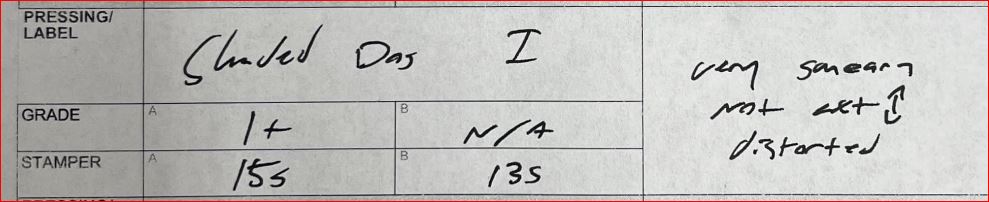
Even though they had the Shaded Dog label, some of the later stampers for this record were not very good sounding compared to the ones that won our shootouts.

15s on side one earned a grade that would prevent it from being sold as a Hot Stamper pressing. There was no reason to play side two (13s) since side one eliminated this copy from the competition.

The 1+ grade found on this side one means it’s simply not very good, Shaded Dog label or no Shaded Dog label.

Pressings with these stampers might be passable, even to some degree enjoyable, especially when played on an old school system, but they would not be worth bothering with on the high quality modern equipment we use.

In this case, the conventional wisdom that the original pressings will most likely have superior sound to the later-numbered copies turns out to be right.

(more…)

On This Rachmaninoff Title, the Right Reissues Clearly Have the Best Sound

More of the music of Sergei Rachmaninoff (1873-1943)

Until we heard the right later pressings, we had always been disappointed with this TAS List recording, wondering what all the fuss was about. The original Shaded Dog pressings we had played left a lot to be desired. Like many of the old records we audition, it badly lacked both highs and lows, our definition of boxy sound.

Well, now we know.

The earliest Shaded Dog pressings have consistently worse sound than the reissues we offer.

We never offered the record in Hot Stamper form because we didn’t think the sound of the originals was all that impressive, TAS List or no TAS List.

Mystery solved, and truly Hot Stampers have now been made available to the discriminating audiophile.

Harry’s list, as was so often the case, did not provide the information needed to find the pressing that captured all the qualities of the recording the way this one does.

Did Harry have a good later pressing?

Did he have an original and simply liked it more than we did?

Who knows? Like so much in the world of records, it’s a mystery.

(more…)

A Truly Awesome Feat of Engineering by Rhett Davies

Hot Stamper Pressings of the Music of Phil Manzanera Available Now

You may recall reading this bit about Rhett Davies‘ superb engineering on Dire Straits’ debut:

“…until something better comes along, this is his Masterpiece.

It has to be one of the best sounding rock records ever made, with Tubey Magical mids, prodigious bass, transparency and freedom from hi-fi-ishness and distortion like few rock recordings you have ever heard.”

Well, something better has now come along, and it’s called Diamond Head.

It has some of the biggest, boldest sound we have ever heard. Diamond Head isn’t known as an audiophile album but it should be — the sound is glorious — wall to wall, floor to ceiling, and as rich and dynamic as it gets.

It’s clearly a big speaker Demo Disc. Play this one as loud as you can. The louder you play it, the better it sounds.

The best copies have room shaking deep bass with the kind of whomp that can drive this music to practically unexplored heights.

(more…)

How Do the Original UK Decca Between The Buttons LPs Sound?

Hot Stamper Pressings of the Music of The Rolling Stones Available Now

The only version of this album that we offer has the British track listing, so don’t pick this one up if you’re looking for great sounding versions of Let’s Spend The Night Together or Ruby Tuesday.

A bummer, but the domestic copies sound awful, so what can you do?

Also, the early UK Decca label pressings have never impressed us.

Congested and compressed, with no real top, who in his right mind could possibly tolerate that kind of sound nowadays?

The early Deccas might be passable on the old school audio systems of the 60s and 70s, but they are much too unpleasant to be played on the high quality modern equipment we use.


Want to find your own top quality copy?

Consider taking our moderately helpful advice concerning the pressings that tend to win our shootouts.

(more…)

Suites for Solo Cello on the Later Label – Ouch!

Hot Stamper Pressings of Mercury Recordings Available Now

UPDATE 2021

The discussion here is for a Oval label copy of Suites for Solo Cello (SR 90370) we reviewed in 2010. These days the Oval label pressings from the early 60s almost never sound very good to us. We no longer buy them and we certainly don’t bother to put them in shootouts.

This record on the Oval Label would be very unlikely to qualify as a Hot Stamper pressing anymore, although we liked it just fine in 2010, as you can see from our old review.

In 2024 we actually put an Oval Label pressing of SR 90370 in a shootout and it did about as poorly as we would have expected. What a waste of time and money. Never again.

(more…)

Black, Green, Yellow, Orange – Which Contemporary Label Has the Best Sound?

Hot Stamper Pressings of Contemporary Jazz Albums Available Now

UPDATE 2026

We’ve learned a lot about this amazing sounding record over the last twenty years. Check out the latest updates.


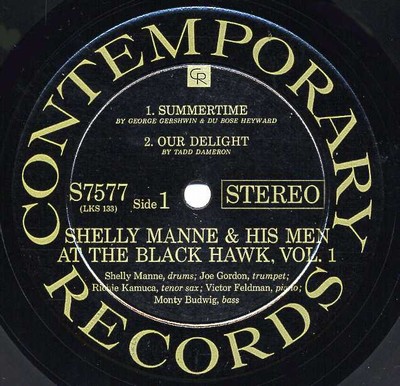
Our Hot Stamper commentary from a long-ago shootout we’d done for the wonderful Helen Humes album Songs I Like to Sing discusses the sonic characteristics we find most commonly associated with the various Contemporary labels.

This Contemporary Black Label Original LP has that classic tube-mastered sound — warmer, smoother, and sweeter than the later pressings, with more breath of life. Overall the sound is well-balanced and tonally correct from top to bottom, which is rare for a black label Contemporary, as they are usually dull and bass-heavy.

We won’t buy them locally anymore unless they can be returned. I’ve got a box full of Contemporarys with bloated bass and no top end that I don’t know what to do with.


UPDATE 2020

This commentary was written a long time ago. There are no boxes full of Contemporary records laying around in the back room. The ones that don’t sound good were sold off years ago.


Like most mediocre-to-bad sounding records we’ve auditioned, they just sit in a box taking up space. All of our time and effort goes into putting good pressings on the site and in the mailings. It’s hard to get motivated to do anything with the leftovers. We paid plenty for them, so we don’t want to give them away, but they don’t sound good, so most of our customers won’t buy them.

(more…)

In the Court of the Crimson King – An Overview

Hot Stamper Pressings of Progressive Rock Albums Available Now

If you have the Atlantic pressing, from any era, you have not yet begun to hear this record at its best. The better sounding domestic originals we’ve played are clearly mastered from copy tapes, which results in dubby sound.

In the Court of the Crimson King is such a well recorded album that even the sound quality derived from second-generation tapes is still better than most of what came out in 1969.

(By the way, 1969 was a phenomenal year for audiophile quality recordings – as of 2026 we’ve auditioned and reviewed more than one hundred and twenty titles, and there are undoubtedly a great many more that we’ve yet to play. To make it easier for audiophiles to separate the wheat from the chaff, we’ve also identified more than 25 Rock and Pop albums essential to any audiophile record collection worthy of the name.)

Now on to brass tacks.

UK Polydor Label

Passable, not really worth the labor to put them in a shootout just to have them earn sub-Hot Stamper grades. A1/B5 is a common stamper for these pressings and with those stampes the Polydor is not worth the vinyl it’s pressed on.

Pink Label Island

The same can be said for some of the earliest UK Pink Label Island pressings. None of them has ever won a shootout and probably none of them ever will. (A number of Pink Label Island pressings that never win shootouts can be found here.)

The conventional wisdom which holds that original pressings are superior to reissues in this case turns out to be flat wrong.

The Pink Label pressings can be good, but we rarely buy them, our two best reasons being:

(more…)

Rossini Overtures – Reissues Versus Originals

Hot Stamper Pressings on Decca & London Available Now

The London and Decca original pressings of Decca’s recordings are the best sounding, right?

Sometimes they are, sometimes they aren’t.

We were a bit surprised that some of the (expensive) originals didn’t sound very good to us in recent shootouts.

Bad vinyl, bad mastering, who knows why so many early copies suffer from thick, dull and veiled sound? 

The Stereo Treasury pressing of Maag’s 1958 recording you see here is shockingly good in many ways. It sure doesn’t sound like a budget reissue.

If anything it sounds more original than the originals we played against it!

It’s yet another remarkable disc from the Golden Age of Vacuum Tube Recording Technology, with the benefit of mastering by means of the modern cutting equipment of the mid- to late- ’60s. (We are of course here referring to the good modern mastering of many years ago, not the bad modern mastering of today.)

The combination of old and new works wonders on this title, as you will surely hear for yourself on both of these Super Hot or better sides.

(more…)

An Overview of Beatles Oldies But Goldies

Hot Stamper Pressings of the Music of The Beatles Available Now

This is a Beatles album we think we know well.

We’ve done a number of shootouts for A Collection of Beatles Oldies over the last ten years or so, and our experimental approach using many dozens of copies provides us with strong evidence to support the following conclusions regarding the sound of the originals vis-a-vis the reissues:

  1. The best of the early pressings always win our shootouts. No reissue has ever earned our top grade of A+++ and it is unlikely any reissue ever will.
  2. The reissues can be quite good however. The best of them have earned grades of Double Plus (A++).
  3. The worst of the early pressings also earned grades of Double Plus (A++).
  4. Conclusion: if you have a bad original and a good reissue, you might be fooled into thinking the sound quality was comparable.

(more…)