Table and Cartridge Setup

Advice for tuning and tweaking your table, arm and cartridge.

Let’s Face It – Some Truly Great Records Are Almost Always Noisy

Hot Stamper Pressings of the Music of Paul McCartney Available Now

Some records are consistently too noisy to keep in stock no matter how good they sound. McCartney’s first album is one of them.

Copies of McCartney’s first can rarely be found on the site, but when there are any copies available, they are most likely to be found in our section for records with condition issues. Here you will find about about 30% of all the Hot Stamper pressings active on the site at any one time.

Hot Stampers are almost exclusively vintage vinyl pressings — “old records” you might say — and old records, even after a good cleaning, are rarely quiet. (We lay out the particulars of our grading system here.)

One of our customers noted that the Hot Stamper we sent him of McCartney’s first album was a bit noisier than he would have liked. We replied:

As for surface issues, we wish we could find them quiet, but that is simply not an option, especially considering how dynamic the recording is. In the listing we noted:

(more…)

Is Your Suspension Sagging?

Basic Audio Advice — These Are the Fundamentals of Good Sound

I wrote a long commentary in 2010 criticizing the advice Mapleshade was giving out regarding cartridge and tonearm adjustments, some of which I agreed with and much of which I did not. You can read all about it here.

However, this excerpt from that commentary will focus on Revolver, to the relief of all who read this blog I suspect. Enough with bashing Mapleshade!

I noted back then that Mapleshade gives out some good advice, but it’s mixed in with a lot of audiophile nonsense. The audio world was drowning in absurdities long before I got into the hobby in the early-70s, and let me be the first to admit that I have fallen for more than my share of bad audio ideas over the years. (That’s partly because I have been doing it for so long, if you will forgive me for using that as an excuse. It’s really the only one I have.)

If you want to get closer to the reality of how audio actually works, watching videos won’t get you there.

Neither will reading blogs.

The audiophile who wants to improve his playback quality has only one option, and that is to get his hands dirty, because doing audio is the only way to achieve meaningful results.

Everyone gives out plenty of advice, including us. Testing that advice and putting what you learn from it into practice is what separates the men from the boys, or the better stereos from the other ones in this case (regardless of price).

Here is the complete quote from Mapleshade:

To get first rate sound and to get your money’s worth from any expensive cartridge, you MUST meticulously adjust VTA or tracking force every 3-4 months — that’s because stylus suspensions always sag with use. This lowers VTA and seriously kills dynamics and treble sparkle. Lots of people misinterpret this as a worn-out cartridge, an expensive error. Instead, raise VTA or lighten tracking force until your test record’s treble sounds too harsh, then drop VTA or lighten tracking force a hair. Your test record must not be thicker or thinner than the bulk of your record collection. Adjusting tracking force yields slightly better sonic results and longer cartridge life than adjusting VTA — and adjusting tracking force on most arms is WAY easier than adjusting VTA.

The basic idea here is that your cartridge sags over time, causing the VTA (Vertical Tracking Angle) to change, which results in less dynamics and “treble sparkle.”

So, with this idea in mind, after doing a serious shootout with Revolver in 2010 and hearing a Triple Plus side one with amazing bass and energy, we decided to reduce the tracking weight on our Triplanar arm a tiny, tiny, practically non-existent amount, something in the range of 1/100th of a gram perhaps. 

(more…)

The Ideal Turntable Setup Disc

More Hot Stamper Pressings Featuring the Violin

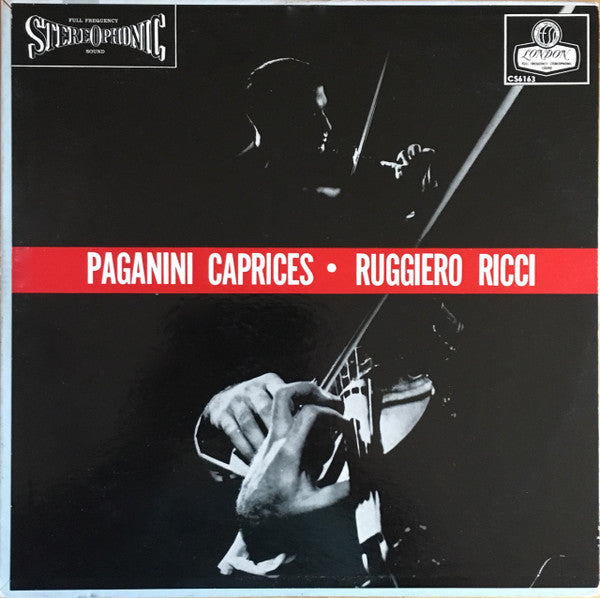
We’ve wanted to have Hot Stamper pressings of this album of Paganini’s Caprices (CS-6163) to offer our customers for years, not for the music per se, but to use as a handy test disc for those who are interested in setting up and dialing in their front ends better.

After all, these are only practice pieces. If you want real music written for the violin, we have plenty of albums to choose from that would be much more enjoyable.

If you like the sound of solo violin — and who doesn’t? — you will have a hard time finding a better sounding recording of it than this. That’s assuming you can set your Vertical Tracking Angle (VTA) correctly, not something every audiophile can manage. If you can, look out — you are in for a sonic treat.

Solo violins in live performance are clear, clean and present. You have no trouble at all “seeing” them clearly.

Our vintage Hot Stamper pressings will always have that kind of clear and present sound for the violin. If they didn’t, they would not qualify as Hot Stamper pressings.

Setup Advice

This is truly the perfect turntable setup disc; when your VTA, azimuth, tracking weight and anti-skate are correct, this is the record that will make it clear to you that all your efforts have paid off.

What to listen for you ask?

(more…)

Mozart – VTA and Balance

What to listen for ask?

Dry sound.

Some of the copies lacked the richness to balance out the clarity and were dry sounding. There is a balance to be found.

The right VTA will be critical in this regard.

When you have all the space; the clearest, most extended harmonics; AND good weight and richness in the lower registers of the cello, you are where you need to be (keeping in mind that it can always get better if you have the patience and motivation to tweak further).

For more advice on setting your VTA properly, please click here.

On the other side of that coin is smear, usually from too much tubey richness. Again, finding the balance is key.

Here are some other records that are good for testing string tone and texture.

(more…)

Mozart’s Quintet / Trio Is a Great VTA Test Disc

Hot Stamper Pressings of the Music of Mozart Available Now

CS 6109 is a handy record for VTA adjustment.

Listen for fullness and solidity, especially in the piano, although a rich, full sounding clarinet is a joy here as well. 

Some of the copies we played in our shootout lacked the weight and solidity to balance out the qualities of transparency and clarity.

The resulting sound is less natural, with the kind of forced detail that CDs do so well, and live music never does. There is a balance to be found.

The right VTA will be critical in this regard. When you have all the space; the clearest, most extended harmonics; AND good weight and richness in the lower registers of the piano, you are where you need to be (keeping in mind that it can always get better if you have the patience and drive to tweak further).

(more…)

Turntable Setup Guide Part 2: Dialing In Tracking Force By Ear

Robert Brook runs a blog called The Broken Record, with a subtitle explaining that the aim of his blog is to serve as:

A GUIDE FOR THE DEDICATED ANALOG AUDIOPHILE

We know of none better, outside of our own humble attempt to enlighten that portion of the audiophile community who love hearing music reproduced with the highest fidelity and are willing to go the extra mile to make that happen.
Below you will find a link to an article about turntable setup. I would have loved to write something along these lines myself, but never found the time to do it. Robert Brook took the job upon himself and has explained many aspects of it well, so if you would like to learn more about turntable setup, I encourage you to visit his blog and read more about it.

I do have some ideas of my own which I hope to be able to write about soon, but for now, check out what Robert has to say.

Turntable Setup Part 2: What To Do For EXCELLENT SOUND

Sibilance Can Be a Bitch (and a Good Test for Table Setup Too)

On side two the tonal balance is key. If there is any boost to the top end, the vocals on track two will SPIT LIKE CRAZY.

This is also a good test for how well your cartridge and arm are doing their jobs. Sibilance is a bitch. The best pressings, with the most extension up top and the least amount of aggressive grit and grain mixed into the sound, played using the best front ends, will keep it to a minimum. VTA, tracking weight, azimuth and anti-skate adjustments are critical to reducing the spit in your records.

We discuss the sibilance problems of MoFi records all over the site. Have you ever read Word One about this problem elsewhere? Of course not. Audiophiles and audiophile reviewers just seem to put up with these problems, or ignore them, or — even worse — simply fail to recognize them at all.

Play around with your table setup for a few hours and you will no doubt be able to reduce the sibilance problems on your favorite test and demo discs. All your other records will thank you for it too. 

This record, along with the others linked below, is good for testing the following qualities.

  1. Grit and grain
  2. Sibilance (it’s a bitch) 

Playing so many records day in and day out means that we wear out our Dynavector 17DX cartridges often, about every three to four months.

Which requires us to regularly mount a new cartridge in our Triplanar.

Once broken in (50 hours min.), we then proceed to the fine setup work required to get it to sound its best, adjusting the VTA, azimuth and tracking weight for maximum fidelity.

(more…)

Record Cleaning and Hearing the Gap

Robert Brook runs a blog called The Broken Record, with a subtitle explaining that the aim of his blog is to serve as:

A GUIDE FOR THE DEDICATED ANALOG AUDIOPHILE

Here is Robert’s latest posting.

What I’ve Learned About Record Cleaning

Robert gets right to the point here:

I’d say that the biggest misconception that I held about record cleaning previously was that it would not improve the bass. My thinking was that better cleaning would reveal more at the top end and upper midrange, but whatever bass was cut into the grooves was either there or it wasn’t, and cleaning those grooves better wasn’t going to bring it out.

This turned out to be completely wrong. Better cleaning makes it easier for our system to reveal what’s on our records, and this helps us hear more of what sits at the very back of the soundstage. These elements of the recording that reside further from our ears rely on an appropriate amount of bass to give them their correct size and weight. So when a record has more bass, it often has a bigger soundstage, and the performers will tend to sound more fleshed-out and have greater presence.

Robert gets his table and arm dialed in, then realizes:

I thought for a long while that the multi-step cleaning method I had developed using Walker Audio fluids was getting my records as clean as Better Records gets theirs. I had bought or borrowed quite a few Nearly White Hot and White Hot Stampers over the years, and then found and cleaned similar copies that, in several cases, equaled or even bettered the Hot Stampers. Or at least I thought they had.

With a new cartridge installed, Robert has an unexpected insight:

Finally I’d reached the full potential of my front end, and what was my reward? I could now hear that the records I’d cleaned with my method did not in fact sound as good as the ones the folks at Better Records had cleaned. I was forced to determine that the Hot Stampers had a level of transparency, top to bottom end extension and overall integration and cohesiveness that my other records lacked.

The differences Robert hears are not a mystery. They are the result of the way Robert cleans records and the number of copies he goes through to find “the one.”

Part of what makes our records sound better than the copies others own with the exact same stampers — when they do sound better, something that may not always be the case — is that even with the right machines and fluids and our step by step instructions, there is more to it than that.

There are some approaches to record cleaning that we use which we have never revealed to the public. We need our records to be a cut above, and the cleaning secrets we keep to ourselves make that not just a possibility, but a near certainty.

Robert points out that it took a lot of work to get to the point where it was no longer possible to ignore this reality. He asks how many other audiophiles have worked as hard and advanced as far. Would others be able to tell that the gap was real, that the difference between their best copy of a record and the one we sold them would be more than audible — that it would in fact be significant.

Not many is our answer, and it’s partly because of some other factually true aspects of record production, the kind that we take great pains to explain and then support with scientific evidence.

We may not know why records sound so different, but we are in a very good position to know that they clearly do.

(more…)

Robert Brook Says: No Azimuth? No Problem!

Robert Brook runs a blog called The Broken Record, with a subtitle explaining that the aim of his blog is to serve as:

A GUIDE FOR THE DEDICATED ANALOG AUDIOPHILE

We know of none better, outside of our own humble attempt to enlighten that portion of the audiophile community who love hearing music reproduced with the highest fidelity and are willing to go the extra mile to make that happen.

Here is Robert’s latest posting.

No Azimuth? No Problem!

After making some adjustments to the arm, getting it in the ballpark, Robert writes:

I changed records to a Jascha Heifetz violin concerto that I like to use for tonearm settings. As I’ve mentioned in an earlier article, I particularly like using concertos for adjusting tonearms because of the challenge of getting both the soloist and the orchestra to sound their best. When the azimuth is just right, the soloist will sound full and present, while the orchestra behind them will be clear and distinct.

A few more tweaks and it was sounding right. Robert continues:

Now it was my friend’s turn to play some of his records, most of which I’d heard before adding the shim. On “Mediocre Bad Guys,” Jack Johnson’s voice now sounded more natural, and the thwack of the drum stick had lost its annoying glare. Zeppelin’s “D’yer Mak’er” was now rocking the way it should with the drum kit sounding appropriately huge and the cymbals showing plenty of top end sparkle and with a long decay. And on Eagles “Take It Easy” I could now better make out the many instruments in the mix, as well as the backing vocals, which I’d been struggling to hear clearly before.

Here’s the first question that comes to mind: Could this tonearm/cartridge tweaking and testing have been done using these other albums instead of the violin concerto recording?

Possibly, but it would have taken all day, because nobody really knows exactly how these records actually sound. Were they good recordings? No doubt, at least in some ways. But were these good pressings of those recordings? Who can say? And we have no business assuming.

Houses of the Holy sounds very different from copy to copy to us. We’ve easily played more than fifty of them, maybe closer to a hundred, and we’ve heard them sound every which way.

(more…)

Letter of the Week – John Wesley Harding Has Playback Issues

Hot Stamper Pressings of the Music of Bob Dylan Available Now

UPDATED 2026

In reply to the letter below, I say only about one out of every five hundred records we’ve sold has ever been returned to us more than once.

I gave this more thought and I honestly cannot remember any record coming back more than once for substandard sound quality other than this very album. It was returned twice, and both times,after we played it again, it sounded fine to us.

Once a record has been returned, we tag it as a returned record so that if it ever does come back again, we know to check it extra carefully upon its return. We’ve been following this procedure for a while now, and, at least to my knowledge, no record has come back twice.


Our Older Commentary

One of our good customers had this to say about a Hot Stamper pressing of John Wesley Harding he purchased a while back:

Hey Tom,   

So many great records in this batch, but some solid misses too — details coming. John Wesley Harding for example sounds great but has some serious distortion through much of side two; a bit ’too vintage’, in spite of the sound it seems once to have had.

Dear Sir,

Definitely check your front end setup on this one, there is no actual distortion on the record, just sound that may be hard to reproduce.

My advice would be to make sure you have replaced your cartridge recently.

Carts that get old have a problem with records like these. We know, we replace our cartridge every three months when hard-to-play records start to sound strained or congested and gritty.

The sheen of massed strings, a sound critical to the orchestral recordings we play, are impossible to reproduce correctly with an older-than-it-should-be unit. A fresh cartridge can make all the difference in the sound of  difficult to reproduce records.

Keeping a cartridge installed for too long is a mistake made by 100% of the audiophiles I have ever known.

The other explanation could be that our microfine tip is playing deeper in the groove and missing whatever damage is encoded above it, damage which may have been caused by the older cartridges of the day that were used to play the record by the previous owner or owners. We can’t say it doesn’t happen.

We can say that if you bring this record back, the next person to buy it has a roughly 98% chance of keeping it. Maybe one out of five hundred or so ever come back a second time. At least that’s how it has worked out over the last twenty-five years.

(more…)