*Mastering Issues

Anatomy of a Failed Shootout

Hot Stamper Pressings of the Music of Beethoven Available Now

By the early 2000s we had finally come to the conclusion that the RCA pressings of the Beethoven 7th offered the best combination of sound and performance we could find.

By 2024 we had enough copies — seven in total — to do a shootout. The best copy we were able to salvage from this debacle is described, perhaps too generously, below.

This Decca-recorded, Shaded Dog pressing of Beethoven’s Symphony No. 7 debuts on the site with big, spacious, and lively Double Plus (A++) Living Stereo sound or close to it.

Side one is doing just about everything right – it’s rich, clear, undistorted, open, and has depth and transparency to rival the best recordings you may have heard, and side two is not far behind in all those areas.

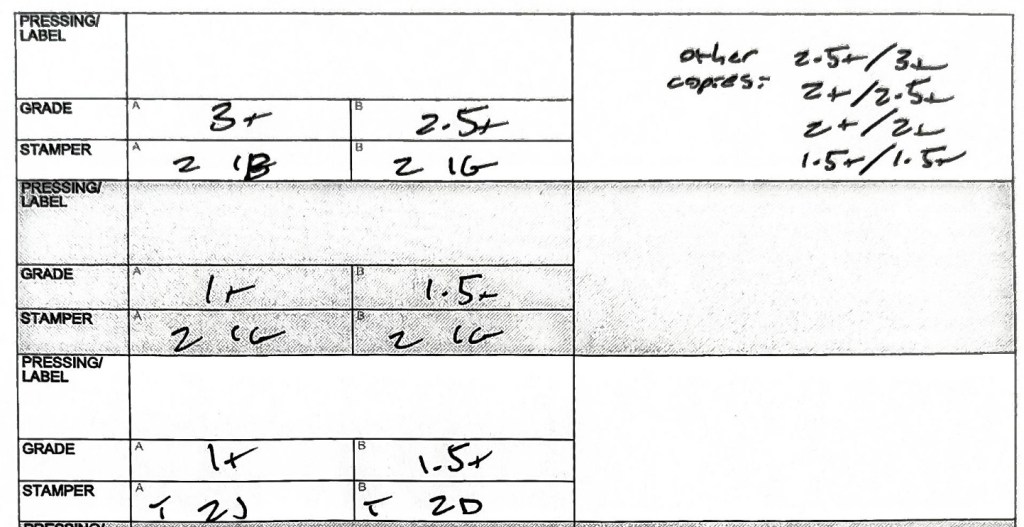
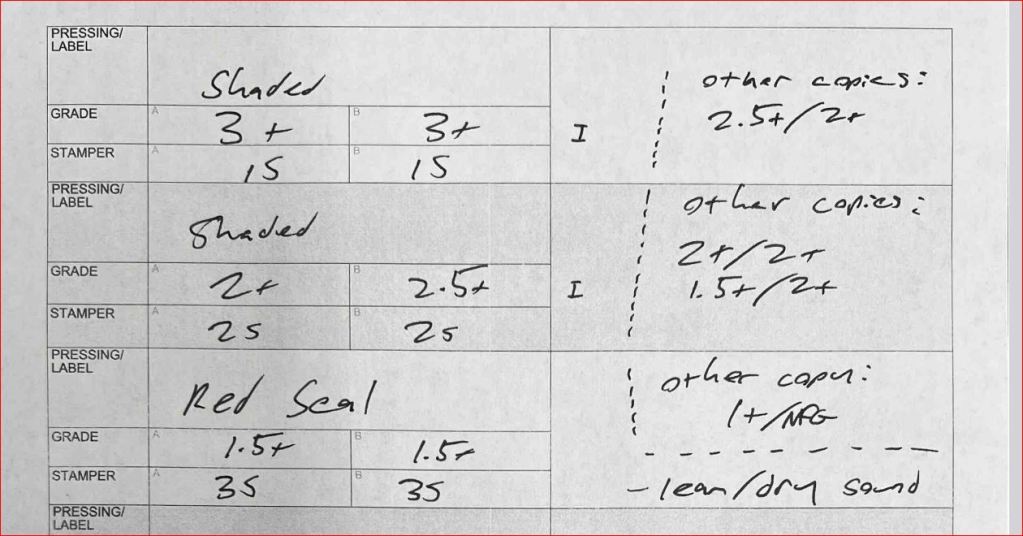
The full stamper sheet shown below makes clear what happens when your luck just plain runs out. The Soria pressings were by far the best — they were the only ones to earn 3+ on either side — but side two of all three copies we played was defective, rendering them all but worthless.

When RCA recut the record for their regularly priced Living Stereo release, LSC-2536, the dropoff in sound quality was profound, a fact readily seen from our notes. (“Rich but bright, side two is worse.”)

(more…)

Some OJC Pressings of Waltz for Debby Can Be Pretty Good

Hot Stamper Pressings of the Music of Bill Evans Available Now

During our most recent shootout for Waltz for Debby, we took the opportunity to play the early OJC that first came out in the 80s. We found the OJC pressings with the stampers identified below had good, not great sound.

I remember playing the Analogue Productions version from 1992, mastered by Doug Sax, and being shocked at how overly rich, murky, thick and unnatural it sounded. I knew the AP Way Out West was bad. Was every title that Analogue Productions remastered going to sound like it was being played by 50’s JBL speakers powered by Mac 30s?

This was the sound audiophiles had always wanted? This was the sound that made them think they were listening to the master tape? (To prove that bad ideas never die — that sooner or later they return in a different guise — there is a Mr. Hutchison who makes records that sound very similar to those Chad was making in the early 90s. The more things change…)

Back to the OJC of Waltz for Debby. A local fellow who had requested my 1990s catalog, the one in which I say the OJCs just kill the new AP Heavy Vinyl pressings, came over and bought some OJCs, the ones I thought sounded very good, which were the only ones we carried. They were all of  ten bucks each.

He promptly went home, played them and called me to tell me just how awful his AP vinyl of the album sounded and how much better his OJC was in comparison, at less than half the price. I’m sure I said something along the lines of “Tell me something I don’t know!” My credibility established beyond all doubt, he and I soon became fast friends.

I never reviewed the Waltz for Debby on AP, but I wrote reviews for three other AP titles: Way Out West, Chet, and Jazz Giant. Spoiler alert: I thought all three were unbelievably awful.

The G1A/B1 OJC pressing we played suffered these problems:

  • It’s opaque but not too opaque
  • It’s small and a bit dull

(more…)

Jimmy Page’s Houses of the Holy Needed Tubes and Didn’t Get Them

Hot Stamper Pressings of the Music of Led Zeppelin Available Now

We did not care for the newly remastered version of Houses of the Holy. It badly lacks the kind of mastering that Robert Ludwig brought to the sound, and by that we mean lots of lovely tubes in the mastering chain.

What tube equipment he used and how he used it is something we have been researching for years now, but rather than go down that rabbit hole, let’s just say the Tubey Magic that is all over the original cuttings of the album is hard to find on the new one, and that means it’s missing a quality that makes Houses of the Holy one of the most luscious audiophile listening experiences one can have, even for those of us who long ago gave up on tube equipment for the home.

The notes for side one, track one (The Song Remains the Same) and track three (Over the Hills and Far Away), read:

(more…)

The Most Serious Fault of the Typical Half-Speed Mastered LP?

Hot Stamper Pressings of Revolver Available Now

UPDATE 2026

This commentary must be fairly old because we haven’t bothered to play anything put out by Sundazed in longer than I can remember.


The most serious fault of the typical Half-Speed mastered LP is not incorrect tonality or poor bass definition, although you will have a hard time finding one that doesn’t suffer from both.

It’s dead-as-a-doornail sound, plain and simple.

And most Heavy Vinyl pressings coming down the pike these days are as guilty of this sin as their audiophile forerunners from the 70s. The average Sundazed record I throw on my turntable sounds like it’s playing in another room. What audiophile in his right mind could possibly find that quality appealing? (Apparently the guy who wrote this absurd list of records you should buy It has a number of inexcusably at best mediocre and mostly awful sounding Sundazed records.)

But Sundazed and other companies just like them keep turning out this crap. Somebody must be buying it.

So how does the famous MoFi pressing of Revolver sound? In a word, clean. Also not as crude as the average British import, and far better than any Japanese or domestic pressing we heard.

But it’s dead, man. It’s just so dead.

(more…)

Some Blue Notes with New York Labels Just Cannot Be Beat

Hot Stamper Pressings of Blue Note Recordings Available Now

Warning: the record you see pictured is not the record we are discussing in this commentary.

Our shootout in 2024 involved all the most important Blue Note labels for this mystery title. New York, Liberty, Black B, White B, all present and accounted for, and all with RVG in the dead wax. (For those who want to know which labels to avoid on Blue Note, you will have to dig through our voluminous reviews and commentaries.)

We don’t need to tell you that those early pressings take us years to find, and cost us a pretty penny — at least the ones that are in audiophile playing condition do — when we can even manage to get hold of them.

And we probably return at least half of what we buy, doubling the trouble of getting a shootout going.

Some folks who produce Heavy Vinyl Blue Note reissues and some of those who review them will tell you that Rudy did not know how to master a record properly. They don’t think his pressings should sound very good to audiophiles, assuming the equipment these audiophiles own is of the highest quality, the way they assume theirs is.

(more…)

These Are the Stampers to Avoid on LSC 2581

Hot Stamper Pressings of Living Stereo Titles Available Now

Even though they had the Shaded Dog label, some of the later stampers for this record were not very good sounding compared to the ones that won our shootouts.

15s on side one earned a grade that would prevent it from being sold as a Hot Stamper pressing. There was no reason to play side two (13s) since side one eliminated this copy from the competition.

The 1+ grade found on this side one means it’s simply not very good, Shaded Dog label or no Shaded Dog label.

Pressings with these stampers might be passable, even to some degree enjoyable, especially when played on an old school system, but they would not be worth bothering with on the high quality modern equipment we use.

In this case, the conventional wisdom that the original pressings will most likely have superior sound to the later-numbered copies turns out to be right.

(more…)

Three Copies of Harold in Italy and Still No Luck

Hot Stamper Pressings of Living Stereo Titles Available Now

For a Living Stereo record from the Golden Age of All Tube recording, especially one from the late-50s, you might expect that the better Shaded Dog pressings would have exceptionally rich, natural sound.

After all, 1958 is clearly one of the great years for analog recordings, as evidenced by this amazing group of albums, all recorded or released in that year.

Unfortunately, the pressings we played of the Berlioz album you see pictured were quite a letdown. We dropped the needle on three different early copies of LSC 2228 with three different sets of stampers and found that none of them were all that impressive, as can be seen from our notes:

  • First: tubey but pretty hot, just okay. (6s/3s)
  • Second: smeary and congested, not great. (4s/4s)
  • Third: tubey but smeary (3s/1s)

We guessed that their final grades after a shootout would probably fall into the range of 1+ or so, just below the cutoff for a minimal Hot Stamper grade (1.5+).

If we’d half a dozen or more to play, some copies would probably be a bit better, some would be a bit worse, but the bulk of them would end up having sound that was merely passable, even after a good cleaning. (Without a good cleaning some might not even earn that single plus.)

For now we’re throwing in the towel and moving on to Golden Age records with better prospects.

(more…)

Our History with Led Zeppelin’s Rock Classic from 1990 – 2010

Hot Stamper Pressings of the Music of Led Zeppelin Available Now

UPDATE 2026

In 2010 we wrote the overview below about what we thought we knew about Zep II. We have since amended the text in a few places and added some links. Please to enjoy.


This is undoubtedly one of the best, maybe THE best hard rock recording of all time, but you need a good pressing if you’re going to unleash anything approaching its full potential. We just conducted a shootout and heard MUCH more bad sound than good. You name it — imports, reissues, originals — we’ve played ’em, and most of them were TERRIBLE.

Especially the non-RL originals. That’s some of the worst sound we’ve ever heard.

If you see a “J” stamper, run for your life.

The best copies of Zep II have the kind of rock and roll firepower that’s guaranteed to bring any system to its knees. I can tell you with no sense of shame whatsoever that I do not have a system powerful enough to play this record at the levels I was listening to it at in one of our shootouts a while back. When the big bass comes in, hell yeah it distorts. It would have distorted worse at any concert the band ever played. Did people walk out, or ask the band to turn down the volume? No way. The volume IS the sound.

(more…)

Biggles Let Us Down on this Pressing of Who Are You

Hot Stamper Pressings of the Music of The Who Available Now

We described a recent shootout winning pressing this way:

This copy has the Glyn Johns big, bold sound we demand from this famous producer/engineer.

Forget the domestic pressings, forget the DD Labs Half-Speed, forget whatever lame reissues have come or will come down the pike – if you want to hear this album right, a Hot Stamper British pressing is the only way to go.

The title song sounds amazing on this killer Triple Plus side two – the dynamic power of the recording comes through loud and clear.

Of course, not all stampers are hot enough to win a shootout. This British A3/B2 cut by none other than Biggles was judged to have middling sound quality.

1.5+ is four grades down from the top copy. That’s a steep dropoff as far as we’re concerned. 1.5+ only hints at how good sounding a recording Who Are You can be on the best pressings.

(more…)

Which Is More Important – The Label or the Stamper Numbers?

Hot Stamper Pressings Featuring the Violin Available Now

In this case, since the label is different but the stampers are the same, it’s the label that tells you how good your pressing may — heavy accent on the may — sound.

Lately we’ve been having exceptionally good luck with the early label pressings of many of the London violin concerto records we’ve done shootouts for, especially those performed by Ruggiero Ricci.

However, the notes you see below do not belong to the wonderful Sibelius record pictured here.

They belong to another London record. We give out lots of bad stampers on this blog, but almost never do we give out the good ones. (When we do give out the best stampers, we usually keep the title a mystery, as is the case of the record here. To see the other titles whose Shootout Winning stampers have been revealed, please click here. The list to date is short but not to worry, more are on their way.)

The amazingly good sounding pressing on the early label took the recording to another level. Our shootout notes read:

  • Amazing violin sound and performance.
  • Very dynamic and realistic.
  • So much subtlety.

Scroll down to see out Key Takeaways from this shootout.

(more…)