Playback Advice

Let’s Face It – Some Truly Great Records Are Almost Always Noisy

Hot Stamper Pressings of the Music of Paul McCartney Available Now

Some records are consistently too noisy to keep in stock no matter how good they sound. McCartney’s first album is one of them.

Copies of McCartney’s first can rarely be found on the site, but when there are any copies available, they are most likely to be found in our section for records with condition issues. Here you will find about about 30% of all the Hot Stamper pressings active on the site at any one time.

Hot Stampers are almost exclusively vintage vinyl pressings — “old records” you might say — and old records, even after a good cleaning, are rarely quiet. (We lay out the particulars of our grading system here.)

One of our customers noted that the Hot Stamper we sent him of McCartney’s first album was a bit noisier than he would have liked. We replied:

As for surface issues, we wish we could find them quiet, but that is simply not an option, especially considering how dynamic the recording is. In the listing we noted:

(more…)

The Ideal Turntable Setup Disc

More Hot Stamper Pressings Featuring the Violin

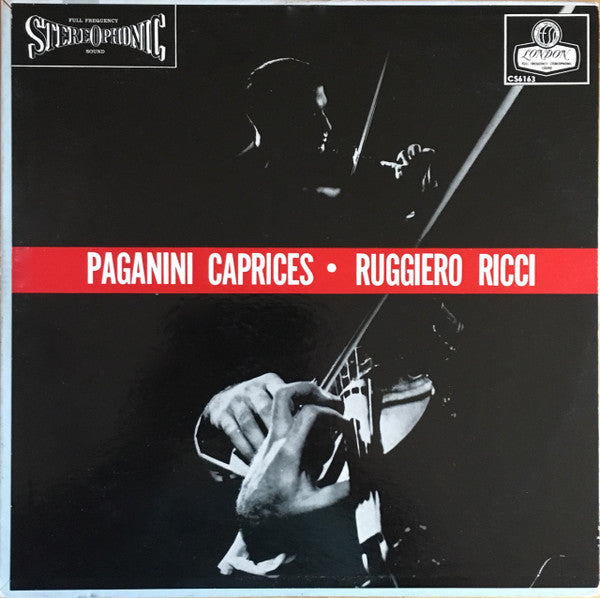
We’ve wanted to have Hot Stamper pressings of this album of Paganini’s Caprices (CS-6163) to offer our customers for years, not for the music per se, but to use as a handy test disc for those who are interested in setting up and dialing in their front ends better.

After all, these are only practice pieces. If you want real music written for the violin, we have plenty of albums to choose from that would be much more enjoyable.

If you like the sound of solo violin — and who doesn’t? — you will have a hard time finding a better sounding recording of it than this. That’s assuming you can set your Vertical Tracking Angle (VTA) correctly, not something every audiophile can manage. If you can, look out — you are in for a sonic treat.

Solo violins in live performance are clear, clean and present. You have no trouble at all “seeing” them clearly.

Our vintage Hot Stamper pressings will always have that kind of clear and present sound for the violin. If they didn’t, they would not qualify as Hot Stamper pressings.

Setup Advice

This is truly the perfect turntable setup disc; when your VTA, azimuth, tracking weight and anti-skate are correct, this is the record that will make it clear to you that all your efforts have paid off.

What to listen for you ask?

(more…)

Five Major Problem Areas in Audio

Hot Stamper Pressings of the Music of Prokofiev Available Now

UPDATE 2026

There was a time, perhaps ten years ago, that many EMI pressings finally started to sound a lot better to us than they had in the early- to mid-2000s when this commentary was written.

(2007 was the year everything changed, but it wasn’t 2007 yet. After being deep into audio for close to thirty years, it wasn’t until a few years later that we learned we still had a long way to go.)

Nowadays we can say that we are proud to offer some truly outstanding recordings conducted by Previn, Fremaux and others for EMI.


What to listen for on this album?

That’s easy: The all-too-common 70s EMI harshness and shrillness.

We could never understand why audiophiles revered EMI the way they did back in the 70s. Harry Pearson loved many of their recordings, but I sure didn’t. 

The longer I stay in this hobby, the more clear it becomes that many of the records on the TAS list are better suited to the old school audio equipment of the 60s rather than the modern approach to audio that is possible today thanks to the many revolutionary changes to every aspect of music reproduction that have come along in the last thirty years or so.

(Obviously there are plenty of audio systems from every era that, for all appearances, seem unlikely to reproduce music well, which goes a long way in explaining most of the rampant enthusiasm for the modern Heavy Vinyl pressing.)

These kinds of records used to sound good on those older systems, and I should know, I had an old school stereo even into the 90s. Some of the records that sounded good to me back then don’t sound too good to me anymore.

(more…)

Lincoln Mayorga, Pianist – Reverse Your Polarity!

Hot Stamper Pressings of Direct-to-Disc Recordings Available Now

This Sheffield Direct-to-Disc LP is one of the top Sheffields.

Lincoln Mayorga is an accomplished classical pianist: this is arguably his best work. (I had a chance to see him perform at a recital of Chopin’s works early in 2010 and he played superbly — for close to two hours without the aid of sheet music I might add.) 

You might want to try reversing the phase when playing this LP; it definitely helps the sound, a subject we discuss below.

With the polarity reversed, this is a top quality solo piano recording in every way.

This is one of the pressings we’ve discovered with reversed polarity.

(more…)

Shootout Winning Stampers for La Boutique Fantasque Revealed

Hot Stamper Pressings of the Music of Rossini Available Now

UPDATE 2026

Our current favorite recording of La Boutique Fantasque is the one Solti recorded for Decca in 1957.

It belongs to that very special group of roughly 150 orchestral recordings which have the potential to offer the discriminating (and well-heeled) audiophile the best performances of major works with by far the highest quality sound.

It has been our experience that modern remastered pressings simply cannot compete with the best pressings of these landmark recordings.

The Fiedler (LSC 2084) is still a very good record, but we no longer see much reason to carry it when the Solti is better in almost every way (and quieter as a rule to boot).

Below we have reproduced our full stamper sheet, including the Shootout Winning stampers, which happen to be 3S/4S for this album.

The early pressings for this album tend to be too bright in our experience as seen from one of the stampers sheets below.

(more…)

Letter of the Week – John Wesley Harding Has Playback Issues

Hot Stamper Pressings of the Music of Bob Dylan Available Now

UPDATED 2026

In reply to the letter below, I say only about one out of every five hundred records we’ve sold has ever been returned to us more than once.

I gave this more thought and I honestly cannot remember any record coming back more than once for substandard sound quality other than this very album. It was returned twice, and both times,after we played it again, it sounded fine to us.

Once a record has been returned, we tag it as a returned record so that if it ever does come back again, we know to check it extra carefully upon its return. We’ve been following this procedure for a while now, and, at least to my knowledge, no record has come back twice.


Our Older Commentary

One of our good customers had this to say about a Hot Stamper pressing of John Wesley Harding he purchased a while back:

Hey Tom,   

So many great records in this batch, but some solid misses too — details coming. John Wesley Harding for example sounds great but has some serious distortion through much of side two; a bit ’too vintage’, in spite of the sound it seems once to have had.

Dear Sir,

Definitely check your front end setup on this one, there is no actual distortion on the record, just sound that may be hard to reproduce.

My advice would be to make sure you have replaced your cartridge recently.

Carts that get old have a problem with records like these. We know, we replace our cartridge every three months when hard-to-play records start to sound strained or congested and gritty.

The sheen of massed strings, a sound critical to the orchestral recordings we play, are impossible to reproduce correctly with an older-than-it-should-be unit. A fresh cartridge can make all the difference in the sound of  difficult to reproduce records.

Keeping a cartridge installed for too long is a mistake made by 100% of the audiophiles I have ever known.

The other explanation could be that our microfine tip is playing deeper in the groove and missing whatever damage is encoded above it, damage which may have been caused by the older cartridges of the day that were used to play the record by the previous owner or owners. We can’t say it doesn’t happen.

We can say that if you bring this record back, the next person to buy it has a roughly 98% chance of keeping it. Maybe one out of five hundred or so ever come back a second time. At least that’s how it has worked out over the last twenty-five years.

(more…)

VTA – A Few Moments of Experimentation Can Really Pay Off

Basic Audio Advice — These Are the Fundamentals of Good Sound

Here we discuss what to listen for as you critically adjust your VTA.

While experimenting with the VTA for this record, we found a precise point where it all came together, far beyond whatever expectations we might have had for the sound at the time.

Practically out of nowhere we heard a solid, full-bodied, palpable violin that appeared to be floating between the speakers, an effect that, speaking for myself as a lifelong, obsessive audiophile — I fully appreciated for the magic trick that it is.

The sound of the wood of the instrument became so clear, the harmonic textures so natural, it was quite a shock to hear a good record somehow become an amazing one.

And all it took was a few moments of experimentation.

With the right VTA setting we immediately heard more harmonic detail, achieved, as is often not the case, with no sacrifice in richness.

That’s the clearest sign that your setup is right, or very close to it.

By the way, Robert Brook can get your front end tuned up and working right. We highly recommend his new service. It might just put you on the path to achieving the next level in audio. (You will definitely struggle to get there with a table, arm and cartridge that aren’t set up with a high degree of precision by a person who knows what they are doing, and Robert has been doing this work for years now.)
(more…)

Get the Phono Finish!

Robert Brook runs a blog called The Broken Record, with a subtitle explaining that his blog is:

A GUIDE FOR THE DEDICATED ANALOG AUDIOPHILE

We know of none better, outside of our own humble attempt to enlighten that portion of the audiophile community who love hearing music reproduced with the highest fidelity and are willing to go the extra mile to make that happen.

Get the PHONO FINISH!

Robert’s Approach

Robert has methodically and carefully — one might even say scientifically — approached the various problems he’s encountered in this hobby by doing the following:

(more…)

A Better Way to Get Rid of Grit and Grain on Jumpin’ Jive

More Records that Are Good for Testing Grit and Grain

Jumpin’ Jive is one of the clearest examples of an album where it is critically important to make sure your stereo is running on good electricity before you make any attempt to play it. This is the kind of recording — bright, full of energy — that will bring most stereo systems to their knees. Of course, when you play a good copy and it really sounds good, it’s a record that rewards all the time and effort you’ve put into your system.

So much of the aggressiveness, grit and grain that we hear in immediate, high-energy recordings such as this are really the fault of the electricity feeding the stereo, not the fault primarily of the record or even the equipment used to play it.

Now it should be noted that this recording has a ton of high frequency information that will be difficult to reproduce on most systems. If you leave a lot of appliances and electronic devices plugged in around the house when you listen to your stereo, you can forget ever hearing this record right. The grit and grunge caused by polluted electricity will make this record practically unlistenable, at the levels we listen at anyway. (At lower levels most of the garbage is masked, one reason no doubt that audiophiles rarely turn their stereos up to anything approaching live levels.) 

So do as we do: unplug everything you can get your hands on before you sit down to listen. Make sure your tubes (if you have tube equipment) are nice and warm too.

(more…)

A Bit of VTA Experimentation Can Really Pay Off

More Setup Advice for Turntables and Cartridges

UPDATE 2026

Although we liked it well enough, it’s unfortunately the case that this Aretha Franklin title did not get much love from our customers. We did learn something from playing it though, which often happens in our shootouts, especially tough ones like Amazing Grace. It’s a handy record for VTA setup, a subject we discuss below.

On the better copies Aretha’s vocals are as dynamic as any you will ever hear, and unlike all the records she did with Tom Dowd, her voice never breaks up on this record. If you have big speakers that can play at loud levels, with the right volume level you can really get Aretha to belt it out like nothing you have ever heard on record. 

Like most modern churches, the kind that have upholstered pews and lots of carpeting, the natural reverberation of the sound isn’t as pronounced as it would be were the recording taking place in a 16th century cathedral.

Note also that the recording is from 1972, not 1962, so the Tubey Magic that would have been on a recording such as this ten years earlier is not going to be as great either.

When we play a big stack of copies of a record like this, the limitations of the recording have to be taken into account.

The best copies will do what the best copies do; we can’t ask them to sound like something they were never designed to sound like.

The best copies of the album clearly sound quite a bit better than the average copy we played, but they still sound like the same recording, just bigger, richer, clearer and more alive.

To set your VTA right, don’t try to make Aretha too smooth — she should sound a bit “hot” when the spirit fills her and she shouts her loudest. If you get her to sound correct you lose a lot of space and ambience. What space and ambience there is on the tape need to be there for the recording to sound “real.”

(more…)