*Stereo, Playback, Setup, etc.

Professional Skateboarder Danny Way on Flow

Confessions of a Thrillseeking Audiophile

This quote comes courtesy of Shane Parrish’s Brain Food newsletter.

“Skateboarding is a game of failure. That’s what makes this sport so different. Skaters are willing to take a great deal of physical punishment. We’ll try something endlessly, weeks on end, painful failure after painful failure after painful failure.

“But for me, when it finally snaps together, when I’m really pushing the edge and skating beyond my abilities, there’s a zone I get into. Everything goes silent. Time slows down. My peripheral vision fades away. It’s the most peaceful state of mind I’ve ever known. I’ll take all the failures. As long as I know that feeling is coming, that’s enough to keep going.”

I expect that Danny would understand exactly why someone would want to go into a room to listen to a record by himself. Good sound tends to make everybody in the room stop talking.

Exceptional records take it to the next level. They cause those in the room to to go silent in order to listen more intently — because the music and the sound demand it.

(more…)

Traveling Back in Time with Cat Stevens on Mobile Fidelity

Hot Stamper Pressings of the Music of Cat Stevens Available Now

Our good customer Roger wrote us a letter years ago about his Tea for the Tillerman on Mobile Fidelity, in which he remarked, “Sometimes I wish I kept my old crappy stereo to see if I could now tell what it was that made these audiophile pressings so attractive then.”

It got me to thinking. Yes, that would be fun, and better yet, it could be done. There are actually plenty of those old school audio systems of the 60s and 70s still around. Just look at what many of the forum posters — god bless ’em — are running. They’ve got some awesome ’70s Japanese turntables, some Monster Cable and some vintage tube gear and speakers designed in the ’50s.

With this stuff you could virtually travel back in time, in effect erasing all the audio progress made possible by the new technologies adopted by some of us over the last 30 years or so.

Then you could hear your Mobile Fidelity Tea for the Tillerman sound the way it used to when you could actually stand to be in the same room with it.

My question to Roger was “What on earth were we hearing that made us want to play these awful half-speed mastered records? What was our stereo doing that made these awful records sound good to us at the time?”

In Search of a Bad Stereo

I know how you can find out. You go to someone’s house who has a large collection of audiophile pressings and have him play you some of them. Chances are that his stereo will do pretty much what your old stereo and my old stereo used to do — be so wrong that really wrong records actually start to sound right! It seems crazy but it just might be true.

(more…)

Breaking Through Barriers and Crossing Bridges

More on the Subject of Critical Listening Skills

The Invisible Barrier Theory

Your ability to recognize that one side of a record more often than not will have sonic qualities that are different from the other side of the same disc is limited by an invisible barrier that exists between you, in your role as a listener, and you, in your role as a judge of the sound.

This barrier also goes by another name: “the stereo.“ There really can be no other explanation for it, assuming you have something in the range of normal hearing.

What the stereo is incapable of showing you must be seen as a limit on what you can hear, regardless of how skilled a listener you may be, or how much money, time and effort you may have dedicated to your system, or how good a job you think it is doing.

There is only one solution to this problem: get better sound.

Then the differences between any two sides of the same record will become as obvious to you as they are to us.

(more…)

Mozart – VTA and Balance

What to listen for ask?

Dry sound.

Some of the copies lacked the richness to balance out the clarity and were dry sounding. There is a balance to be found.

The right VTA will be critical in this regard.

When you have all the space; the clearest, most extended harmonics; AND good weight and richness in the lower registers of the cello, you are where you need to be (keeping in mind that it can always get better if you have the patience and motivation to tweak further).

For more advice on setting your VTA properly, please click here.

On the other side of that coin is smear, usually from too much tubey richness. Again, finding the balance is key.

Here are some other records that are good for testing string tone and texture.

(more…)

Five Major Problem Areas in Audio

Hot Stamper Pressings of the Music of Prokofiev Available Now

UPDATE 2026

There was a time, perhaps ten years ago, that many EMI pressings finally started to sound a lot better to us than they had in the early- to mid-2000s when this commentary was written.

(2007 was the year everything changed, but it wasn’t 2007 yet. After being deep into audio for close to thirty years, it wasn’t until a few years later that we learned we still had a long way to go.)

Nowadays we can say that we are proud to offer some truly outstanding recordings conducted by Previn, Fremaux and others for EMI.


What to listen for on this album?

That’s easy: The all-too-common 70s EMI harshness and shrillness.

We could never understand why audiophiles revered EMI the way they did back in the 70s. Harry Pearson loved many of their recordings, but I sure didn’t. 

The longer I stay in this hobby, the more clear it becomes that many of the records on the TAS list are better suited to the old school audio equipment of the 60s rather than the modern approach to audio that is possible today thanks to the many revolutionary changes to every aspect of music reproduction that have come along in the last thirty years or so.

(Obviously there are plenty of audio systems from every era that, for all appearances, seem unlikely to reproduce music well, which goes a long way in explaining most of the rampant enthusiasm for the modern Heavy Vinyl pressing.)

These kinds of records used to sound good on those older systems, and I should know, I had an old school stereo even into the 90s. Some of the records that sounded good to me back then don’t sound too good to me anymore.

(more…)

Gino Vannelli, Big Speakers and The Amazing SP3A-1 Preamp

Rock Records that (Potentially) Sound Amazing on Big Speakers at Loud Levels

At one time Storm at Sunup was easily my favorite Gino Vannelli album. When it came out in 1975 I immediately fell in love with the music and put it into heavy rotation on my turntable (a phrase that had not been invented yet but perfectly describes how easy it is to become obsessed with an album).

It was one of a group of recordings that made me want to pursue higher quality equipment, hoping that any improvement in playback would allow the music to sound even bigger and more exciting.

It was pretty damn big and exciting already, but I wanted more. 

Right around that time I got my first tube preamp, the Audio Research SP3A-1, which replaced a Crown IC-150. As you can imagine, especially if you know the IC-150 well, playing this album through that state-of-the-art tube preamp was a revelation.

From that point on there was no going back. I started spending all my money on (what I took to be) better and better equipment and (often mistakenly) better records by the score. That was fifty plus years ago and I haven’t stopped yet. [Not so much now that I’m retired, but you get the point.]

Even at the age of 21 I wanted to pursue Big Systems driving Big Speakers.

You need a lot of piston area to move enough air to bring the dynamics of a recording like this to life, and to get the size of all the instruments to match their real life counterparts, or at least to seem to, this being a multi-track studio recording.

For that you need big speakers in big cabinets, the kind I’ve been listening to for more than fifty years. (My last small speaker was given the boot around 1973 or so.)

To tell you the truth, the Big Sound is the only sound that I can enjoy. Anything less is just not for me, mostly because the music I love demands the big sound, whether the listener is aware of that fact or has anything like the system required to reproduce it.

With few exceptions, the records that helped us improve our playback required big speakers that could play at loud volumes.

(more…)

Mozart’s Quintet / Trio Is a Great VTA Test Disc

Hot Stamper Pressings of the Music of Mozart Available Now

CS 6109 is a handy record for VTA adjustment.

Listen for fullness and solidity, especially in the piano, although a rich, full sounding clarinet is a joy here as well. 

Some of the copies we played in our shootout lacked the weight and solidity to balance out the qualities of transparency and clarity.

The resulting sound is less natural, with the kind of forced detail that CDs do so well, and live music never does. There is a balance to be found.

The right VTA will be critical in this regard. When you have all the space; the clearest, most extended harmonics; AND good weight and richness in the lower registers of the piano, you are where you need to be (keeping in mind that it can always get better if you have the patience and drive to tweak further).

(more…)

Turntable Setup Guide Part 2: Dialing In Tracking Force By Ear

Robert Brook runs a blog called The Broken Record, with a subtitle explaining that the aim of his blog is to serve as:

A GUIDE FOR THE DEDICATED ANALOG AUDIOPHILE

We know of none better, outside of our own humble attempt to enlighten that portion of the audiophile community who love hearing music reproduced with the highest fidelity and are willing to go the extra mile to make that happen.
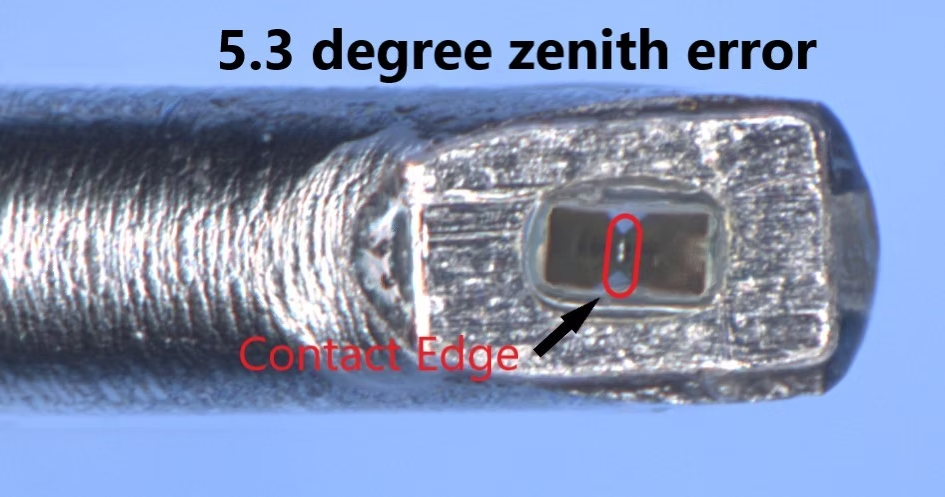
Below you will find a link to an article about turntable setup. I would have loved to write something along these lines myself, but never found the time to do it. Robert Brook took the job upon himself and has explained many aspects of it well, so if you would like to learn more about turntable setup, I encourage you to visit his blog and read more about it.

I do have some ideas of my own which I hope to be able to write about soon, but for now, check out what Robert has to say.

Turntable Setup Part 2: What To Do For EXCELLENT SOUND

Sibilance Can Be a Bitch (and a Good Test for Table Setup Too)

On side two the tonal balance is key. If there is any boost to the top end, the vocals on track two will SPIT LIKE CRAZY.

This is also a good test for how well your cartridge and arm are doing their jobs. Sibilance is a bitch. The best pressings, with the most extension up top and the least amount of aggressive grit and grain mixed into the sound, played using the best front ends, will keep it to a minimum. VTA, tracking weight, azimuth and anti-skate adjustments are critical to reducing the spit in your records.

We discuss the sibilance problems of MoFi records all over the site. Have you ever read Word One about this problem elsewhere? Of course not. Audiophiles and audiophile reviewers just seem to put up with these problems, or ignore them, or — even worse — simply fail to recognize them at all.

Play around with your table setup for a few hours and you will no doubt be able to reduce the sibilance problems on your favorite test and demo discs. All your other records will thank you for it too. 

This record, along with the others linked below, is good for testing the following qualities.

  1. Grit and grain
  2. Sibilance (it’s a bitch) 

Playing so many records day in and day out means that we wear out our Dynavector 17DX cartridges often, about every three to four months.

Which requires us to regularly mount a new cartridge in our Triplanar.

Once broken in (50 hours min.), we then proceed to the fine setup work required to get it to sound its best, adjusting the VTA, azimuth and tracking weight for maximum fidelity.

(more…)

Lincoln Mayorga, Pianist – Reverse Your Polarity!

Hot Stamper Pressings of Direct-to-Disc Recordings Available Now

This Sheffield Direct-to-Disc LP is one of the top Sheffields.

Lincoln Mayorga is an accomplished classical pianist: this is arguably his best work. (I had a chance to see him perform at a recital of Chopin’s works early in 2010 and he played superbly — for close to two hours without the aid of sheet music I might add.) 

You might want to try reversing the phase when playing this LP; it definitely helps the sound, a subject we discuss below.

With the polarity reversed, this is a top quality solo piano recording in every way.

This is one of the pressings we’ve discovered with reversed polarity.

(more…)