Mystery Stampers

Some Blue Notes with New York Labels Just Cannot Be Beat

Hot Stamper Pressings of Blue Note Recordings Available Now

Warning: the record you see pictured is not the record we are discussing in this commentary.

Our shootout in 2024 involved all the most important Blue Note labels for this mystery title. New York, Liberty, Black B, White B, all present and accounted for, and all with RVG in the dead wax. (For those who want to know which labels to avoid on Blue Note, you will have to dig through our voluminous reviews and commentaries.)

We don’t need to tell you that those early pressings take us years to find, and cost us a pretty penny — at least the ones that are in audiophile playing condition do — when we can even manage to get hold of them.

And we probably return at least half of what we buy, doubling the trouble of getting a shootout going.

Some folks who produce Heavy Vinyl Blue Note reissues and some of those who review them will tell you that Rudy did not know how to master a record properly. They don’t think his pressings should sound very good to audiophiles, assuming the equipment these audiophiles own is of the highest quality, the way they assume theirs is.

Naturally we think audiophiles who believe any of the above are as wrong as wrong can be. And you can easily prove to yourself just how misguided they are simply by ordering one of our Hot Stamper pressings and playing it.

You can send it back — that’s up to you — but at least you will know how full of it these audiophile reviewers must be to write such nonsense. We love Rudy and make no bones about it. He is one of the All Time Greats.

Our notes for a recent shootout are shown below. There were six pressings in all, each of them mastered by RVG himself, which unsurprisingly are the only ones with any hope of sounding good, if our experience can act as a guide.

(more…)

What’s More Important – The Right Label or the Right Stamper Numbers?

Hot Stamper Pressings Featuring the Violin Available Now

In this case, since the label is different but the stampers are the same, it’s the label that tells you how good your pressing may — heavy accent on the may — sound.

Lately we’ve been having exceptionally good luck with the early label pressings of many of the London violin concerto records we’ve done shootouts for.

However, the notes you see below do not belong to the wonderful Sibelius record pictured here.

They belong to another London record. We give out lots of bad stampers on this blog, but almost never do we give out the good ones. (When we do give out the best stampers, we usually keep the title a mystery, as is the case of the record here. To see the other titles whose Shootout Winning stampers have been revealed, please click here. The list to date is short but not to worry, more are on their way.)

The amazingly good sounding pressing on the early label took the recording to another level. Our shootout notes read:

  • Amazing violin sound and performance.
  • Very dynamic and realistic.
  • So much subtlety.

(more…)

WW, LW, JW? Which Stampers Sound the Best?

Hot Stamper Pressings of Rock and Pop Albums Available Now
UPDATE 2026

In 2005 we acquired more than a dozen sealed copies of a popular Warner Bros. title, how I don’t remember. (For now we are keeping that title, and even the band that recorded it, a mystery. It might have been The Doobie Brothers, but then again, it might not.)


Our story goes like this:

Knowing that no two of these pressings would sound exactly the same, we decided to crack them open, clean them up and play them.

2005 was very early in the development of Hot Stamper Shootouts. By 2007 we were much better at them, and not coincidentally, that is also the year we decided that Heavy Vinyl pressings were just not good enough for us to bother selling.

All three of the major stamper prefixes for Warners were represented in the various matrix numbers: WW, JW and LW. Once we started to play them it quickly became clear that most copies of this record just do not sound very good.

The typical copy is hard, midrangy, opaque, dull and badly lacks Tubey Magic.

Only one of the prefixes — WW, JW, LW — actually has any hope of sounding good, and surprisingly it’s not the one I would have expected it to be. Live and learn, right?


We liked either JW or WW back in 2005, I don’t remember which, but the evidence we compiled over the ensuing twenty years contradicted that finding.

Live and learn is right, because since the dark days of 2005, we have done this shootout many times, at least five by my count, and it turns out that the stampers we tend to like are exactly the ones we tend to like in general for Warner Bros.

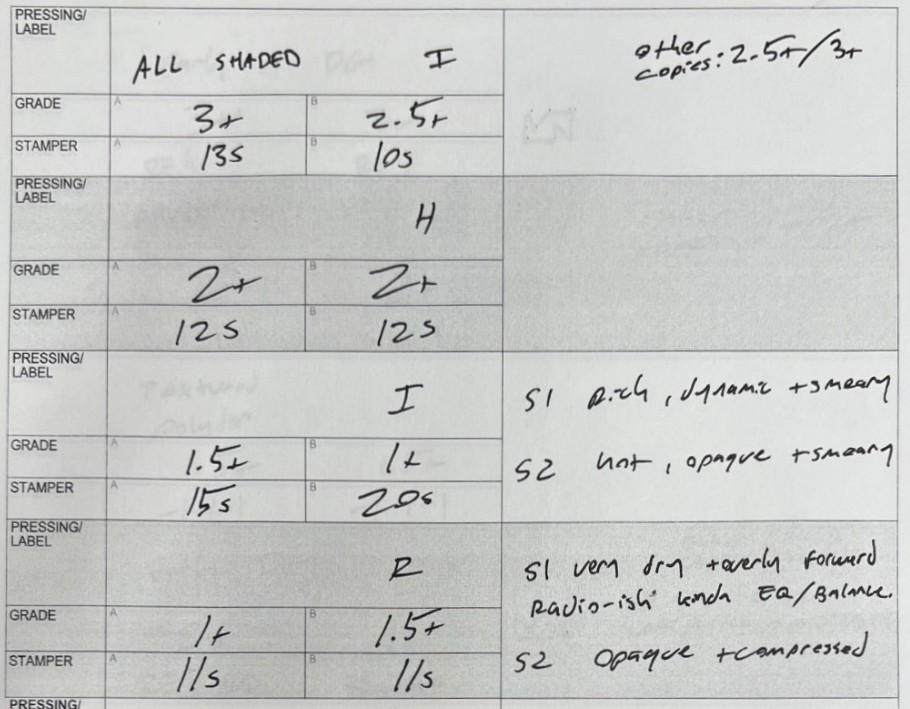
Here is the full stamper sheet from a shootout we did not long ago laying out the stampers we like for this mystery title: LW, with low numbers.

(more…)

Is It Hard for You to Imagine Similar Stampers Sounding So Different?

Hot Stamper Pressings of Living Stereo Recordings Available Now

Subtitle: it’s also hard to imagine that space and time are two aspects of the same reality, spacetime, but that’s why we employ rigorous scientific methods to test our theories and — in some cases — prove ourselves wrong.

We here at Better Records like testing records. We want to know if the predictions we make about the titles we play are accurate, which is simply to say, do they match the data derived from our blinded shootouts?

In the case of the stampers for this mystery title, it turns out that whatever intuitions we may have had going in would have been no help at all. Who could possibly predict that, for sound quality on side one, 13s would substantially beat 12s, 12s would beat 15s, and that 15s would beat 11s.

(more…)

3s Can Have Amazingly Good Sound, or 3s Can Have Mediocre Sound

Hot Stamper Pressings of Living Stereo Recordings Available Now

But how can you tell which 3s copies sound amazing and which 3s copies don’t?

Below you will see the stamper sheet for a shootout we did not long ago.

A lot of our stamper sheets look like this one, close to half I would guess.

As you can see, the stampers and the sound are all over the map. This is not the least bit unusual in our experience. It’s simply the nature of records — they tend to come off the press with very different sound depending on factors that no one seems to understand very well, not even us!

Note that the album you see pictured is not the record we did the shootout for.

(more…)

Could This Be More of the Sound Audiophiles Complain About with RVG’s Mastering?

Hot Stamper Pressings of the Music of John Coltrane Available Now

Some of the Rudy Van Gelder cuttings of this album were decent, but had you bought a copy with these stampers, you could be forgiven for using the man’s name in vain.

VAN GELDER in the dead wax is no guarantee of high quality sound, on any record. Records don’t work like that.

The 1+ grade found on side one of both discs means the sound for those two sides may be passable, but the NFG sound on side two of record one means you have at best only half an album with decent sound, and what good is that?

As you can see from our notes, the sound is way too hot and messy and thin.

Note that side two of the second record wasn’t played at all. Why waste more time on a record that clearly did not come off the press properly, whether from bad mastering or bad vinyl? Or bad something else, who can say?

We do not sell records with 1+ grades. You should have no trouble finding those on your own. The world is full of them.

Poor Rudy

Rudy Van Gelder comes in for a lot of criticism from the audiophile community, especially from audiophiles who tend to prefer the remastered Heavy Vinyl pressings made from his recordings.

Unsurprisingly, much of the criticism comes from some of the very same engineers responsible for the remastering those records.

Those who produce reissues of his recordings are notable critics as well.

(more…)

What Can You Learn from a Mercury Shootout Like This One?

Hot Stamper Pressings of Mercury Classical Recordings Available Now

The short answer is that you can’t learn much from this shootout, because we’re not telling you which title the stampers you see below belong to.

Be that as it may, in the case of this mystery title the conventional wisdom turns out to be correct — the earlier numbered pressings did better than the later numbered pressings, and the early labels did better than the later labels.

That happens a lot, and we are happy to admit that it does. Why? Because the experimental evidence — the datasay that is what happened.

As usual for posts in which the stamper sheet from a shootout is reproduced in its entirety, the stamper numbers shown below will belong to a different album than the one you see pictured.

These can be found under the heading of Mystery Stampers. Most of these posts will illustrate something to be learned from a Hot Stamper shootout, but because the information reveals the shootout winning stampers, the actual title of the record is rarely revealed.

Much more useful stamper information can be found using this link, which includes plenty of stamper numbers for specific titles that are best avoided by audiophiles looking for top quality sound. In addition, we post the winning and losing stampers for some titles that are an unreliable guide to good sound. Unreliable stampers are also quite common.

The right stampers are only one of the many reasons some copies win our shootouts and others don’t, but in the case of this rare Mercury, a record that we only had four copies of, the RFR-2/2 stampers were clearly the best, with no other set of stampers coming close. The best of the others earned grades no better than 2+/2+.

One lesson that was clear was that the best stampers were, to quote our reviewer, “a step up!”

(more…)

What Are the Best Stampers for Led Zeppelin’s Albums?

Hot Stamper Pressings of the Music of Led Zeppelin Available Now

What are the best sounding stampers for Led Zeppelin’s albums?

As if we would tell you!

This is a reworked excerpt from a much longer piece entitled record collecting for audiophiles – the limits of expert advice

In it we discussed the various stampers for some of Led Zeppelin’s albums and what role they play in our Hot Stamper shootouts.

Please to enjoy.

There is no way to know whether a record is any good without playing it, early stamper, late stamper or any other stamper.

First pressings (A, 1A, A1) don’t always win shootouts.

If they did we would simply buy only first pressings with those early stampers and only sell copies with those early stampers, since they are the best.

But this ignores the inconvenient fact that a great many other things go into the production of a record that have nothing to do with how early the stamper is.

A single copy of an album with stampers numbered (or lettered) A, when compared to B, when compared to C, has no definitive meaning for stampers A, B, C, or any others, because of the tremendous variation in the sound of all the pressings with A,B,C and other stampers.

Example Number One

There is a hot stamper for a certain Zep album that always wins the shootouts, [redacted].

It beats the hell out of the early stampers, A and B. In fact, we don’t even go after A and B anymore because they are expensive and rarely sound good enough to recoup our investment of the time and money we would spend buying, cleaning and auditioning them in a shootout.

A and B can be good, but why pay top dollar for them when they have never been any better than “good?”

We’re looking for “great” so that we can charge a premium price for them. This accomplishes three things that are obviously of great importance to any business:

  1. It pleases the hell out of our customers.
  2. It covers our costs, and
  3. It lets us pay our staff good wages and bonuses for their hard work, skill and knowledge.

(more…)

So You Actually Think an OJC Can Beat an Original Black Label Contemporary?

Hot Stamper Pressings of Contemporary Jazz Albums Available Now
Yes, we think that, because that’s what the evidence from our most recent shootout in 2025 showed us.

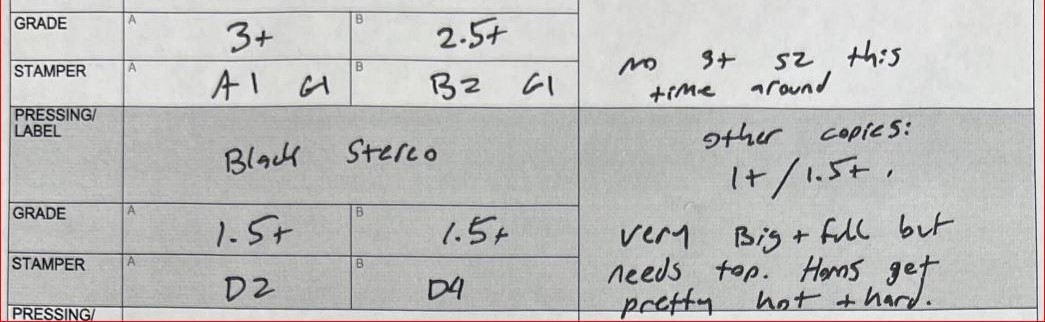
As you can see from the stamper sheet below, the A1/B2 stampers of our OJC, in a blinded test, came out on top.

Better mastering equipment? Better mastering skills? Better vinyl? Better pressing methods?

Who the hell knows?

Better yet, what audiophile or record collector with a lick of sense would even pretend to know?

Not us, that’s for sure. At this point we are very comfortable not having answers for the unanswerable questions we posed above.

But don’t rush off to buy the OJC of the Sonny Rollins record you see pictured. This commentary has nothing to do with that record. For now we’re keeping the title a mystery, consistent with the idea that we give out lots of the bad stampers on this blog, but rarely do we give out the good ones. (That said, here are some of the stampers that win shootouts, and we expect to be posting more soon, mostly for records we can no longer do shootouts for due to: 1.) a lack of interest, or 2.) unacceptably high costs for the best pressings, or 3.) or the fact that we are simply unable to find pressings that play quietly enough for audiophiles.)

So why is it that you can’t tell us the title of this record?

The cost of discovering the right stampers (aka R&D) is usually high, can sometimes take decades, and is fundamentally at the heart of how we make our money: by taking pressings we hope to be good, cleaning them up, playing them, and offering only those that actually do sound good, regardless of when they were made, who made them or why.

Once the shootout is done, the time for hoping and guessing is over. We have the evidence, and in our world that is the only thing that counts. That evidence may be provisional — we could prove ourselves wrong with the next shootout, and there have been times when that has happened — but for now this is the best information we have to work with.

Key Takeaways for this Mystery Record

  • We did not have enough copies with the right stampers to find a 3+ side two. (The other copies earned grades of no better than 2+/2+.)
  • Which simply means that if we’re not hearing faultless or nearly-faultless sound on one side or another, the sound is not White Hot and does not deserve a 3+ grade. Fair’s fair after all.
  • The original pressing you see with D2/D4 stampers had some of that “old record” sound we find on far too many vintage pressings.
  • True, it was very big and full, but lacked top end, causing, among other things, the horns to get hot and hard.
  • Who wants to listen to a Sonny Rollins famous classic jazz record with horns that don’t sound right?

(more…)

Does 1s Sound Great or Does It Sound Good (but Hot, Dry and Crude)?

Hot Stamper Pressings of Living Stereo Recordings Available Now
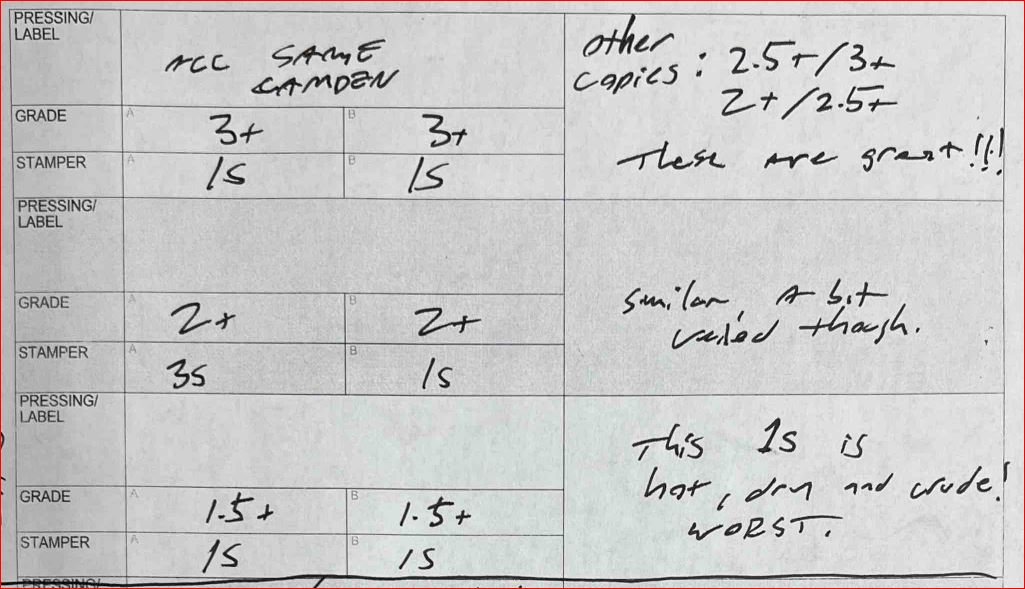
Below you will see the complete stamper sheet for a shootout we did recently.

Note that the album you see pictured is not the record we did the shootout for.

We are not revealing what record had these stampers and earned these grades for the simple reason that we rarely if ever give out the specific information that identifies the best sounding pressing of any album.

As I’m sure you can understand, we want you to buy the copy with the Hottest Stampers from us, not find one on your own! We’re happy to be moderately helpful, but naturally we find it necessary to draw the line somewhere, and giving out “the shootout winning stampers” is where we choose to draw it.

How Come?

Since, as we discovered recently, 1s wins, and handily, why would any 1s pressing sound as bad as the one at the bottom does?

(Which by the way is not actually bad — just far from the best.)

If the 1s wins the shootout as it did here, that means that the received knowledge about RCA Living Stereo pressings being better on the first pressing is correct.

But if you are the unlucky buyer of the 1s that did not do nearly as well, you might say to yourself “Hey, I thought the 1s pressing was supposed to be the hot ticket. Wha’ happen?” (Assuming you don’t conclude that the recording is at fault, which is what most audiophiles and record collectors would be likely to do. I did it and I bet you did too.)

We noted in a commentary from many years ago that the record collecting theories we see commonly promoted by those who consider themselves “in the know” seem to have a great deal of trouble accounting for these anomalies.

We had two copies of Court and Spark, each with one good side opposite a bad side on the same pressing. An excerpt:

(more…)