Record Labels with Shortcomings

Al Di Meola et al. on Speakers Corner Heavy Vinyl

Sonic Grade: D?

The Speakers Corner remastered Heavy Vinyl pressing of this famous jazz album had two big strikes against it right from the get go. The sound is both congested and hard.

With these guys hell-bent on one-upping each other right off of the stage, even our best Hot Stamper pressings struggle with clarity, transparency and harmonic sweetness

Do you really want to add all the problems of the modern remastered heavy vinyl pressing to a tape that already has plenty of problems to start with?

Congested and hard is the kind of sound Speakers Corner should be quite familiar with by now. You can hear it on plenty of their mostly mediocre-at-best pressings.

Sourced from a digital tape of the master? Maybe, but who cares what tape was used to make this dog?

It’s a loser and should be avoided at any price.

Our Hot Stamper pressings of this album will be dramatically more transparent, open, harmonically-correct, resolving of musical information, clear and just plain REAL sounding, because these are the most obvious areas in which Heavy Vinyl pressings tend to fall short, if our experience with hundreds of them over the last few decades counts for anything.

(more…)

Capriccio Italien on Classic Records and How Badly I Missed the Boat

More of the Music of Peter Ilyich Tchaikovsky

More of the Music of Nikolai Rimsky-Korsakov

Years ago, around 2005 if memory serves, I played a copy of the Classic Records pressing of LSC 2323 and thought it was pretty good.

I thought it was better than the Shaded Dog copies I had compared it to, which, based on hundreds of other Classic Records titles I had auditioned, was unexpected to say the least.

Little did I know that the Shaded Dog pressings on this title are not remotely competitive with the early reissues.

The best of the Shaded Dog pressings we could find, which just happened to have a 1s side one, came in tied for last with the one 70s Red Seal pressing we thought sounded good enough to make the shootout.

(Some inside baseball: most of the Shaded Dogs and Red Seals were needle-dropped, and all but two were eliminated before the shootout. It takes time and wastes money to clean and play pressings that sound hopeless, so a quick elimination round often precedes the cleaning process.)

Back then it was tough to wrap my head around the idea that a Classic Record classical title could actually be better sounding than a Shaded Dog — it had never happened, so I knew there had to be more to the story.

Finding the time to do the serious investigation of LSC 2323 that would be necessary to get to the bottom of it was not in the cards, so I shelved the project for close to the next twenty years.

The title would have to wait until 2024 to go through a proper shooout, and when it did, naturally the Classic was part of the mix, which is the way we do things here at Better Records. Every record gets the chance to show us what it can do, to be evaluated fairly without the listener having any way to know which pressing is playing.

It turns out that side one of the Classic was passable, but side two — the side I had probably never played — was every bit as bad as most of their other classical offerings.

Side One, Second Movement (Tchaikovsky)

  • Big, but bright and compressed
  • Gets loud but opaque and hot
  • Good weight

Side One, First Movement

  • Bright and blurry bells
  • Sort of tubey but a mess
  • Grade: 1+ (passable, but no Hot Stamper)

Side Two (Rimsky-Korsakov)

  • Big but boomy and smeary
  • Brass is edgy and opaque
  • No top end or space
  • Peaks are hot and congested
  • Grade: NFG

To recap: In 2005 I was impressed with Classic’s pressing of LSC 2323. That was only twenty years ago, yet I could not have been more wrong. I thought my stereo was great — I’d owned top quality equipment since 1975 by then — thirty sodding years — so my audiophile credentials would surely dwarf those of the vast majority of forum posters who write about audiophile pressings today. How reliable should we expect their reviews to be?

(more…)

Music of Old Russia – We Give Up (on Noisy Angel Vinyl)

Hot Stamper Pressings Featuring the Violin Available Now

White Hot Stamper sound on side one – the Tubey Magic is off the scale. Milstein is brilliant on these shorter violin works, 7 in all.

This rare, hard to find original Blue Angel stereo pressing has exquisite sound. As we noted in our listing for Milstein’s Saint-Saens Third, it is the rare Heifetz album on Shaded Dog (or any other label) that could hope to compete with it.

We would rank this Angel pressing with the best of Rabin and Milstein on Capitol, as well as the wonderful Ricci and Campoli discs on London/Decca.

The transparency of both sides lets you “see” the orchestra clearly, without sacrificing richness or weight.

What a record! What a performance from the incomparable Nathan Milstein. 


UPDATE 2024

This is an album we can no longer find enough clean, early stereo pressings with which to do a proper shootout.

Consequently it has been tagged as a never again record. It’s possible we could do it again, but unlikely.

We love both the music and sound and encourage you to find a nice copy for yourself.

For best results, stick to the Blue Label stereo pressings. There are two, but only one of them sounds good.

See how hard all this record stuff is!

(more…)

Mobile Fidelity – The Ultimate Pretender

Hot Stamper Pressings of the Music of Jackson Browne Available Now

During the recording of The Pretender, a newly invented piece of electronics was used called the Aphex Aural Exciter. It harmonically “richened” the sound in interesting and, most would say, pleasing ways.

It was designed to have a euphonic effect, and it succeeded in that aim, beguiling its listeners for a while, especially those at the lo- and mid-fi level, the obvious if unspoken target market these days (although the thought of admitting such a thing would surely cause the sky to fall) for the Heavy Vinyl reissue.

The Aphex was clearly creating distortions, but they were the kinds of distortions that many folks of the audiophile persuasion seemed to like. Which is the very definition of euphonic colorations.

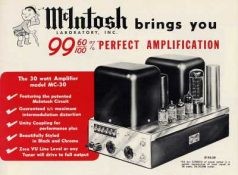
The poster boy for euphonic colorations is our friend here, the famous Mac 30, an amp that came on the market in 1954 and one that still has adherents to this day, some of them quite famous. I had a pair and learned some lessons — as I did with every piece of equipment I owned — in the time I spent listening to them.

If you like old school tubey colorations, the kind we’ve found to be antithetical to the proper reproduction of music in the home, this is the amp for you.
How Much Is Too Much of a Good Thing?

When you play the MoFi pressing of The Pretender, it just seems to have more of that Aphex Aural Excitement.

Here’s the $64,000 question: is MoFi’s supposedly superior mastering technology revealing more of the “aphexy” sound already present on the tapes, or is it adding its own distortions that mimic the Aphex distortions?

It seems to me that in the case of The Pretender it’s clearly the latter.

Deja Vu on MoFi has that same too rich, too smooth sound. Where on earth did that extra richness and smoothness come from? No vintage pressings we have ever played has ever had that sound.

Obviously MoFi preferred The Pretender to sound the way they preferred it to sound, or perhaps it’s more accurate to say that they wanted it to sound the way they thought their customers would prefer it to sound.

Or maybe they have no idea what they’re doing and never did. That strikes me as the most likely explanation for a label that should have gone out of business a long time ago.

Is it just EQ? I’m not expert enough to know, but I do know this: Hot Stamper pressings of The Pretender have much more transparency and clarity, while at the same time offering a good balance of of sweetness and smoothness, with less of that thick, blurry, overly-rich quality that you find on the MoFi pressings of the album.

More on the Aphex

Owen Penglis on the Happymag.tv site describes the Aphex Aural effect this way:

The Aural Exciter brought presence, intelligibility, ‘air’ without hiss, and renewed clarity through its arbitrary process of adding phase shift, harmonics, compression, and intermodular distortion.

(more…)
The Dreadful Sound of the Heavy Vinyl Reissues Doug Sax Mastered in the 90s

Hot Stamper Pressings of the Music of Sonny Rollins Available Now

Longstanding customers know that we have been relentlessly critical of so-called “audiophile” LPs for years, especially in the case of these Analogue Productions releases from back in the early-90s. A well-known reviewer loved them, I hated them, and he and I haven’t seen eye to eye on much since.


(Old) Newflash!

Just dug up part of my old commentary discussing the faults with the original series that Doug Sax cut for Acoustic Sounds. Check it out.

In the listing for the OJC pressing of Way Out West we wrote:

Guaranteed better than any 33 rpm 180 gram version ever made, or your money back! (Of course I’m referring to a certain pressing from the early 90s mastered by Doug Sax, which is a textbook example of murky, tubby, flabby sound. Too many bad tubes in the chain? Who knows?

This OJC version also has its problems, but at least the shortcomings of the OJC are tolerable. Who can sit through a pressing that’s so thick and lifeless it communicates none of the player’s love for the music they’re making?

If you have midrangy transistor equipment, go with the 180 gram version (at twice the price).

If you have good equipment, go with this one.


UPDATE 2015

We are no longer fans of the OJC of Way Out West, and would never sell a record that sounds the way even the best copies do as a Hot Stamper. It’s not hopeless the way the Heavy Vinyl pressing is, but it’s not very good either. It’s yet another example of a record we was wrong about.

Live and learn, right?


(more…)

Waiting For Columbus Gets the Bernie Treatment Care of Rhino Records

Hot Stamper Pressings of the Music of Little Feat Available Now
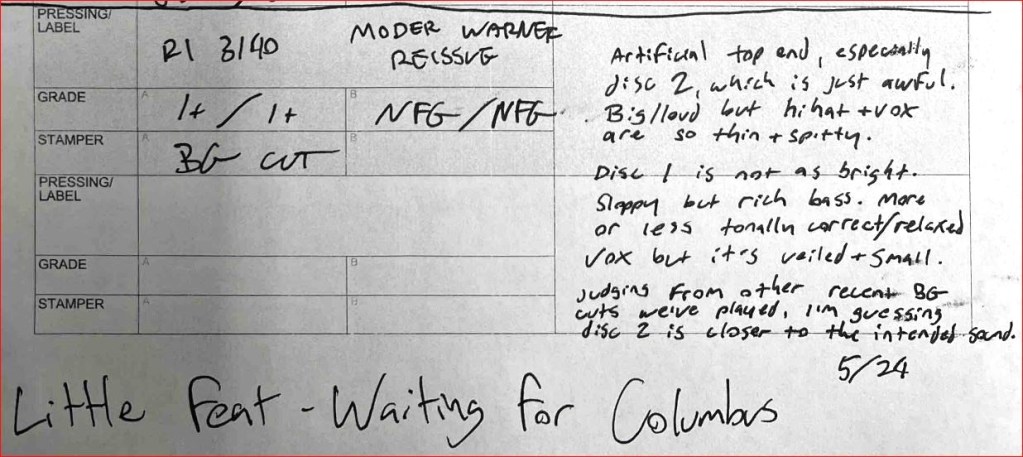
A Hot Stamper pressing of this amazing sounding album, a title we regret to say we have in stock only rarely, might be described this way:

Some of the best sounding live rock and roll sound you will ever hear outside of a concert venue. If you want to understand the unique appeal of the band, there’s no better place to start than right here.

It’s one of our all-time favorite live recordings and their single best release – a true Masterpiece.

I have lately been listening to this album in its entirety at the gym (playing the standard cassette over headphones) and enjoying the hell out of it. As good as their best studio albums are, and I count myself as big a fan of the band as there is, Waiting for Columbus is surely the pinnacle of their recorded output. It is as close to perfect as any live album I know.

(The Last Record Album is my personal favorite of their studio albums, but since nobody seems to want to buy it at the prices we charge, I regret to say we had to stop doing shootouts for it years ago. We were losing too much money that way.)

But Bernie Grundman’s version is just another one in a very long line of disastrous recuts, the kind of crap he has been churning out for the last thirty years. It’s all but unplayable on modern high quality equipment. (If it’s not on your system, you might consideer the idea that you still have plenty of work left to do, audio-wise.)

As you can see from the notes below, record one may be passable, but record two is NFG. How is it possible to turn such a wonderful recording into such a ridiculously bad sounding pressing? Even Mobile Fidelity did a better job with the album, and they’re one of the most incompetent remastering outfits that the audiophile world has even known.

We’re frankly at a loss to understand any of it.Bernie Grundman used to make good sounding records. We know that for a fact, having played them by the hundreds. Apparently those days are gone, and, based on this album and plenty of others, there is very little chance of them returning.

Notes on the Sound

(more…)

Can the Brightness Problem on the UHQR of Tea for the Tillerman Be Fixed?

Hot Stamper Pressings of the Music of Cat Stevens Available Now

Can adjusting the VTA for the heavier weight vinyl of the UHQR fix its tonality problems?

[This subject also came up in a discussion of the remastered pressings of Scheherzade.]

Probably not. VTA is all about balance.

Adjusting for all the elements in a recording involve tradeoffs. When all the elements sound close to their best, and none of them are “wrong,” the VTA is mostly right.

Try as you might, you cannot fix bad mastering by changing your VTA.

Tea for the Tillerman on UHQR

When I first got into the audiophile record business back in the 80s, I had a customer tell me how much he liked the UHQR of Tea for the Tillerman.

This was a record I was selling sealed for $25. And you could buy as many as you liked at that price!

I was paying $9 for them and could order them by the hundreds if I’d wanted to. Yes, I admit I had no shame.

I replied to this fellow that “the MoFi is awfully bright, don’t you think?” (My old Fulton system may have been darker than ideal, but no serious audio system can play a UHQR as bright as this one without someone noticing the paint has started to peel.)

His reply: “Oh no, you just adjust your VTA until the sound is tonally correct.”

(more…)

Half-Speed Mastering – A Technological Fix for a Non-Existent Problem

Hot Stamper Pressings of the Music of Joe Jackson Available Now

UPDATE

This commentary was written many years ago. We had a Hot Stamper Section back then, because we were selling lots of other kinds of records including direct-to-disc recordings, Heavy Vinyl, Half-Speeds, OJC‘s and various other pressings which we thought would appeal to those in search of higher quality sound.

In 2011, we officially stopped selling anything other than records we had cleaned, evaluated, and found to have superior sound.


We do a lot of MoFi bashing here at Better Records, and for good reason: most of their pressings are just plain awful. We are shocked and frankly dismayed to find that the modern day audiophile still flocks to this label with the expectation of a higher quality LP, seemingly unaware that although the vinyl may be quiet, the mastering — the sound of the music as opposed to the sound of the record’s surfaces — typically leaves much to be desired. 

Hence the commentary below, prompted by a letter from our good friend Roger, who owned the MoFi Night and Day and who had also purchased a Hot Stamper from us, which we are happy to say he found much more to his liking.

In my response, after a bit of piling on for the MoFi, I then turned my attention to three Nautilus records which I had previously held in high regard, but now find deserving of a critical beatdown. (We actually have a section for bad sounding records I once liked. Live and learn, right?) This one is entitled:

(more…)

Carnival of the Animals on Klavier Is Another Doug Sax-Mastered Disaster

Hot Stamper Pressings of the Music of Saint-Saens Available Now

Yet another murky, smeary audiophile piece of vinyl trash from the mastering lathe of the formerly brilliant Doug Sax. He used to cut the best sounding records in the world. (Exhibit A: this one.)

Then he started working for perhaps the worst record label of all time and to my knowledge never cut a good sounding record again.

This record may be on the TAS Super Disc list, but we don’t think it belongs there. Instead, it belongs on the bad TAS list that we created specifically for these far-from-super records.

To be fair, the real EMI is on there as well, ASD 2753. However, including the Klavier on the list brings into doubt the compentence of whoever is curating it these days.

This Klavier pressing, along with all the Classic Records titles, as well as other modern reissues, renders the advice found there all but useless. Is anyone calling attention to all the bad sounding records that have lately been recommended by The Absolute Sound? I think we might just be the only ones. If you know of any others, please email me at tom@better-records.com.

Doug Sax

For those of us who remember the consistently superb work Doug Sax was doing in the 70s, we sadly note that he passed away in 2015. I was honored to have met him a few years before then at a Chopin concert with Lincoln Mayorga performing on the piano. (Impressively performing, I might add. He played the complete Chopin Preludes from memory, all 24 of them.)

Both he and Lincoln were gentlemen and artists of the highest caliber. Needless to say, I hope this awful sounding Klavier is not the kind of record that he would want to be remembered by.

On this record, in Doug’s defense it should be noted that he had only second generation tapes to work with, which is neither here nor there as these pressings are not worth the dime’s worth of vinyl used to make them and should never have seen the light of day.

Can this dubbysmeary sound possibly be what EMI engineer Stuart Eltham was after?

Hard to believe. We’ve played plenty of his recordings and we cannot ever remember any of the non-audiophile pressings having this kind of sound.

But isn’t that just the way? The mainstream labels mass produce the good sounding pressings and the audiophile labels produce the limited edition junk.

Now there’s a rule of thumb you might want to keep in mind, especially if you’ve made the mistake of buying any of the Heavy Vinyl pressings we reviewed in 2024 and 2025, a parade of horribles that defy understanding.

Actually, if we understand that there is a need for vinyl product for the lo- to mid-fi record collector market, it makes perfect sense. That’s what Klavier was in the business of producing, and now everybody wants in on the action, hence the proliferation of crap Heavy Vinyl pressings coming to market, practically every one even worse sounding than the last.

(more…)

Mozart / Symphony No. 35 – A Cisco Recommended LP, or Is It?

Hot Stamper Pressings of the Music of Mozart Available Now

I wrote this review in 2001, the equivalent of the stone age in my audio world — most everything of value that I’ve learned in audio over the last fifty years I learned in this century — and would now disagree with a great deal of what I said about the sound of the record.

The music and performances are fine, but the sound has all the hallmarks of bad cutting equipment and dead-as-a-doornail RTI vinyl.

This is the review I wrote in 2001:

Hearing this performance from Thomas Nee and his orchestra is like hearing the work for the first time. It may be difficult to reproduce the magic in these grooves but wonderfully rewarding when you do. You won’t be bored! The sound is intimate and immediate; this is the record for those of you who appreciate more of a front row center seat. Count me in; that’s where I like to sit myself.  

I worked hard on my system for about 4 hours one night, using nothing but this record as my test, because of its wealth of subtle ambience cues, excellent string tone, and massed string dynamics. There is a lot to listen for, and a lot to get right, for this album to sound right.

The performance of the Mozart’s 35th Symphony is definitive. Without a doubt this is the best Mozart record currently available, one that belongs in any serious record collection. I give it a top recommendation for its sublime musical qualities that set it apart from other current releases. In short, a Must Own.


UPDATE 2020

Twenty years and a great deal of audio progress later I have changed my tune. Now I would say:

Cisco’s titles had to fight their way through Kevin Gray’s opaque, airless, low-resolution cutting system, a subject we discussed on the blog in some depth here. Other bad sounding records that he mastered can be found here.

An excerpt:

As is the case with practically every record pressed on Heavy Vinyl over the last twenty years, there is a suffocating loss of ambience throughout, a pronounced sterility to the sound. Modern remastered records just do not breathe like the real thing.

Good EQ or bad EQ, they all suffer to one degree or another from a bad case of audio enervation.

Where is the life of the music?

You can try turning up the volume on these remastered LPs all you want; they simply refuse to come to life.

A textbook case of live and learn.


Cisco Music had this to day about their record:

One of Mozart’s most popular symphonies is given a visceral and driving performance. Instead of slowing down the tempo in service to lyricism, conductor Thomas Nee chose to adhere to Mozart’s written instructions: ‘The first movement must be played with fire; the last, as fast as possible.’ Even if you own several recordings of this bright and joyous work, you’ve never heard it played like this, and certainly never with this kind of audiophile sound! 

This is exactly the kind of “audiophile sound” I fell for 20 25 years ago, long before I had a clue as to just how good the best orchestral recordings could sound.

(more…)