MFSL (All)

Labels with shortcomings – Mobile Fidelity

If This Guy Isn’t on the Payroll…

Hot Stamper Pressings of the Music of The Cars Available Now

He sure ought to be!

Based on what I’ve just read, if Rhino Records is looking for a cheerleader, they could hardly do better than Mr. Youman.

I stumbled upon this fellow’s review of The Cars first album on Positive Feedback just a few days ago.

Not sure I would even call it a review. It comes across to me as more of a PR release.

I don’t think Positive Feedback cares either way. They need content, and apparently they consider this content.

The New Rhino High Fidelity Series – The Cars And John Coltrane Kick It Off in Grand Style!

One thing I have noticed about PF is that they do not seem to employ editors of any kind. My friend Robert Pincus writes for them — here is his review of a Dillards album that no one would be likely to buy from us at our prices but is probably worth picking up for the five or ten dollars a record store might charge. There are plenty of typos throughout his reviews and others I have read.

You’re on your own with PF. And they are good with however many exclamation marks you may want to use. Four in one paragraph? Bring it on they say!

The following paragraph from Youman’s review contains a ridiculous mistake that any knowledgeable editor should have noticed. Can you spot it? If so, email me at tom@better-records.com

Mastered by George Marino, the 1978 original would seem hard to beat, as the level of detail and attack is quite impressive. It absolutely rocks, and I would be very happy if this was my one and only copy. The 1980 Nautilus, which was half speed mastered by Jack Hunt, is surprisingly very much like the original with some minimal improvement in transparency and dynamic punch. Most would be hard pressed to hear the difference. Of course, the super quiet Japanese vinyl might be contributing to this. We also have the 2009 Mofi, which was half speed mastered by Shawn Britton. In my system, I found it to be dark and somewhat veiled. Bass was just too prominent to my ears. It was almost impossible to sit through the entire Mofi after hearing the OG and the Nautilus. I am a huge Mofi fan, so this was very disappointing.

When someone as clearly lacking in critical listening skills as this fellow has the temerity to compare “the” original and the Nautilus remaster (reviewed here) and declare “Most would be hard pressed to hear the difference,” it rubs me the wrong way.

I want to sit such a person down and say that it’s unlikely that anyone with two working ears and a halfway-decent stereo would not hear the difference.

You can hardly hear it, that seems clear, but why insult others of a Cars-loving persuasion?

The reference to Giant Steps below is yet more evidence of this fellow’s inability to recognize a bad record when he hears it:

Let’s return to that Rhino catalog and all that it could possibly offer to the audiophile enthusiast. We need to send our wish lists and raise our hands if not bring out the megaphones!  Of course we have the Led Zeppelin catalog, but that has been debated ad nauseum on several internet websites and forums. It seems that those in control will not allow it. Can you imagine a Kevin Gray mastering for Led Zeppelin II? There have been several very good reissues for the Black Sabbath catalog, but the original UK pressings are still the ones to beat based on my own comparisons with various other collectors. Lets [sic] get those original analog UK tapes and hand them over to Kevin!  I also have a copy of the 45 RPM John Coltrane, Giant Steps released by Rhino in 2008. Some argue that this is best pressing ever and by a wide margin! One of the top ten jazz releases of all time as ranked by many jazz experts. Bernie Grundman did a fantastic job on that reissue but there was only a limited production of 2500 copies. Lets [sic] take another shot at those tapes as part of the new Rhino High Fidelity series!

We make the case that Bernie’s recutting of Giant Steps for Rhino is possibly the worst sounding version of the album ever, and perhaps by a wide margin! He already had his shot, the patient did not survive the operation, what good would it do to put another bullet in the corpse?

Jazz experts may rank it one of the top releases of all time — I certainly would — but it is unlikely they have ever heard Rhino’s bloated, thick, dull, lifeless and altogether unsatisfactory pressing of the album. We gave it an a F and felt that we were being too kind. There is some consolation to be had though: The limited production meant that only 2500 people had to suffer through it upon release. (According to Discogs, these days the average price paid for a copy is $225. We may charge a lot for records, but we charge a lot for good sounding records, not bad sounding records, and that should count for something, shouldn’t it?)

And Kevin Gray already ruined the album once for Rhino, so why would anyone want to hand him the tapes to do it again? Is he now a better mastering engineer than he was in the mid-2000s? What evidence to support this proposition could you possibly supply to those of us who question his competence? The shockingly bad sounding records he’s cut recently — Stand Up, Moondance and Rickie Lee Jones are three that spring to mind — make a mockery of the very idea that this guy knows what he is doing.

More comments from the above paragraph of the exploding head variety:

There have been several very good reissues for the Black Sabbath catalog…

Have there? Would someone please name one? We would love to hear it.

but the original UK pressings are still the ones to beat based on my own comparisons with various other collectors.

Then you need to get out more. The UK pressings we have played are not competitive in the least with the best domestic originals. Maybe there are some new reissues that are comparable to the UK pressings, but that is clearly setting the bar much too low. For our last shootout, we noted:

(more…)

Boston’s First Album on MoFi Anadisq

Hot Stamper Pressings of the Music of Boston Available Now

Sonic Grade: F

The MoFi Anadisc of Boston’s first album has the same problems that seem to have plagued the whole of the Anadisq 200 series. The sound was:

  • thick,
  • opaque,
  • blurry, and
  • murky.

A real slogfest. Audiophile trash of the worst kind. If this isn’t the worst version of the album ever made, I cannot imagine what would be.

Many of the worst releases from MoFi in this era were mastered by Ken Lee. If you happen to come across a record in a store with his name in the credits, or his initials in the deadwax, you are best advised to drop it back in the bin and keep moving. Anything else is just asking for trouble.
Do people still pay good money for this kind of awful sound?

Yes they do!

Go to ebay and see the high prices these kinds of records are fetching. This is in equal parts both shocking and disgusting. 

Here is what is available for the MoFi pressing on Discogs today (2/2/2022). If you have $400 you can order one there.

Marketplace 3 For Sale from $399.99

And people complain about our prices? At least we send you a great sounding record for all the money we charge.

(more…)

“Ultra High Quality Records” or “Lipstick on a Pig”?

Hot Stamper Pressings of Audiophile Recordings Available Now

Today’s vinyl-loving audiophile seems to be making the same mistakes I was making more than forty years ago. Heavy Vinyl, the 45 RPM 2 LP pressing, the Half-Speed Limited Edition — aren’t these all just audiophile fads, each with a track record of underperformance that seems to worsen with each passing year? Would you really want to defend this piece of junk in 2023?

In my formative years in audio, starting in the mid-70s, it would never have occurred to me to buy more than one copy of a record. I didn’t need to do a head-to-head comparison in order to find out which one sounded better. I approached the subject Platonically, not scientifically: the record that should sound better, would sound better.

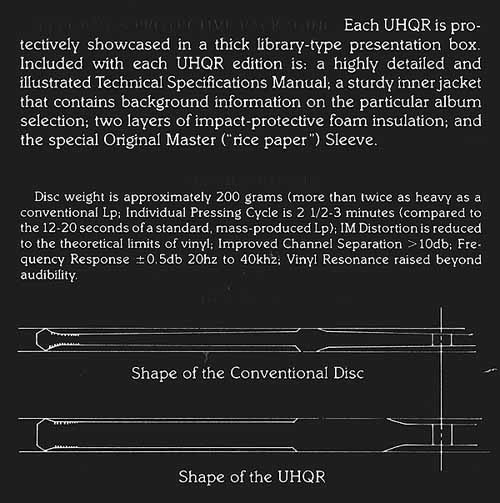
uhqrb

Later on in the decade, a label by the name of Mobile Fidelity would come along claiming to actually make better sounding pressings than the ones the major labels put out, and cluelessly I bought into that nonsense too. (To be fair, sometimes they did — Waiting for Columbus and American Beauty come to mind if you don’t have properly-pressed, properly-mastered originals, but my god, Katy Lied, Year of the Cat and Sundown have to be three of the worst sounding records I’ve ever played in my life.)

And isn’t it every bit as true today as it was in the past that the audiophiles who buy these “special” pressings, like the ones I bought back in the 70s and 80s, rarely seem to notice that many of them don’t actually sound good? (Some of the worst can be found here, the worst of the worst here.)

CofAEasy Answers and Quick Fixes

Turns out there are no easy answers. There are no quick fixes. In audio there’s only hard work and more hard work. That’s what gives the learning curve its curvature — the more you do it, the better you can do it.

And if doing all that work is also your idea of fun, you just might get really good at it.

If you actually enjoy playing five or ten or even fifteen copies of the same album to find the few that really sound good, and the one that sounds amazing — because hearing your favorite music the way it was meant to be heard is a positive thrill — then you just might end up with one helluva record collection, worlds better than one filled with audiophile pressings from any era, most especially the present.


Further Reading

We Owe You a Really Big Apology

Hot Stamper Pressings of the Music of Santana Available Now

Sonic Grade: F

Santana is a record we admit to having liked when it came out back in 2007. Since then we have changed our minds. As embarrassing as it may be, and let’s be clear, this pressing is very embarrassing, We got this one wrong and there is no sense trying to deny it.

It’s just so damn compressed and lifeless.

The whomp factor on this pressing is zero. Since whomp is critical to the sound of Santana’s music, it’s Game Over for us. The review below is exactly what we wrote at the time the record came in.

We tried to like it, but it’s clear to us now that we tried to like it too hard. Please accept our apologies.

I noted in my [now discontinued] blog on the site: “But now I would have to say that the MoFi LP is far too lifeless to be acceptable to anyone, even those with the worst kinds of Audiophile BS systems.”

And I noted that the Abraxas they remastered never got past the first elimination round. It had to have been one of the worst half-speeds I have ever heard. 

We also mentioned a while back (4/29/08, time flies) on our blog how bad the latest crop of MoFi vinyl was, with the heading: “Mobile Fidelity, Ouch.” Please to enjoy:

(more…)

Thoughts on MoFi’s Midrange Suckout

Our Favorite Roots Rock Albums with Hot Stampers Available Now

I was already a huge Mobile Fidelity fan in 1982 when they released Music from Big Pink, which, for some strange reason, was an album I knew practically nothing about.

I was 15 when the second album came out and I played that album all the time. For some reason the first album had eluded me. How it managed to do that I cannot understand, not at this late date anyway. A major malfunction on my part to be sure.

At some point in the early 90s I got hold of an early British pressing of the album.

Comparing it to my MoFi, I was shocked to hear the singers in the band so present and clear. Having only played MoFi’s remastered LP, I had never heard them sound like that.

The MoFi had them standing ten feet back.

The Brit put them front and center.

There was no question in my mind which presentation was right.

Around that time I was noticing that many Mobile Fidelity pressings seemed to be finding that same distant-midrange sound, and finding it on wildly different recordings. Recordings from different studios, by different engineers, in different eras.

The midrange suckout effect is easily reproducible in your very own listening room. Pull your speakers farther out into the room and farther apart and you can get that MoFi sound on every record you own. I’ve been hearing it in the various audiophile systems I’ve been exposed to for more than 40 years.

Nowadays I would place it under the general heading of My-Fi, not Hi-Fi. Our one goal for every tweak and upgrade we make is to increase the latter and reduce the former.

And note also that when you play your records too quietly, it creates an artificial sense of depth.

That’s one of the main reasons we play them loud; we want to hear the pressings that have real presence and immediacy, because they’re the ones that are most likely to win our shootouts.

(more…)

Bachelor No. 2 – MoFi Reviewed

More Rock and Pop Personal Favorites

An Audiophile Hall of Shame pressing and another Mobile Fidelity LP incompetently mastered for the benefit of those given to falling for easy answers and quick fixes.

I had not actually played the LP when I reviewed the MoFi CD, noting that the CD sounded great and that I expected the vinyl to be even better. In 2006 I should have known better but apparently I did not.

Mea culpa.

Boy, was I ever wrong. The vinyl has a bad case of sucked-out half-speed midsIt’s far too polite and lifeless to be taken seriously.

Is it the worst version of the album ever made? Since every CD I own sounds better, that would seem to be the case.

The comments about the music of course still apply — it’s brilliant — but I recommend the Gold or regular CD over this audiophile Heavy Vinyl pressing.

I used to consider this Mann’s One True Masterpiece. It’s actually her co-masterpiece, taking its place alongside the amazing I’m With Stupid, which is more of the rocker side of Mann. This is her Burt Bacharach side, prettier, sweeter and more melodic. Both are brilliant.

Aimee Mann is one of a handful of artists from the ’90s who actually makes music that can hold its own against the best popular recordings of the last forty years. There are few albums that I prize more highly or that have provided me with more musical satisfaction than those by Aimee Mann.

If you don’t know her music try one or both of the above-mentioned titles. Modern pop music just doesn’t get any better.   (more…)

Traveling Back in Time with Cat Stevens on Mobile Fidelity

Hot Stamper Pressings of the Music of Cat Stevens Available Now

Our good customer Roger wrote us a letter years ago about his Tea for the Tillerman on Mobile Fidelity, in which he remarked, “Sometimes I wish I kept my old crappy stereo to see if I could now tell what it was that made these audiophile pressings so attractive then.”

It got me to thinking. Yes, that would be fun, and better yet, it could be done. There are actually plenty of those old school audio systems of the 60s and 70s still around. Just look at what many of the forum posters — god bless ’em — are running. They’ve got some awesome ’70s Japanese turntables, some Monster Cable and some vintage tube gear and speakers designed in the ’50s.

With this stuff you could virtually travel back in time, in effect erasing all the audio progress made possible by the new technologies adopted by some of us over the last 30 years or so.

Then you could hear your Mobile Fidelity Tea for the Tillerman sound the way it used to when you could actually stand to be in the same room with it.

My question to Roger was “What on earth were we hearing that made us want to play these awful half-speed mastered records? What was our stereo doing that made these awful records sound good to us at the time?”

In Search of a Bad Stereo

I know how you can find out. You go to someone’s house who has a large collection of audiophile pressings and have him play you some of them. Chances are that his stereo will do pretty much what your old stereo and my old stereo used to do — be so wrong that really wrong records actually start to sound right! It seems crazy but it just might be true.

Think about it. If your stereo has no real top end extension, then a boosted top end like the kind found on practically every record MoFi ever made is a positive boon.

Down low, if you don’t have good bass reproduction, the bad bass that pretty much all half-speeds evince won’t bother you, it’ll sound bad the way the bass on all your records sounds: bad. And the boosted bass you get on so many MoFi pressings works to your benefit too.

How about those sparkling guitars? For systems that are incredibly opaque and low-resolution, the kind we all used to have, the kind that sound like we added three or four grilles to the front of the speaker, the MoFi guitars actually might start to cut through the veils and may sound — gulp! — right.

(more…)

Rainbow Seeker – Live and Learn

Reviews and Commentaries for Mobile Fidelity Records

A classic case of Live and Learn

[This commentary is at least fifteen years old. We mention Disc Doctor below, and once we had discovered the Walker System in 2007, we stopped using it to clean our records.]

Hot Stampers discovered! It took years, decades even, but it FINALLY happened. This copy has a side one with all the sound I always knew must be on the tape but somehow never seemed to make it to the vinyl. This copy has that sound!

Let me backtrack a bit. I’ve been recommending the MOFI for as long as I can remember, because it has always been the only copy that didn’t sound like a bad cassette.

The domestic pressings and imports I had run into over the years had no top end whatsoever, no bass below 50 or 60 cycles, and enough veils over the midrange to cover an entire harem. (No top and no bottom is our definition of boxy sound.)

The sound was also Pure Compressed Cardboard.

The best MOFI copies had an actual top end; a real bottom too. (Not a tight or deep one but that’s MOFI for you.) I’ve always loved the music, so even though the sound was somewhat washed out and lifeless, you could listen to the MOFI and enjoy it for what it was: not perfect, but a whole lot better than the alternatives. (The CD was hopeless by the way, no surprise there.)

Ah, but all that changed this week. We finally broke through.

I had just picked up a sealed original copy at a local store and was considering putting it up on the site, sealed of course. Then a thought went through my mind. I’ve always loved this record. What if this copy is The One? So I did the unthinkable. I cracked it open, and soon enough the needle was in the groove on my favorite track, Fly With Wings of Love.

To my surprise it had the BEST SOUND I had EVER heard for that song. When all was said and done, when all the copies in the backroom had been disc doctored, along with my three MOFI copies, and each carefully evaluated, sure enough this is the side two that turned out to be the King. I give it an A with Two Pluses. The typical domestic copy gets an F.

Wait, there’s more.

So with all our copies cleaned and ready to play, it was now time to play all the side ones. Even more shocking and surprising, one copy had a side one that was OUT OF THIS WORLD. Master tape sound, As Good As It Gets, perfection.

That’s this copy. Side two is pretty good, maybe a B+ or so. Better than average, but no Hot Stamper.

Since this is one of my favorite pop-jazz albums, I can’t recommend this album highly enough. It may not be deep — for real piano trio jazz check out Sample’s The Three — but it’s not trying to be. It is what it is — sophisticated, melodic, well-crafted piano-based easy-going jazz. With the awesome Eric Gale on guitar too.


Further Reading on Half-Speeds

The best place to start is here:

How come you guys don’t like Half-Speed Mastered records?

(more…)

Parallel Lines – MoFi Reviewed

Hot Stamper Pressings of the Music of Blondie Available Now

I became a giant fan of this album the moment I heard it, but I always felt that the sound of my old original left something to be desired. So many copies are thick and lifeless; the music wants to cook but the sound seems to be holding it back.

The record I had in the ’70s was probably not that good anyway. Fortunately, it only took us another 35+ years to figure out how to find the best pressings.

And like an idiot I’m sure I had traded my original domestic pressing in for the MoFi when it came out in the early ’80s, the kind of dumbass audiophile move I discuss in the commentary What Kind of Fool Was I?

As previously noted, the MoFi, one of those Jack Hunt turgid muckfests (check out City to City for the ultimate in murky MoFi sound), is incapable of conveying anything resembling the kind of clean, clear, oh-so-radio-friendly pop rock sound that Mike Chapman and the band were aiming for.

The recording has copious amounts of Analog Richness and Fullness to start with. Adding more is not an improvement; in fact it’s positively ruinous.

Is it the worst version of the album ever made?

(more…)

One of the Great Audio Disasters, Courtesy of Mobile Fidelity

More of the Music of Steely Dan

We recently amended this listing. Scroll down to see what we have to say about it in 2023.

More MoFi bashing, but boy does this MoFi deserve it. In our estimation, it is tied with the Cisco 180g pressing (2007) for the worst version ever.

I remember back in 1977 when Aja was released. I was a big Steely Dan fan by then, having been turned on to their albums with Countdown to Ecstasy in 73. With each new Dan record I became more impressed with their music, from Pretzel Logic to Katy Lied to Royal Scam and finally on to this, their commercial breakthrough.

At the time I thought the album sounded pretty good on my plain old ABC original.

Then I got a copy of the Mobile Fidelity pressing and I thought it sounded much, much better.

Side two of the MoFi had bass that was only hinted at on my domestic copy. Wow! Listen to all that bass!

Sometime in the 80s, I realized that the MoFi was hideously phony sounding, and that all the bass on side two was boosted far out of proportion to what must be (I’m guessing) on the master tape.

If I May

How much bass is on the master tape is of course of no concern to anyone not mastering the record. The bass has to be right on the record, not the tape.

The song Home At Last has at least an extra three or four DBs added around 50 cycles. It’s ridiculous.

And that’s just the bottom end; the highs are every bit as wrong.

(more…)