Decca/London/Argo – Reviews, Commentaries, Letters, etc.

Khachaturian Conducts Spartacus – Not As Good As We Thought

Hot Stamper Pressings of Orchestral Spectaculars Available Now

Probably more than ten years ago we had written the following about CS 6322:

The famous TAS list recording. The Decca 180 gram version is very good, but those of you who appreciate the qualities of the original mastering will want to have this one. 

Now jump ahead five years to five years ago. We played three or four copies of the album and none of them really worked for us.

The sound was a bit opaque, a bit dry, and not nearly as tubey as we would have liked. (Many Decca recordings suffer from dry strings, a shortcoming that is apparently rarely noticed by audiophiles and the reviewers who write for them.)

A good record, not a great one, and for that reason really not worth cleaning up and doing a shootout for.  The best copy would not pay for the labor to discover it.

Seems we got this one wrong. Live and learn is our motto, for precisely this reason.

There are quite a number of others that we’ve run into over the years with similar shortcomings. Here they are, broken down by label.

  • London/Decca records with weak sound or performances
  • Mercury records with weak sound or performances
  • RCA records with weak sound or performances

To this day, some of the records on the TAS list seem to me better suited to the old school audio systems of the 60s and 70s than the modern systems of today. These kinds of records used to sound good on those older systems, and I should know, I had an old school stereo and some of the records I used to think sounded good back in the day don’t sound too good to me anymore.

For a more complete list of those records, not just the ones on the TAS List, click here.

The following three things are best kept in mind when a pressing doesn’t sound like we remember it did, or think it should:

(more…)

El Amor Brujo – Brilliant Decca Remastering from 1967

Hot Stamper Pressings of Orchestral Spectaculars Available Now

UPDATE 2022

In 2012 we were knocked out by this Stereo Treasury Budget Reissue pressing.

We had the temerity to charge $175 for our Hot Stamper copy, a record we’d probably picked up locally for five or ten bucks. Nowadays of course it would go for even more than that, and still be worth every penny, assuming the buyer was looking for wonderful music with top quality sound regardless of the vinyl’s trade-in value, which in this case would probably be a dollar.

It is our strongly held belief that records are for playing and enjoying, not trading-in. Some records (like this one) are perfect for collectors, but their appeal is lost on us and has been since I soured on Mobile Fidelity records back in the 80s. It would take us another twenty years before we were done with other pressings that promised so much and delivered so little.

Decca released this title on their London label as a budget reissue, but that didn’t keep them from mastering it properly and pressing it on high quality vinyl.  The same cannot be said for RCA, which kept many of their golden age recordings in print on the RCA red label as well as others, but with sound that was most of the time clearly inferior to those earlier releases.


Our 2012 Review

Our current favorite El Amor Brujo for sound and performance is this Decca recording from 1967 with De Burgos conducting the New Philharmonia.

The best sound on this album is on side two, where El Retablo de Maese Pedro can be found.

(more…)

Some Stereo Systems Make It Difficult to Find Better Sounding Pressings

Hot Stamper Pressings on Decca & London Available Now

Many London and Decca pressings lack weight down low, resulting in an overall thinning of the sound and lower strings that get washed out.

On some sides of some copies of some titles the strings are dry, lacking Tubey Magic. This is decidedly not our sound, although it can easily be heard on many London pressings, the kind we’ve played by the hundreds over the years.

If you have a rich sounding cartridge, perhaps with that little dip in the upper midrange that so many moving coils have these days, you will not notice this tonality issue nearly as much as we do.

Our 17Dx is ruler flat and quite unforgiving in this regard. It makes our shootouts much easier, but brings out the flaws in all but the best pressings, exactly the job we require it to do.

Here are some other records that are good for testing string tone and texture.

If you have vintage tube equipment, or modern equipment that is trying to mimic the sound of vintage tubes, you never have to worry that the strings on your London orchestral recordings will sound too dry.

You haven’t solved the problem, obviously.  You’ve just made it much more difficult — impossible even — to hear what is really on your records.

Some audiophiles have gone down this road and may not even realize what road they are on, or where it leads. Assuming you want to make progress in this hobby, it is, from our point of view, a dead end.

If you want to find Better Records, you need equipment that can distinguish good records from bad ones.

Vintage tube equipment is good for many things, but helping you find the best sounding records is not one of them.

A rack full of equipment such as the one shown here — I suspect it is full of transistors but it really doesn’t matter whether it is or not — is very good at eliminating the subtleties and nuances that distinguish the best records from the much more common second- and third-rate pressings that often look identical to them.

If you have this kind of audio firepower, Heavy Vinyl pressings and Half-Speed mastered LPs don’t sound nearly as irritating as they do to those of us without the kind of filtering you get from the electronic overkill you see.

In my experience, this much hardware can’t help but create a barrier between you and the music you love.

It may be new and expensive, but the result is the kind of old school stereo sound I have been hearing all my life (and was perfectly happy with myself before the early 2000s.)

(more…)

Brahms / Piano Concerto No. 1 – What to Listen For

Hot Stamper Pressings of of the Music of Brahms Available Now

Our general notes for the recording seen below explain why the typical copy in our shootout fell short.

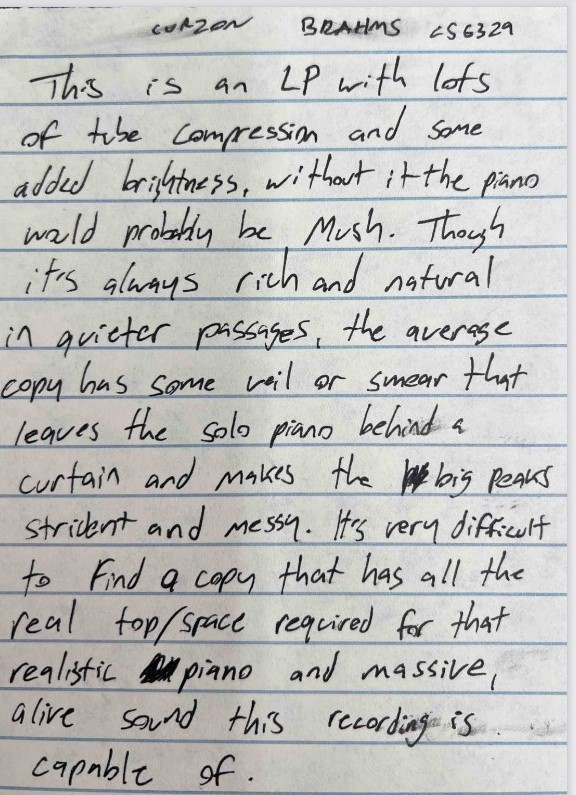
This is an LP with lots of tube compression, and some added brightness.

Without the added brightness, the piano would probably be mud.

The added brightness and compression results in a piano that always sounds rich and natural in the quieter passages.

The average copy also has some veiling or smearing that make the solo piano parts sound like they are coming fom behind a curtain. On these copies, the big peaks can often get strident and very messy.

It’s difficult to find a copy that has all the top end extension and space required to reproduce both a realistic piano and the massive live sound the orchestra is capable of.


All of which adds up to a difficult shootout in which relatively few copies had the sound we were looking for.

Production and Enginneering

(more…)

Borodin / Symphonies 2 & 3 – Side Two Had Some Common Sonic Problems

More of the music of Alexander Borodin (1833-1887)

This shootout, conducted back in 2012, was our first for the album.

This White Hot Stamper pressing has DEMO QUALITY sound of the HIGHEST ORDER on fairly quiet vinyl no less. We’ve long considered the album one of the greatest of all the Decca / London recordings, but this pressing takes the sound beyond even our high expectations.

There is simply nothing in the sound to fault. Where is the slightly dry and midrangy quality in the upper strings that so many Londons from this era suffer from? It’s nowhere to be found on this side one. (If you have a rich sounding cartridge, perhaps with that little dip in the upper midrange that so many moving coils have these days, you will not notice this tonality issue nearly as much as we do.)

And it’s not as though our stereo was hiding that quality, because some of it creeps into the sound on this very side two (which is why it earned a slightly lower grade of A++).

Big, rich and dynamic, this is the sound of LIVE MUSIC, and it can be yours, to enjoy for years to come — if you’ve got the stereo to play it and the time to listen to it.

The powerful lower strings and brass are gorgeous. Ansermet and the Suisse Romande get that sound better than any performers I know. You will see my raves on record after record of theirs produced during this era. No doubt the world renowned Victoria Hall they recorded in is key. One can assume Decca engineers use similar techniques for their recordings regardless of the artists involved. The only real variable should be the hall.

Ansermet’s recordings with the Suisse Romande exhibit a richness in the lower registers that is unique in my experience. His Pictures At Exhibition has phenomenally powerful brass, the best I’ve ever heard. The same is true for his Night On Bald Mountain. Neither performance does much for me — they’re both too slow — but the sound is out of this world. Like it is here.

Side One

A+++, big, rich and lively, yet clear, transparent and spacious. The brass is shockingly dynamic and powerful. I defy you to find better brass on a record than can be found on this side one. I can’t recall hearing it, and we play the best sounding Golden Age classical recordings by the score week after week.

Side Two

A++, a bit wider, with lovely sheen to the strings, but tonally a bit thinner and drier than it should be. Still, awfully good in comparison to the better classical records we put up every week, just not competitive with this amazing side one.

If you’re looking for Demonstration Quality Sound, look no further. This side one has it in spades.

Heavy Vinyl

Speakers Corner did a heavy vinyl reissue of this title, which we auditioned and used to sell. It’s reasonably good, but like all reissues it lacks the weight found on this original. I remember it being a little flat and bright. I haven’t played it in years so I could easily be wrong.

(more…)

It’s Records Like This that Give Decca Reissues a Bad Reputation

Hot Stamper Pressings of of the Music of Johannes Brahms Available Now

Apparently mastered with no regard to sound quality, this Decca SPA reissue is a mess.

How do we know that? We go out of our way to play every pressing we can get our hands on, even cheap reissues such as this. That’s our job.  We play everything to find the best sounding records so you don’t have to.

And some of these cheap reissues win shootouts!

But you can’t guess which ones will. You have to play them to find out.

And that’s how we know that some of them are good, some of them are mediocre, and some, like this one, are just awful.

Want to be assured of getting good sounding pressings of the greatest classical recordings of all time?

Step right up and order anything classical or orchestral you see here, Every one of them is guaranteed to please.

(more…)

On Dvorak’s Ninth, Big Brass Is Key to the Sound of the Best Pressings

More of the music of Antonin Dvorak (1841-1904)

What do all the best pressings all have in common?

There the ones with brass that is both powerful and weighty. That’s the sound that has the drive and energy to move the listener. As a rule, the tympani too will sound right when the brass has the air-moving power it should. The same is true for the lower strings.

Without fullness, richness and clarity in the area below the midrange, neither the sound nor the music can succeed. Many of the pressings we auditioned early on in an elimination round could not reproduce the brass with much weight; consequently they did not make it to the shootout.

(Sibelius’ Finlandia is the same way; it needs real weight down low. The huge brass opening of the piece is breathtaking on the best copies.)

More  of our favorite orchestral recordings with especially weighty brass

(more…)

Tchaikovsky / Swan Lake – Notes for All Four Sides

More of the Music of Tchaikovsky

This review was written for our first shootout of the complete ballet in 2012.

This London Small Red Label “Whiteback” (it’s white inside the box, not on the back, but you get what I mean) UK Import 2 LP Set put every other recording we had of Swan Lake to shame. This is the one folks, assuming you want a nearly complete performance of the work. (We will have some single LP highlight pressings coming to the site down the road. The Fistoulari on London can be especially good on the right pressing.) 

The performance here by Ansermet and the Suisse Romande I rank second to none.

Ansermet is surely the man for this music, and the famously huge hall he recorded in just as surely contributes much to the wonderful sound here. (The Royal Gala Ballet is a good example. If you have the two grand to spend we highly recommend you find yourself a good one. And don’t waste your money on the Classic no matter what you may have read elsewhere.)

Speaking of bad sounding Heavy Vinyl, Speakers Corner reissued this very recording on 180g fifteen years ago or so and ruined it. Imagine that. (I happily admit their Nutcracker was quite good for a Heavy Vinyl reissue. It cannot hold a candle to a good vintage pressing but it will beat most of what’s out there on audiophile vinyl, which, truth be told, isn’t saying much.)

This Masterpiece of Ballet Music should have a place in any audiophile’s classical collection.

Others that belong in that category can be found here.

(more…)

Beethoven / Symphony No. 3 – As Good as We Thought?

Hot Stamper Pressings of the Music of Ludwig van Beethoven Available Now

UPDATE 2025

We’ve just done the shootout for this album again and we could not find an original that sounded as good as the one we review here. Not only that, none of the originals we played earned even our minimum Hot Stamper grade.

To see the superior sounding reissue pressing we like now, please click here.


  • Both sides of this original copy were giving us the rich and Tubey Magical Decca / London sound we were looking for, earning excellent Double Plus (A++) grades
  • It’s simply bigger, more transparent, less distorted, more three-dimensional and more REAL than most of what we played
  • A top performance from Solti and the Vienna Phil – it’s classic Solti: fast-paced, exciting and powerful
  • Solti’s Beethoven recordings from 1959 are superb, with the 5th and 7th being every bit as good — it’s his later recordings, the ones from the early 1970s, that we find lacking

(more…)

Ravel and Ansermet Produce The Best Bolero on Vinyl

Hot Stamper Pressings of the Music of Maurice Ravel Available Now

Here are some comments from a Hot Stamper listing we did years ago.

The sound is clear, with wonderful depth to the stage.

As a rule, the classic ’50s and ’60s recordings of Ansermet and the Suisse Romande in Victoria Hall are as big and rich as any you may have ever heard.

These recordings may just be the ideal blend of clarity and richness, with depth and spaciousness that will put to shame 98% of the classical recordings ever made.

Side One

Bolero (Ravel)

Tubey and clear, with both the snare and the flute coming from so far back in the hall. OUTSTANDING energy and dynamic power.

Turn it up and it really comes to life like LIVE MUSIC. It’s big, wide and believable. We loved it.

Side Two

The Sorcerer’s Apprentice (Dukas)

ZERO compression. ZERO distortion when loud. Which means it has ZERO compressor distortion, something not five out of a hundred Golden Age recordings can claim. Nice extended top too.

There is depth and richness to beat the band, as well as clarity and tonal correctness that let you forget the recording and just enjoy the music. This piece is not quite as transparent as the Ravel, but still has earned every one of its Three Pluses.

The timbre of the brass is right on the money. As we have noted before, the brass of the Suisse Romande is some of the best to have ever been committed to analog tape.

Again, this side had OUTSTANDING energy and dynamic power the likes of which we think you may never have heard.

La Valse (Ravel)

Boasting some of the best sound of the three works we played on this copy. Again, with that wondrously huge hall adding a sense of space that will allow your speakers to disappear. The performers are not too close, which is very much in keeping with live music.

In his tribute to Ravel after the composer’s death in 1937, Paul Landormy described the work as follows:

“….the most unexpected of the compositions of Ravel, revealing to us heretofore unexpected depths of Romanticism, power, vigor, and rapture in this musician whose expression is usually limited to the manifestations of an essentially classical genius.”