
_Composers – Dvorak

Dvorak’s Symphony No. 9 – An Overview of Decca’s Recordings

More of the music of Antonin Dvorak (1841-1904)

This commentary was written close to a decade ago, when we were first trying to figure out which pressings and performances of the work were worth pursuing.

Please to enjoy.

We got off to a rough start with this piece of music. The early pressings we played were often sonically uninspiring, and that’s being charitable.

The London pressings with Kubelik (CS 6020) that we had thought were competitive with some of the better recordings we had on hand turned out to be disappointing.

The strings were often hard and shrill, the overall sound crude and full of smear.

These Londons cost us a pretty penny owing to the high quality condition we require them to be in for our shootouts. In the end, all that time, effort and money was for naught. A big chunk of dough was headed down the drain.

The Stereo Treasury pressing of this same performance sounded better to us than any of the Bluebacks we played but far from competitive with the recordings we ended up preferring.

The Londons and Deccas from 1967 with Kertesz conducting the LSO also left much to be desired sonically. After hearing the 9th on both London and Decca, we did a quick needle drop on the other symphonies from the complete cycle that Kertesz conducted and concluded that none of them were worth our time.

The trade-in pile was growing ever taller.

Then some good news came our way when we dropped the needle on the Decca/London recording with Mehta and the LA Phil. Our best London sounded shockingly good, much better than the one Decca pressing we had on hand.

His 8th Symphony (CS 6979) is also quite good by the way.

This is surprising because we rarely like anything by Mehta and the LA Phil. from this period — the recording in question is from 1975 — but of course we are happy to be surprised when the recordings sound as good as the ones we played.
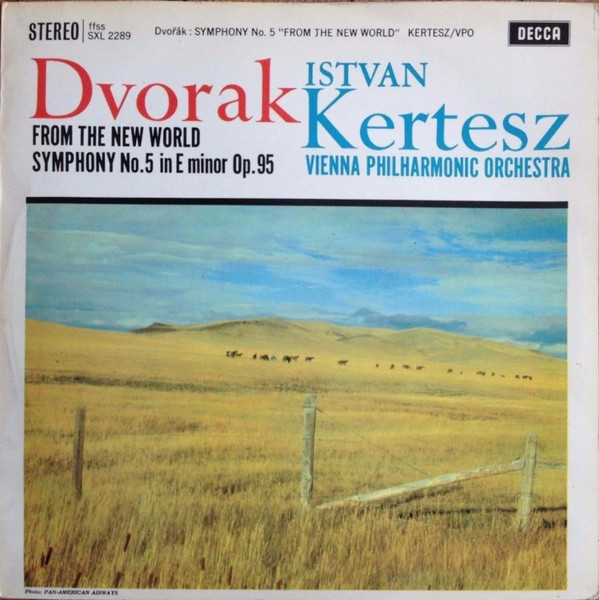
The one that seemed to us to be the best balance of sound and performance was conducted by Istvan Kertesz, but not with the LSO.

His recording with the Vienna Philharmonic in 1961, his debut for Decca as a matter of fact, is the one that ended up winning our shootout of a dozen pressings or so.

We prefer a later mastering of the recording though, not the original.

Here are more reviews of music conducted by Kertesz, a man whose work we very much admire.

(more…)

On Dvorak’s Ninth, Big Brass Is Key to the Sound of the Best Pressings

More of the music of Antonin Dvorak (1841-1904)

What do all the best pressings all have in common?

There the ones with brass that is both powerful and weighty. That’s the sound that has the drive and energy to move the listener. As a rule, the tympani too will sound right when the brass has the air-moving power it should. The same is true for the lower strings.

Without fullness, richness and clarity in the area below the midrange, neither the sound nor the music can succeed. Many of the pressings we auditioned early on in an elimination round could not reproduce the brass with much weight; consequently they did not make it to the shootout.

(Sibelius’ Finlandia is the same way; it needs real weight down low. The huge brass opening of the piece is breathtaking on the best copies.)

More  of our favorite orchestral recordings with especially weighty brass

(more…)

Dvorak / Symphony No. 9 – The Best on Record

More of the Music of Antonin Dvorak

  • This big, lively, and dynamic UK Decca pressing boasts superb Double Plus (A++) grades on both sides – fairly quiet vinyl too
  • The sound of the hall the Vienna Phil recorded in is huge, so wide and deep, spacious and open – the perspective is above all natural
  • Tons of energy, loads of rich detail and texture, superb transparency and excellent clarity – this pressing is the very definition of Orchestral Demo Disc Sound
  • “It is a great symphony and must take its place among the finest works in the form produced since the death of Beethoven.” – The New York Times
  •  When you hear how good this record sounds, you may have a hard time believing that it’s a budget reissue from 1970. Even more extraordinary, the right copies are the ones that win shootouts
  • There are about 150 orchestral recordings we’ve awarded the honor of offering the Best Performances with the Highest Quality Sound, and Kertesz’s with the Vienna Phil. certainly deserves a place on that list.

Presenting yet another remarkable Demo Disc from the Golden Age of Vacuum Tube Recording Technology, in this case 1961, with the added benefit of mastering courtesy of the more modern equipment of the ’70s, in this case 1970. (We are of course here referring to the good modern equipment of 50+ years ago, not the bad modern mastering equipment of today.)

(more…)

Dvorak / Symphony No. 9 – Probably a Good Speakers Corner Release

More of the music of Antonin Dvorak (1841-1904)

The one recording of this work that seemed to us to have the best balance of sound and performance was conducted by Istvan Kertesz. His recording with the Vienna Philharmonic in 1961, his debut for Decca as a matter of fact, is the one that ended up winning our shootout of a dozen pressings or so.

You may be aware that Speakers Corner remastered this recording  in the ’90s. We carried it and recommended it highly at the time.

Now that we have much better equipment and much higher standards than we did then, we probably would not like it as well. Still, if you can pick one up for cheap, something close to the thirty bucks we used to charge, it might not be such a bad deal.

I will be happy to give Speakers Corner credit for knowing which recording of the work was most deserving of remastering. They make a lot of mistakes, but this is not one of them.

Unsurprisingly, we prefer a later mastering of the recording, not the original.

Here are more reviews of music conducted by Kertesz, a man whose work we very much admire.

(more…)

Dvorak / Cello Concerto / Fournier / Szell – Reviewed in 2010

More of the music of Antonin Dvorak (1841-1904)

This Deutsche Grammophon German Import LP is especially warm and sweet, especially for a DG record.

The tape hiss here is exactly right, which tells me that the smooth sound that I’m hearing is what the tape actually recorded and the engineers wanted. The cello sound is wonderful with an especially woody tone and nice texture to the strings.


This is an Older Classical/Orchestral Review

Most of the older reviews you see are for records that did not go through the shootout process, the revolutionary approach to finding better sounding pressings we started developing in the early 2000s and have since turned into a veritable science.

We found the records you see in these older listings by cleaning and playing a pressing or two of the album, which we then described and priced based on how good the sound and surfaces were. (For out Hot Stamper listings, the Sonic Grades and Vinyl Playgrades are listed separately.)

We were often wrong back in those days, something we have no reason to hide. Audio equipment and record cleaning technologies have come a long way since those darker days, a subject we discuss here.

Currently, 99% (or more!) of the records we sell are cleaned, then auditioned under rigorously controlled conditions, up against a number of other pressings. We award them sonic grades, and then condition check them for surface noise.

As you may imagine, this approach requires a great deal of time, effort and skill, which is why we currently have a highly trained staff of about ten. No individual or business without the aid of such a committed group could possibly dig as deep into the sound of records as we have, and it is unlikely that anyone besides us could ever come along to do the kind of work we do.

The term “Hot Stampers” gets thrown around a lot these days, but to us it means only one thing: a record that has been through the shootout process and found to be of exceptionally high quality.

The result of our labor is the hundreds of titles seen here, every one of which is unique and guaranteed to be the best sounding copy of the album you have ever heard or you get your money back.

Stick with Stereo on the Dvorak & Glazounov Violin Concertos with Milstein

More of the music of Antonin Dvorak (1841-1904)

Stick with stereo on this album.

The Mono pressings — at least the ones we’ve played — aren’t worth anybody’s time (scratch that: any audiophile’s time).

(more…)

Dvorak / Cello Concerto – Hard to Recommend on Living Stereo

Hot Stamper Pressings of Living Stereo Titles Available Now

I have never heard a copy of this record sound better than decent. This title is very unlikely to have the wonderful sound of the best Living Stereo pressings that you can find on our site, each of which has been carefully evaluated to the highest standards.

If you can get one for cheap, go for it. Otherwise I recommend you pass if what you are looking for is audiophile quality sound.

Perhaps the poor recording quality (I’m guessing; obviously I’ve never heard the master tape) explains the poor sound of the Classic Records remastered version from 1994.

Not that that stopped anybody from buying those awful 180 gram pressings! They may have been mastered by one of the greats, Bernie Grundman, but he was well past his prime when he was working for that awful label, as we explain here.

Have You Noticed?

If you are a fan of Living Stereo pressings, have you noticed that many of them – this one for example – don’t sound all that good?

If you’re an audiophile with good equipment, you should have. But did you? Or did you buy into the hype surrounding these rare LSC pressings and just ignore the problems with the sound?

There is an abundance of hype surrounding the hundreds of Heavy Vinyl pressings currently in print. I read a lot about how wonderful their sound is, but when I actually play them, I rarely find them to be any better than mediocre, and most of them are downright awful.

Music Matters made this garbage remaster. Did anyone notice how awful it sounded? I could list a hundred more that range from bad to worse — and I have! Take your pick: there are more than 150 entries in our Heavy Vinyl Disasters section, each one worse sounding than the next.

It seems as if the audiophile public has completely fallen for these modern Heavy Vinyl pressings.

Audiophiles have made the mistake of approaching these records without the slightest trace of skepticism. How could so many be fooled so badly? Surely some of these people have good enough equipment to allow them to hear how bad these records sound.

Maybe not this guy, or this guy, but there has to be at least some group of audiophiles, however small their number might be, with decent equipment and two working ears out there, right? (Excluding our customers of course, they have to know what is going on to spend the kind of money they spend on our records. And then write us all those letters.)

I would say RCA’s track record during the ’50s and ’60s is a pretty good one, offering (potentially) excellent sound for roughly one out of every three titles or so.

But that means that odds are there would be a lot of dogs in their catalog. This is definitely one of them.

(more…)

Overtures and Dances with Reiner – Were We Wrong? Probably

Hot Stamper Pressings of TAS List Super Disc Albums

Reviews and Commentaries for TAS Super Disc Recordings

This is a very old commentary. Lately every copy of this record that we have auditioned has left us wondering: what is the appeal?

Take this review with a large grain of salt and don’t spend a lot of money on this title unless you can easily return it.

We don’t think it sounds very good, and rather than continue to buy more copies, we are going to give up and write it off as a lost cause, TAS List or no TAS List.

This RCA Pink Label TAS List LP plays Mint Minus. Side one of this record sounds AMAZING, especially the Dvorak piece.

Here are the comments for the copy we recently sold on the site:

Superb string tone. This is one record that deserves to be on the TAS list, and you have to give Harry credit for going against the audiophile tide and recognizing a cheap, thin pink VIC! Side one sounds incredible. I do not ever recall hearing sound like this on this Victrola. It’s demonstration quality sound.

Classic Records remastered this record not long ago and ruined it.

This is what it’s supposed to sound like. (more…)

Dvorak / Cello Concerto – Hard to Recommend on Classic Records

Hot Stamper Pressings of the Music of Dvorak Available Now

Sonic Grade: F

An Audiophile Hall of Shame pressing and another Classic Records LP debunked.

This is a Classic Records pressing (Remember the Sound!) that never sounded very good to me. But the original never impressed either, as you can see from our review of it below.

I have never heard a copy of this record sound better than decent. This title is very unlikely to have the wonderful sound of the best Living Stereo pressings that you can find on our site, each of which has been carefully evaluated to the highest standards.

We love the Starker recordings on Mercury. Wish we could afford to buy some and do a shootout. At the prices they command these days, that is very unlikely to happen.


UPDATE: 2024

Starting in 2024, we were able to do a number of shootouts for Starker’s Mercury recordings.

If we have any titles in stock, they can be found here.

Reviews can commentaries for them can be found here,


We used to recommend the Superanalogue pressing you see pictured when it was in print. I doubt we would care much for it now.

(more…)

Dvorak’s Symphony No. 1 with Kertesz Is Just Too Smooth

Hot Stamper Classical and Orchestral Imports on Decca & London

This is an IMMACULATE London LP with the old style paste-on back cover. We cracked open the factory seal just to make sure that this was a British pressing.

As we’ve said before, Kertesz is the Dvorak man! He recorded the complete cycle for London; many of those LPs have superb performances and excellent sound.

We dropped the needle momentarily on this title and heard sound that was overly smooth for my taste. If you like your records on the smooth side, this record might be more up your alley than it was ours.

There are a number of other Deccas and Londons that we’ve played over the years that were disappointing, and many of them can be found here.