_Composers – Copland

Copland / Billy The Kid / Rodeo – Johanos

More Classical Masterpieces

  • This vintage copy of this Copland Masterpiece boasts solid Double Plus (A++) sound from first note to last, with no audible marks and no Inner Groove Distortion (IGD)
  • The vinyl is somewhat noisy, alas, as is sometimes the nature of the beast with these early pressings, but once you hear just how superb sounding this copy is, you might be inclined, as we were, to stop counting ticks and pops and just be swept away by the music
  • A spectacular Demo Disc recording that is clear, rich, dynamic, transparent and energetic – here is the big, bold sound we love
  • “To the ultimate delight of audiences Copland managed to weave musical complexity with popular style.”
  • If you’re a fan of orchestral showpieces such as these, this recording from 1967 belongs in your collection.

This vintage Turnabout pressing has the kind of Tubey Magical Midrange that modern records can barely BEGIN to reproduce. Folks, that sound is gone and it sure isn’t showing signs of coming back. If you love hearing INTO a recording, actually being able to “see” the performers, and feeling as if you are sitting in the studio with the band, this is the record for you. It’s what vintage all analog recordings are known for —this sound. (more…)

Rodgers – Slaughter On Tenth Avenue / Fiedler

More Orchestral Spectaculars

  • With two outstanding Double Plus (A++) sides, you’ll have a hard time finding a copy that sounds remotely as good as this vintage Shaded Dog pressing, recorded in All Tube 1959 Living Stereo
  • Boasting two INCREDIBLE Shootout Winning Triple Plus (A+++) sides or close to them, this early Shaded Dog pressing, recorded in Living Stereo, is practically as good a copy as we have ever heard
  • It’s also fairly quiet at Mint Minus Minus, which makes it unusual in our experience for a record made in 1959
  • These sides are doing nearly everything right – they’re rich, clear, undistorted, open, spacious, and have depth and transparency to rival the best recordings you may have heard
  • The music flows from the speakers effortlessly – you are there
  • This record will have you asking why so few Living Stereo pressings actually do what this one does. The more critical listeners among you will recognize that this is a very special copy indeed. Everyone else will just enjoy the hell out of it.
  • Like many of our favorite orchestral spectaculars, weighty, powerful brass is key to the sound of the best copies like this one
  • 1959 was a phenomenal year for audiophile quality recordings – we’ve auditioned and reviewed more than a hundred and thirty so far, and there are undoubtedly a great many more that we’ve yet to play

Years ago we wrote:

This copy was so good it almost left me speechless. Why is it not one of the most sought-after recordings in the RCA canon? Beats the hell out of me.

But wait just one minute. It wasn’t until a few years ago that I found out just how good this record could sound, so how can I criticize others for not appreciating a record I had never taken the time to appreciate myself?

Which more than anything else prompts the question — why is no one exploring, discovering and then bringing to light the exceptional qualities of these wonderful vintage recordings (besides those of us here, of course)?

(more…)

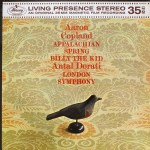
This Mercury Copland Record Had Screechy, Shrill Strings

Hot Stamper Classical and Orchestral Pressings Available Now

Our notes for SR 90246 read:

Lively and clear but screechy strings. Dry and bright sound.

To help you avoid records with these sonic faults, we’ve linked below to others with similar problems.

Here are some titles we’ve found that tend to have dry sound, and here are some that tend to have bright sound.

And of course shrill strings are the kiss of death on any orchestral record. (Classic Records, I’m talking to you!)

None?

None of the copies of SR 90246 we played were any good, but the RFR3 / RFR6 was the worst of the bunch.

Are there good sounding pressings of the recording?

There may well be. We didn’t hear any, but that doesn’t mean they don’t exist.

However, we have no intention of spending more money trying to find them. If you know of some killer stampers for the album, please shoot us an email.

We tend to like Dorati’s work with the London Symphony Orchestra, but in this case the better Dorati/Copland record was recorded in Minneapolis in 1959, SR 90172.

If You’re a Fan

If you’re a fan of Mercury Living Presence records — and what right-thinking audiophile wouldn’t be? — have you noticed that many of them, this one for example, don’t sound very good?

If you’re an audiophile with good equipment, you should have.

But did you? Or did you buy into the hype surrounding these rare pressings and just ignore the problems with the sound?

(more…)

Copland – Rodeo / El Salon Mexico / Danzon Cubano / Dorati

More Music Conducted by Antal Dorati

  • Dorati and the Minneapolis Symphony Orchestra’s performance of these wonderful Copland works appears on the site for only the second time ever, here with solid Double Plus (A++) sound or BETTER throughout this original Plum Label Mercury stereo pressing of SR 90172
  • It’s also remarkably quiet at the high end of Mint Minus Minus, a grade that even our most well-cared-for vintage classical titles have trouble playing at
  • This copy is everything that a good Mercury should be: dynamic, open, immediate, exciting, and of course, with Dorati and the MSO, beautifully performed
  • The “of course” should be taken with a grain of salt — plenty of Dorati Mercury records do not sound good, and if anybody should know, we should, we’ve played them by the score
  • But we love what he and the MSO have done with these Copland pieces – we tried lots of other recordings, and nothing could touch Mercury for exciting, lifelike and energetic sound
  • 1959 was a phenomenal year for audiophile quality recordings – as of 2025 we’ve auditioned hundreds and reviewed more than one hundred and seventy titles, and there are undoubtedly a great many more that we’ve yet to discover.
  • We think there are a large number that belong in any audiophile’s record collection worthy of the name.

(more…)

An Insult to Aaron Copland on Reference Records

Hot Stamper Pressings of Orchestral Music Available Now

Yet another Reference Record we’ve reviewed and found wanting.

In all the years I was selling audiophile records, one of the labels whose appeal made no sense to me whatsoever (along with their long-forgotten TAS list brethren, American Gramaphone and Telarc) was Reference Records.

Back then, when I would hear one of their orchestral or classical recordings, I was always left thinking, “Why do audiophiles like these records?”

I was confused, because at that time, back in the 80s, I had simply not developed the listening skills that today make it so easy to recognize the faults of their recordings.

I made the mistake of thinking that other audiophiles with more advanced equipment and more refined listening skills must be hearing something I was not.

I had trouble putting my finger on what I didn’t like about them, but now, having worked full time (and then some!) for more than twenty years to develop better critical listening skills, the shortcomings of their records, or, to be more accurate, the shortcomings of this particular copy of this particular title, took no time at all to work out.

My transcribed notes for RR-22:

  • Lean tonality
  • No real weight
  • No Tubey Magic
  • Blurry imaging when loud
  • No real depth
  • Bright tonal balance

Is this the sound you are looking for in an audiophile record?

Shouldn’t you be looking for audiophile quality sound?

Well, you sure won’t find it here.

On our current playback system, this Reference Record is nothing but a joke, a joke played on a much-too-credulous audiophile public by the ridiculously inept and misguided engineers and producers who worked for Reference Records.

This is a reference for something? For what?

As I wrote about another one of their awful releases, if this is your idea of a reference record, you are in real trouble.

It would be hard to imagine that anyone who has ever heard a good vintage classical recording — here are some of our favorites — could ever confuse this piece of audiophile trash with actual hi-fidelity orchestral sound.

(more…)

Destination Stereo, Gresham’s Law and the State of Reviewing As We See It

Hot Stamper Pressings of Orchestral Spectaculars Available Now

Explosive dynamics, HUGE space and size, with unerringly correct tonality, this is a Demo Disc like no other.

When “in-the-know” audiophiles discuss three-dimensionality, soundstaging and depth, they should be talking about a record with sound such as this.

But are they? The so-called “glorious, life-changing” sound of one Heavy Vinyl reissue after another seems to be the only kind of record audiophiles and the reviewers who write for them want to talk about these days.

Even twenty years ago reviewers noted that tracks on compilations such as this often had better sound than the albums from which they were taken, proof that they were listening critically and comparing pressings.

What happened to reviewers of that caliber?

I can tell you what happened to them: they left audio, driven out according to the principle that underlies Gresham’s Law:

Bad reviewers drive out good ones.

Which leaves you with the type that can’t tell how mediocre-at-best most modern Heavy Vinyl reissues are. A sad state of affairs if you ask me, but one that no longer impacts our business as we simply don’t bother to buy, sell or play most of these records.

(more…)

Ambrosia – Somewhere I’ve Never Travelled

  • An original pressing of this truly phenomenal 70s big rock production (one of only a handful of copies to hit the site in years) with solid Double Plus (A++) grades or close to them from top to bottom
  • Side two was sonically very close to our Shootout Winner – you will be shocked at how big and powerful the sound is
  • The reason you never see this album on the site is that it’s extremely difficult to find good sounding pressings that play quietly — most of our best copies are just too noisy to sell, making this shootout pretty much a bust
  • This copy gives you the harmonic coherency, richness, body and Tubey Magic that nothing being pressed today can begin to offer
  • The better sides have the trademark Alan Parsons sound, with huge amounts of space in the studio, and the kind of musical energy that made the first Ambrosia album (which he mixed) such a joy to play
  • I’ve been listening to this album a lot lately — even though I was never that big of a fan of their sophomore effort, now that I’ve played thousands of albums since this one came out, I can tell you that I became obsessed with trying to understand all the musical influences that went into the heads of these four guys and came out on this album
  • “There is an unusual dreamlike quality that pervades its work. The songs seem to be reaching the listener direct from some strange and beautiful realm of the unconscious. It is an experience rare in popular music today or at any time.” – Billboard

Alan Parsons produced this album, and at its best, it is truly a Demo Disc — if you have the system to play it.

This album needs lots of space and a big, wide, open soundstage if it’s going to work, and the best sides deliver that sound. It’s a rare copy that manages to have real presence and top end without getting too edgy; on the good ones, the bass is big, solid and punchy and the energy is superb. (more…)

Billy The Kid / Rodeo – How Do the Record Club Copies Sound?

Hot Stamper Pressings of Classical Masterpieces Available Now

Without anyone knowing, a Record Club pressing found its way into one of our shootouts a few years back. Because the person doing the listening has no idea what pressing is on the table, biases and prejudices cannot affect the grading or the outcome of the shootout.

It earned Two Pluses, not enough to win a shootout, but enough to put practically any orchestral record made in the last thirty years to shame. We noted at the time:

This spectacular Demo Disc recording is clear, rich, dynamic, transparent and energetic – here is the BIG, BOLD sound we love. There is a note on the inner sleeve that says this was a Record Club of America purchase in 1973.

Can you imagine that a Record Club was offering records in 1973 that were better sounding than anything being made today? Astonishing.

There are about 150 orchestral recordings we think offer the best performance coupled with the highest quality soundThis record has earned a place on that list.

If you’re a fan of orchestral showpieces such as these, this recording from 1967 belongs in your collection.

(more…)

Bose Salutes the Sound Of Mercury Records (and Some Audio Lessons Learned Long Ago)

Hot Stamper Pressings of Mercury Recordings Available Now

This Bose / Mercury Demonstration LP is autographed by none other than Amar G. Bose. The autograph reads “To EMI, with regards and best wishes, Amar G. Bose.”

Bose may not have ever made very good speakers, but they sure knew good recordings when they heard them. This LP has excerpts from some of the top Mercury titles, including music by Copland (El Salon Mexico), Kodaly (Hary Janos Suite), Mussorgsky/ Ravel (Pictures At An Exhibition), and Rimsky-Korsakov (Russian Easter Overture).

I played one of these Bose records years ago and was surprised at how good it sounded. The transfers of the Mercury tapes were excellent. I guess that makes sense — if you want to show off your speakers you had better use a well-mastered record for the demonstration.

I was duped into buying my first real audiophile speaker, Infinity Monitors, when the clever salesman played Sheffield’s S9 through them. I bought them on the spot. It was only later when I got home that none of my other records sounded as good, or even good for that matter. That was my first exposure to a Direct to Disc recording.

To this day I can still picture the room the Infinity’s were playing in. It was a watershed moment in my audiophile life.

And of course I couldn’t wait to get rid of them once I’d heard them in my own system with my own records. I quickly traded them in for a pair of RTR 280-DRs. Now that was a great speaker! A 15 panel RTR Electrostatic unit for the highs; lots of woofers and mids and even a piezo tweeter for the rest. More than 5 feet tall and well over 100 pounds each, that speaker ROCKED.

(more…)

Rimsky-Korsakoff, Saint-Saens, Prokofieff – Destination Stereo

More Classical and Orchestral Recordings

  • Boasting two STUNNING Shootout Winning Triple Plus (A+++) Living Stereo sides, this original Shaded Dog pressing is the BEST we have ever heard
  • It’s also fairly quiet at Mint Minus Minus, a grade that even our most well-cared-for vintage classical titles have trouble playing at
  • Explosive dynamics, huge space and size, unerringly correct tonality, this is a Demo Disc like no other
  • Shockingly real – proof positive that the cutting systems of the day are capable of much better sound than some audiophiles might think – if more evidence of that fact is what you’re after, see here and here
  • It has all the Living Stereo magic one could ask for, as well as the bass and dynamics that are missing from other Golden Age records
  • If you’re a fan of orchestral showpieces such as these, this Living Stereo from 1959 belongs in your collection.

This record is designed to show off the Living Stereo sound at its best and it succeeds magnificently. The full range of colors of the orchestra are presented here with remarkable clarity, dynamic contrast, spaciousness, sweetness, and timbral accuracy.

If you want to demonstrate to a novice listener why modern recordings are unsatisfactory, all you have to do is play this record for them. No CD ever sounded like this.

Just play “Gnomus” to hear The Power of the Orchestra, Living Stereo style.

The fourth and fifth movements of “Capriccio Espagnol,” the second track on side one, sound superb, clearly better here than on the Shaded Dog pressings we played a few years ago (which were terrible and never made it to the site. Great performance but bad mastering of what obviously was a very good master tape).

You can also hear the Living Stereo sound especially well on the excerpt from “The Fourth of July” performed by Morton Gould. It’s one of the best sounding tracks here.

When “in-the-know” audiophiles discuss three-dimensionalitysoundstaging and depth, they should be talking about a record that sounds like this.

(more…)