Month: September 2023

Yes – Fragile

  • Fragile is FINALLY back on the site after a two year hiatus, here with excellent Double Plus (A++) sound from start to finish
  • Both of these sides boast superb clarity and astonishing transparency thanks to the brilliant engineering of Eddie Offord
  • Bigger and bolder, with more bass, more energy, and more of the “you-are-there-immediacy” of ANALOG that sets the better vintage pressings apart from reissues, CDs, and whatever else you care to name
  • If all you know is the mediocre Heavy Vinyl pressing from years back, you are in for a real treat with this Hot Stamper
  • AMG 5 stars, our Top 100, and the second of the band’s three Must Own Prog Rock Masterpieces (the other two, of course, being The Yes Album and Close to the Edge)
  • “Fragile was Yes’ breakthrough album… it also marked the point where all of the elements of the music (and more) that would define their success for more than a decade fell into place fully formed.”

We doubt you’ve heard too many (if any) rock records that sound as amazing as this one. It’s dynamic, punchy and powerful, with the kind of super-low distortion sound that lets you really crank the levels, the louder the better. How many Yes records will let you do that? This one will. That’s what you get for your money — the kind of sound that can blow your mind over and over again for as long as you live, or at least as long as your hearing holds out.

Both sides are smooth and sweet with virtually no smearing up top or distortion on the piano. The overall sound is airy, open, spacious, and three-dimensional. The grit, grain and spit that characterize most copies are nowhere to be found here.

(more…)

Magical Mystery Tour – Our Beyond White Hot Copy from 2007

Hot Stamper Pressings of the Music of The Beatles Available Now

Looking back, 2007 seems to have been a milestone year for us here at Better Records, although we certainly did not know that at the time.

Later that same year we swore off Heavy Vinyl for good (prompted by the mediocre sound of the Rhino pressing of Blue) and committed ourselves to doing record shootouts of vintage pressings full time. (Please excuse the overuse of capitals.)


Our Commentary from 2007

The best sounding Magical Mystery Tour ever! Hot Stamper copies of this album are a regular feature on this site, but we’ve NEVER heard one like this — on EITHER side.

We had no choice but to award this album the very rare grade of A++++ (Four Pluses!) on both sides.

Our lengthy commentary entitled  entitled outliers and out-of-this-world sound talks about how rare these kinds of pressings are and how to go about finding them.

We no longer give Four Pluses out as a matter of policy, but that doesn’t mean we don’t come across records that deserve them from time to time.

(more…)

Sergio Mendes and Brasil ’66 – Stillness (with Correct Polarity)

More Sergio Mendes

More Bossa Nova

  • An excellent A&M pressing of this incredibly well-recorded and criminally-overlooked LP with Double Plus (A++) grades or close to them throughout
  • Both sides of this copy are in correct polarity, so no need to worry about switching the polarity, as we must do with many of the copies – just drop the needle and enjoy!
  • The soundfield has a three-dimensional quality that will absolutely blow you away (assuming you have big speakers and like to turn them up good and loud)
  • Wonderfully present and breathy vocals from the lovely ladies in Sergio’s band – they provide most of the audiophile  appeal (and all of the sex appeal), and we know of nothing else like them on record
  • A permanent member of our Top 100 and Demo Disc par excellence
  • 4 stars: “Stillness is a concept album — the title tune opens and closes it in moody stillness — and a transition piece all at once…. Overlooked in its day, Stillness is the great sleeper album of Sergio Mendes’ first A&M period.”
  • This is a Must Own album from 1970, which just happens to be a great year for Rock and Pop Music, maybe the greatest of them all

We figure we’re about due for a thank you note from Mr. Mendes, because we’ve turned a huge number of audiophiles into die-hard fans of this album. It’s easy to see why when you play a copy that sounds like this. All of the qualities we look for on this album are right here.

If you are looking for DEMO DISC QUALITY SOUND with music every bit as wonderful, look no further — this is the record for you.

If I had one song to play to show what my stereo can really do, “For What It’s Worth” on a Hot Stamper copy would probably be my choice. I can’t think of any material that sounds better. It’s amazingly spacious and open, yet punchy and full bodied the way only vintage analog recordings ever are. This one being from 1970 fits the bill nicely.

Side two of this album can be one of THE MOST MAGICAL sides of ANY record — when you’ve got a killer copy. I don’t know of any other record like it. It seems to be in a class of its own. It’s an excellent test disc as well. All tweaks and equipment changes and room treatments must pass the Stillness test.

To fail to make this record sound better is to fail completely. The production is so dense, and so difficult to reproduce properly, that only recently have I begun to hear just how good this record can sound. There is still plenty to discover locked in these grooves, and all of us here at Better Records enthusiastically accept the challenge to find all the sounds that Sergio created in the studio, locked away in the 50+ year old vinyl.

(more…)

Do the “Wrong Stampers” Sometimes Win Shootouts?

mendestill_depth_1102533608More of the Music of Sergio Mendes and Brasil ’66

Soren has some questions about shootouts and our White Hot Stamper pressing of Stillness. His questions are indented, our answers are not.

Tom,

Does it ever bug you to realize, maybe one or two years down the road and with (as Tom mentions) better playback/cleaning technology, that stampers which you dismissed in a shootout turn out to win the next one, meaning that you could have let many possible hot stampers go?

Soren,

We talk about that a bit here: which is better: Phil DeLancie digital or George Horn analog?

But being bugged by it does no good. It is a reality that must be accepted.

Because we know how easy it is to be wrong, or, more precisely, to not know everything we would like to know, we never stop doing research and development for the titles we sell.

We tell people all the time, go play your Heavy Vinyls and Half-Speeds that you haven’t played recently. If you’ve made improvements to your system, they will often start to show themselves to be not nearly as good sounding as you remember, and that means you are making progress.

I was actually reaching out to you to inquire whether the super hot Sergio Mendes Stillness that I bought from you a couple of years ago is the version with the phase reversed on side 2?

I ask because I don’t recall a phase issue on this specific title was ever mentioned on your site back when I bought it (i would have remembered, I think) so maybe you only found out recently?

Side 1 on the record sounds better to me than side 2. The matrix on this side 2 ends in “M3”.

Both M2 and M3 are in correct polarity.

M3 used to win shootouts by the way. For the longest time, at least ten years, I thought M3 was the ultimate side two.

(more…)

Led Zeppelin / II – Jimmy Page Remasters a Classic, Part III

Hot Stamper Pressings of the Music of Led Zeppelin Available Now

One of our customers did his own comparison with two pressings he had on hand. (Emphasis added.)


I briefly listened to the recent JP copy against the RL pressing I have from Presswell. I think that (according to Robert Brook) the Monarch or Specialty ones usually win your shootouts, and that the Presswells don’t often sound as transparent. The copy I have is pretty good but probably still falls into this category.

Having said that, my main takeaway was the almost complete absence of reverb on the JP copy. This was especially apparent when listening to the big drums and the vocals. The RL cut seems to give a much better sense of the studio and more space around the instruments, on my system.

The imaging and placement of the musicians is clear and distinct, but not as spacious as the RL pressing. The tonality and timbre on the JP cut are very good though, and the mix is not muddy and does not fall apart in loud complex passages like most other modern pressings I have heard. But this may have been his intention: to focus the instruments and tighten up the way the compositions come across without the “echoey” quality of the reverb and the overwhelming bass of the RL cut.

Also the JP cut is a bit more angular sounding and less tubey magic, but that could be my pressing — which is definitely tubey.

The overall sound of the JP is surprisingly good, but it sounds a more compressed to me than the RL, and the dynamic range also seems a bit more constricted.

Ian

Ian,

A lot of what you are hearing I would have to check again, since a lot of what you note is not something that stuck out to me, although it ties in to the one big issue that is fundamental to the difference in sound between the two pressings.

I’ve just been reading what different reviewers have said about the sound of the new album versus the old one, and most of it does not sound very much like the albums I played, but double-checking all this now that I live in GA is going to be hard!

I may have my main guy Riley give it another listen for some things, like reverb and compressed dynamics, and see what he thinks.

Best, TP

Click here to read the original story from January, 2023

(more…)

The Beatles / A Collection of Beatles Oldies (Yellow and Black Label)

  • Boasting two INSANELY GOOD Shootout Winning Triple Plus (A+++) sides, this Yellow and Black Label UK pressing could not be beat
  • An excellent source for many of the Beatles’ greatest hits up to 1966 – with 8 songs per side you are getting a lot for your money with this one
  • Although the first label stereo originals will always win our shootouts, the early reissues still sound quite good to us, just not as good
  • Several tracks, including “I Want to Hold Your Hand,” “Day Tripper,” “We Can Work It Out,” and “Paperback Writer” were given their first stereo mixes for this very album
  • Amazing sound for “From Me to You,” “We Can Work It Out,” “Yesterday,” “I Feel Fine,” and the list goes on

As is usually the case with compilations like this, there is quite a bit of variation in sound quality between tracks — what works well for a song from 1963 may not quite suit a song from 1966 — but from start to finish on both sides this record strikes a much better balance than most.

And the choice of songs is outstanding, with just the right mix — almost as if you had compiled the thing yourself from all the best tunes from that era of The Beatles. They’re almost all favorites of mine, and I hope yours too.

This collection has a number of songs that are not on the original British LPs: the first three on side one for starters; also “Can’t Buy Me Love,” “I Feel Fine,” “Bad Boy,” “Paperback Writer” and “I Want To Hold Your Hand.”

(more…)

Soundstaging at All Costs – A Flawed Approach to Audio

More on the Subject of Vague Imaging

The first thing I noticed about this system is that the Hallographs are in the wrong place, or at least they are in the wrong place if you are only using one pair. The first pair should be to the outside and just behind the speakers.

What this system screams out to those of us who have heard a lot of stereos, in my case having spent about fifty years in high-end audio, is “Soundstage Freak.”

The speakers are too far apart to create a proper center image.

The sound will be exceptionally spacious this way, but it is also very likely to be washed out and vague.

If you listen exclusively to orchestral music, and you like to sit toward the back of the hall when you go to live performances, then yes, you can almost justify having the speakers this far apart.

For most other music this is not a good approach.

A good vocal recording is all you would need to demonstrate the serious shortcomings of placing your speakers this wide apart.

If this were your setup, But I Might Die Tonight could show you the error of your ways, the way it showed me some of mine (albeit different ones) when I had initially finished the speaker setup at our new studio.

I worked on my speaker placement and room treatments for weeks and months after that, but I knew something was wrong well before that two minute song was over.

Stardust would also be a good choice. Most of Julie London‘s records would work. Some of the more intimate Ella records would be ideal of course, but we rarely have much stock. Blue would work, as would any early Joni Mitchell album.

The recordings of singer songwriters rarely place them anywhere but in the center of the stage, the best of them as prominently as possible. Many of our Hot Stamper pressings would make excellent test discs for getting this aspect of speaker placement dialed in better.

(more…)

Letter of the Week – “…modern records are “recessed” and “veiled” and “murky,” and the records you sell are “present” and “transparent” and “lively.”

More Hot Stamper Testimonial Letters

One of our good customers had this to say about some Hot Stampers he purchased recently:

Hey Tom, 

I’m always eager to learn from you guys (i.e., The Masters!) on how to improve sound reproduction when listening to records at home. Can you refer me to additional resources on 1) room treatments and 2) having good electricity?

Any assistance you could provide on these subjects would be greatly appreciated!

Jonathan R

Jonathan,

Happy to give you some pointers:

Here is a bit of help from the blog:

How To Get The Most Out Of Your Records – A Step By Step Guide

(more…)

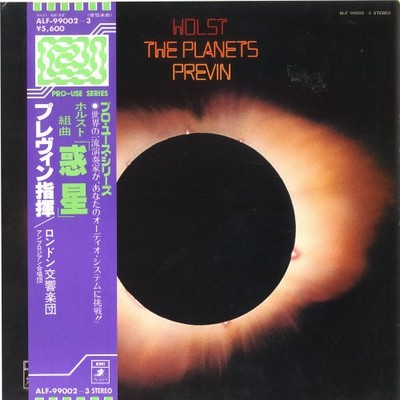
The Planets on Pro-Use Japanese Vinyl at 45 RPM Is Just Awful

More of the music of Gustav Holst (1874-1934)

This EMI 45 RPM Japanese Import 2 LP set is considered one of the great Planets by many audiophiles, but it’s not, based on our playing of a copy we had years ago, which means it belongs in our audiophile hall of shame.

The best copies on British or Dutch EMI vinyl are clearly better than this “audiophile” pressing.

What could be less surprising?

This is precisely why we dislike Japanese pressings as a rule — they sound like this audiophile trash.

Our favorite performance of The Planets can be found here.

The Big Picture from a Lifelong Audiophile

You may have seen the following text in another listing, but it bears repeating.

There is nothing new under the sun, and that is especially true when it comes to bad sounding audiophile records. The world is full of them.

There has been one big change from the days when I self-identified as a freshly minted audiophile in the 70s.

Yes, the records being marketed to audiophiles these days may have second- and third-rate sound, but at least now they have good music. That’s progress, right?

The title reviewed above is a good example of the kind of crap we newbie audiophiles used to put up with back in the old days, long before we had anything resembling a clue.

This one clearly belongs on our list of bad audiophile records.

You might be asking: What kind of audio fool was I? to buy a dumbass record like this.

It’s a fair question. Yes, I admit I was foolish enough to buy records like this and expect it to have good music, or at least good sound. Of course it had neither. Practically none of these kinds of records ever did. Sheffield and a few others made some good ones, but most Direct to Disc recordings were crap.

As clueless as I was, even back in the day I could tell that I had just thrown my money away on this lipsticked-pig in a poke.

But I was an audiophile, and like a certain Mr. Mulder, I wanted to believe. These special super-hi-fidelity records were being made for me, for special people like me, because I had expensive equipment and regular records are never going to be good enough to play on my special equipment, right?

To say I was wrong to think about audio that way is obviously an understatement. Over the course of the last forty years, I (and to be fair, my friends and my staff) have been wrong about a lots of things in the worlds of records and audio.

You can read more about many of the things we got wrong under the heading: live and learn.

The good news? Audio progress is real and anyone who goes about doing audio the right way can achieve the equivalent of miracles.

(more…)

Schubert – The Trout Quintet / Curzon / Vienna Octet

More of the music of Franz Schubert (1797-1828)

More Classical Recordings Featuring the Violin

  • With two outstanding sides earning solid Double Plus (A++) grades, this vintage London LP was one of the better copies we played in our recent shootout
  • It’s simply bigger, more transparent, less distorted, more three-dimensional and more REAL than much of what we played – this is music you cannot help but be drawn into
  • It’s also fairly quiet at Mint Minus Minus, a grade that even our most well-cared-for vintage classical titles have trouble playing at
  • The cello does not have that “fat” sound some audiophiles seem to like – Decca knew more about recording chamber music in 1958 than practically any of the audiophile labels that would come along later, the ones that managed to make a mess of the very idea of audiophile quality sound. (You know who I mean.)
  • There are about 150 orchestral recordings we’ve awarded the honor of offering the Best Performances with the Highest Quality Sound, and this record certainly deserve a place on that list.

The piano and the strings have that Golden Age Tubey Magical sound we love. It’s been years since I’ve had the opportunity to play this record. Most copies are just too beat up to bother with, so I was glad to find a number in minty condition.

Now what I hear in this recording is sound that is absolutely free from any top end boost, much the way live music is. There’s plenty of tape hiss and air; the highs aren’t rolled off, they’re just not boosted the way they normally are in a recording. (more…)