rules-of-thumb

Defined as: “a method or procedure derived entirely from practice or experience, without any basis in scientific knowledge; a roughly practical method.”

Rules of thumb will often lead you astray if what you’re trying to find are not just GOOD sounding pressings of albums, but GREAT sounding pressings of albums.

Like it or not, those can only be found by trial and error.

Straight Up – Porky Not So Prime Cut

Hot Stamper Pressings of the Music of Badfinger Available Now

British band, British pressing… right?

Nope. It’s just another mistaken idea.

We had an original British pressing in our shootout, unbeknownst to me as it was playing of course. And guess where it finished: dead last. The most thick, congested, crude, distorted, compressed sound of ALL the copies we played. We love the work of Porky, Pecko, et al. in general, but once again this is a case where a British Band recorded in England sounds best on domestic vinyl. (McCartney’s first album on Apple is the same way.)

Just saw this today (11/29/2021)

On November 18, 2019, a fellow on Discogs who goes by the name of Dodgerman had this to say referencing the original UK pressing of Straight Up, SAPCOR 19:

So Happy, to have a first UK press, of this lost gem. Porky/Pecko

Not sure what those two commas are doing there. Pausing for emphasis? Sure, why not? This is a big deal.

Like many record collectors, he is happy to have a mediocre-at-best, dubby-sounding original pressing, poorly mastered by a famous mastering engineer, George Peckham, a man we know from extensive experience to be responsible for cutting some of the best sounding records we’ve ever played. He is one of the greats.

Is Dodgerman an audiophile? He could be! Many audiophiles employ this kind of mistaken audiophile thinking, believing that a British band’s albums must sound their best on British vinyl for some reason, possibly a cosmic one.

(more…)

Take Our Advice and Skip the Original of The Stone Poneys

More of the Music of Linda Ronstadt

The originals from 1967 have never impressed us much.

Click on the links below for more records that sound best to us on the right reissue pressing 

Here are some Hot Stamper pressings that we think sound their best on the right reissue (the ones we sell, obviously; there are plenty of reissues that don’t have good sound, but the ones we offer handily beat the originals we’ve — and no doubt you’ve — heard).

Here are all the titles we’ve reviewed to date that have the potential to sound their best on the right reissue

On this album the sound varies quite a bit from track to track.

The best tracks are rich, tubey and clear; the worst thin, bright and hard. 

The first track on side one rarely stayed clean when loud, but here for the most part it does. It’s a good test for whether or not you have a copy with high quality, low distortion mastering.

Listen for the least amount of smear and congestion and the most resolution.

The second track is richer and tubier – it proves that side one is mastered correctly.

(more…)

Is the 1s Pressing Always the Best on the Brahms Violin Concerto with Heifetz?

Hot Stamper Pressings that Sound Their Best on the Right Reissue

This early Shaded Dog pressing of the 1958 recording has surprisingly good sound on side two. On the second side the sound opens up and is very sweet, with the violin becoming much more present and clear.

The whole of side two is transparent with an extended top. Usually the earliest Living Stereo titles suffer from a lack of top end extension, but not this one.

Maybe the 1s pressing is also that way. For some reason audiophiles tend to think that the earliest cuttings are the best, but that’s just more mistaken audiophile thinking if our experience can serve as any guide, easily refuted if you’ve played hundreds of these Living Stereo pressings and noted which stampers sound the best and which do not.

The 1s pressings do not consistently win our shootouts.

About half the time, maybe less would be my guess.

Of course, to avoid being biased, the person listening to the record doesn’t know the stamper numbers, and that may help explain why the 1s loses so often.

If you are interested in finding the best sounding pressings, you have to approach the problem scientifically, and that means running record experiments.

Practically everything you read on this blog we learned through experimentation.

When we experimented with the Classic Records pressing of LSC 1903, we were none too pleased with what we heard. Our review is reproduced below.

(more…)

How Good Are the UK Original Unboxed Deccas of Satanic Majesties?

Hot Stamper Pressings of the Music of The Rolling Stones Available Now

How good are the original Unboxed Deccas on Satanic Majesties?

They can be very good.

But they are never as good as the right later pressings with the Decca in a box label, the ones produced from about 1970 on.

The Unboxed Decca pressing earned a Super Hot Stamper grade (A++). The later pressing, with the right stamper, showed us just how good the album can sound.

Since the originals are pricey and hard to find, and, as a rule, noisier than the later pressings, we don’t pick them up unless we find them for cheap, which rarely happens. They have not won any shootouts, and that is very unlikely to change.

There is one set of stampers for this album that always wins, and those stampers are not found on the early label.

(more…)

Siren on Import Vinyl? Not So Fast

Hot Stamper Pressings of the Music of Roxy Music Available Now

Siren is one of our favorite Roxy albums, right up there with the first album and well ahead of the commercially appealing Avalon.

After reading a rave review in Rolling Stone of the album back in 1975, I took the plunge, bought a copy at my local Tower Records and instantly fell in love with it.

As is my wont, I then proceeded to work my way through their earlier catalog, which was quite an adventure. It takes scores of plays to understand where the band is coming from on the early albums and what it is they’re trying to do. Now I listen to each of the first five releases on a regular basis.

Somehow they never seem to get old, even after more than forty years.

Of all the Roxy albums (with the exception of Avalon) this is probably the best way “in” to the band’s music. The earlier albums are more raucous, the later ones more rhythmically driven — Siren catches them at their peak, with, as other reviewers have noted, all good songs and no bad ones.

Imports? Not So Fast

The British and German copies of Siren are clearly made from dub tapes and sound smeary, small and lifeless.

To be fair, Siren has never impressed us as an exceptionally good sounding recording. Like other middle period Roxy, records such as Country Life and Manifesto (the albums just before and after), it simply does not have Demo Disc analog sound the way Avalon, Stranded or the Self-Titled albums do (the latter two clearly being the best sounding in their catalog).

One would be tempted to assume that the import pressings of Siren would be better sounding, the way the imports of the first four Roxy albums are clearly better sounding. (There has never been a domestic Hot Stamper pressing of any of those titles and, since we never buy them or play them, there probably never will be.)

But in the case of Siren it’s the imports that are made from dubs. It may be a British band, recorded in British studios with a British producer, but the British pressed LPs are clearly made from sub-generation tapes, whereas the domestic copies sound like they’re made from the real masters.

Go Figure. And another thing: when it comes to records, never assume anything.

The typical domestic pressing is flat, bass-shy and opaque, sounding more like compressed cardboard than analog vinyl.

Unsurprisingly, the CD, whether imported or produced domestically, is clean and clear and tonally correct but lacks the warmth and richness of the better vinyl pressings.

(more…)

How Is It that the Earliest Pressings from the Tube Era Often Lack the Sound of Tubes?

Hot Stamper Pressings of Music on Island Records Available Now

Please note that the album you see pictured on the left is not the one we are discussing here.

It has been our experience going back many years that the earliest pressings for many records on the Island label are not very good.

To be fair, this one — again, not Mr. Fantasy — is not a bad sounding pressing.

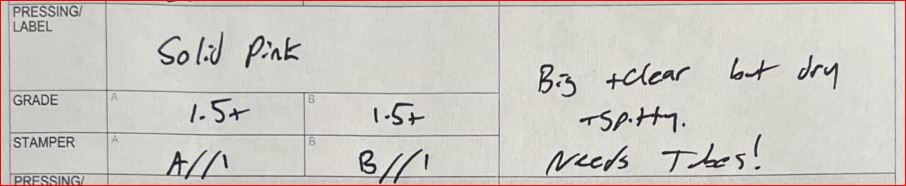
With grades of 1.5+ on both sides, it fits comfortably in our section for good, not great sounding LPs. But the right reissues are a big step up in class sonically. They’re the ones that win shootouts, not these Pink Label LPs.

It’s big and clear but dry and spitty and badly needs tubes — or the sound of tubes — in the cutting chain.

That’s not supposed to happen, the early pressings are supposed to be the most Tubey Magical ones, with the reissues being less Tubey Magical — but in the world of records, when has that rule of thumb ever counted for anything?

Been There, Done That

We’ve run into so many sonically-flawed Pink Label Islands by now that hearing one sound lackluster if not actually awful doesn’t phase us in the least. Some of the other Pink Labels that never win shootouts can be found here.

(more…)

How to Avoid Making this Rookie Record Collecting Mistake

Record Shopping Day Video!

Not sure how much of this video you can stand — nothing could interest me less than watching a couple of vinyl enthusiasts spouting off on what they think about some random records sitting in a local store’s bins.

But one or two bits caught my eye. I thought I might take the opportunity to share my take on them with you.

Is there any value to the comments of these two collectors? If you care about what music they like, perhaps.  Anything about what to look for on the label or jacket that might correspond to better sound?  If it’s there I sure didn’t see it, but I admit to speeding through most of it, so I can’t say for sure.

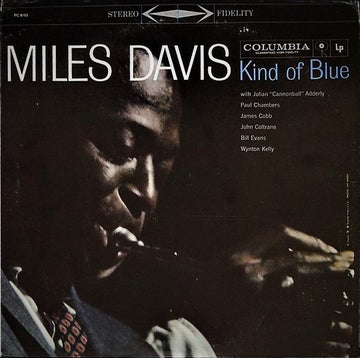
The first bit I refer to above is at 18:42.  The album in question is the legendary Kind of Blue. At this point the unseen helmet-cammed audiophile picks up the record, recognizes the cover, and proceeds to pull the record out to see what era the pressing is from.

Drat! The disappointment in this audiophile’s voice is palpable as he drops the record back in the bin with his dismissive comment that  “it’s a later pressing.”

But we here at Better Records would be falling all over ourselves to get our hands on that later pressing.

Those late pressings can and often do win shootouts. We would never look down our noses at a Red Label Columbia jazz LP, and neither should you.


UPDATE 2025

As good as the best pressings on the Red Label can sound, it has been years since one won a shootout. Here is our commentary for a recent 70s copy that went up on the site, one that earned a Super Hot grade on both sides.

They tend to sell for four or five hundred dollars these days. Why so much you ask? Because they beat the pants off of every so-called audiophile pressing of the album ever made. The testimony of one of our customers does a good job of describing the differences.

In addition, it turns out that at least nine out of ten of the copies with the red label are not remotely as good as the ones that earn Super Hot grades. The good ones are so rare that we only pick them up locally since practically none of the ones we find on the web have the right stampers. Trying to find the right red label needle in the haystack is more trouble than it’s worth, so don’t expect to see many coming to the site.


Our intrepid audiophile explorer does much the same thing about 23 minutes in. It seems pretty clear to us that he has no respect for such reissues, another example of one of the most common myths in record collecting land, the myth that the  original pressing is always, or to be fair, usually better.

This is simply not true, and those of our customers who have purchased White Hot Stamper pressings from us that turned out to be reissues know exactly what I am talking about. This is especially true for the records we sell by The Beatles. No original pressing has every won a shootout. [With one exception.]

Let’s get back to Kind of Blue.

Is the 50s original always better, is the 70s reissue always better, is the 60s 360 pressing always better?

No to one, two and three.

Why? Because no pressing is always better. All pressings are unique and should only be judged on their merits, and you do that by playing them, not by looking at their labels. For us this truth is practically axiomatic. It is in fact the premise of our entire business. Over the course of the 28 years we have been selling records we have never found any compelling evidence to invalidate it.

The day that someone can accurately predict the sound quality of a specific record by looking at the label or cover is a day I do not expect to come, ever.


UPDATE 2025

The above is somewhat misleading. With enough clean 6-Eye pressings on hand to play in a shooout, one of them will win.

That being the case, we have created two lists for those who would like to know which Columbia labels win shootouts — one for 6-Eye winners and one for 360 Label winners.


(more…)

What the Shootout Winning Copies of A Hard Day’s Night Really Get Right

Hot Stamper Pressings of the Music of The Beatles Available Now

I wrote this bit of commentary about twenty years ago:

When comparing pressings of this record, the copies that get their voices to sound both present and warm, smooth, and sweet, especially during the harmonies, are always the best.  All the other instruments seem to fall in line when the vocals are correct. This is an old truism — it’s all about the midrange — but in the case of A Hard Day’s Night, it really is true.

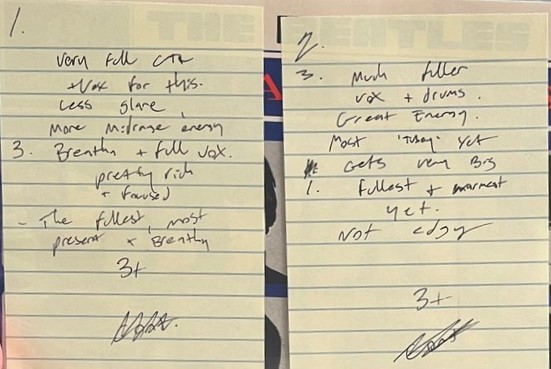
Now that we are putting our unredacted (!) shootout notes on the blog for everyone to see, here are the actual notes for the shootout winning pressing we just played (6/2025), notes that back up what we said so many years ago 100%.

What’s does this amazing side one sound like?

  • Very full guitars and vocals for this
  • Less glare
  • More midrange energy
  • Breathy and full vocals
  • Pretty rich and focussed
  • The fullest, most present and breathy vocals

And this amazing side two?

  • Much fuller vocals and drums
  • Great energy
  • Most “tubey” yet
  • Gets very big
  • Fullest and warmest yet
  • Not edgy

Both sides had qualities that did much to set them apart, coupled with fewer of the shortcomings we found in practically all the other pressings we played.

Less glary and less edgy are critical to the better pressings, simply because few copies are not glary and edgy in the midrange to some degree.

But the real keys to the shootout winners are vocals that are full, present, warm and breathy.

For The Beatles in 1964, nothing else about the sound of their recordings could possibly compete with those four qualities.

We could add two more. Energy would probably be the next most important one, followed by Tubey Magic.

That brings the total of most important qualities to a grand total six.

(more…)

Why Do the Later Stampers of this Shaded Dog Sound So Much Better than the Earlier Ones?

Hot Stamper Pressings of Living Stereo Recordings Available Now
For RCA classical and orchestral recordings, the earliest pressings on the Shaded Dog label, in stereo, tend to be the best sounding, right? 

Maybe. It’s an open question, at least it is for us when we consider how many exceptions to the rule we’ve run into over the 30+ years we’ve been buying and selling them.

If we tallied all the copies we’ve played and created a very large spreadsheet using the data, perhaps we could give you a better answer than “we don’t know,” but we’ve definitely never tallied them up and have no plans to do so. It sounds to me like a lot of work.

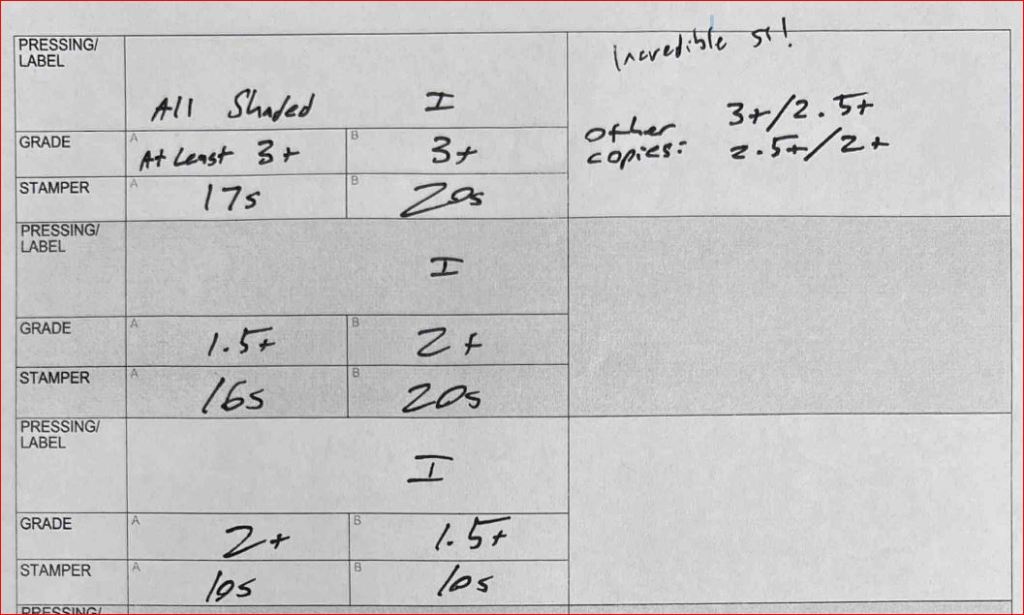
However, in our experience, and contrary to the conventional wisdom, sometimes the higher-numbered pressings are better sounding than the lower-numbered pressings. This is true of the stampers for the Shaded Dog pressings below.

Keep in mind that the stamper numbers you see belong to a different album.

The questions that audiophiles who collect shaded dog pressings should be asking themselves right about now are:

  • Why is 17s/20s consistently better sounding than any copy with any other stampers?
  • Why is the 16s pressing worse sounding than even the worst 17s pressing when they are both Indianapolis pressings only one digit apart?
  • Why does the 20s side two potentially win the shootout with a 3+ grade, but more often only earn a grade of 2.5+ or 2+?
  • And the hardest to stomach of them all are those second-rate 10s stampers. How on earth can they come in last in a shootout against all the copies with higher numbers?

It turns out that the old rule of thumb that the lower-numbered stampers will sound better than the higher-numbered ones is not nearly as reliable as some folks would like it to be.

If it were more reliable, we could all just buy the lowest-numbered stamper copies we could find and know that we had the best available pressing. Then, if we were lucky enough to encounter an even lower-numbered stamper copy, we could buy that one and know that we now had an even better sounding pressing, all without having to play the old “best” one against the new “best” one.

It’s so convenient and logical this way, why would anyone want to bother with a different illogical, inconvenient and obviously counterintuitive method when the other one has so much going for it?

There is only one problem with the idea of collecting the earliest shaded dog pressings in order to secure the best sounding pressings — the fact that the evidence to support such an approach is so spotty. Yes, early stampers win lots of shootouts. No, early stampers do not win all the shootouts, or even a majority of them, judging by a rough calculation using the data from the many hundreds of stamper sheets we’ve created over the years.

Predictions Are Futile

The unfortunate reality we run into is that most of the time we are not able to predict which stampers will win a shootout before we actually sit down to play all our copies.

Although it’s true that there are many pressings in which one set of stampers always wins, the odds are that any particular pressing with those stampers will do well but won’t win, and it sometimes happen that some pressings with those stampers won’t do well at all.

This is why we have to do shootouts, and why you have to do them too, if finding the highest quality pressings is important to you.

Fortunately for readers of this blog, our methods are explained in detail, free of charge.

We’ve also written quite a few commentaries to help audiophiles improve the way they think about records.

I implore everyone who wants to make progress in this hobby to learn from the mistakes we’ve made. There are 146 “we were wrong” listings on the site as of this writing, and we learned something from every damn one of them, painful and costly as those experiences may have been.

(more…)

Talk About Getting the Sound Wrong – What Was Decca Thinking?

Hot Stamper Pressings of the Music of The Rolling Stones Available Now

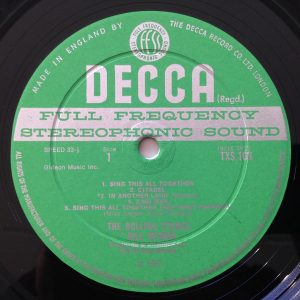
Even though we know that the UK Decca pressings have not done well in our shootouts for more years than I care to remember, if we see one for cheap locally you know we’re going to buy it and get it another chance at the brass ring no matter how many times it’s failed in the past.

As you can see from our shootout notes, the Decca import has once again let us down.

It’s bright, with no warmth or weight. It’s not musical like the London pressings with the right stampers are.

If a certain kind of audiophile were to play this record, the kind of audiophile who might be given to simplistic conclusions based on insufficiently small sets of data — which, in our experience, pretty much covers the entire audiophile record collector community, including, if not especially, the so-called expert reviewers — the conclusion such a person might reach is that Beggars Banquet is just not very well recorded.

If Decca pressings don’t sound good, what on earth would?

Or, to put it another way, if Decca, the label that the Stones recorded this album for, can’t figure out how to make Beggars sound its best, why would we assume that any other company could?

We would, naturally, assume that Decca did the best they could with the tape and the mediocre quality of the sound you hear — 1+/1.5+ is pretty much our definition of mediocre — is all there is.

The Option that Is Almost Always Wrong

Worse — if a new Heavy Vinyl pressing of the album came out with even halfway-decent sound, then it would prove beyond a doubt that some modern mastering engineer had finally figured out how to get Beggars to sound right.

But of course it would prove no such thing.

If all you have to guide you is conventional collector wisdom, then the one thing you can be sure of is that the Decca pressing from the UK should have better sound than any other, especially any record made in the states.

But it doesn’t. It’s possible I suppose – we haven’t played every pressing ever made – but it sure is unlikely based on the evidence presented to our ears over the course of the last twenty to thirty years or so.

If you would like to hear Beggars Banquet sound right, and have the hundreds of dollars we charge for a copy that is guaranteed to sound right or your money back, click on the link. It’s rare that we have one in stock, but you never know.

(more…)