rules-of-thumb

Defined as “a method or procedure derived entirely from practice or experience, without any basis in scientific knowledge; a roughly practical method.”

Rules of thumb will often lead you astray if what you’re trying to find are not just GOOD sounding pressings of albums, but GREAT sounding pressings of albums.

Like it or not, those can only be found by trial and error.

The Reissues Consistently Beat the Originals on this Mercury

Hot Stamper Pressings of Mercury Classical Records Available Now

For Mercury classical and orchestral recordings, the original FR pressings on the plum label are the way to go, right? 

In some cases, yes. We talk about how much better the FR pressings for The Firebird are compared to the much more common, and still quite good, M2 reissue pressings here.

The stamper numbers you see below belong to a different album.

The notes for the FR original pressings we played read:

  • Less spacious, more bright and flat.

They’re not bad sounding, they’re just not as good sounding as the RFR reissues, which, incidentally, won the shootout.

We’ve lately been giving out much more stamper information than we used to, but we make it a point to never give out the stamper information for our shootout winners, as finding those very special pressings has been the work of a lifetime and is certainly not something that should be given away for free.

Rules of Thumb

It’s just another one of a number of rules of thumb collectors use (“A method or procedure derived entirely from practice or experience, without any basis in scientific knowledge; a roughly practical method”), one that will sometimes lead you astray if what you are trying to find are not just good sounding pressings of albums, but the best sounding pressings of albums.

Same with reissue versus original. Nice rule of thumb, but it only works, to the extent that it works at all, if you have enough copies of the title to know that you’re not just assuming the original is better. You actually have the data — gathered from the other LPs you have played — to back it up.

Who Knew?

Who knew the recording would sound so much better on the right reissue pressings?

Certainly not us, not until we had done the shootout.

The difference between the way we do things and the way others do them boils down to this: We assumed that the original could be the best, and then we tested that assumption and found out we were wrong.

But the right reissues of this Mercury — again not the ones you see pictured — is indeed an exceptionally good sounding record.

This is why we do shootouts, and why you must do them too, assuming that owning the highest quality pressings is important to you.

(more…)

The Original Mercury Pressings Don’t Sound Good on this Title, But Why?

Hot Stamper Pressings of Mercury Classical Recordings Available Now

For Mercury classical and orchestral recordings, the original FR pressings (when there are such pressings) on the plum label are the way to go, right? 

In some cases, yes. We talk about how much better the FR pressings for The Firebird are compared to the much more common, and still quite good, M2 reissue pressings here.

And the FR pressing of the Rachmaninoff record you see pictured above may indeed have the best sound.
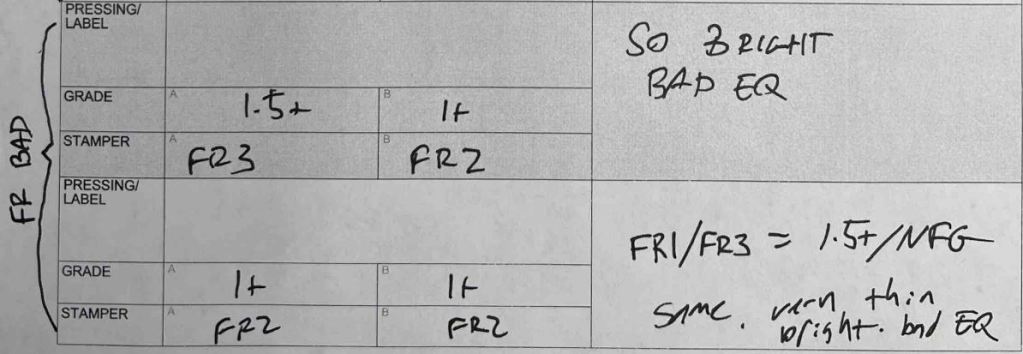

The stamper numbers you see below belong to a different album.

(We’ve lately been giving out much more stamper information than we used to, but for now we are keeping this title closer to the vest.)

Note that we had FR1, FR2 and FR3, all originals, yet none of them could be considered good enough to offer our customers.

It’s just another one of a number of rules of thumb collectors use (“A method or procedure derived entirely from practice or experience, without any basis in scientific knowledge; a roughly practical method.”), one that will sometimes lead you astray if what you are trying to find are not just good sounding pressings of albums, but the best sounding pressings of albums.

Same with reissue versus original. Nice rule of thumb, but it only works, to the extent that it works at all, if you have enough copies of the title to know that you’re not just assuming the original is better. You actually have the data — gathered from the other LPs you have played — to back it up.

Who knew the recording would sound so much better on the right reissue pressings?

(more…)

Before and After Science – Rules Are Made to Be Broken

Hot Stamper Pressings of Art Rock Recordings Available Now

The domestic pressings of Before And After Science are typically grainy, low-rez and hard sounding — they’re simply not competitive with the smoother British Polydors.

But our best Hot Stamper pressing isn’t an import; it was made right here in the good old US of A.

Say what? Yes, it’s true. We were SHOCKED to find such hot stamper sound lurking in the grooves of a domestic Eno LP. It’s the One and Only.

In thirty plus years of record playing I can’t think of any domestic Eno LP that ever sounded this good.

Now hold on just a minute. The British pressings of Eno’s albums are always the best, aren’t they?

For the first three albums, absolutely. But rules were made to be broken. This pressing has the knockout sound we associate with the best British originals of Eno’s albums, not the flat, cardboardy qualities of the typical domestic reissue.

Kinda Blind Testing

Since the person listening and making notes during the shootouts has no idea what the label or the pressing of the record is that he is evaluating — this is after all a quasi-scientific enterprise, with blind testing being the order of the day — when that domestic later label showed up at the top of the heap, our jaws hit the floor.

(more…)

A Very Bad Porky/Pecko Cutting of My Aim Is True

Hot Stamper Pressings of Elvis’s Albums Available Now

My notes for the one and only UK pressing I’ve played in many years, the one with Porky is the dead wax, note its many weaknesses:

Really loud and full.

Too loud and hot vocal.

Strains a lot.

You know what the sound of this record reminds me of?

An old 45 RPM 7″ single. Remember those?

It’s not unusual for 45 RPM singles from back in the day to be very loud, very compressed, and they often have much-too-hot vocals designed to jump right into your lap.

Mono mixes sometimes have some of that same lowest-common-denominator sound.

This mix is stereo but it sounds like it’s coming right out of a jukebox.

No doubt Mr. Peckham was told to make the record sound that way, and he did his job very well.

But audiophiles looking for good sound should heed this warning and avoid the UK LPs of the album. It’s a joke next to the domestic pressings with the right stampers. (The right stampers are hard to find but you will never hear a good sounding early pressing unless you have a copy with the stampers that sound right, a tautology to be sure but one worth noting.)

(more…)

What Are Some Good General Rules for Finding Records with the Highest Quality Sound?

More Entries from Tom’s Audiophile Notebook

The Riverside pressings we’ve auditioned of both The Thelonious Monk Orchestra – At Town Hall and Thelonious Monk Quartet Plus Two – At The Blackhawk were just awful sounding.

The OJC reissues of both albums from the 80s, although better, were not overflowing with the rich, natural, relaxed analog sound we were looking for either.

Ah, but a few years back (2015, maybe?) we happened to drop the needle on one of these Monk Milestone Two-Fers. Here was the sound we were looking for and had had so little luck finding until then.

Which prompts the question that should be on the mind of every audiophile:

What are the rules for collecting records with the best sound quality?

The answer, of course, is that there are no such rules and there never will be.

There is only trial and error. Our full-time staff has been running trials — we call them shootouts  and needle drops — for more than twenty years now, with far more errors than successes. Such is the nature of records.

(more…)

Fire and Water on a Mythical Pink Island

Reviews and Commentaries for Island Pressings on the Pink Label

Free’s Third Album on the original British Island pink label — wow!

Found one at a local record store a while back. It was the first one I’d ever seen in nice enough condition to buy. Checking the dead wax was a bit of a shock though. Care to guess where it was mastered? Right here in the good old U S of A. In fact, at one of the worst mastering houses of all time: Bell Sound in New York. [This is not fair. We have found many good pressings mastered at Bell Sound.]

Now what does that tell you about British First Pressings? Are those the ones you’re looking for? Don’t get me wrong; I look for them too. But you had better look before you leap, or you’ll end up with a bad sounding, probably quite expensive pressing.

It’s one more reason why we try to play as many records as we can here at Better Records. You can’t rely on anything but the grooves.

Rules of Thumb

Which brings up another interesting issue. Some audiophiles use the following rule of thumb for rock record collecting.

If it’s an English band, get the import pressing. If it’s an American band, the tapes should be here in this country, so the original domestic pressing should be the best.

As a rule of thumb it’s not bad. It’s just wrong so often (Led Zeppelin, Cat Stevens, The Eagles, etc.) that you must be very careful how you apply it.

Same with reissue versus original. Nice rule of thumb but only if you have enough copies of the title to know that you’re not just assuming the original is better. You actually have the data — gathered from the other LPs you have played — to back it up.

(more…)

Atlantic Crossing – Thick, Dull and Dubby on British Vinyl

Another Well Recorded Album that Should Be More Popular with Audiophiles

The copies we liked best were the biggest and richest, the least thin and dry. Many of the brighter copies also had sibilance problems which the richer and tubier ones did not.

On some of the Rod Stewart albums that we happen to know well, the British pressings are clearly superior; the first two Rod Stewart albums come immediately to mind. After that, strange as it may seem, all the best pressings are domestic. This album is certainly no exception.

I remember bringing back a few Brit copies from England many years ago and being surprised that they were so thick, dull and dubby sounding. Of course, they were; the album was recorded right here in the good old US of A. The master tapes are here. The Brit pressings sound dubby because they are made from copy tapes.

If there is any doubt, the following is a list of the studios in which Atlantic Crossing was recorded.

  • A&R, NY
  • Criteria, Miami, FL
  • Wally Heider, Los Angeles, CA
  • Hi Recording and
  • Muscle Shoals Sound, AL

(more…)

Jazz Giant – Is the OJC Really 100x Worse?

Hot Stamper Pressings of Contemporary Jazz Albums Available Now

The OJC versions of Contemporary Records are typically thin and somewhat opaque, as well as tizzy up top, the kind of sound one often hears on CDs (and that CD lovers for some reason never seem to notice, or bothered by, who can say?).

Some OJC pressings, however, can be excellent — when you are lucky enough to chance upon the right copy.

The pressings that were mastered and put out by Contemporary in the mid-70s (until they were bought by Fantasy) are almost always superior to the OJCs, but these rules of thumb break down so badly and so often that the only workable approach is just to play as many different copies of the album as you can get your hands on and simply let them sort themselves out sonically.

This of course is exactly how we conduct our shootouts. We make a lot of mistakes, but when all is said and done, we rarely fail to come up with the goods, the goods being phenomenal sounding pressings of important music, pressings that are dramatically superior to any others.

Although we’ve liked the OJC of Jazz Giant in the past, last time around the OJC versions were quite a bit thinner, smaller and less energetic than our real Contemporary stereo pressings. They were a big step down from our killer Shootout Winner.

The notes for that copy read “100x better” if that tells you anything (!)

A clear case of live and learn.

(more…)