lacks-weight

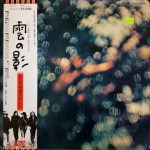
Thick As a Brick on MoFi

Hot Stamper Pressings of the Music of Jethro Tull Available Now

Sonic Grade: D

Here you will find the same problems as the MoFi Meddle, released the previous year, 1984. Here is what we had to say about it back in the day when we were selling this kind of crap.

The MoFi is TRANSPARENT and OPEN, and the top end will be lush and extended. If you prize clarity, this is the one.

But if you prize clarity at the expense of everything else, you are seriously missing the boat on Meddle (and of course Thick As A Brick too).

The MoFi is all mids and highs with almost nothing going on below.

This is a rock record, but without bass and dynamics the MoFi pressing doesn’t rock, so why would anyone want to own it or play it?

The one thing these pressings have going for them is that they tend to be transparent in the midrange.

It sounds like someone messed with the sound, and of course someone did. That’s how they get those audiophile records to sound the way they do.

For some reason, some audiophiles like their records to sound pretty and lifeless with blurry bass.

The whomp factor on this pressing is Zero. Since whomp is critical to the sound of this album, it’s Game Over for us.

That is not our sound here at Better Records. We don’t offer records with shortcomings like these and we don’t think audiophiles should have to put up with records that sound the way this one does.

(more…)

Sibelius / Violin Concerto / Ricci

Hot Stamper Pressings of the Music of Jean Sibelius Available Now

This is a wonderful sounding London Stereo Treasury pressing featuring one of our favorite violinists, Ruggiero Ricci, performing the Sibelius Violin Concerto in D Minor.

The tone of the violin on side one is just right — every nuance of Ricci’s bowing can clearly be heard.

While the violin sounds amazing on side one, the orchestra lacks a bit of weight.

This side is also not quite as Tubey Magical as it could be. In our opinion, however, the violin tone and the incredible dynamics are more than enough to make us want to award this record a fairly high grade.

Side two actually has a bit more fullness, but this also seems to rob the violin of some of its presence. 

(more…)

Obscured By Cloudy Japanese Vinyl

Hot Stamper Pressings of the Music of Pink Floyd Available Now

When I was just getting up to speed in audio and exploring the world of music available on vinyl in the 70s, many of the stereo stores I frequented carried Japanese pressings. They were widely believed to have superior sound relative to their domestic counterparts — in this case, the mass-produced pressings I would see at the Tower Records right across from the Sports Arena in my hometown of San Diego. I went there at least once a week, probably more like two or three times.

Tower was far and away the best place to go record shopping in those days. The store was huge and they had dramatically more stock than Licorice Pizza or The Wherehouse.

They also had a separate section for Half-Speed mastered pressings from a number of labels, which of course was the first place in the store I would visit, digging through the bins to see what new remastered titles may have been produced for audiophiles searching for the ultimate in sound quality.

Of course, I identified as just such a person. In terms of sound quality, and with the extremely limited knowledge I had acquired at the time, I believed I set a high standard for the sound of the records I bought. I was willing — eager even, you could even say excited — to pay whatever premium price I had to for a record that was sure to deliver superior sound quality. To me, in the late 70s, that meant two things: direct to disc recordings, and Half-Speed mastered pressings.

(There was a another category of records that did not fall into the above two, best exemplified by American Grammaphone and the Fresh Aire series, but the less said about those schlocky releases the better, other than to point out that some of their titles are TAS list carryovers from HP’s time running the Super Disc list, specifically Fresh Aire 2 and 3, both best avoided.)

And, like any other open-minded individual, when it came to Japanese vinyl I was willing to give a few a spin.

However, the more of them I bought, the more clear it became to me that even the best of them sounded mediocre (veiled, smeary and dubby from second generation tapes) and more often than not they were just plain awful. (Second generation tape issues being the main problem, of course, with the additional insult of poor tonality, the result of being mastered using wacky equalization, typically with added brightness where none was needed.)

Pink Floyd

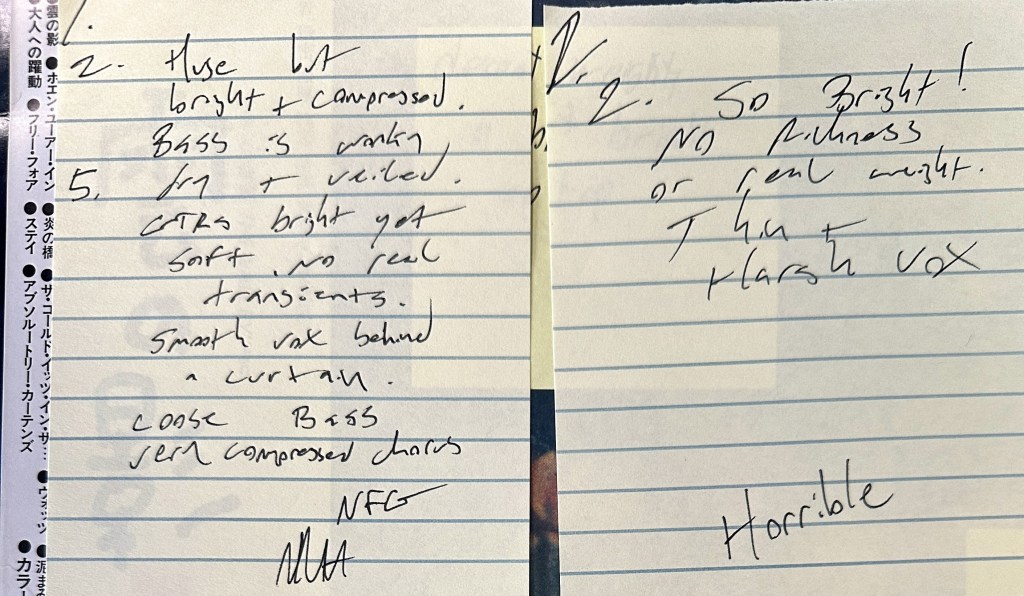
The notes for the Pink Floyd album you see below, Obscured by Clouds, were written sometime in March of 2025 as part of the shootout we conducted for the album.

If we assume it would be an audiophile who would be attracted to this pressing, perhaps for its quieter playing surfaces, perhaps operating under the assumption that the Japanese engineers mastering the record would be more likely to do a better job as well, then what we have here is a textbook case of an audiophile bullshit pressing.

One that sounds nothing like the album is supposed to, based on having played a number of exceptionally good sounding copies, all British and all on the Green Harvest label, mastered from good tapes, sometimes by the legendary Harry T. Moss. We feel we are more than qualified to make these judgments. If we can’t make them, nobody can.
Discogs allows us to glean some information regarding the desirability of this Japanese reissue with the record buying public currently in the market for Pink Floyd vinyl who register on their site.

(more…)
Andre Previn – These Two OJC Pressings Didn’t Make the Grade

Hot Stamper Pressings of Contemporary Jazz Recordings Available Now

The mastering choices of the cutting engineers for these two recordings did them no favors.

Like so many of the early OJC pressings we’ve played over the years, we found that both of these reissues tended to be somewhat thin tonally, with a brittle top end, which can clearly be heard in the tizzy quality of the cymbals.

This is not remotely the right sound for a vintage Contemporary recording.

When doing the shootouts for these albums, warmth turned out to be key to the sound of the best copies.

When the piano sounds warm and smooth, everything else in the recording seems to fall into place.

(more…)

Pros and Cons of this Copy of Swings in High Stereo

Hot Stamper Pressings of Large Group Jazz Recordings Available Now

Side One

Big and spacious, yet clear, dynamic and energetic. The brass is never “blary” the way it can be on so many Big Band or Dance Band records from the 50s and 60s. (Basie’s Roulette records tend to have a bad case of blary brass as a rule.)

Sharp transients and mostly correct tonality and timbres, powerful brass — practically everything you want in a Hot Stamper is here!

The stage is exceptionally wide on this copy.

Listen to the top end on track two — man, that is some natural sound!

This side could use a bit more weight so we feel a grade of Super Hot (A++) gets it right.

(more…)

Stick with Porky on East Side Story

More Hot Stamper Pressings We Only Offer on Import Vinyl Available Now

Porky cut the original British pressings of this Squeeze album, one of countless personal favorites of yours truly. They are records (and cassettes and CDs) I have played hundreds of times and still listen to regularly to this very day, in this case more than forty years after I purchased my first copy. (Good albums age well.)

I would have picked the record out of the bin at my local Tower Records, probably based on the radio play Tempted was getting.

That copy undoubtedly would have been domestic and made from a sub-generation tape, although I’m quite sure I could not have recognized what constituted dubby sound back then. In 1981, what I understood about the importance of different record pressings would have fit comfortably in a thimble.

I had my MoFi’s, and although I hate to admit it, that’s about as far as I had gotten in my quest for superior sounding pressings. You could add Nautilus and a few other Half-Speeds to the list of what pressing I thought were impressive, leaving plenty of room in that thimble unfilled.

Thankfully those bad old days are gone, and the music can now, finally, live and breath on the best of these imports from the UK. Of course they are the only ones we buy these days for our shootouts. The others are what are known around these parts as “mistakes.”

Sometimes the imported pressings are mastered by Porky and sometimes they are not. The ones that are not tend to have a lot of problems, as you can see from our stamper sheet below.

When Porky is not on side one, that side will tend to be hard, lean and bright. Side two of that copy had decent sound, earning a minimal Hot Stamper grade of 1.5+.

(more…)

Black Byrd on Heavy Vinyl – Yes, You COULD Do Worse!

Hot Stamper Pressings of Blue Note Recordings Available Now

We did a shootout for Black Byrd in 2025. We were fortunate to be able to include the Heavy Vinyl pressing that came out in 2002 along with the vintage pressings we had on hand.

The reissue was made back in the days when Rainbo Records was pressing records. (Scorpio carried a lot of Rainbo Records when I was still selling regular vinyl, and their pressings were often warped and defective, causing me to stop buying their releases.) Rainbo Records went under in 2011 (according to Discogs), not a moment too soon. They pressed mostly cheap junk vinyl aimed squarely at the lo-fi crowd.

But let’s get back to Black Byrd. Here is the way we described a Hot Stamper we put up on the site recently:

We played a bunch of these recently and only a few had the kind of sound we were looking for. This one was one of the best we heard — big, bold and lively with excellent presence. The bottom end is meaty and punchy, the highs are sweet and extended, and the mids sound right.

Most copies didn’t jump out of the speakers the way this one does. You’ll have a hard time finding such rich, smooth sound for this wonderful jazz album.

Some of these later pressings are just plain weak, but every now and then you find one like this that clearly benefits from the use of modern cutting equipment. The bass is tighter, the drums have more snap, and the soundfield has real depth. There’s excellent energy and good presence throughout, and the top end sounds just right.


Admittedly the above is fairly generic, but good records tend to do what good records always do, so why get specific? If you want to see in-depth notes for records that we’ve played in shootouts, we have a section full of them on the blog and you can be sure there are a great many more on their way if I have anything to say about it. (You can’t fire me — technically I still own the company.)

At around $30, all this Heavy Vinyl pressing would have to be is decent sounding. With a grade of 1+, it’s close, but just short of a cigar. Heavy Vinyl reissues of mediocre quality have their own section, mostly populated by the better releases on Speakers Corner, Cisco, Classic Records and others starting in the 90s.

We use the 1+ grade for vintage records that are passable, not good enough to qualify as a Hot Stamper but not really a bad pressing either.

A mediocre grade puts it well ahead of the pack when you consider just how dreadful many of the releases we’ve played recently turned out to be.

(The Heavy Vinyl disasters section you see below has more than two hundred entries at this point, with many more on the way. As long as they keep making bad sounding remastered vinyl, we’ll keep publishing our notes, hopefully to help music lovers and audiophiles more easily recognize their shortcomings. Perhaps someday both groups will recognize what a waste of money these pressings are.)

We only played side two of this copy for some reason. It’s possible side one is better, but it may be worse, we honestly can’t say since we didn’t play it. Considering it was pressed by Rainbo Records, side one is unlikely to be any better.

(more…)

How Do the Early Pressings of The Poll Winners Sound?

Hot Stamper Pressings of Contemporary Jazz Albums Available Now

A recent Shootout Winning copy with the early stereo badge cover was described this way:

Stunning sound throughout this vintage Black Label Stereo Records pressing, with both sides earning Shootout Winning Triple Plus (A+++) grades or close to them

Roy DuNann always seems to get the real sound out of the sessions he recorded – amazingly realistic drums in a big room; Tubey Magical guitar tone; deep, note-like bass, and on and on

4 1/2 stars: “The choice of material, the interplay between the three players, and the lead work all meld together beautifully on The Poll Winners, making it a classic guitar album in a small-group setting.”

Musically, all true. Sonically, not so much. The early D1/D2 stampers on the early Black Label might be passable on side one (1+), but side two was just a mess (NFG).

Side One

Track Two

  • A bit bright and flat

Track One

  • Very clear but lacking richness, weight and depth
  • Thin, and bright up top
  • 1+

Side Two

Track One

  • Narrow stereo field
  • Weird tape hiss
  • Metallic top end
  • Very recessed and weird
  • Nope

A different Stereo Badge Cover copy sporting a Black Label won the shootout by the way. Go figure.

(more…)

A Scheherazade that Lacks Power in the Brass and Richness in the Lower Strings? No Thanks

Hot Stamper Pressings of the Music of Rimsky-Korsakov Available Now

One of the most dynamic Scheherazade‘s on record. The brass really blasts through in this recording. 

Of course the question is how does this recording stack up to the famous Reiner. Well, I’ll tell you.

The Minneapolis Symphony Orchestra is not in the same league with the CSO, that’s well known. Dorati may be every bit as talented as Reiner, but he doesn’t have the players at his disposal capable of pulling off demanding material such as this.

But the orchestra acquits itself well here. The first violinist is quite good. That’s not the problem.

What lets the side down is the Mercury recording team, who fail to adequately present the weight of the orchestra in the lower midrange and below. One thing I noticed recently when playing an original LSC 2446 was how rich and powerful the sound was in the lower strings and in the brass relative to later pressings of the same title and other recordings of the work.

That opening movement of Scheherazade needs power down there and the Mercury simply doesn’t have enough of that power to qualify it as one of the top sounding Mercs.

(more…)

You Say the Budget Stereo Treasury Has Better Sound than the Speakers Corner?

Hot Stamper Pressings of the Music of Borodin Available Now

The Borodin album you see pictured is a decent enough Speakers Corner Decca repress.

The Heavy Vinyl reissue of this title is not bad, but like a number of reissues, it lacks the bottom end weight found on the early London pressings.

(Classic Records pressings rarely had that problem. Just the opposite in fact. The bass was boosted most of the time, especially the deep bass, but for some reason the lower strings are never rich the way the best vintage pressings can be.)

I remember this Speakers Corner pressing being a little flat and bright.

Since I haven’t played it in years, there is some chance that I could be wrong. I have never had trouble admitting to the possibility, a fact that makes us practically unique in the world of audiophile reviewers.

The glorious sound I hear on the best London pressings is simply not the kind of thing I hear on 180 gram records by Speakers Corner, or anybody else for that matter.

They do a good job some of the time, but none of their records can compete with a vintage pressing when that vintage pressing is mastered and pressed properly. 

The best pressings of this UK London Stereo Treasury from the Seventies will beat the pants off of it. That ought to tell you something, right?

(more…)