lacks-space

Tea for the Tillerman – This Is Your Idea of Analog?

Dear Record Loving Audiophiles of Earth,

I’m afraid we have some bad news. [This was written back in 2011 when the record came out so it’s hard to imagine that what I am about to say is news to anyone after all these years.]

Regrettably we must inform you that the 2011 edition of Tea for the Tillerman pressed by Analogue Productions on Heavy Vinyl doesn’t sound very good. We know you were all hoping for the best. We also know that you must be very disappointed to hear this unwelcome news.

But the record is what it is, and what it is is not very good. Its specific shortcomings are many and will be considered at length in our review below.

Yes, we know, the folks over at Acoustic Sounds, in consultation with the late George Marino at Sterling Sound, supposedly with the real master tape in hand, and supposedly with access to the best mastering equipment money can buy, labored mightily, doing their level best to master and press the Definitive Audiophile Tea for the Tillerman on Vinyl of All Time.

It just didn’t come out very good, no matter what the reviewers say. And what do they say? Allow me to quote one.

…superbly dynamic, spacious and detailed…The attack of the pick on the guitar strings is astonishingly clean and detailed.

Depth is pronounced…

…the resolution of low level detail reveals a host of details that are either buried or glossed over on the other versions I’ve heard…

Uh-oh, wait a minute, here’s a blindingly red flag:

If you have the edition, you’ll find this similar in one way: there’s nothing “mellow” about the overall production and when the music gets loud (and Marino lets it get so) it can get a bit hard, but better that than to soften it and lose the clarity, focus and detail of this superb recording, especially in the quieter passages where the resolution of low level detail is astonishing.

More about that later.

(more…)

So at 45 RPM – One Side Bad, Another Awful, What’s a Mother to Do?

Hot Stamper Pressings of the Music of Peter Gabriel Available Now

In 2016 a version of So came out using this currently popular vinyl format:

2 180g discs / 45 RPM / Deluxe, Numbered, Limited Edition /Half Speed mastered

As of this writing, there are 15 copies on Discogs, the cheapest of them starting at $139.77.

Sounds like it must be pretty good for that kind of money!

This So release was mastered by a fellow named Matt Colton, who has been doing this kind of work for a very long time, judging by the fact that he has 3,775 technical credits under his name on Discogs.

That did not stop this particular 2 LP set from being one of the worst sounding albums we have played in quite a while.

Let’s take a closer look at the specifics. We played sides one and four of the two-disc, four-sided album. That was more than enough to evaluate the sound quality.

(more…)

The Electric Recording Company Does My Favorite Things No Favors

Hot Stamper Pressings of the Music of John Coltrane Available Now

My Favorite Things happens to be one of our favorite Coltrane records, but we much prefer the stereo pressing of the album. (This is almost always the case when an album has been recorded in stereo, as My Favorite Things was in 1960, later released on Atlantic vinyl in 1961.)

We even tell you what to listen for to help you separate the best pressings from the merely good ones: the piano.

A solid, full-bodied, clear and powerful piano. As we focused on the sound of the instrument, we couldn’t help but notice how brilliant McCoy Tyner is. This may be John Coltrane’s album, but Tyner’s contribution is critically important to the success of My Favorite Things.

The engineering duties were handled by Tom Dowd (whose work you surely know well) and Phil Iehle, who happens to be the man who recorded some of Coltrane’s most iconic albums for Atlantic: Giant Steps (1960) and Coltrane Jazz (also in 1961).

Our last shootout for My Favorite Things was in 2018, not exactly yesterday, but in our defense let me just say that we have done plenty of other Coltrane albums from this period and feel as though we would have no trouble recognizing the sound his engineers were going for.

Unfortunately for those of you who have bought into the idea that the Electric Recording Company produces records with audiophile quality sound, you will find an utterly alien My Favorite Things, one nobody has ever heard before and one that no audiophile should want anything to do with.

Allow us to lay out the specifics of our complaints:

Notes for Side One

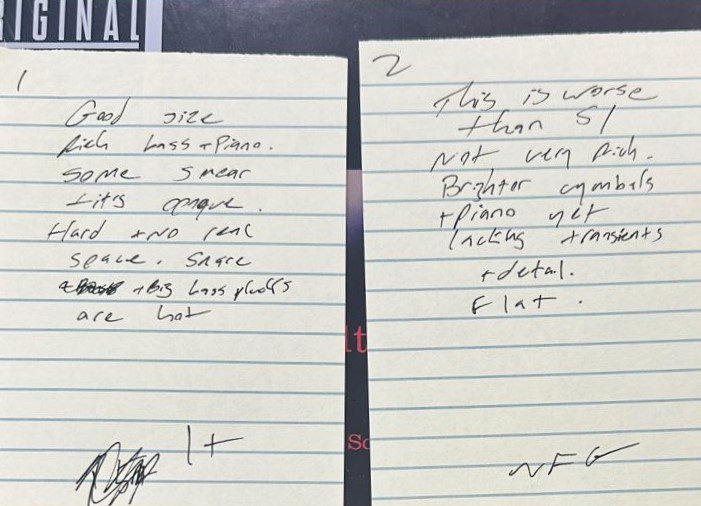
  • Big and full but smeary, flat and dull sax
  • No space or depth anywhere
  • Bloated bass
  • A mess

Notes for Side Two

  1. Side two is even worse
  2. Where is the breathy detail of the sax?

Electric Recording Company

We’ve played a few other ERC releases produced by the gentleman who owns The Electric Recording Company, a Mr. Pete Hutchison.

As you no doubt know, we would not be correct in using the term “mastered.” He does no mastering. He does “transferring.” He transfers the tapes to disc and puts them in nice jackets of his own design.

(more…)

After the Gold Rush – Because Sound Matters?

Hot Stamper Pressings of the Music of Neil Young Available Now

I don’t know why I wasted so much time critiquing the sound of this remastered (2009) pressing. Frankly, it really wasn’t worth it.

However, since I listen to records for a living, I figured I might as well listen to this one, head to head with an excellent vintage pressing, of course. What other way to do it is there?

Since we do shootouts for this album regularly, we know just how good the best pressings of After the Gold Rush can sound, and this newly remastered vinyl is missing almost everything that makes the album essential to any right thinking music lover’s collection.

We can summarize the sound of this dreadful record in one word: boring.

Since some of you reading this review are no doubt fans of Chris Bellman, the engineer credited on the album, and a man apparently held in some esteem by a great many audiophiles, perhaps we owe it to his fans to break down the sonic strengths and weaknesses of this pressing in more detail.

What It Does Right

It’s tonally correct. Unlike many modern pressings, it is not overly smooth.

Uh, can’t think of anything else…

What It Does Wrong

Where to begin?

(more…)

Is the Heavy Vinyl from 2012 the Best Sounding Sgt. Pepper?

beatlessgtHot Stamper Pressings of Sgt. Peppers Available Now

You might agree with some reviewers that EMI’s engineers did a pretty good job with the new stereo pressing of Sgt. Pepper mastered by Sean Magee from the 2009 digitally remastered tapes.

In the March 2013 issue of Stereophile Art Dudley weighed in, finding little to fault on this title but being less impressed with most of the others in the new box set. His reference disc? The MoFi UHQR! Oh, and he also has some old mono pressings and a domestic Let It Be.

Now there’s a man who knows his Beatles. Fanatical? Of course he is! We’re talkin’ The Beatles for Chrissakes.

When I read the reviews by writers such as these, I often get the sense that I must’ve fallen through some sort of Audio Time Warp and landed back in 1982. How is it that our so-called experts evince so little understanding of how records are made, how variable the pressings can be, and, more importantly, how absolutely crucial it is to understand and implement rigorous protocols when attempting to carry out comparisons among pressings.

Critically comparing LPs is difficult and time-consuming. It requires highly developed listening skills. I didn’t know how to do it in 1982. I see no evidence that the audiophile reviewers of today are much better at it now than I was in 1982.

Just to take one example: They all seem to be operating under the same evidence-free conceit: that the original is the benchmark against which other pressings must be compared.

To those of us who have played Beatles pressings by the hundreds, this is patent nonsense. To cite just one instance, a recent Hot Stamper listing notes [inaccurately as it turns out, see below]:

We defy any original to step into the ring with it. One thing we can tell you, it would not be a fair fight. The cutting equipment to make a record of this quality did not exist in 1967, not at EMI anyway.

We had the opportunity not long ago to audition a very clean original early pressing of the album and were frankly taken aback by how AWFUL it was in virtually every respect. No top end above 8k or so, flabby bass, murky mids — this was as far from Hot Stamper sound as one could imagine. If it were a Heavy Vinyl or Audiophile pressing we would surely have graded it F and put it in our Hall of Shame.

To be fair we have played exactly one early copy of the record on our current system. (Played a copy or two long ago but on much different equipment, so any judgments we might have made must be considered highly suspect.) Perhaps there are good ones. We have no way of knowing whether there are, and we are certainly not motivated to find out given the price that original Sgt. Pepper’s are fetching these days.

We can tell you this much: no original British pressing of any Beatles album up through Pepper has ever impressed us sonically. We’ve played plenty and have yet to hear one that’s not congested, crude, distorted, bandwidth-limited and full of tube smear. (The monos suffer from all of these problems and more of course, which is only natural; they too are made with the Old School cutting equipment of the day.)

If that’s your sound more power to you. It’s definitely not ours. The hotter the stamper, the less congested, crude, distorted, bandwidth-limited and smeary it will be. (Or your money back.)


UPDATE 2023

There is a copy of a Beatles album on the original label that was competitive with our best 70s pressings, this one. We explained why it’s not a problem to admit we were wrong about the album in question, For Sale, this way:

This finding about For Sale is precisely why live and learn is our motto.

We don’t know it all, and we’ve never claimed that we did. We constantly learn things about pressings in our daily shootouts. That should not be too surprising, as record shootouts are the only way to learn anything about the sound of records that’s actually worth knowing.

Start doing your own experiments and your record knowledge might just take off the way ours has. 99% of what we think we know about the sound of records we’ve learned in shootouts over the course of the last twenty years.

Here is our advice on getting started.

Before this, the only Beatles record we would sell on the Yellow and Black Parlophone label was A Collection of Oldies… But Goldies. That title does have the best sound on the early label. In numerous shootouts, no Black and Silver label pressing from the ’70s was competitive with the best stereo copies made in the ’60s.

Until now, it was clearly the exception to our rule. From With the Beatles up through Yellow Submarine, the best sounding Beatles pressings would always be found on the 70s reissue label.


The Best Pepper Pressings

How did we come to find the best Sgt. Peppers pressings? Our recent commentary about a wonderful Benny Carter record on the original Contemporary Black Label may serve to shed some light on the process.

(more…)

Let It Be on Heavy Vinyl – The Gong Rings Once More

Hot Stamper Pressings of Let It Be Available Now

At the end of a shootout for Let It Be back in June of 2014, we decided to see how the 2012 Digitally Remastered Heavy Vinyl pressing would hold up against the 12 (yes, twelve!) British copies we had just critically auditioned.

Having evaluated the two best copies on side two, we felt we knew exactly what separated the killer copies (White Hot) from the next tier down (Super Hot). Armed with just how good the recording could sound fresh in our minds, we threw on the new pressing. We worked on the VTA adjustment for the thicker record for a couple of minutes to get the sound balanced and as hi-rez as possible, and after a few waves of the Talisman we were soon hearing the grungy guitar intro of I’ve Got a Feeling.

My scribbled first notes: not bad! Sure, there’s only a fraction of the space and three-dimensionality of the real British pressings, but the bass seemed to be there, the energy seemed decent enough, the tonality was good if a bit smooth and dark — all in all not a bad Beatles record.

Then we played One After 909 and the sound just went off a cliff. It was so compressed! The parts of the song that get loud on the regular pressings never get loud on the new one. The live-in-the-studio Beatles’ rock energy just disappeared.

We couldn’t take more than a minute or two of the song, it was that frustrating and irritating. What the hell did they do to make this record sound this way? We had no idea.

Didn’t matter. It was game over. The gong from The Gong Show had rung. The record had to go.

We had played twelve British copies, all with stampers that we knew to be good on side two. Two or three of those copies did not merit a Hot Stamper sonic grade. Nothing new there, happens all the time.

Yet even the worst copy we played of the twelve had more jump-factor, more life and more dynamic energy than the new Heavy Vinyl pressing.

Which means that there’s a very good chance that any copy you pick up on British vinyl will be better sounding — maybe not a 100% chance but easily a 90+% chance. Which makes buying the new Heavy Vinyl LP — not to mention playing it — entirely pointless.

(more…)

L.A. Woman – Rhino Heavy Vinyl Reviewed

Hot Stamper Pressings of the Music of The Doors Available Now

The Rhino pressing we auditioned from the Doors Box Set was surprisingly good. It’s rich and smooth with an extended top end — tonally correct, in other words — and there’s lots of bass.

This is all to the good. For the thirty bucks you might pay for it you’re getting a very good record, assuming yours sounds like ours, something we should really not be assuming, but we do it because there is simply no other way to write about records other than to describe the sound of the ones we actually have played.

What it clearly lacks compared to the best originals is, first and foremost, vocal immediacy.

Jim Morrison seems to be singing through a veil, an effect which becomes more and more bothersome over time, as these kinds of frustrating shortcomings have a habit of doing.

A bit blurry, a bit smeary, somewhat lacking in air and space, on the plus side it has good energy and better bass than most of the copies we played. All in all we would probably give it a “B.” You could do a helluva lot worse.

(more…)

The Free Story – Another Dubby Compilation

Hot Stamper Pressings of British Blues Rock Albums Available Now

This is a Limited Edition Black Label Island Numbered Import 2 LP set.

The sound is passable at best. Unfortunately, like many of the compilations done over the years, this is a very dubby sounding album. It’s smearyveiled, and lacks space.

The good vintage pressings of the original albums just kill it. 

Not all compilation albums are bad. Here are some with the potential for very good sound.

(more…)

Live At The Village Gate on Audio Fidelity Heavy Vinyl

Hot Stamper Pressings of Jazz Albums Available Now

An Audiophile Hall of Shame pressing. It’s yet another Disastrous Heavy Vinyl release with godawful sound.

What a murky mess. Hard to imagine you couldn’t find a common domestic pressing that wouldn’t sound better.

I mention throughout this blog that, starting in the ’90s, the records put out by Cisco, DCC, S&P and finally Audio Fidelity had to fight their way through Kevin Gray’s opaque, airless, low-resolution cutting system. We discuss that subject in some depth here.

Compressedthickdullopaque, and almost completely lacking in ambience, this record has all the hallmarks of a Modern Heavy Vinyl Reissue pressed at RTI.

The average ’70s pressing on the Atlantic Red and Green label will kill this audiophile piece of junk, and it’s unlikely to cost you more than ten bucks. Whatever you do, don’t waste your money on this incompetently remastered reissue.


For 35 years we’ve been helping music loving audiophiles the world over avoid bad sounding records.

To see the records with bad sound or bad music we’ve reviewed that weren’t marketed to audiophiles, click here.

It’s yet another public service from Better Records, the home of the best sounding records ever pressed. Our records sound better than any others you’ve heard or you get your money back.

(more…)

The Voice (Isn’t What It Should Be) on Heavy Vinyl

More of the Music of Frank Sinatra

Reviews and Commentaries for the Music of Frank Sinatra

Sonic Grade: D

An audiophile hall of shame pressing and another Classic Records popular music LP badly remastered for the benefit of audiophiles looking for easy answers and quick fixes.

There is a boatload of TUBEY MAGIC to be heard on the early pressings, no doubt due to the fact that they are mastered with tube equipment, but you would never know it by playing this barely passable Classic repressing.

The difference is night and day.

It’s been quite a while since I played the Classic pressing, but I remember it as nothing special. Like a lot of the records put out by this label, it’s tonally fine but low-rez and lacking spacewarmth and above all, Tubey Magic.

I don’t think I’ve ever played an original that didn’t sound better, and that means that the best grade to give Classic’s pressing is probably a D, for below average. It sounds far too much like a CD.

Who can be bothered to play a record that has so few of the qualities we audiophiles are looking for on vinyl?

Back in 2007 we put the question this way: Why own a turntable if you’re going to play mediocrities like these?

(more…)