lacks-air & ambience

DCC + RTI = Audio Enervation

Hot Stamper Pressings of the Music of Bonnie Raitt Available Now

This commentary was the first one I wrote criticizing the sound of DCC vinyl, probably around 2008 or so. There would be many to follow.

A well-known Joni Mitchell album we played the year before didn’t exactly set us on a different path, but it did have the effect of kicking us up into a higher gear, and Bonnie’s album was one of the early fruits of that change.

During our shootout for Bonnie’s first Capitol album, we found that the DCC pressing was lacking in so many ways that I felt compelled to spell out for our customers what its shortcomings were.

I had enthusiastically recommended the album in 1996 when it came out, but our first big shootout had shown me how wrong that judgment would turn out to be. Our complete commentary from 2008 is reproduced below.


The no-longer-surprising thing about our Hot Stamper pressings of Nick Of Time is how completely they MURDER the DCC LP. Folks, it’s really no contest.

Yes, the DCC is tonally balanced and can sound very good, but it can’t compete with the best original pressings. It’s missing too much of the presence, intimacy, immediacy and transparency that we’ve discovered on the better original pressings. 

As is the case with practically every record pressed on Heavy Vinyl over the last twenty years, there is a suffocating loss of ambience throughout, a pronounced sterility to the sound.

Modern remastered records just do not BREATHE like the real thing.

Good EQ or Bad EQ, they all suffer to one degree or another from a bad case of audio enervation. Where is the life of the music? You can try turning up the volume on these remastered LPs all you want; they simply refuse to come to life.

We play albums like this VERY LOUD. I’ve seen Bonnie Raitt live a number of times and although I can’t begin to get her to play as loud in my listening room as she did on stage, I can try. To do less is to do her a disservice.

The DCC Approach

The DCC, like a lot of modern remastered titles we”ve played, is too damn smooth.

It’s an understandable approach for DCC to take, since this recording is more hyped-up than any of Bonnie’s earlier work. But this album actually has loads of personality and nuance. Just because an album sounds polished and maybe a bit too “clean,” it’s foolish to think that it lacks intensity or passion.

You listen to a track like “Thing Called Love” on the DCC, and it sounds good — the tambourine sounds like a tambourine, the bass guitar sounds like a bass guitar. The problem is you don’t hear the jingles of the tambourine hitting each other and the bass doesn’t smack you in the chest.

When these elements are veiled, the life and, for lack of a better term, the point of the music go with them.

(more…)

I Have to Admit: the Cisco Pressing of Home Again! Had Me Vexed

Reviews and Commentaries for the Music of Doc Watson

Folks, if you made the mistake of buying the Cisco Heavy Vinyl reissue of this album, and you manage to grab one of our Hot Stamper pressings, you are really in for a treat.

I have to confess that when this record came out in 2003 I had a hard time coming to grips with what was wrong with it. I knew I didn’t like it, but I wasn’t sure exactly why. I wasn’t sure exactly what it was doing wrong, if anything. It seemed tonally correct and natural sounding. Why didn’t I like it?

It wasn’t phony up top with sloppy bass like a MoFi.

It wasn’t hard and transistory like so many of the Classic Records pressings back then.

I didn’t know the record at all so I really had nothing to judge it by.

But there was definitely something lacking in the sound that had me confused. Eventually I figured it out. Looking back on it now, the problems with the Cisco I could not identify were these:

  • The Cisco lacks presence. It puts Doc Watson further back than he should be, assuming that he is where he should be on the good vintage pressings, which sound right to me — some better, some worse, of course. Moving him back in the sound field does him no favors.
  • The Cisco lacks intimacy, which is key to the best pressings. The shootout winners remove all the veils and put you in the presence of the living, breathing Doc Watson. The Cisco adds veils and takes the intimacy right out of the record.
  • The Cisco lacks transparency. It frustrates your efforts to hear into the recording.
  • Doc is in a studio, surrounded by the air and ambience that would naturally be found there. The Cisco is airless and ambience-free, with Doc performing in a heavily damped booth of some kind. At least that’s what it sounds like.
  • And the last thing you notice is the lovely guitar harmonics on the originals and early reissues, harmonics that are attenuated and dulled on the Cisco.

As my stereo got better and better, and my critical listening skills improved in tandem, it became more and more obvious to me what was wrong with the Cisco. When we play modern Heavy Vinyl pressings these days, especially albums we know well, it usually doesn’t take us two minutes to hear what they are doing wrong.

We go back and forth between the new pressing and one of our Hot Stampers a few times, make some notes, and proceed to put the review up on the blog, and maybe mention it in our listings for the album. A half hour or an hour is the most it takes these days. Like I say, these records are obviously doing some things poorly, and their failings are easy to spot if you know the album well — a little harder, but not that much harder, if you don’t.

(more…)

How Does the Heavy Vinyl Rubber Soul Sound?

Hot Stamper Pressings of Rubber Soul Available Now

This review was originally written in 2015.


We are so excited to tell you about the first of the Heavy Vinyl Beatles remasters we’ve played! As we cycle through our regular Hot Stamper shootouts for The Beatles’ albums we will be of course be reviewing more of them*. I specifically chose this one to start with, having spent a great deal of time over the last year testing the best vinyl pressings against three different CD versions of Rubber Soul.

The short version of our review of the new Rubber Soul vinyl would simply point out that it’s awful, and, unsurprisingly, it’s awful in most of the ways that practically all modern Heavy Vinyl records are: it’s opaque, airless, energy-less and just a drag.

I was looking forward to the opportunity to take Michael Fremer, the foremost champion of thicky vinyl, to task in expectation of his usual rave review, when to my surprise I found the rug had been pulled out from under me — he didn’t like it either. Damn!

MF could hear how bad it was. True to form, he thinks he knows why it doesn’t sound good:

As expected, Rubber Soul, sourced from George Martin’s 1987 16 bit, 44.1k remix sounds like a CD. Why should it sound like anything else? That’s from what it was essentially mastered. The sound is flattened against the speakers, hard, two-dimensional and generally hash on top, yet it does have a few good qualities as CDs often do: there’s good clarity and detail on some instruments. The strings are dreadful and the voices not far behind. The overall sound is dry and decay is unnaturally fast and falls into dead zone.

It strikes me as odd that the new vinyl should sound like a CD. I have listened to the newly remastered 2009 CD of Rubber Soul in stereo extensively and think it sounds quite good, clearly better than the Heavy Vinyl pressing that’s made from the very same 16 bit, 44.1k remixed digital source.

If the source makes the new vinyl sound bad, why doesn’t it make the new CD sound bad? I can tell you that the new CD sounds dramatically better than the 1987 CD I’ve owned for twenty years. They’re not even close. How could that be if, as MF seems to believe, the compromised digital source is the problem?

Lucky for me I didn’t know what the source for the new CD was when I was listening to it. I assumed it came from the carefully remastered hi-rez tapes that were being used to make the new series in its entirety, digital sources that are supposed to result in sound with more analog qualities.

Well, based on what I’ve heard, they do, and those more analog qualities obviously extend to the new Rubber Soul compact disc. At least to these ears they do.

It’s possible my ignorance of the source tape allowed me to avoid the kind of confirmation bias — hearing what you expect to hear — that is surely one of the biggest pitfalls in all of audio and a pit that Fremer falls into regularly.

Doors Progress

He raved about the digitally remastered Doors Box Set when it came out, but now that Acoustic Sounds is doing Doors albums on 45, he is singing a different tune:

Whatever I wrote about that box then [5/1/2010 if you care to look it up], now, by comparison, the best I can say for The Doors on that set is that it sounds like you’re hearing the album played back on the best CD player ever. It’s smoooooth, laid back and pleasant but totally lacks balls, grit, detail, spaciousness and raw emotional power. The entire presentation is flat against a wall set up between the speakers. The double 45 has greater dynamics, detail, spaciousness and appropriate grit—everything the smooooth 192k/24 bit sourced version lacks.

We, on the other hand, had no trouble at all hearing how bad it was right from the start. For our last Hot Stamper shootout winner of The Soft Parade we noted:

Need I even mention how much better this copy sounds than the recent 180g version from the Rhino Box Set, digitally remastered by Bernie Grundman? That thing is just awful, possibly the worst sounding pressing I have ever heard. The Gold CD Hoffman did for Audio Fidelity would be night and day better. So much for the concept of vinyl superiority. Not with Bernie at the helm.

To his credit MF finally recognizes his mistake, but let’s stop and think about how he came by this insight.

He did it by playing a pressing that, to his mind, has every reason to sound better, being sourced from analog tapes and mastered at 45.

Now he hears that Bernie’s cutting sounds like a CD. To us it sounded worse than a CD when we played it the first time, vinyl or no vinyl. We even recommended the Hoffman-mastered DCC Gold CDs for those who didn’t want to spring for one of our Hot Stamper pressings.

As we like to say, good digital beats bad analog any day.

Real Progress

Then again, who are we to talk? Bear in mind that as recently as the early 2000s we were still recommending the DCC vinyl pressings, records that I can’t bear to listen to these days.

My system couldn’t show me how colored and lifeless they were then, but it sure can now.

(more…)

Remain In Light on Ridiculously Bad Sounding Rhino Vinyl

Hot Stamper Pressings of the Music of Talking Heads Available Now

The Rhino Heavy Vinyl reissue of this album was dead on arrival the minute it hit my turntable.

No top, way too much bottom, dramatically less ambience than the average copy — this one is a disaster on every level.

Rhino Records has really made a mockery of the analog medium. Rhino touts their releases as being pressed on “180 gram High Performance Vinyl.” However, if they are using performance to refer to sound quality, we have found the performance of their vinyl to be quite low, lower than the average copy one might stumble upon in the used record bins. 

Mastered by Kevin Gray, this record has what we would call ”modern” sound, which is to say it’s clean and tonally correct, but it’s missing the analog qualities the better originals have plenty of.

In other words, it sounds like a CD.

Who can be bothered to play a record that has so few of the qualities audiophiles are looking for on vinyl? Back in 2007 we put the question this way: why own a turntable if you’re going to play mediocrities like these?

(more…)

Kevin Gray Returns to the Scene of the Crime for One Flight Up

Hot Stamper Pressings of Blue Note Recordings Available Now
Robert Brook wrote about the Tone Poets remastered pressing of One Flight Up a few year back. We noted at the time:

We have never heard the Tone Poets pressing that Robert played against the Van Gelder cutting he discusses in his commentary.

We have one in stock and are just waiting to do the shootout for the album so that we can compare it to the better pressings we know we will find.

You may have read that we were knocked out by a killer copy way back in 2007. We expect to be no less knocked out in 2023.

Make that 2025. (Clean Blue Note pressings are hard to come by.)

Robert concludes with the strengths and weaknesses of the two pressings. Here is an excerpt:

Overall, the Tone Poet is closed, distant and frankly boring to listen to. Where is the energy of the music? Where is the presence of these musicians? Where is the studio space?

Now that we’ve played the Tone Poets pressing against the best Blue Notes we could find, we know exactly what he means!

Kevin Gray had previously cut the record for Cisco and made a real mess of it, so we are not the least bit surprised that this newer version is every bit as bad sounding as that one.

Why anyone is hiring this hack to make records is a mystery to those of us who play them, and if for some reason it isn’t a mystery to you, it should be.

How inaccurate and unrevealing does a stereo have to be in order to hide the shortcomings of this incompetently mastered record? If you have such a stereo — and there seem to be plenty of them out there in audio land, judging by the fact that Tone Poets is still in business — now is the time to get rid of it, or, at the very least, start making major improvements.

You might want to consider taking some audio advice from us along those lines.

Robert Brook has plenty to say on that subject as well.

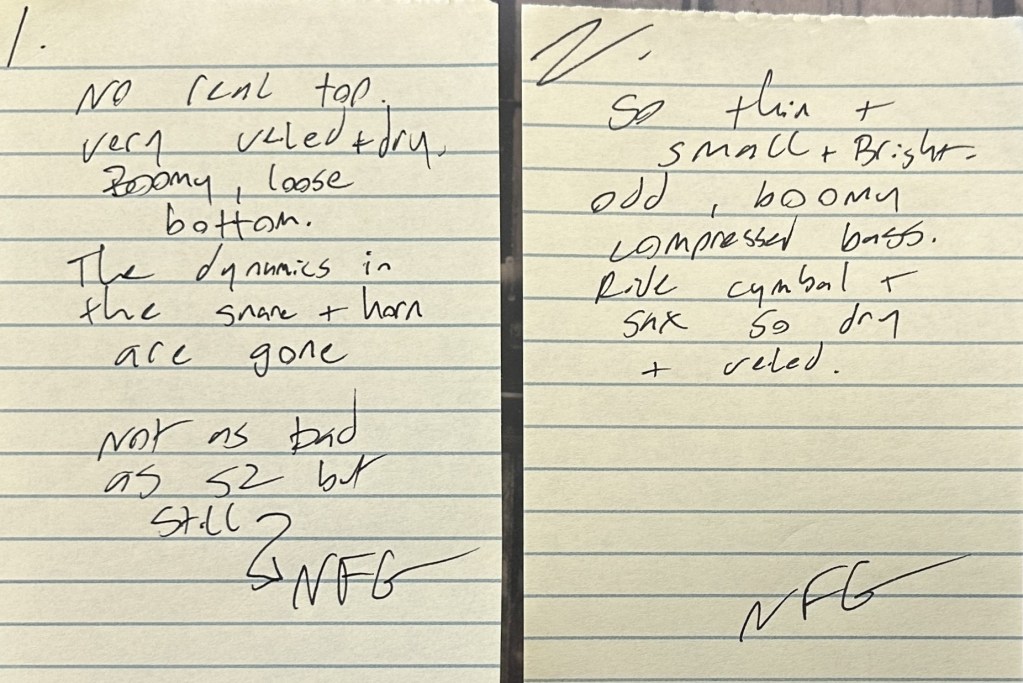
Here are the notes we took while playing the Tone Poets pressing after completing our shootout. We had already heard some killer copies, the White Hot shootout winners, so we knew just how good the record could sound.

Side One

  • No real top
  • Very veiled and dry
  • Boomy, loose bottom
  • The dynamics in the snare and horn are gone
  • Not as bad as side two but still NFG

Side Two

  • So thin and small and bright
  • Odd, boomy compressed bass
  • Ride cymbal and sax are so dry and veiled
  • Our grade: NFG

Yup, that sounds like a record Kevin Gray could have cut! Terrible? Of course it is.

We’ve played plenty of them and it’s hard to find one that’s not awful.

Kevin Gray’s transistory, opaque, airless, low-resolution cutting system is almost guaranteed to make even the most wonderful analog recordings sound like CDs, and often worse than a CD. I have lots of great sounding CDs in my collection. If any of them sounded as bad as this Tone Poets LP, I would have traded in the ones that did years ago.

We discuss that subject in some depth here. You can add this disaster to the list of bad sounding Heavy Vinyl we’ve reviewed in 2024/25.

(more…)

Alan Sides Sure Likes a Dead Studio

Hot Stamper Pressings of Pablo Recordings Available Now

Many of Allen Sides‘ recordings suffer from a lack of ambience. The musicians do not seem to have much room around them. In audiophile parlance, his recordings often lack “air.”  I can’t say all his recordings are made in a dead studio, but some of them sure are.

Many audiophile recordings, especially direct-to-disc recordings from the ’70s, are insufferable in this respect, with too much multi-miking and not enough studio space.

This Bach recording on Crystal Clear is a good example of the sound some audiophile labels were going for. Back in the 70s, audiophile producers and engineers were using state-of-the-art high-tech recording equipment, but they seemed to lack experience as well as knowledge of the recordings of the past. They regularly ended up producing records that are not remotely the equal of those that were commonly made only twenty years before.

For Duke is the poster boy for that sound. The instruments are dynamic as all get out, but no one ever imagined that the ideal approach to recording Ellington’s music would be to cram a big group of players into the equivalent of a heavily carpeted and draped livingroom.

Miller and Kreisel created a completely new, strange and inappropriate sound for Duke’s music, and it has been rubbing me the wrong way since I first heard it demoed in the audio showrooms I frequented back in the 70s.

(more…)

Green Street on Music Matters – Tizzy Cymbals and a Bright Snare Drum, That’s Your Idea of Audiophile Sound?

Hot Stamper Pressings of Blue Note Albums Available Now

An audiophile hall of shame pressing and a Heavy Vinyl disaster if there ever was one (and oh yes, the audiophile world is practically drowning in them).

After discovering Hot Stampers and the mind-blowing sound they deliver, a new customer generously sent me a few of his favorite Heavy Vinyl pressings to audition, records that he considered the best of the modern reissues that he owns.

He admitted that most of what he has on Heavy Vinyl is not very good, and now that he can clearly hear what he has been missing, having heard some of our best Hot Stamper jazz pressings, he is going to be putting them up on Ebay and selling them to anyone foolish enough to throw their money away on this kind of junk.

We say more power to him.  That money can be used to buy records that actually are good sounding, not just supposedly good sounding because they were custom manufactured with the utmost care and marketed at high prices to soi-disant audiophiles.

Audiophile records are a scam. They always have been and they always will be.

I haven’t listened to a copy of this album in a very long time, but I know a good sounding jazz record when I hear one, having critically auditioned more than a thousand over the course of the 33 years I have been in business. (To be clear, we only sold verified good sounding records starting in 2004.)

I knew pretty early on in the session that this was not a good sounding jazz record.  Five minutes was all it took, but I probably wasted another ten making sure the sound was as hopeless as it initially seemed.

For those of you who might have trouble reading my handwriting, my notes say:

  • Bass is sloppy and fat.

The bass is boosted and badly lacks definition. It constantly calls attention to itself. It is the kind of sloppy bass that cannot be found on any RVG recording, none that I have ever heard anyway, and I’ve heard them by the hundreds.

You no doubt know about the boosted bass on the remastered Beatles albums. It’s that sound. Irritating in the extreme, and just plain wrong.

  • Reserved. Playing through a curtain.

Very few Heavy Vinyl records these days do not sound veiled and reserved in the midrange.

To get a better sense of the effect, throw a medium weight blanket over your speakers. Voila! Your thin vinyl now weighs 180 grams!

  • No space.

Typical of Heavy Vinyl. The studio space and ambience found on the better vintage pressings, the kind we play all day long, is GONE.

RTI pressings are serial offenders in this regard.  We find them uniformly insufferable.

  • No transients.

Not the sound of the instruments that RVG is famous for.  No leading edges to any instrument anywhere.

Somebody screwed them up in the mastering. Bad cutting equipment? Bad EQ? Both? What else could it be?

  • Boring.

Of course it is. Nothing sounds right and it’s all just so dead.

I would be very surprised if the CD was not dramatically better sounding in practically every way, and far more fun to listen to.

  • Snare is hot when played loud like a bad OJC

We’ve auditioned close to a hundred OJC titles over the years. We sell quite a few of them, but of course we only sell the ones that sound good. We are in the good sounding records business. And some of them are hard to beat.

But lots of them have a phony, boosted top end, easily heard as tizzy, sizzly, gritty, phony cymbals and too-hot snare drums.

This record has that phony sound.

We would never sell any record that sounds this phony and wrong. It is an utter disgrace and an affront to vinyl loving audiophiles around the world.

If this record sounds right to you, one thing I can say without fear of contradiction: no matter how much money and time you may have spent on it, you still have a great deal of work to do on your stereo system if you want it to sound right.

(more…)

Moondance on Heavy Vinyl Is a Disgrace to Audiophiles and Record Lovers All Over the World

Hot Stamper Pressings of the Music of Van Morrison Available Now

The original grade I gave out in 2015 when I last played this remastered version as part of a shootout was “D.” I explained at the time:

Just listen to how strange Van’s voice sounds, so lean, hard and sour. That alone qualifies it for an “F,” but considering how bad most pressings of this album are, let’s be fair, if not downright generous, and call it a “D.”

I just revisited the record in a current shootout, and after giving it some thought I have decided that the right grade is in fact “F.” It cannot be any other, for reasons I discuss below.

In 2014 I had written:

Where is the Tubey Magic of the originals? The sweetness? The richness? And why is there so little ambience or transparency? You just can’t “see” into the studio on this pressing the way you can on the good originals, but that’s fairly consistently been the knock on these remastered Heavy Vinyl records. We noted as much when we debunked Blue all the way back in early 2007, so no surprise there.

Having just played a marvelous shootout-winning early pressing, this time around I found the reproduction of Van’s voice on the reissue to be so leaned-out, artificial and unpleasant that I could hardly stand to listen to it.

We had reset the VTA correctly; the overall tonal balance of the recording from top to bottom was correct. It was only the voice that sounded so off. All the other shortcomings I had mentioned before were still true of course, but none of that mattered. The singer on this record just sounded awful.

As you know, we are constantly making improvements to our playback system. The real Moondance we had just played sounded better than ever. The fake Moondance, however, was sounding worse than ever. That’s what higher quality playback can do for you. It makes your good records sound better than they’ve ever sounded, and shows you just how bad your bad records really are.

Do I have a bad copy of the Heavy Vinyl pressing? Maybe, can’t say I don’t. If any of you out there in the real world have a copy of this pressing that you like, and would be willing to send it to me to hear for myself, I would be more than happy to give it a listen and report my findings on this blog.

Short of that I’m not sure what more I can do. I certainly do not feel the least bit inclined to waste a nickel of my hard-earned money on another copy of this ridiculously badly-mastered crap vinyl.

If you want to read about other records that have these same shortcomings, there are links below to the ones we’ve auditioned and identified to date. Our advice would be to avoid them, and if you own some of these pressings, perhaps now is the time to give them another listen and see if you don’t hear the same faults we did.

And, of course, the Hot Stamper pressings we offer, when played side by side with any of these Heavy Vinyl remasters, can help you to see more clearly just where these new records are going wrong, or, in the case of Moondance, completely off the rails.

(more…)

Chad and Bernie Step on Another Rake

Hot Stamper Pressings of the Music of Art Pepper Available Now

Just in time for Record Store Day — what could be better?

In the interest of streamlining the process of getting reviews like this up on the blog, we’ll try to stick mostly to the facts and let the description of the strengths and weaknesses of the pressings speak for themselves.

One quick note: the sonic qualities you see described below are the ones we heard with the mono switch on our EAR 324P phono stage activated.

Without the switch set to mono, the sound is even thicker and darker.

Yes, as bad as this pressing sounds, you can make it worse if you don’t switch your preamp or phono stage to mono. Hard to believe but it’s true!

The notes for side one can be seen below. For side one we started with the second track.

Side One

Track Two / Red Pepper Blues

  • Boomy low end
  • Sax is stuck [in the speaker]
  • And lacking in breath and space

Track One / You’d Be So Nice to Come Home To

  • Very flat piano and hard snare
  • Compressed, almost pumping
  • Thick and opaque

Our grade: No Good

Side Two

Track One / Jazz Me Blues

  • Compressed and boomy
  • Not as dark as side one
  • But still very flat and boring

Our grade: Again, No Good

(more…)

Good Digital Beats Bad Analog Any Day

Hot Stamper Pressings of the Music of Sonny Rollins Available Now

And this is some very bad analog indeed!

We here present our 2010 review of the Sonny Rollins Plus 4 album, the one remastered on two slabs of 45 RPM Analogue Productions Heavy Vinyl.

It has everything going for it, right?

Steve Hoffman, Kevin Gray, 45 RPMs, Heavy Virgin Vinyl, fancy packaging — clearly no expense was spared!

The ingredients may have been there, but the cake they baked was not only not delicious, it was positively inedible.

I cannot recall hearing a more ridiculously thick, opaque and unnatural sounding audiophile record than this Rollins record, and believe me, I’ve heard plenty

As I noted in another commentary “Today’s audiophile seems to be making the same mistakes I was making as a budding enthusiast more than thirty years ago. Heavy Vinyl, the 45 RPM 2 LP pressing, the Half-Speed limited edition — aren’t these all just the latest audiophile fads, each with a track record more dismal than the last one?”

It reminds me of the turgid muck that Doug Sax was cutting for Analogue Productions back in the 90s. The CD has to sound better than this. There’s no way could it sound worse.

CD Update: I managed to track down a copy of the CD and it DOES sound better than this awful record, and by a long shot. It’s not a great sounding CD, but it sure isn’t the disaster this record is.

Buy the CD, and whatever you do, don’t waste money on this kind of crap vinyl.

This is a very bad sounding record, so bad that one minute’s play will have you up and out of your chair trying to figure out what the hell is wrong with your system. But don’t bother. It’s not your stereo, it’s this record.

It has the power to make your perfectly enjoyable speakers sound like someone wrapped them in four inches of cotton bunting while you weren’t looking.

Presence? Gone!

Transients? Who needs ’em!

Ambience, openness, three-dimensionality?

Uh, will you consider settling for murk, bloat and smear? There’s a special on them today at Acoustic Sounds.

And yet no one seems to have noticed, except us of course.

(more…)