lacks-air & ambience

Kevin Gray Returns to the Scene of the Crime for One Flight Up

Hot Stamper Pressings of Blue Note Recordings Available Now
Robert Brook wrote about the Tone Poets remastered pressing of One Flight Up a few year back. We noted at the time:

We have never heard the Tone Poets pressing that Robert played against the Van Gelder cutting he discusses in his commentary.

We have one in stock and are just waiting to do the shootout for the album so that we can compare it to the better pressings we know we will find.

You may have read that we were knocked out by a killer copy way back in 2007. We expect to be no less knocked out in 2023.

Make that 2025. (Clean Blue Note pressings are hard to come by.)

Robert concludes with the strengths and weaknesses of the two pressings. Here is an excerpt:

Overall, the Tone Poet is closed, distant and frankly boring to listen to. Where is the energy of the music? Where is the presence of these musicians? Where is the studio space?

Now that we’ve played the Tone Poets pressing against the best Blue Notes we could find, we know exactly what he means!

Kevin Gray had previously cut the record for Cisco and made a real mess of it, so we are not the least bit surprised that this newer version is every bit as bad sounding as that one.

Why anyone is hiring this hack to make records is a mystery to those of us who play them, and if for some reason it isn’t a mystery to you, it should be.

How inaccurate and unrevealing does a stereo have to be in order to hide the shortcomings of this incompetently mastered record? If you have such a stereo — and there seem to be plenty of them out there in audio land, judging by the fact that Tone Poets is still in business — now is the time to get rid of it, or, at the very least, start making major improvements.

You might want to consider taking some audio advice from us along those lines.

Robert Brook has plenty to say on that subject as well.

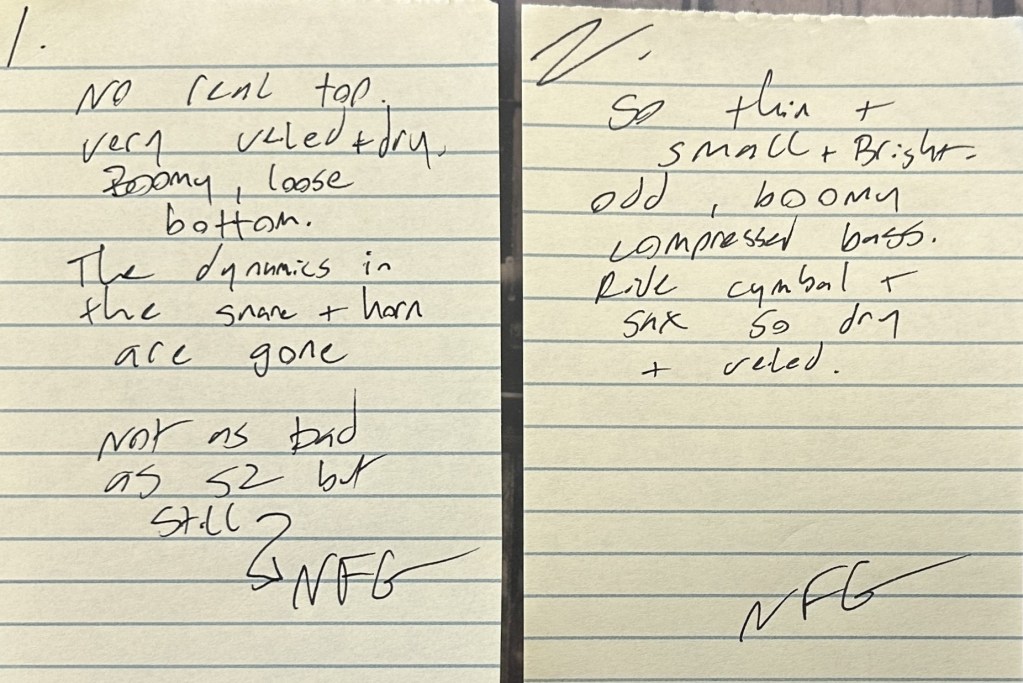
Here are the notes we took while playing the Tone Poets pressing after completing our shootout. We had already heard some killer copies, the White Hot shootout winners, so we knew just how good the record could sound.

Side One

(more…)

Alan Sides Sure Likes a Dead Studio

Hot Stamper Pressings of Pablo Recordings Available Now

Many of Allen Sides‘ recordings suffer from a lack of ambience. The musicians do not seem to have much room around them. In audiophile parlance, his recordings often lack “air.”  I can’t say all his recordings are made in a dead studio, but some of them sure are.

Many audiophile recordings, especially direct-to-disc recordings from the ’70s, are insufferable in this respect, with too much multi-miking and not enough studio space.

This Bach recording on Crystal Clear is a good example of the sound some audiophile labels were going for. Back in the 70s, audiophile producers and engineers were using state-of-the-art high-tech recording equipment, but they seemed to lack experience as well as knowledge of the recordings of the past. They regularly ended up producing records that are not remotely the equal of those that were commonly made only twenty years before.

For Duke is the poster boy for that sound. The instruments are dynamic as all get out, but no one ever imagined that the ideal approach to recording Ellington’s music would be to cram a big group of players into the equivalent of a heavily carpeted and draped livingroom.

Miller and Kreisel created a completely new, strange and inappropriate sound for Duke’s music, and it has been rubbing me the wrong way since I first heard it demoed in the audio showrooms I frequented back in the 70s.

(more…)

Music Matters – Tizzy Cymbals and a Bright Snare Drum, That’s Your Idea of Audiophile Sound?

Hot Stamper Pressings of Blue Note Albums Available Now

UPDATE 2026

This review was written in 2021.


An audiophile hall of shame pressing and a Heavy Vinyl disaster if there ever was one (and oh yes, the audiophile world is practically drowning in them).

After discovering Hot Stampers and the mind-blowing sound they deliver, a new customer generously sent me a few of his favorite Heavy Vinyl pressings to audition, records that he considered the best of the modern reissues that he owns.

He admitted that most of what he has on Heavy Vinyl is not very good, and now that he can clearly hear what he has been missing, having heard some of our best Hot Stamper jazz pressings, he is going to be putting them up on Ebay and selling them to anyone foolish enough to throw their money away on this kind of junk.

We say more power to him.  That money can be used to buy records that actually are good sounding, not just supposedly good sounding because they were custom manufactured with the utmost care and marketed at high prices to soi-disant audiophiles.

Audiophile records are a scam. They always have been and they always will be.

I haven’t listened to a copy of this album in a very long time, but I know a good sounding jazz record when I hear one, having critically auditioned more than a thousand over the course of the 33 38 years I have been in business. (To be clear, we only sold verified good sounding records starting in 2004.)

I knew pretty early on in the session that this was not a good sounding jazz record.  Five minutes was all it took, but I probably wasted another ten making sure the sound was as hopeless as it initially seemed.

For those of you who might have trouble reading my handwriting, my notes say:

  • Bass is sloppy and fat.

The bass is boosted and badly lacks definition. It constantly calls attention to itself. It is the kind of sloppy bass that cannot be found on any RVG recording, none that I have ever heard anyway, and I’ve heard them by the hundreds.

You no doubt know about the boosted bass on the remastered Beatles albums. It’s that sound. Irritating in the extreme, and just plain wrong.

  • Reserved. Playing through a curtain.

Very few Heavy Vinyl records these days do not sound veiled and reserved in the midrange.

To get a better sense of the effect, throw a medium weight blanket over your speakers. Voila! Your thin vinyl now weighs 180 grams!

  • No space.

Typical of Heavy Vinyl. The studio space and ambience found on the better vintage pressings, the kind we play all day long, is GONE.

RTI pressings are serial offenders in this regard.  We find them uniformly insufferable.

  • No transients.

Not the sound of the instruments that RVG is famous for.  No leading edges to any instrument anywhere.

Somebody screwed them up in the mastering. Bad cutting equipment? Bad EQ? Both? What else could it be?

  • Boring.

Of course it is. Nothing sounds right and it’s all just so dead.

I would be very surprised if the CD was not dramatically better sounding in practically every way, and far more fun to listen to.

  • Snare is hot when played loud like a bad OJC

We’ve auditioned close to a hundred OJC titles over the years. We sell quite a few of them, but of course we only sell the ones that sound good. We are in the good sounding records business. And some of them are hard to beat.

But lots of them have a phony, boosted top end, easily heard as tizzy, sizzly, gritty, phony cymbals and too-hot snare drums.

This record has that phony sound.

We would never sell any record that sounds this phony and wrong. It is an utter disgrace and an affront to vinyl loving audiophiles around the world.

If this record sounds right to you, one thing I can say without fear of contradiction: no matter how much money and time you may have spent on it, you still have a great deal of work to do on your stereo system if you want it to sound right.

(more…)

Moondance on Heavy Vinyl Is a Disgrace to Audiophiles and Record Lovers All Over the World

Hot Stamper Pressings of the Music of Van Morrison Available Now

The original grade I gave out in 2015 when I last played this remastered version as part of a shootout was “D.” I explained at the time:

Just listen to how strange Van’s voice sounds, so lean, hard and sour. That alone qualifies it for an “F,” but considering how bad most pressings of this album are, let’s be fair, if not downright generous, and call it a “D.”

I just revisited the record in a current shootout, and after giving it some thought I have decided that the right grade is in fact “F.” It cannot be any other, for reasons I discuss below.

In 2014 I had written:

Where is the Tubey Magic of the originals? The sweetness? The richness? And why is there so little ambience or transparency? You just can’t “see” into the studio on this pressing the way you can on the good originals, but that’s fairly consistently been the knock on these remastered Heavy Vinyl records. We noted as much when we debunked Blue all the way back in early 2007, so no surprise there.

Having just played a marvelous shootout-winning early pressing, this time around I found the reproduction of Van’s voice on the reissue to be so leaned-out, artificial and unpleasant that I could hardly stand to listen to it.

We had reset the VTA correctly; the overall tonal balance of the recording from top to bottom was correct. It was only the voice that sounded so off. All the other shortcomings I had mentioned before were still true of course, but none of that mattered. The singer on this record just sounded awful.

As you know, we are constantly making improvements to our playback system. The real Moondance we had just played sounded better than ever. The fake Moondance, however, was sounding worse than ever. That’s what higher quality playback can do for you. It makes your good records sound better than they’ve ever sounded, and shows you just how bad your bad records really are.

Do I have a bad copy of the Heavy Vinyl pressing? Maybe, can’t say I don’t. If any of you out there in the real world have a copy of this pressing that you like, and would be willing to send it to me to hear for myself, I would be more than happy to give it a listen and report my findings on this blog.

Short of that I’m not sure what more I can do. I certainly do not feel the least bit inclined to waste a nickel of my hard-earned money on another copy of this ridiculously badly-mastered crap vinyl.

If you want to read about other records that have these same shortcomings, there are links below to the ones we’ve auditioned and identified to date. Our advice would be to avoid them, and if you own some of these pressings, perhaps now is the time to give them another listen and see if you don’t hear the same faults we did.

And, of course, the Hot Stamper pressings we offer, when played side by side with any of these Heavy Vinyl remasters, can help you to see more clearly just where these new records are going wrong, or, in the case of Moondance, completely off the rails.

(more…)

Chad and Bernie Step on Another Rake

Hot Stamper Pressings of the Music of Art Pepper Available Now

Just in time for Record Store Day — what could be better?

In the interest of streamlining the process of getting reviews like this up on the blog, we’ll try to stick mostly to the facts and let the description of the strengths and weaknesses of the pressings speak for themselves.

One quick note: the sonic qualities you see described below are the ones we heard with the mono switch on our EAR 324P phono stage activated.

Without the switch set to mono, the sound is even thicker and darker.

Yes, as bad as this pressing sounds, you can make it worse if you don’t switch your preamp or phono stage to mono. Hard to believe but it’s true!

The notes for side one can be seen below. For side one we started with the second track.

Side One

Track Two / Red Pepper Blues

  • Boomy low end
  • Sax is stuck [in the speakers]
  • And lacking in breath and space

(more…)

How Can Sound This Bad Possibly Earn a 10?

Hot Stamper Pressings of the Music of Bob Dylan Available Now

Maybe if the scale goes from 1 to 100, sure, I could see it. Yeah, 10 out of 100 sounds about right.

But the scale goes to 11, which makes a grade of 10 risible to anyone who has played this seriously flawed pressing. Here is how we described its sound many years ago:

We found this mono reissue to be flat as a pancake and dead as a doornail, like most of the Sundazed records we’ve played, starting way back in the early 2000s. No, they never got any better.

In our experience, Sundazed is one of the worst record labels of all time. This pressing is just more evidence to back up our low opinion of them.

Obviously we may have a low opinion of them, but a famous audiophile reviewer seemed to find the sound to his liking. He wrote:

Sundazed’s reissue gives the original a run for the money and remains true to the original, though it suffers in the bass, which while deep and reasonably well defined, is not as tightly drawn or focused. The upper mids on the original also bloom in a way that the reissue’s don’t, giving the reissue a slightly darker, recessed sound, but there’s still sufficient energy up there since Dylan’s close-miked vocals pack an upper midrange punch. If the vocals or harmonica sound spitty and unpleasantly harsh, it’s your system, not the record [!] – though there’s plenty of grit up there. On the plus side, the overall clarity and transparency of the reissue beats the original. [!] A really fine remastering job.

Of course we find every word of this review arrant nonsense, except the discussion of the qualities he praises in the original relative to the reissue. It’s been twenty years since this remastered pressing came out, does anybody still like the sound of it? Anybody? Let’s hope not.

The intro to his review boldly declares a respect for Sundazed (and Classic Records and Analogue Productions) that we find puzzling after playing so many of their rarely-better-than-awful-sounding records. (Here is a commentary from 2007 that puts our antipathy in perspective. And no, modern records have no improved since then, if the releases from 2024 are any indication.)

Sundazed’s decision to issue Blonde on Blonde using the much sought after mono mix is indicative both of the company’s dedication to doing what’s musically correct, and of the vinyl marketplace’s newfound maturity. There was a time a few years ago when no “audiophile” vinyl label would dare issue a mono recording; audiophiles wouldn’t stand for it was the conventional wisdom. Perhaps back then it was even true. Today, with Sundazed, Classic, Analogue Productions and others issuing monophonic LPs on a regular basis (and one has to assume selling them as well) listeners are appreciating the music for music’s sake, and equally importantly, for the wonderful qualities of monophonic sound reproduction.

My grade might be 2 out of 11. No audiophile should be fooled by the crap sound of this pressing, and no audiophile should believe a word of this review.

Reviewer incompetence? We’ve been writing about it for more than 25 years. From the start we knew we could never begin to do much more than scratch the surface of preposterous record reviews in need of rebuttal. The audiophile world is drowning in this sh*t.

(more…)

Tea for the Tillerman – This Is Your Idea of Analog?

Dear Record Loving Audiophiles of Earth,

I’m afraid we have some bad news. [This was written back in 2011 when the record came out so it’s hard to imagine that what I am about to say is news to anyone after all these years.]

Regrettably we must inform you that the 2011 edition of Tea for the Tillerman pressed by Analogue Productions on Heavy Vinyl doesn’t sound very good. We know you were all hoping for the best. We also know that you must be very disappointed to hear this unwelcome news.

But the record is what it is, and what it is is not very good. Its specific shortcomings are many and will be considered at length in our review below.

Yes, we know, the folks over at Acoustic Sounds, in consultation with the late George Marino at Sterling Sound, supposedly with the real master tape in hand, and supposedly with access to the best mastering equipment money can buy, labored mightily, doing their level best to master and press the Definitive Audiophile Tea for the Tillerman on Vinyl of All Time.

It just didn’t come out very good, no matter what the reviewers say. And what do they say? Allow me to quote one.

…superbly dynamic, spacious and detailed…The attack of the pick on the guitar strings is astonishingly clean and detailed.

Depth is pronounced…

…the resolution of low level detail reveals a host of details that are either buried or glossed over on the other versions I’ve heard…

Uh-oh, wait a minute, here’s a blindingly red flag:

If you have the edition, you’ll find this similar in one way: there’s nothing “mellow” about the overall production and when the music gets loud (and Marino lets it get so) it can get a bit hard, but better that than to soften it and lose the clarity, focus and detail of this superb recording, especially in the quieter passages where the resolution of low level detail is astonishing.

More about that later.

(more…)

How Good Are the Later Reissues of The Bridge?

When we did this shootout ten years ago, we thought the reissues with the cover you see to the left actually sounded better than the original pressings, but we were wrong and we have to admit it, as painful as that may be.

True, we never cared much for the later reissues described below — the tan labels can be passable but fall well short of the standards we set now.

However, even the best orange label pressings from 1975 don’t sound as good to us now as we thought they did ten years ago.

They can be good, but in our experience they can never be great.

Great is the sound that can only be found on the best originals, and they win all the shootouts now.

The notes for the AFL pressing with the black label describe it as bright, phony and lean.

This is the kind of sound better suited to the stone age stereos of the past.

I should know. I had a stereo all the way up until the late-90s — not exactly stone age quality, but far from the sound we have now — that prevented me from hearing my records with the highest quality reproduction.

As a result of the shortcomings of my system, I was wrong about a lot of records. (I loved DCC back in those days. Not that many years later I would undergo a “deconversion” as my stereo and critical listening skills improved.)

Of course, I was convinced my stereo was fantastic. It sure sounded better to me than any other system I’d ever heard, and by a long shot.

I had been working with expensive stereo equipment for more than twenty years at that point. The system I had put together by then cost a lot of money, played at loud levels with great energy, was in a dedicated room, et cetera, et cetera.

Are the audiophiles of today making the same mistakes I made back then?

Probably, if not almost certainly, and the one test we can use to determine which audiophiles have made the least amount of progress in this hobby are those who play records like the ones on this list and find nothing wrong with them. Their defense? “They sound just fine to me and who are you to say otherwise?”

Well, we’re the guys who say “you don’t know what you’re missing, and we have the superior-sounding pressing to prove it.”

Which, of course, as is the way of these things, almost always falls on deaf ears, pun intended.

Bottom Line

As of 2024, it’s clear to us that the early pressings have the potential for the best sound, but that the reissues can still sound very good, certainly quite a bit better than any Heavy Vinyl reissue is likely to.

Want to find your own top quality copy?

(more…)

After the Gold Rush – Because Sound Matters?

Hot Stamper Pressings of the Music of Neil Young Available Now

I don’t know why I wasted so much time critiquing the sound of this remastered (2009) pressing. Frankly, it really wasn’t worth it.

However, since I listen to records for a living, I figured I might as well listen to this one, head to head with an excellent vintage pressing, of course. What other way to do it is there?

Since we do shootouts for this album regularly, we know just how good the best pressings of After the Gold Rush can sound, and this newly remastered vinyl is missing almost everything that makes the album essential to any right thinking music lover’s collection.

We can summarize the sound of this dreadful record in one word: boring.

Since some of you reading this review are no doubt fans of Chris Bellman, the engineer credited on the album, and a man apparently held in some esteem by a great many audiophiles, perhaps we owe it to his fans to break down the sonic strengths and weaknesses of this pressing in more detail.

What It Does Right

It’s tonally correct. Unlike many modern pressings, it is not overly smooth.

Uh, can’t think of anything else…

What It Does Wrong

Where to begin?

(more…)

Physical Graffiti on Classic Records

More of the Music of Led Zeppelin

An Audiophile Hall of Shame pressing and another Classic Records Rock LP badly mastered for the benefit of audiophiles looking for easy answers and quick fixes.

Tonally correct, which is one thing you can’t say for most of the Zeps in this series, that’s for sure. Those of you with crappy domestic copies, crappy imported reissues and crappy CDs, which make up the bulk of offerings available for this recording, probably do not know what you’re missing.

What’s Lost

What is lost in these newly remastered recordings? Lots of things, but the most obvious and bothersome is transparency.

Modern records are just so damn opaque.

We can’t stand that sound. It drives us crazy. Important musical information — the kind we hear on even second-rate regular pressings — is simply nowhere to be found. That audiophiles as a group — including those that pass themselves off as champions of analog in the audio press — do not notice these failings does not speak well for either their equipment or their critical listening skills.

It is our contention that almost no one alive today is capable of making records that sound as good as the vintage ones we sell.

Once you hear a Hot Stamper pressing, those 180 gram records you own may never sound right to you again. They sure don’t sound right to us, but we are in the enviable position of being able to play the best properly-cleaned older pressings (reissues included) side by side with the newer ones.

(more…)