dry-str

Gorgeous Cover, Bad Sound

Hot Stamper Pressings of the Music of Felix Mendelssohn Available Now

UPDATE 2025

Our favorite recording of the work can be found here.


Awful sound. It’s bright, dry and flat, with strident strings.

The sound is much too unpleasant to be played on high quality modern equipment.

If your system is dull, dull, deadly dull, the way older systems tend to be, this record has the hyped-up, bright and aggressive sound that is sure to bring it to life in no time.

There are scores of commentaries on the site about the huge improvements in audio available to the discerning (and well-healed) audiophile. It’s the reason Hot Stampers can and do sound dramatically better than their Heavy Vinyl or audiophile counterparts: because your stereo is good enough to show you the difference.

With an Old School system, you will continue to be fooled by bad records, just as I and all my audio buds were fooled thirty and forty years ago. Audio has improved immensely in that time. If you’re still playing Heavy Vinyl and other audiophile pressings, there’s a world of sound you don’t know you’re missing.

(more…)

Our Old Prediction for LSC 2563 Came True

Hot Stamper Pressings that Feature the Violin

Many years ago we wrote:

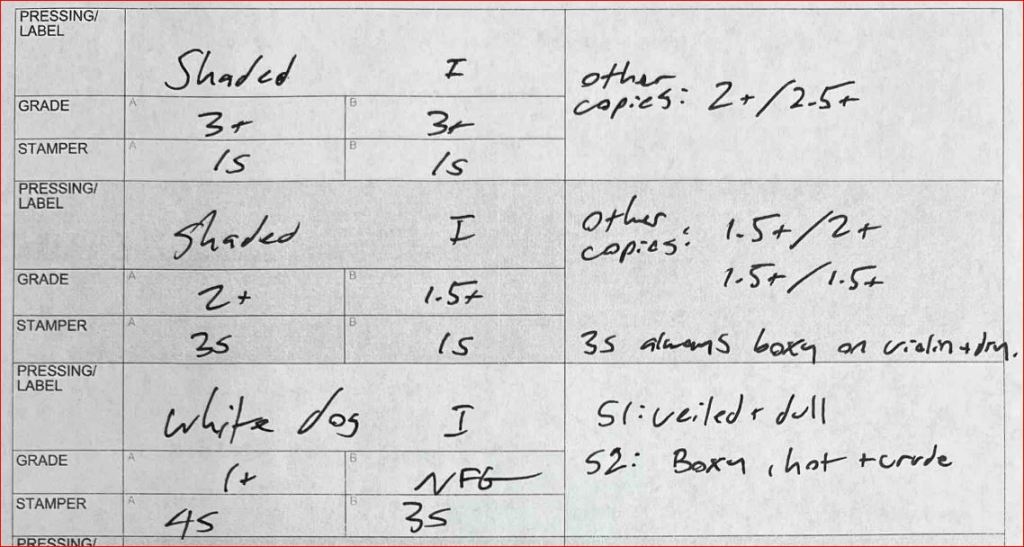
This is a very old review and it’s doubtful we would not prefer the right Shaded Dog pressing these days.

That turned out to be the case, as we had two late-label 70s Red Seal pressings in the shootout we just did and only one of them was even passable.

A few things about the new pressings and the old commentary caught my eye.

First off, 3s is a fairly low number. The Shaded Dogs that win the shootout must be lower, which means they are either 1s or 2s. Not much to choose from there!

Secondly, the commentary you see below goes into great detail regarding what each piece found on the pressing was doing right and wrong.

It makes us sound like we knew what we were talking about when it came to this specific Red Seal pressing of the album we had played.

I assure you that we did not.

On the web I come across lots of reviews for audiophile pressings in which the writers go on for page after page about how much better the new Heavy Vinyl pressing is compared to the old record the reviewer owns.

This is no longer hard for me to understand. They are simply as lost as I used to be.

(more…)

Borodin / Symphonies 2 & 3 – Side Two Had Some Common Sonic Problems

More of the music of Alexander Borodin (1833-1887)

This shootout, conducted back in 2012, was our first for the album.

This White Hot Stamper pressing has DEMO QUALITY sound of the HIGHEST ORDER on fairly quiet vinyl no less. We’ve long considered the album one of the greatest of all the Decca / London recordings, but this pressing takes the sound beyond even our high expectations.

There is simply nothing in the sound to fault. Where is the slightly dry and midrangy quality in the upper strings that so many Londons from this era suffer from? It’s nowhere to be found on this side one. (If you have a rich sounding cartridge, perhaps with that little dip in the upper midrange that so many moving coils have these days, you will not notice this tonality issue nearly as much as we do.)

And it’s not as though our stereo was hiding that quality, because some of it creeps into the sound on this very side two (which is why it earned a slightly lower grade of A++).

Big, rich and dynamic, this is the sound of LIVE MUSIC, and it can be yours, to enjoy for years to come — if you’ve got the stereo to play it and the time to listen to it.

The powerful lower strings and brass are gorgeous. Ansermet and the Suisse Romande get that sound better than any performers I know. You will see my raves on record after record of theirs produced during this era. No doubt the world renowned Victoria Hall they recorded in is key. One can assume Decca engineers use similar techniques for their recordings regardless of the artists involved. The only real variable should be the hall.

Ansermet’s recordings with the Suisse Romande exhibit a richness in the lower registers that is unique in my experience. His Pictures At Exhibition has phenomenally powerful brass, the best I’ve ever heard. The same is true for his Night On Bald Mountain. Neither performance does much for me — they’re both too slow — but the sound is out of this world. Like it is here.

Side One

A+++, big, rich and lively, yet clear, transparent and spacious. The brass is shockingly dynamic and powerful. I defy you to find better brass on a record than can be found on this side one. I can’t recall hearing it, and we play the best sounding Golden Age classical recordings by the score week after week.

Side Two

A++, a bit wider, with lovely sheen to the strings, but tonally a bit thinner and drier than it should be. Still, awfully good in comparison to the better classical records we put up every week, just not competitive with this amazing side one.

If you’re looking for Demonstration Quality Sound, look no further. This side one has it in spades.

Heavy Vinyl

Speakers Corner did a heavy vinyl reissue of this title, which we auditioned and used to sell. It’s reasonably good, but like all reissues it lacks the weight found on this original. I remember it being a little flat and bright. I haven’t played it in years so I could easily be wrong.

(more…)

Not as Good a TAS List Title as We Thought, Sorry!

Hot Stamper Pressings of Living Stereo Titles Available Now

We had a handful of copies of this famous TAS List title in the backroom, so we decided it was high time to get a shootout going. We pulled all the pressings of the music (both Billy the Kid and Rodeo) we had on hand on every label and proceeded to needle-drop them in preparation for a big Copland shootout.

Much to our chagrin, most of the copies of LSC 2195 we played were unacceptable. The sound, for the most part, was very much not to our liking. Our notes read:

  • Smeary — (more records with smeary sound can be found here),
  • Dry — (more records with dry sound can be found here),
  • Bright — (more records with bright sound can be found here),
  • Flat — (more records with flat sound can be found here),
  • Hi-Fi-ish — (more records with hi-fi-ish sound can be found here),

Those records weren’t cheap. That was a lot of money down the drain. Not only can’t we sell records that sound as bad as this Living Stereo — our customers simply would not buy them — but we would never even try. Unlike other record dealers, we actually know what our records sound like. We don’t care about the reputations of the records we sell. We only care about their sound.

Some of the records on the TAS List seem better suited to the old school audio systems of the 60s, 70s and 80s than the modern systems of today.

(more…)

London Orchestral Records from the 70s and the Problem of Opacity

Decca and London Hot Stamper Pressings Available Now

The average copy of this 1976 recording has that dry, multi-miked modern sound that the 70s ushered in for many of the major labels, notably London and RCA.

How many Solti records are not ridiculously thick and opaque? One out of ten? If that. We’re extremely wary of records produced in the 70s; we’ve been burned too many times.

And to tell you the truth, we are not all that thrilled with most of what passes for good sound on Mehta‘s London output either, especially those recorded in Royce Hall. If you have a high-resolution system, these recordings, like those on Classic Records Heavy Vinyl that we constantly criticize, leave a lot to be desired.

Opacity is a real dealbreaker for us. Most of the classical records we play from later eras simply do not have the transparency essential to transporting us from our listening room into the concert hall.

One thing you can say about live classical music, it is never opaque. (It can be dry though. Some concert halls have that sound.)

No recording in our experience — our experience having been informed by playing thousands upon thousand of them — can ever be remotely as transparent as live music.

If you have any doubts, next time you come home from the concert hall, take a moment to put on a favorite recording of the same music. You may be in for quite a shock.

Other Deccas and Londons that we’d cleaned and played and found to be disappointing can be seen here.

For more on the subject of opacity on record, click here.

Here are some of the other records we’ve discovered that are good for testing string tone and texture.

(more…)

Concierto De Aranjuez – Another London with Dry Strings (on Some Copies)

More of the music of Joaquín Rodrigo (1901-1999)

On some copies of this album the strings are dry, lacking the full measure of Tubey Magic we know the tape to have. This is decidedly not our sound, although we’ve heard if often enough, having played hundreds of vintage Decca and London pressings over the years.

If you have a rich sounding cartridge, perhaps with that little dip in the upper midrange that so many moving coils have these days, you will not notice this tonality issue nearly as much as we do.

Our 17D3 is ruler flat and quite unforgiving in this regard. While it certainly makes our shootouts much easier, it does bring out the flaws in all but the best pressings — exactly the job we require it to do.

Here are some other records that are good for testing string tone and texture.

With a sonic grade of A++, the sound is glorious, with practically all of the qualities that make listening to classical music in analog so involving. The presentation is shockingly three-dimensional, with an exceptionally wide and deep stage. The orchestral sound is rich and sweet, yet the guitar is clear and immediate. Managing to balance — so effortlessly — two dissimilar elements such as these, in 1959 no less, requires an enormous amount of skill and effort. Fifty-odd years later, those of us with good turntables are profoundly thankful for their achievement, in terms of both performance and sound.

If you were only to be allowed one Guitar Concerto recording, this would probably be the one to own. You will recognize the main theme instantly; it’s the one Miles Davis appropriated for the astonishingly innovative Sketches of Spain album he did with Gil Evans which came out the following year in 1960.

Side One – Guitar Concerto: “Concerto De Aranjuez” (1939)

A++, including all the qualities we discussed above, with an especially immediate and real solo guitar.

With a bit more top end extension this side would have been White Hot. It should be noted that no Decca or London copy in our shootout had as much top end as we would have liked on the Rodrigo, a fault perhaps in the recording?

Side Two – Fantasìa Para Un Gentilhombre (1954)

A++, equally good in its own way. Rich and lush strings, but slightly veiled compared to side one. So musical and analog, although, like many concerto recordings, the guitar is much larger in the soundfield of the recording than it would be in the concert hall.

The music is reminiscent of Respighi’s Ancient Airs and Dances, for those of you familiar with the work (a longtime resident of the TAS List. Wish we could find them!).

(more…)

Observations on RCA’s Chamber Recordings

beethseren_LSC2550

Hot Stamper Pressings of Living Stereo Titles Available Now

What do the best copies of this album sound like?

The sound is RICH and TRANSPARENT, and unlike a lot of RCA’s chamber recordings, not dry.

The tonality is also Right On The Money.

The performers are present and the transients of their instruments are not in the least bit smeared.

A case of good tube mastering?

On the best pressings, absolutely.

(More on the subject of tubes in audio here.)

Classical Shootouts

RCA is justly famous for its chamber recordings, which tend to be somewhat rare for some reason. Let’s be honest: we did not conduct this shootout with a dozen copies of the album. (It would take us at least twenty-five years to find that many clean pressings.)

What we had were quite a few other Heifetz RCA chamber recordings, as well as some favorites by the Quartetto Italiano and I Musici that we are very fond of and know well.

After thirty two years in business selling vintage vinyl, by now we’ve played scores if not hundreds of good violin recordings. We have no problem recognizing good violin sound (as well as correct violin tone, not exactly the same thing) when we hear it. In the past our top Hot Stamper classical pressings would go directly to our best customers, customers who want classical recordings that actually sound good. not just the kind of Golden Age Recordings that are supposed to. Now that we are able to do classical shootouts on a regular basis, we hope to have enough superb sounding classical recordings for all of our audiophile customers.

I’ve commented often over the years of the benefits to be gained from listening to classical music regularly. Once a week is a good rule of thumb I would say. I love rock and roll, jazz and all the rest of it, but there is something about classical music that restores a certain balance in your musical life that can’t be accomplished by other means. It grounds your listening experience to something perhaps less immediately gratifying but deeper and more enriching over time. Once habituated, the effect on one’s mood is not hard to recognize.

Orchestral Music Is Hard to Record, Master and Press, Apparently

(more…)

What Do You Mean by “Boxy” Sound?

More of the Music of Tchaikovsky

Many Golden Age classical records simply do not have very good sound, and this is one of them.

We’ve never heard a good sounding copy of LSC 2216, and we’ve played quite a number of them over the decades that we’ve been in the business of selling them. (LSC 1901, with Monteux conducting, is no better.)

A copy came in a while back so I figured it was time to give it a spin and see if there was any reason to change my opinion. Hey, maybe this one had Hot Stampers!

Can’t say it wouldn’t be possible. Unlikely, yes, impossible, no.

So here’s what I heard. No real top above 6k, hardly any bottom, but with a very wide stage – the textbook definition of “boxy sound.” (Dry and thin too, on a vintage RCA pressing no less!)

If you are a fan of Living Stereo pressings, have you noticed that many of them – this one for example – don’t sound good?

If you’re an audiophile with good equipment, you should have. But did you? Or did you buy into the hype surrounding these rare LSC pressings and just ignore the problems with the sound?

(more…)

This 1K/1K Pressing of Three-Cornered Hat Sure Was a Letdown

Hot Stamper Pressings of Orchestral Spectaculars Available Now

This London original pressing with 1K/1K stampers was so bright, dry, and shrill I could hardly stand to listen to it for more than the minute it took me to realize it was not going to get any better. The sound is bad enough to send it right into our hall of shame.

There are a number of other Deccas and Londons that we’ve played over the years that were disappointing, and they can be found here.

The copy we had back in 2010 was a very good sounding record, or so we thought.

Maybe we were wrong! It’s not as though we don’t admit to the possibility. You can read all about it below.

Falla’s Three-Cornered Hat is positively WONDERFUL on this copy (A++), and the Sinfonia Sevillana by Turina on side two is every bit as good! The second suite on side one is particularly lovely — check out how rich and full the sound is. Side two has a HUGE soundstage, as wide as they come. The sound is very rich and full of audiophile colors — this is the kind of record that you’re going to love playing for your audio pals!

Argenta brings the authentic Spanish flavor out in these works. Like so many audiophile reviewers over the years, you may find these performances definitive.

The strings on the first side are a bit dry to start, kind of like the sound many of you will recognize from Mercury’s classical records. Still, there’s much to like about the sound and you’ll have a very hard time finding a copy that’s any better. Most pressings do not have such an extended top end, and that quality here really brings this music to life.

On many copies the strings are somewhat dry, lacking Tubey Magic. This is decidedly not our sound, although it can easily be heard on many London pressings, the kind we’ve played by the hundreds over the years.

(more…)

The Trout Quintet – Original Versus Reissue

More of the music of Franz Schubert

This unusual 2-pack combines two very different pressings from very different eras to create a complete performance of The “Trout” Quintet with SUPERB Super Hot Stamper (or better) on both sides. One pressing, the one shown, is from the early ’60s; the other is from 1982. How could an imported budget late reissue beat a superb Golden Age pressing on any side you ask? Well, the answer to that question is provided by the records we will send you. 

Side one of this London Whiteback pressing is dark and opaque, with a serious lack of both top end and clarity. Side two however is GORGEOUS: so big, rich, clear and lively, it earned a sonic grade of A++ to A+++! In our shootouts the person reviewing the records (in this case me) never knows which pressing is being critiqued. Imagine my surprise when the late London handily beat the early one.

Actually it’s easy to imagine my surprise, because there was simply no surprise to imagine. In our shootouts here at Better Records, later pressings beat early pressings regularly. We let the records speak for themselves, and that’s what they told us, at least on side one of The “Trout.” The reason the late pressing even made it into our shootout was that in a preliminary round it showed us that it had very good sound on side one. Side two didn’t hold up, but any record with good sound on any side is going to go in the shootout, regardless of the “incorrectness” of its label or country of origin.

On the earlier pressing (CS 6090) the sound is rich and sweet; some might say it’s too rich, but for this music it works. The piano and the strings have that Golden Age Tubey Magical sound we love. It’s been years since I’ve had the opportunity to play this record; most copies are just too beat up to bother with, so I was glad to find this one in such minty condition. (more…)