dry-sound

These are some of the records that we’ve found to have dry sound. We felt they could benefit greatly from more Tubey Magic somewhere in the recording chain.

Is Digital Really the Problem on this Cowboy Junkies Album?

Hot Stamper Pressings of Digital Recordings with Audiophile Sound 

The RCA domestic pressings cut at Sterling are not worth the vinyl they’re pressed on.

Don’t be one of those die-hard analog types who point fingers at the fact that there was digital in the recording chain when their pressing doesn’t sound good.

It’s got nothing to do with digital. It has everything to do with Sterling doing a bad job mastering the domestic vinyl.

(Keep in mind that a very large group of audiophiles, including some well-known reviewers, had no idea there was a digital step used in the process of making some of the records they had raved about. Apparently the only way to hear it is when you already know it’s there.)

Our notes for the domestic pressing below read:

  • Flat and dry vox.
  • Shifted up [tonally]
  • A bit scooped [or “sucked out” in the midrange, meaning the middle of the midrange is missing to some degree]

The midrange suckout effect is easily reproducible in your very own listening room. Pull your speakers farther out into the room and farther apart from each other and you can get that sound on every record you own. I’ve been hearing it in the various audiophile systems I’ve been exposed to for more than 40 years.

Why Defend the Indefensible?

When good mastering houses like Kendun and Sterling and Artisan make bad sounding records, we offer no excuses for their shoddy work. The same would be true for the better-known cutting engineers who’ve done work for them, as well as other cutting operations.

Individuals working for generally good companies sometimes produce substandard work product.

How is this news to anyone outside of the sycophantic thread posters, youtubers, and self-identified record experts who write for the audiophile community?

(more…)

Gorgeous Cover, Bad Sound

Hot Stamper Pressings of the Music of Felix Mendelssohn Available Now

UPDATE 2025

Our favorite recording of the work can be found here.


Awful sound. It’s bright, dry and flat, with strident strings.

The sound is much too unpleasant to be played on high quality modern equipment.

If your system is dull, dull, deadly dull, the way older systems tend to be, this record has the hyped-up, bright and aggressive sound that is sure to bring it to life in no time.

There are scores of commentaries on the site about the huge improvements in audio available to the discerning (and well-healed) audiophile. It’s the reason Hot Stampers can and do sound dramatically better than their Heavy Vinyl or audiophile counterparts: because your stereo is good enough to show you the difference.

With an Old School system, you will continue to be fooled by bad records, just as I and all my audio buds were fooled thirty and forty years ago. Audio has improved immensely in that time. If you’re still playing Heavy Vinyl and other audiophile pressings, there’s a world of sound you don’t know you’re missing.

(more…)

This Side Two of Highway 61 Revisited Was a Little Dry

Hot Stamper Pressings of the Music of Bob Dylan Available Now

This commentary was written about ten years ago.

This 360 Label pressing has a SUPERB A+++ SIDE ONE backed with a strong A++ side two. We had a big stack of 360s and Red Labels with good stampers to compare, and this copy had a side one that could not be beat. 

Side two has amazing clarity and transparency as well. Compared to side one it’s just a bit dry.

Those of you with tubey systems — vintage and otherwise — will probably go crazy for this sound. This was the best side two we heard this time around, but since side one was clearly more impressive we topped off the grade for the second side at A++.

The 360 label pressings are a mixed bag, running from mediocre to mindblowing; most of the time they are too trashed to even consider playing on an audiophile turntable.

Most of the later pressings are sterile, congested, and lean. [We no longer buy them or put them in shootouts.]

What separates the best copies from the also-rans is more than just rich, sweet, full-bodied sound. The best copies like this one make Dylan’s voice more palpable — he’s simply more of a solid, three-dimensional real presence between the speakers. You can hear the nuances of his delivery more clearly on a copy like this.

(more…)

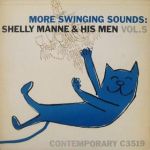
Audiophiles Should Skip the OJC of More Swinging Sounds

Hot Stamper Pressings of Well Recorded Jazz Albums In Stock Now

The vintage OJC pressings we played in our most recent shootout suffer from sonic problems common to many of these reissues: it was bright and dry.

To help you avoid records with this kind of sound, better suited to those who might prefer the sound of a compact disc to vintage vinyl, we have linked to others with similar problems on the blog.

Here are some of the titles we found had dry sound and here are some that had bright sound.

The OJC pressing of this album is clearly better suited to the old school audio systems of the 60s and 70s than the modern systems of today. These kinds of reissues used to sound good on those older systems, and I should know, I had an old school stereo and some of the records I used to think sounded good back in the day don’t sound too good to me anymore (although this one never did).

The OJC pressings of More Swinging Sounds are thinner and brighter than even the worst of the later pressings we’ve auditioned. That is decidedly not our sound. It’s not the sound Roy DuNann was famous for, and we don’t like it either, although we have to admit that we did find the sound of many of these OJC pressings more tolerable in the past.

(more…)

Our Old Prediction for LSC 2563 Came True

Hot Stamper Pressings that Feature the Violin

Many years ago we wrote:

This is a very old review and it’s doubtful we would not prefer the right Shaded Dog pressing these days.

That turned out to be the case, as we had two late-label 70s Red Seal pressings in the shootout we just did and only one of them was even passable.

A few things about the new pressings and the old commentary caught my eye.

First off, 3s is a fairly low number. The Shaded Dogs that win the shootout must be lower, which means they are either 1s or 2s. Not much to choose from there!

Secondly, the commentary you see below goes into great detail regarding what each piece found on the pressing was doing right and wrong.

It makes us sound like we knew what we were talking about when it came to this specific Red Seal pressing of the album we had played.

I assure you that we did not.

On the web I come across lots of reviews for audiophile pressings in which the writers go on for page after page about how much better the new Heavy Vinyl pressing is compared to the old record the reviewer owns.

This is no longer hard for me to understand. They are simply as lost as I used to be.

(more…)

The Yellow Submarine Songtrack Did Not Float My Boat

Last year a customer wrote to tell me how much he liked the sound of his 2004 Japanese DMM pressing of the Yellow Submarine Songtrack.

After looking into the background of this album, we saw right from the start that it had three strikes against it.

First off, we rarely like Japanese pressings outside of those that were recorded in Japan, such as the direct to disc jazz and classical records we’ve done shootouts for. Other Japanese pressings we like were recorded in the states for the Japanese market: the jazz direct to discs on East Wind come to mind.

Secondly, whenever possible we avoid DMM pressings. They often add what seems to us like digital artifacts to the sound.

And lastly, we rarely like modern remixes, especially modern remixes that obviously use digital processes of various kinds. The remixed Abbey Road is a complete disaster. Nothing that comes out of Abbey Road these days should be expected to sound good. Their work is a disgrace.

So rather than buy the Japanese-pressed version of the album, we cheaped out and just bought a UK one for half the price.

We half-expected the worst and that’s pretty much what we found.

I used to sell this very version of the album back in 1999 when it came out. I thought it sounded just fine. That was about twenty years ago. My all tube system was darker and dramatically less resolving than the one I have now.

Scores of improvements have been made since then to every aspect of analog reproduction, something we discuss endlessly on this blog.

We Have No Idea

To be fair, we admit that we have no idea what the Japanese pressing of the album sounds like. We’ve never played one.

So what’s wrong with the UK pressing of the Yellow Submarine Songtrack?

From the notes reproduced on the left — incidentally some of the last I wrote before I retired — you can see that the overall sound struck me as drythin and CD-like.

(more…)

Borodin / Symphonies 2 & 3 – Side Two Had Some Common Sonic Problems

More of the music of Alexander Borodin (1833-1887)

This shootout, conducted back in 2012, was our first for the album.

This White Hot Stamper pressing has DEMO QUALITY sound of the HIGHEST ORDER on fairly quiet vinyl no less. We’ve long considered the album one of the greatest of all the Decca / London recordings, but this pressing takes the sound beyond even our high expectations.

There is simply nothing in the sound to fault. Where is the slightly dry and midrangy quality in the upper strings that so many Londons from this era suffer from? It’s nowhere to be found on this side one. (If you have a rich sounding cartridge, perhaps with that little dip in the upper midrange that so many moving coils have these days, you will not notice this tonality issue nearly as much as we do.)

And it’s not as though our stereo was hiding that quality, because some of it creeps into the sound on this very side two (which is why it earned a slightly lower grade of A++).

Big, rich and dynamic, this is the sound of LIVE MUSIC, and it can be yours, to enjoy for years to come — if you’ve got the stereo to play it and the time to listen to it.

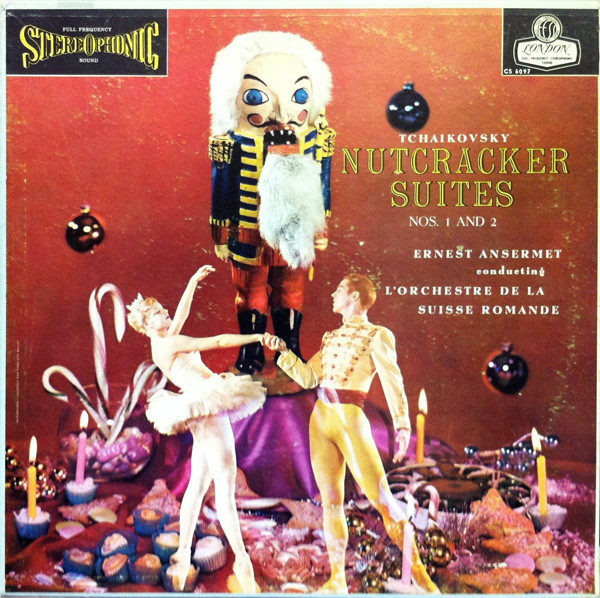
The powerful lower strings and brass are gorgeous. Ansermet and the Suisse Romande get that sound better than any performers I know. You will see my raves on record after record of theirs produced during this era. No doubt the world renowned Victoria Hall they recorded in is key. One can assume Decca engineers use similar techniques for their recordings regardless of the artists involved. The only real variable should be the hall.

Ansermet’s recordings with the Suisse Romande exhibit a richness in the lower registers that is unique in my experience. His Pictures At Exhibition has phenomenally powerful brass, the best I’ve ever heard. The same is true for his Night On Bald Mountain. Neither performance does much for me — they’re both too slow — but the sound is out of this world. Like it is here.

Side One

A+++, big, rich and lively, yet clear, transparent and spacious. The brass is shockingly dynamic and powerful. I defy you to find better brass on a record than can be found on this side one. I can’t recall hearing it, and we play the best sounding Golden Age classical recordings by the score week after week.

Side Two

A++, a bit wider, with lovely sheen to the strings, but tonally a bit thinner and drier than it should be. Still, awfully good in comparison to the better classical records we put up every week, just not competitive with this amazing side one.

If you’re looking for Demonstration Quality Sound, look no further. This side one has it in spades.

Heavy Vinyl

Speakers Corner did a heavy vinyl reissue of this title, which we auditioned and used to sell. It’s reasonably good, but like all reissues it lacks the weight found on this original. I remember it being a little flat and bright. I haven’t played it in years so I could easily be wrong.

(more…)

Not as Good a TAS List Title as We Thought, Sorry!

Hot Stamper Pressings of Living Stereo Titles Available Now

We had a handful of copies of this famous TAS List title in the backroom, so we decided it was high time to get a shootout going. We pulled all the pressings of the music (both Billy the Kid and Rodeo) we had on hand on every label and proceeded to needle-drop them in preparation for a big Copland shootout.

Much to our chagrin, most of the copies of LSC 2195 we played were unacceptable. The sound, for the most part, was very much not to our liking. Our notes read:

  • Smeary — (more records with smeary sound can be found here),
  • Dry — (more records with dry sound can be found here),
  • Bright — (more records with bright sound can be found here),
  • Flat — (more records with flat sound can be found here),
  • Hi-Fi-ish — (more records with hi-fi-ish sound can be found here),

Those records weren’t cheap. That was a lot of money down the drain. Not only can’t we sell records that sound as bad as this Living Stereo — our customers simply would not buy them — but we would never even try. Unlike other record dealers, we actually know what our records sound like. We don’t care about the reputations of the records we sell. We only care about their sound.

Some of the records on the TAS List seem better suited to the old school audio systems of the 60s, 70s and 80s than the modern systems of today.

(more…)

Manna – Super Hot Versus White Hot

Hot Stamper Pressings of Great Sounding Pop Albums Available Now

Back in the mid- to late-2000s, we felt we owed our Hot Stamper customers a more complete picture of the good and bad qualities we heard in our shootout for practically every record we played.

The idea was that the buyer could listen along for what the record was doing well and what it might not be doing so well. If you noticed that the top end was a little soft, well, that’s what we might have heard too. We would put that shortcoming, and any others we thought worth mentioning, right there in the listing.

Over the years, in order to avoid having to write every listing from scratch, we streamlined the process and dropped the criticisms.

Below you can see a typical example of an older listing. This is how we used to recognize when a record was Super Hot as opposed to White Hot.

This commentary on the famous recording of The Firebird with Dorati discusses the same issues in more depth.

Side One

A++, with good balance and lots of rockin’ energy. It’s transparent — just listen to how clear the drums are on the first track. It’s a bit dry and doesn’t have all the top end extension of the best, so Super Hot is a fair grade we think.

(more…)

Can’t Buy Much of a Thrill – Now with Notes!

Hot Stamper Pressings of the Music of Steely Dan Available Now

At least some of the thrills are here, and for any record on Chad’s label, that is really saying something.

Sonic Grade: B+ to A-

A few comments for the UHQR have been added since this went up on 4-4-23, now that I’ve had a chance to see the notes in full. I’ve noted the additions in brackets and sectioned some off as well.

Word from the listening panel is in, and they say the new Bernie Grundman mastered UHQR is actually not bad! [Not good, but not bad.]

The tonality is much closer to correct than a lot of the Heavy Vinyl LPs we’ve played recently. Oddly enough, instead of the EQ being overly smooth, in the way that appears to be all the rage these days, the tonality instead errs on the side of somewhat thinner and brighter than ideal. (One could also use the term “correct.”)

This should not be especially surprising. Bernie Grundman has been remastering Heavy Vinyl records since the mid-’90s. Overly smooth titles that he cut are hard to find, on the hundreds of titles he did for Classic Records or anywhere else. The more of his recent work I play, the more I have come to see his disastrously dull Giant Steps as an outlier.

The instruments where these tonality issues are most easily recognized are two that we have written a great deal about on this blog: pianos and snare drums.

The snare sound on the Brothers in Arms that Chris Bellman cut at Bernie Grundman Mastering has the same problem as this new Can’t Buy a Thrill. (Review with specifics coming, sorry for the delay, it has only been two years and I’ve been busy with other things.)

The thin sounding piano on the Cisco pressing of Aja is likewise a common shortcoming we notice on many of the modern recuts we play.

With links to 29 titles to test for a correct piano sound, and 13 for the snare test, the critical listener should be able to find some records in his own collection that will shed light on the problems we heard on Chad’s UHQR.

If your system errs on the side of fat and dark, Chad’s repress has what you need to “fix” the sound of the album. Instead of a murky piano, now you have a clear one. Instead of a too-fat snare getting lost in the mix, now you have a clear snare that you can more easily separate out from the other instruments.


Added 4/5

Note that we did not play all four sides. We felt sides one and three were enough to get an idea of how thrilling this pressing was going to be. We don’t get paid to play Heavy Vinyl pressings. We play them to help audiophiles understand their strengths and weaknesses. We hope that some audiophiles will hear what we have described and perhaps consider that there is a better way. That other way can be found in the bins of their local record store or, for those with deeper pockets, on our site. Either way, settling for the kind of sound found on these modern reissues is the one choice no one should be making.

We played the following four songs, and heard the sonic qualities described below:

(more…)