confirmation-bias

An Overview of Beatles Oldies But Goldies

Hot Stamper Pressings of the Music of The Beatles Available Now

This is a Beatles album we think we know well.

We’ve done a number of shootouts for A Collection of Beatles Oldies over the last ten years or so, and our experimental approach using many dozens of copies provides us with strong evidence to support the following conclusions regarding the sound of the originals vis-a-vis the reissues:

  1. The best of the early pressings always win our shootouts. No reissue has ever earned our top grade of A+++ and it is unlikely any reissue ever will.
  2. The reissues can be quite good however. The best of them have earned grades of Double Plus (A++).
  3. The worst of the early pressings also earned grades of Double Plus (A++).
  4. Conclusion: if you have a bad original and a good reissue, you might be fooled into thinking the sound quality was comparable.

(more…)

A Collection of Beatles Oldies on Video – Expert Advice?

The LOST Beatles Album | Cancelled By Apple – Should It Be Re-released?

Click on the link above to see an interesting and informative video that we think is well worth watching.

Allow me to make a few points:

As to the question posed above, my vote would of course be no. The new Beatles albums are awful sounding. Here are a few of rour eviews detailing their many shortcomings:

After playing those three, we gave up on the idea of playing the rest of the set.

The Mono Box (in analog!) was even worse. We played one record, heard truly awful sound, and that was all she wrote.

Mushy Sound Quality

Andrew Milton, the Parlogram Auctions guy, offers opinions about the sound quality of the various pressings he reviews. Naturally we are skeptical of reviewers’ opinions for reasons that should be clear to readers of this blog.

We have no idea how he cleans his records or how carefully he plays his records, or even what he listens for.

Frankly, even if we knew all those things it wouldn’t mean much to us. So many reviewers like so many bad sounding modern records that we’ve learned not to take anything they say seriously.

The comment about the 1G stampers being “mushy” that Andrew makes about 19 minutes in is one we take exception to. Part of the problem with his comment is that we can’t really be sure what he means by “mushy.” If it means smeary or thick, that has not been our experience with the best cleaned originals.

Since the later pressings tend to be thinner and less Tubey Magical, they are probably even less “mushy,” assuming I have the definition of the term right.

My guess is that he has a system with problems like those we had thirty years ago.

Our playback systems from the 80s and 90s were tubier, tonally darker and dramatically less revealing, which strongly worked to the advantage of leaner, brighter, less Tubey Magical pressings such as the reissues of A Collection of Beatles Oldies…

But to say that the 1G stampers were used for both the originals as well as the reissues with the Black and Silver labels and that therefore the sound is the same is definitely a sign that Andrew’s understanding of stampers and pressings is hopelessly incomplete.

What We Think We Know

We have done a number of shootouts for the album over the last ten years or so, and our experimental approach using many dozens of copies provides us with strong evidence to support the following conclusions regarding the originals versus the reissues:

(more…)

How Does the Heavy Vinyl Rubber Soul Sound?

Hot Stamper Pressings of Rubber Soul Available Now

This review was originally written in 2015.


We are so excited to tell you about the first of the Heavy Vinyl Beatles remasters we’ve played! As we cycle through our regular Hot Stamper shootouts for The Beatles’ albums we will be of course be reviewing more of them*. I specifically chose this one to start with, having spent a great deal of time over the last year testing the best vinyl pressings against three different CD versions of Rubber Soul.

The short version of our review of the new Rubber Soul vinyl would simply point out that it’s awful, and, unsurprisingly, it’s awful in most of the ways that practically all modern Heavy Vinyl records are: it’s opaque, airless, energy-less and just a drag.

I was looking forward to the opportunity to take Michael Fremer, the foremost champion of thicky vinyl, to task in expectation of his usual rave review, when to my surprise I found the rug had been pulled out from under me — he didn’t like it either. Damn!

MF could hear how bad it was. True to form, he thinks he knows why it doesn’t sound good:

As expected, Rubber Soul, sourced from George Martin’s 1987 16 bit, 44.1k remix sounds like a CD. Why should it sound like anything else? That’s from what it was essentially mastered. The sound is flattened against the speakers, hard, two-dimensional and generally hash on top, yet it does have a few good qualities as CDs often do: there’s good clarity and detail on some instruments. The strings are dreadful and the voices not far behind. The overall sound is dry and decay is unnaturally fast and falls into dead zone.

It strikes me as odd that the new vinyl should sound like a CD. I have listened to the newly remastered 2009 CD of Rubber Soul in stereo extensively and think it sounds quite good, clearly better than the Heavy Vinyl pressing that’s made from the very same 16 bit, 44.1k remixed digital source.

If the source makes the new vinyl sound bad, why doesn’t it make the new CD sound bad? I can tell you that the new CD sounds dramatically better than the 1987 CD I’ve owned for twenty years. They’re not even close. How could that be if, as MF seems to believe, the compromised digital source is the problem?

Lucky for me I didn’t know what the source for the new CD was when I was listening to it. I assumed it came from the carefully remastered hi-rez tapes that were being used to make the new series in its entirety, digital sources that are supposed to result in sound with more analog qualities.

Well, based on what I’ve heard, they do, and those more analog qualities obviously extend to the new Rubber Soul compact disc. At least to these ears they do.

It’s possible my ignorance of the source tape allowed me to avoid the kind of confirmation bias — hearing what you expect to hear — that is surely one of the biggest pitfalls in all of audio and a pit that Fremer falls into regularly.

(more…)

Hot Stampers Simply Do Not Exist for Some Audiophiles

Please Consider Taking Some of Our Hard-won Audio Advice

It is an unfortunate fact that, at least for some audiophiles, Hot Stampers simply do not exist.

They may be lovers of sound, the dictionary definition of an audiophile, but their systems are not revealing and accurate enough to allow them to hear how good a properly-mastered, properly-pressed, properly-cleaned vintage (or maybe not so vintage) pressing can sound relative to whatever other version of the music they may have — Heavy Vinyl, cassette, CD, etc.

They simply do not possess a system (power, equipment, room, tweaks) of the quality required to play them at their best. 

Others won’t have developed the rudimentary listening skills needed to recognize the superior sound of a Hot Stamper pressing when it’s playing on their turntable.

Speculation? Opinion? Not really. Not when the evidence is this overwhelming. Let’s look at some of the facts.

A great many analog-oriented audiophiles are quite happy with the sound of Heavy Vinyl LPs, the kind that we regularly trash around here.

Those pressings set a decidedly low standard for sound quality, to our ears anyway, so if the typical audiophile is happy with them, what does that tell you about the quality of his audio chain and the nature of his critical listening skills?

It may be hard to wrap your head around this unfortunate and depressing fact, but many of the audiophile records being made today are even worse sounding than the audiophile pressings that were made back in the bad old days of the 70s, 80s and 90s. (Maybe the bad old days, like the poor, will always be with us.)

Boat Rocking

Our Hot Stampers will of course sound quite a bit better on even a run-of-the-mill audiophile system than practically any Heavy Vinyl pressing you care to name. But if you’re happy with a $30 reissue, what’s your incentive to spend five or ten or twenty times that amount based on nothing more than our say-so?

Even with a 100% Money Back Guarantee, why rock your own boat?

On the site we take great pains to make it clear that there are many ways that an audiophile — even a novice — can prove to himself that what we say about pressing variations is true, using records he already owns.

You don’t have to spend a dime to discover the reality underlying the concept of Hot Stampers.

We not only tell you how to go about finding them, we also help you to do a better job of playing them.

Have You Noticed?

But perhaps you may have noticed, as we have, that most audio skeptics rarely go out of their way to prove themselves wrong.

And a little something psychologists and cognitive scientists call confirmation bias practically guarantees that they won’t hear something they don’t want to hear.

Which is fine. At Better Records we don’t let that slow us down. Instead, we happily go about our business turning skeptics into believers (one record at a time of course), taking a few moments out to debunk the hell out of practically any audiophile LP we run into, for sport if for no other reason.

(more…)

On Heroes, It Took Us Ages to Break the Sound Barrier

More of the Music of David Bowie

Because the conventional wisdom turned out to be so wrong.

Our intuition that the British originals would sound the best was incorrect.

The experiments we carried out falsified that prediction.

In the audiophile record collecting world, intuitions have a bad track record, but more than a few audiophiles — many of whom are addicted to sharing their “record knowledge” on audiophile forums — seem unaware of this reality.

Taking a page from one of the greatest minds of the 20th century, we’ve opted to use a more scientific approach to discovering the best sounding record pressings, and we encourage you to do likewise. 

We pioneered the evidence-based approach to finding the best sounding pressings, and, like all good scientists, we shared it with everyone. Some in the audiophile community have taken it to heart, but most have chosen to put their faith in reviewers, forum posters, common sense and logic.

None of these produce consistently good results, but those who use these methods are loathe to doubt them and only rarely if ever learn the error of their ways.

Once a decision has been made and a specific pressing acquired — you could call it door number three I suppose — cognitive dissonance and confirmation bias immediately kick in to justify the result, and soon enough the game is over. The prize has been won. It’s the best prize ever. It does everything right, everything you’d hoped for.

But the best sounding copy of the record was not behind door number three.

You don’t have the best sounding pressing (well, you might, but if you did it would be entirely the result of chance, since you have no experimental evidence), but as long as you think you do, and, like most audiophiles, you play records only for yourself, and purely for enjoyment, you have no way of  discovering where on the spectrum of best to worst your record sits.

As long as you think you have the best, you have the best. How could there ever be any evidence offered to the contrary?

(more…)

John writes: “The only problem I have with my evaluations is that I never heard his records.”

More Commentaries Prompted by Forums, Videos and Comments Sections

If you haven’t had a chance yet, please check out the interview Wired conducted with me a few years back.

If you have some time on your hands, maybe too much time on your hands, go to the comments section and read the 300 plus postings that can be found there, the writers of which seem to be offended by the very idea of Hot Stampers. They also decry the obvious shortcomings of analog vinyl itself, as well as the ridiculously expensive equipment some “credulous, misguided audiophiles,” their terms, use to play vinyl records, as if you didn’t know already!

Here is one that I found to be especially interesting, from a psychological perspective if not from an audio one: 

Bad, mismatched system setup. Customer base probably has the same. Also evaluation process is questionable. Uses a mediocre solid state amp and looks for “tubey magic” because of some misplaced concept of “accuracy” as I discussed before. [Man, this guy has got our number all right, ouch!]

Yes, there is a lot of bad stuff out there, and it does give the stereo industry as a whole a bad name. I have heard some pretty crappy, expensive setups in my day.

I was listening to Phoebe Snow’s “Second Childhood” on my best system last night. Boy, I love my new turntable!

The only problem I have with my evaluations is that I never heard his records. My comments are probably correct, but it would be interesting to audition a few of his “golden” albums just to confirm he hasn’t really found anything. The reason I am confident that he probably does not have anything is because virtually every repressing I’ve heard is better than the original. Claiming otherwise hurts his credibility.

John

There is one sentence in the paragraphs above that should raise a giant red flag and help you to appreciate how reliable John’s analysis of our stereo and methods might turn out to be. If you didn’t catch it the first time through, give it another shot. Okay, here goes:

The reason I am confident that he probably does not have anything is because virtually every repressing I’ve heard is better than the original.

That’s so strange! Virtually every repressing I’ve heard is worse than the original.

What gives?

If I may paraphrase our writer: the reason I am confident that he probably does not know anything about records or audio is that he thinks repressings are always better than vintage pressings.

We’ve critically auditioned tens of thousands of records, including many hundreds of repressings, admittedly on our “bad, mismatched system setup,” and I guess we must have gotten it all wrong over the 38 years we’ve been in the audiophile record business. The shame of it all!

Obviously, John knows he does not need to try one of our Hot Stampers. You can see him talking himself into the wisdom of doing nothing with every succeeding paragraph.

It’s easy for him to be right by simply pretending to know something he cannot possibly know.

(Knowledge that is not backed up by empirical findings [1] comes in for a lot of criticism here at Better Records, and for good reason. Guessing, speculating and assuming are poor approaches to separating the good pressings from the bad ones.)

And if he did ever order one, and had at least a halfway decent stereo to play it on, it would turn his world upside down so fast it would make his head hurt, and the possibility of that happening would be very, very upsetting. It makes no sense for John to risk such an outcome.

Even if our records were as cheap as the ones he is buying, even the superior sound would not justify the psychological damage that would result. He would basically have to start his collection over again, as this good customer did.  A few hundred others just like him have done the same, and they’re the ones that will be keeping us in business for years to come. To paraphrase another famous saying, “They’ve heard the future, and it works!”

Better for John to follow the path he is on. It’s working for him. Why would he want to rock his own boat?

(more…)

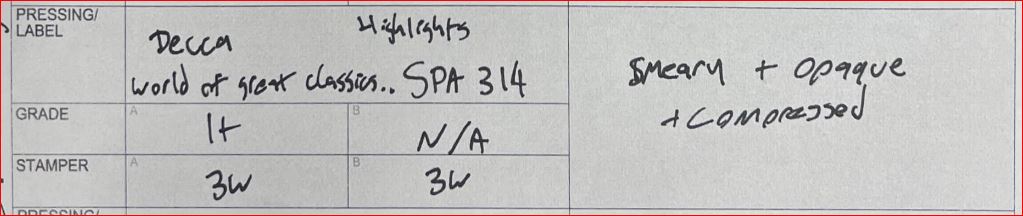
Coppelia and Sylvia / London Vs. Decca – Updated 2025

Hot Stamper Pressings of Music Conducted by Ernest Ansermet Available Now

Once again, the right Decca reissue blows the doors off the original London we played. This has lately become a pattern, but keep in mind it’s a pattern that’s reliable less than half the time, if memory is any guide. Many of the Decca reissues we’ve played over the last few years have failed badly in a head to head with their earlier-mastered and -pressed counterparts.

But the ones that beat all comers are the ones that stick in our minds and show up on our site.


UPDATE 2025

A copy of one of the SPA reissues we used to like shown above made it to our latest shootout and did not do nearly as well as a copy did years ago.

We don’t have those copies anymore and cannot say whether they actually did sound as good as we thought they did.

Our advice would be to assume that this is not the best way to buy this album. But neither is the original, as you will read below.


Clearly a case of confirmation bias, but at least we know something about our own biases, and that puts us well ahead of the audiophile pack.

Record collectors and record collecting audiophiles will tell you it shouldn’t happen, but fools like us, who refuse to accept the prognostications of those supposedly “in the know,” have done the work and come up with the experimental data that’s proven them wrong again and again.

Sort of. We had one, and only one, pressing of the original London (CS 6185), and boy was it a mess — crude as crude can be.

It sounded like an “old London record,” not the Decca engineered and mastered vintage collectible we know it to be.

We’ve played them by the hundreds, so we know that sound fairly well by now.

Are there copies that sound better? Surely there are, but how are you going to find them? Are you going to shell out the going rate of $25-50 on ebay for one (or more) clean copies, only to find that it/they sound every bit as bad as the one we auditioned? The question answers itself.

If, however, you are one of the lucky few who has a nice London or Decca original of this recording, please let us send you this copy so that you can do the shootout for yourself. You may be shocked at how good this music can sound on the right pressing. And if your copy sounds better than ours we will be very shocked indeed. [This offer was only good while we had the record, and it is long gone at this point. We still remember the sound though!]

Production and Engineering

James Walker was the producer, Roy Wallace the engineer for these sessions from April of 1959 in Geneva’s glorious Victoria Hall. It’s yet another remarkable disc from the Golden Age of Vacuum Tube Recording.

The hall the Suisse Romande recorded in was possibly the best recording venue of its day, possibly of all time. More amazing sounding recordings were made there than in any other hall we know of. There is a solidity and richness to the sound beyond all others, yet clarity and transparency are not sacrificed in the least.

It’s as wide, deep and three-dimensional as any, which is of course all to the good, but what makes the sound of these recordings so special is the weight and power of the brass, combined with unerring timbral accuracy of the instruments in every section of the orchestra.

(more…)

The D4/D5 Stereo Pressings Are Just Awful on My Fair Lady

Hot Stamper Pressings Featuring Shelly Manne Available Now

In our experience, the Black Label stereo originals with D4/D5 stampers are terrible sounding.

With those stampers, My Fair Lady is undoubtedly a hall of shame pressing, as well as another early pressing we’ve reviewed and found wanting.

Both sides graded “No,” our not-especially-technical term for a record that sounds really bad.

Notes for Side One:

Track one is bright and unnatural up top. Track two is not very musical.

Notes for Side Two:

Track one is very weird sounding, thin and small.

(Obviously there was no need to play a second track.)

As you may have read elsewhere on the site, some Contemporary label originals are very poorly mastered, which should put paid to the idea that Hot Stampers are only, or even usually, original pressings.

In our most recent shootout, the second-best sounding pressing was on the early Black Label. We would love to give out the stampers for that one, but we don’t do that.

(more…)