compressed-sound

These albums tend to suffer from exceptionally compressed sound.

They are often Half-Speed mastered and/or pressed on Heavy Vinyl. Many of them are orchestral recordings from the Golden Age.

Our Hot Stamper pressings of these same albums will be dramatically more lively and dynamic than any of the records on this list.

Thick As a Brick on MoFi

Hot Stamper Pressings of the Music of Jethro Tull Available Now

Sonic Grade: D

Here you will find the same problems as the MoFi Meddle, released the previous year, 1984. Here is what we had to say about it back in the day when we were selling this kind of crap.

The MoFi is TRANSPARENT and OPEN, and the top end will be lush and extended. If you prize clarity, this is the one.

But if you prize clarity at the expense of everything else, you are seriously missing the boat on Meddle (and of course Thick As A Brick too).

The MoFi is all mids and highs with almost nothing going on below.

This is a rock record, but without bass and dynamics the MoFi pressing doesn’t rock, so why would anyone want to own it or play it?

The one thing these pressings have going for them is that they tend to be transparent in the midrange.

It sounds like someone messed with the sound, and of course someone did. That’s how they get those audiophile records to sound the way they do.

For some reason, some audiophiles like their records to sound pretty and lifeless with blurry bass.

The whomp factor on this pressing is Zero. Since whomp is critical to the sound of this album, it’s Game Over for us.

That is not our sound here at Better Records. We don’t offer records with shortcomings like these and we don’t think audiophiles should have to put up with records that sound the way this one does.

(more…)

Obscured By Cloudy Japanese Vinyl

Hot Stamper Pressings of the Music of Pink Floyd Available Now

When I was just getting up to speed in audio and exploring the world of music available on vinyl in the 70s, many of the stereo stores I frequented carried Japanese pressings. They were widely believed to have superior sound relative to their domestic counterparts — in this case, the mass-produced pressings I would see at the Tower Records right across from the Sports Arena in my hometown of San Diego. I went there at least once a week, probably more like two or three times.

Tower was far and away the best place to go record shopping in those days. The store was huge and they had dramatically more stock than Licorice Pizza or The Wherehouse.

They also had a separate section for Half-Speed mastered pressings from a number of labels, which of course was the first place in the store I would visit, digging through the bins to see what new remastered titles may have been produced for audiophiles searching for the ultimate in sound quality.

Of course, I identified as just such a person. In terms of sound quality, and with the extremely limited knowledge I had acquired at the time, I believed I set a high standard for the sound of the records I bought. I was willing — eager even, you could even say excited — to pay whatever premium price I had to for a record that was sure to deliver superior sound quality. To me, in the late 70s, that meant two things: direct to disc recordings, and Half-Speed mastered pressings.

(There was a another category of records that did not fall into the above two, best exemplified by American Grammaphone and the Fresh Aire series, but the less said about those schlocky releases the better, other than to point out that some of their titles are TAS list carryovers from HP’s time running the Super Disc list, specifically Fresh Aire 2 and 3, both best avoided.)

And, like any other open-minded individual, when it came to Japanese vinyl I was willing to give a few a spin.

However, the more of them I bought, the more clear it became to me that even the best of them sounded mediocre (veiled, smeary and dubby from second generation tapes) and more often than not they were just plain awful. (Second generation tape issues being the main problem, of course, with the additional insult of poor tonality, the result of being mastered using wacky equalization, typically with added brightness where none was needed.)

Pink Floyd

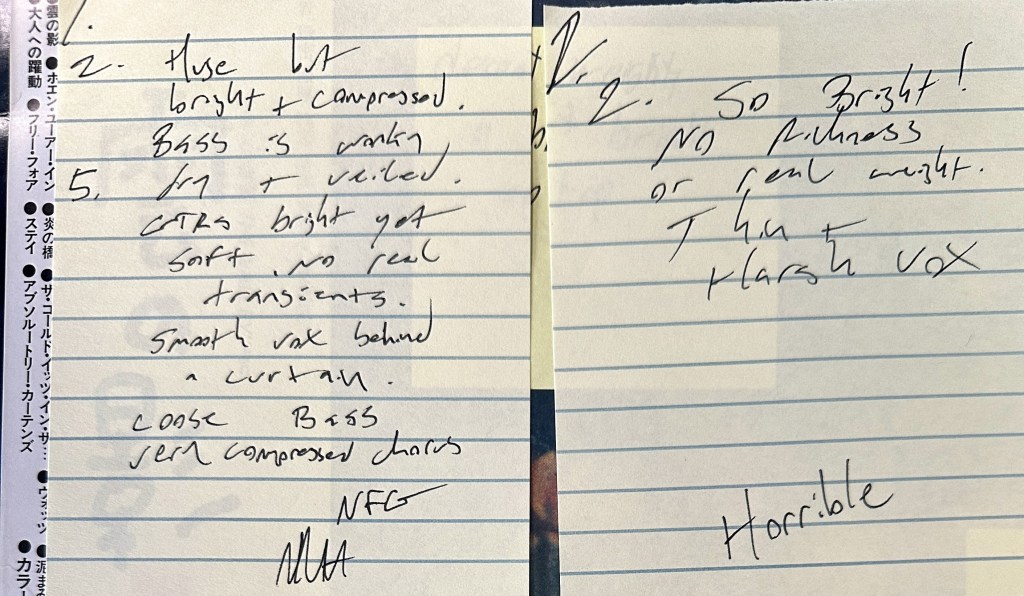
The notes for the Pink Floyd album you see below, Obscured by Clouds, were written sometime in March of 2025 as part of the shootout we conducted for the album.

If we assume it would be an audiophile who would be attracted to this pressing, perhaps for its quieter playing surfaces, perhaps operating under the assumption that the Japanese engineers mastering the record would be more likely to do a better job as well, then what we have here is a textbook case of an audiophile bullshit pressing.

One that sounds nothing like the album is supposed to, based on having played a number of exceptionally good sounding copies, all British and all on the Green Harvest label, mastered from good tapes, sometimes by the legendary Harry T. Moss. We feel we are more than qualified to make these judgments. If we can’t make them, nobody can.
Discogs allows us to glean some information regarding the desirability of this Japanese reissue with the record buying public currently in the market for Pink Floyd vinyl who register on their site.

(more…)
Breakfast in America – An A&M Half-Speed Mastered Disaster

Hot Stamper Pressings of the Music of Supertramp Available Now

Sonic Grade: F

This title is yet another Half-Speed we think belongs in our audiophile hall of shame.

It’s better suited to the stone age stereos of decades past. I should know — my system in 1976 was one-tenth as revealing as the one we use now.

But this pressing is so awful even my old system could not be fooled by this kind of audiophile BS sound. The console you see pictured might be the ideal system to play it. Hard to say, I haven’t heard one of those since the 60s.

It is just ridiculous that someone would consider marketing this kind of sound to audiophiles.

So washed out, brittle, thin and lifeless, it practically defies understanding that anyone with two working ears ever considered calling this piece of crap an “audiophile” record.

But are today’s remastered records marketed to those looking for superior sound any better? Not the ones we’ve played recently. (If you know of any good ones, please drop us a line.)

Is this A&M pressing the worst version of the album ever made? It’s hard to imagine it would have much competition.

(more…)

Diamonds and Rust – Another TAS Listed Anadisq Disaster

Hot Stamper Pressings of the Music of Joan Baez Available Now

Mobile Fidelity released their version of Diamonds and Rust on Anadisq in 1995, and if you want to hear a pressing that’s not murky, compressed and opaque, you would be wise to avoid their Heavy Vinyl Half-Speed.

Somehow it ended up on the TAS Super Disc List, but we could find nothing “super” about it. We felt it more properly belonged on our list of records that have no business being called Super Discs.

It was a real muckfest, as was to be expected from a record mastered by this awful label during the Anadisq era, the darkest chapter in the disgraceful history of Mobile Fidelity, which, considering the consistently dismal quality of their output, is really saying something.

Ken Lee Strikes Again

Many of the worst of them were mastered by a Mr. Ken Lee. If you happen to come across a record in a store with his name in the credits, or his initials in the deadwax, you are best advised to drop it back in the bin and keep moving. Anything else is just asking for trouble.

To be fair, MoFi made some reasonably good sounding records too. For those of you whose budget is on the limited side, if you find an affordable copy of any of these MoFis, you are probably not wasting your money.

Although I had a long way to go in this hobby in the early days of my audiophile record business, even then I could tell how bad the Anadisq series that Mobile Fidelity released in the 90s was. They produced one awful sounding record after another, with not a single winner that I knew of. I sold them — my bad, an ethical lapse for which I must apologize — but I sure never recommended them or had anything good to say about them.

(more…)

Gaucho According to MCA Masterphile

Hot Stamper Pressings of the Music of Steely Dan Available Now

The Masterphile Half-Speed is a pathetic shadow of the real thing, the real thing being an early Masterdisk pressing cut by Robert Ludwig.

We’ve played at least a hundred of the original pressings, and I would be surprised if every one of them did not sound better than this compressed, desiccated audiophile piece of trash.

With sound like that, the MCA Masterphile gets our vote for the worst version of the album ever made.

Of all the great albums Steely Dan released, and that means their seven original albums and nothing that came after, there are only three in our opinion that actually support their reputation as studio wizards and recording geniuses. Chronologically they are Pretzel Logic, Aja, and Gaucho.

Every sound captured on these albums is so carefully crafted and considered that it practically brings one to tears to contemplate what the defective DBX noise reduction system did to the work of genius that is Katy Lied, their best album and the worst sounding. (Those cymbal crashes can really mess with your mind if you let them. To get a better picture of the DBX sound just bang two trash can lids together as close to your head as possible.)

The first two albums can sound very good, as can Royal Scam, but none of those can compete with The Big Three mentioned above for sonics. A Hot Stamper copy of any of them would be a serious DEMO DISC on anyone’s system system.

Mistakes Were Made

If you are still buying these modern remastered pressings, making the same mistakes that I was making before I knew better, take the advice of some of our customers and stop throwing your money away on Heavy Vinyl and Half-Speed Mastered LPs.

(more…)

Nursery Cryme on Classic Records – What System Can Make It Sound Good?

Hot Stamper Pressings of Genesis Albums Available Now

Sonic Grade: F

The Classic Heavy Vinyl pressing from 2000 is a smeary, lifeless mess next to the best early tan label British pressings. No Classic pressing of any of the Genesis albums that we’ve played sounded right to us.

The Peter Gabriel albums they remastered were just as bad. All of them earned a grade of F. We made no effort to do listings for most of them because they all were bad sounding, and bad sounding in the same way.

If I were to try to “reverse engineer” the sound of a system that could play this record and compensate for its many faults, I would look for a system that was thick, dark and fat, with added richness and a heaping portion of euphonic tube colorations.

I know that sound. I had a stereo in the 90s with many of those same shortcomings, but of course I hadn’t a clue about any of that. Back then, I didn’t know what I didn’t know. I needed to put together a system with a lot more “Hi-fi” and a lot less “My-fi,” a process that took many years and a great deal of effort.

I’m glad to say things are different now.

What to Listen For

As a general rule, this Heavy Vinyl pressing will fall short in some or all of the following areas when played head to head against the vintage pressings we offer:


Further Reading

The sonic signature of the modern Heavy Vinyl Classical reissue in five words: diffuse, washed out, veiled, and vague.

(more…)

“KEV” Didn’t Have a Clue How to Master Teaser and the Firecat

Hot Stamper Pressings of the Music of Cat Stevens Available Now

In 2025, in preparation for a new shootout, we ordered a copy of Teaser from overseas that supposedly had the right stampers — we know what they are and we are only interested in copies with the right ones — and were sent this “KEV” pressing by accident.

Accident is right — whoever KEV is, he sure has no business mastering records if the one we played is anything to go by.

Discogs has an entry for it, current price around $10. (Apparently the word got out about the sound of this miserable pressing.)

  • This release is the pink ring Island Label. No Sterling etchings. (KEV) in matrix.
  • Side 1 has 9514 hashed out and 9154 etched above
  • Matrix / Runout (A-side runout. etched): ILPS 9154A-1K 1 KEV B
  • Matrix / Runout (B-side runout. etched): ILPS 9154B-1K 1 KEV B

Our notes read:

  • Loud, congested and hot.
  • Big, wonky bass.
  • Opaque and so compressed that it pumps.

And the best line of all:

  • Not too different sounding from the 2021 remaster that’s on Spotify. (!)

I looked up that 2021 release, mastered at Abbey Road Studios, and it appears they remixed it for some reason, as those who work at Abbey Road are wont to do, the result of which seems to be one disaster after another.

(more…)

Capriccio Italien on Classic Records and How Badly I Missed the Boat

More of the Music of Peter Ilyich Tchaikovsky

More of the Music of Nikolai Rimsky-Korsakov

Years ago, around 2005 if memory serves, I played a copy of the Classic Records pressing of LSC 2323 and thought it was pretty good.

I thought it was better than the Shaded Dog copies I had compared it to, which, based on hundreds of other Classic Records titles I had auditioned, was unexpected to say the least.

Little did I know that the Shaded Dog pressings on this title are not remotely competitive with the early reissues.

The best of the Shaded Dog pressings we could find, which just happened to have a 1s side one, came in tied for last with the one 70s Red Seal pressing we thought sounded good enough to make the shootout.

(Some inside baseball: most of the Shaded Dogs and Red Seals were needle-dropped, and all but two were eliminated before the shootout. It takes time and wastes money to clean and play pressings that sound hopeless, so a quick elimination round often precedes the cleaning process.)

Back then it was tough to wrap my head around the idea that a Classic Record classical title could actually be better sounding than a Shaded Dog — it had never happened, so I knew there had to be more to the story.

Finding the time to do the serious investigation of LSC 2323 that would be necessary to get to the bottom of it was not in the cards, so I shelved the project for close to the next twenty years.

The title would have to wait until 2024 to go through a proper shooout, and when it did, naturally the Classic was part of the mix, which is the way we do things here at Better Records. Every record gets the chance to show us what it can do, to be evaluated fairly without the listener having any way to know which pressing is playing.

It turns out that side one of the Classic was passable, but side two — the side I had probably never played — was every bit as bad as most of their other classical offerings.

Side One, Second Movement (Tchaikovsky)

  • Big, but bright and compressed
  • Gets loud but opaque and hot
  • Good weight

Side One, First Movement

  • Bright and blurry bells
  • Sort of tubey but a mess
  • Grade: 1+ (passable, but no Hot Stamper)

Side Two (Rimsky-Korsakov)

  • Big but boomy and smeary
  • Brass is edgy and opaque
  • No top end or space
  • Peaks are hot and congested
  • Grade: NFG

To recap: In 2005 I was impressed with Classic’s pressing of LSC 2323. That was only twenty years ago, yet I could not have been more wrong. I thought my stereo was great — I’d owned top quality equipment since 1975 by then — thirty sodding years — so my audiophile credentials would surely dwarf those of the vast majority of forum posters who write about audiophile pressings today. How reliable should we expect their reviews to be?

(more…)

The Dreadful Sound of the Heavy Vinyl Reissues Doug Sax Mastered in the 90s

Hot Stamper Pressings of the Music of Sonny Rollins Available Now

Longstanding customers know that we have been relentlessly critical of so-called “audiophile” LPs for years, especially in the case of these Analogue Productions releases from back in the early-90s. A well-known reviewer loved them, I hated them, and he and I haven’t seen eye to eye on much since.


(Old) Newflash!

Just dug up part of my old commentary discussing the faults with the original series that Doug Sax cut for Acoustic Sounds. Check it out.

In the listing for the OJC pressing of Way Out West we wrote:

Guaranteed better than any 33 rpm 180 gram version ever made, or your money back! (Of course I’m referring to a certain pressing from the early 90s mastered by Doug Sax, which is a textbook example of murky, tubby, flabby sound. Too many bad tubes in the chain? Who knows?

This OJC version also has its problems, but at least the shortcomings of the OJC are tolerable. Who can sit through a pressing that’s so thick and lifeless it communicates none of the player’s love for the music they’re making?

If you have midrangy transistor equipment, go with the 180 gram version (at twice the price).

If you have good equipment, go with this one.


UPDATE 2015

We are no longer fans of the OJC of Way Out West, and would never sell a record that sounds the way even the best copies do as a Hot Stamper. It’s not hopeless the way the Heavy Vinyl pressing is, but it’s not very good either. It’s yet another example of a record we was wrong about.

Live and learn, right?


(more…)

How Do the Original Mono Pressings of Mingus Dynasty Sound?

Hot Stamper Pressings of the Music of Charles Mingus Available Now

Although this album is fairly common in mono, we found the sound of the mono pressing we played seriously wanting. It’s dramatically smaller and more compressed than even the worst of the other pressings we played in our shootout.

We will never buy another, and of course we would never sell a record that sounds as bad as this mono pressing does.

For those looking for the best sound, the mono pressing is hard to take seriously, and for that reason, we say skip it.

For records reviewed on the blog that sound their worst in mono, click here.

Are You a Jazz Collector or an Audiophile?

If you’re a jazz collector, of course you want the mono. If you’re an audiophile who likes jazz, you should want the stereo.

And if you are a very serious audiophile who has a great deal of time and money tied up in his equipment and room, someone whose motto might best be summarized as “nothing but the best,” then you need one of our killer Hot Stamper pressings of the album.

(more…)