*Arcana – Stamper Info

Some audiophiles complain that our reluctance to give out stamper information is selfish. We think that’s not fair.

We admit that we rarely give out the stamper numbers for the pressings that win shootouts — we paid a high price in time and effort to discover them — but we do give out a great deal of information for records that did not sound especially good to us, a free – and valuable! — service from your friends at Better Records.

Cat Stevens on 2 Heavy Vinyl 45 RPM Discs, Part 1 – Is This the Truest Tillerman of Them All?

About ten years ago we auditioned and reviewed the 2011 edition of Tea for the Tillerman pressed by Analogue Productions, the one that came on a single Heavy Vinyl 33 RPM LP.

I wrote a very long commentary about the sound of that record, taking it to task for its manifold shortcomings, at the end of which I came to the conclusion that the proper sonic grade for such a record is F as in Fail. My exhaustive review asked the not-very-subtle question, this is your idea of analog?

Our intro gave this short overview:

Yes, we know, the folks over at Acoustic Sounds, in consultation with the late George Marino at Sterling Sound, supposedly with the real master tape in hand, and supposedly with access to the best mastering equipment money can buy, labored mightily, doing their level best to master and press the Definitive Audiophile Tea for the Tillerman of All Time.

It just didn’t come out very well, no matter what anybody tells you.

Recently I was able to borrow a copy of the new 45 cutting from a customer who had rather liked it. I would never have shelled out my own money to hear a record put out on the Analogue Productions label, a label that has an unmitigated string of failures to its name. But for free? Count me in!

The offer of the new 45 could not have been more fortuitous. I had just spent a number of weeks playing a White Hot Stamper Pink Label original UK pressing in an attempt to get our new Playback Studio sounding right.

We had a lot of problems. We needed to work on electrical issues. We needed to work on our room treatments. We needed to work on speaker placement.

We initially thought the room was doing everything right, because our Go To setup disc, Bob and Ray, sounded super spacious and clear, bigger and more lively than we’d ever heard it. That’s what a 12 foot high ceiling can do for a large group of musicians playing live in a huge studio, in 1959, on an All Tube Chain Living Stereo recording. The sound just soared.

But Cat Stevens wasn’t sounding right, and if Cat Stevens isn’t sounding right, we knew we had a Very Big Problem. Some stereos play some kinds of records well and others not so well. Our stereo has to play every kind of record well because we sell every kind of record there is. You name the kind of music, we probably sell it. And if we offer it for sale, we had to have played it and liked the sound, because no record makes it to our site without being auditioned and found to have excellent sound.

But I Might Die Tonight

The one song we played over and over again, easily a hundred times or more, was But I Might Die Tonight, the leadoff track for side two. It’s short, less than two minutes long, but a lot happens in those two minutes. More importantly, getting everything that happens in those two minutes to sound not just right, but as good as you have ever heard it, turned out to be a tall order indeed.

I could write for days about what to listen for in the song, but for now let me just point the reader to one of the most difficult parts to reproduce correctly.

At about 50 seconds into the track, Cat repeats the first verse:

I don’t want to work away
Doing just what they all say
Work hard boy and you’ll find
One day you’ll have a job like mine, job like mine, a job like mine

Only this time he now has a multi-tracked harmony vocal singing along with him, his own of course, and he himself is also singing the lead part louder and more passionately. Getting the regular vocal, call it the “lower part,” to be in balance with the multi-tracked backing vocal, call it the “higher part,” turned out to be the key to getting the bottom, middle and top of the midrange right.

When doing this kind of critical listening we play our records very loud. Live Performance level loud. As loud as Cat could sing, that’s how loud it should be when he is singing his loudest toward the end of the song for the final “But I might die tonight!” If he is going to sing loudly, I want my stereo to be able to reproduce him singing as loud as he is actually singing on the record. No compression. No distortion. All the energy. That’s what I want to hear.

The last fifteen seconds or so of the song has the pianist (Cat himself) banging out some heavy chords on the piano. If you have your levels right it should sound like there is a real piano at the back of the room and that someone is really banging on it. It’s a powerful coda to the song. (more…)
What Exactly Does Van Gelder Stamped in the Deadwax Tell You?

Hot Stamper Pressings of CTI Titles Available Now
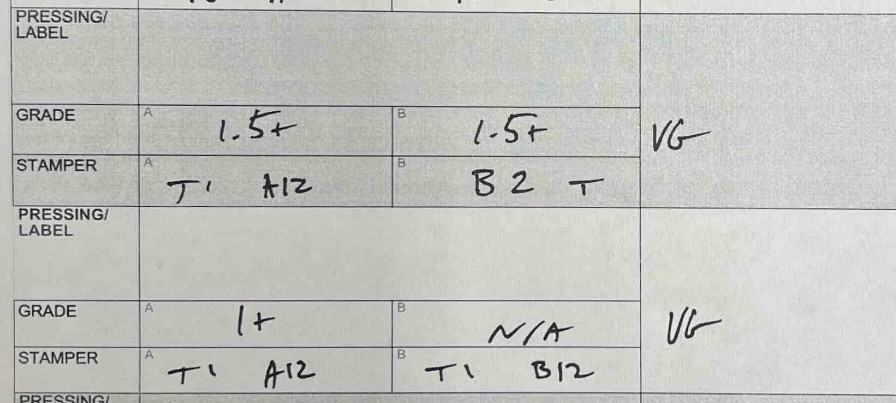
The section of the stamper sheet we wrote up after our most recent shootout belongs to George Benson’s White Rabbit album, the one released by CTI in 1972.

We think these stampers illustrate an important reality regarding the variability of record pressings, and it’s one that we run into on regularly during shootouts.

Keep in mind that the notes you see were made without the listener knowing what the stamper numbers were for the copy being evaluated. Some relevant facts:

  • Rudy Van Gelder cut all the original domestic pressings for the album that we played in our shootout since those are the only ones we know of to have the potential for Hot Stamper sound. (Hint: forget the reissues, imports, etc.)
  • The stampers for the two copies you see below were the two worst performers out of the six we had to work with. (We started out with more than six copies to audition. Unfortunately, some of the copies we clean and play get tossed out during the shootout for having noise issues — scratches that play, bad vinyl, inner groove distortion, etc. Noisy copies of  fairly common jazz records are not saleable no matter how good they sound.)
  • The top pressing shown below earned good, not great Hot Stamper grades of 1.5+ on both sides. This is the minimal rating any Hot Stamper pressing must earn to be offered to our customers. As you can see, A12/B2 are the stampers for this pressing.
  • There was another A12 side one in our shootout that did slightly better, earning a 2+ grade. The pressing you see at the bottom also had an A12 side one, but it did not make the grade. (The N/A means we didn’t play side two of that copy because the 1+ side one makes the record not worth the bother.)

We know that White Rabbit is an outstanding George Benson album, recorded by the immensely talented Rudy Van Gelder himself. All the original pressings were mastered by him as well. We’ve been doing shootouts for the album for more than a decade and in that time have heard some amazing sounding copies. I don’t recall one ever being returned, for any reason.

(more…)

An Overview of Beatles Oldies But Goldies

Hot Stamper Pressings of the Music of The Beatles Available Now

This is a Beatles album we think we know well.

We’ve done a number of shootouts for A Collection of Beatles Oldies over the last ten years or so, and our experimental approach using many dozens of copies provides us with strong evidence to support the following conclusions regarding the sound of the originals vis-a-vis the reissues:

  1. The best of the early pressings always win our shootouts. No reissue has ever earned our top grade of A+++ and it is unlikely any reissue ever will.
  2. The reissues can be quite good however. The best of them have earned grades of Double Plus (A++).
  3. The worst of the early pressings also earned grades of Double Plus (A++).
  4. Conclusion: if you have a bad original and a good reissue, you might be fooled into thinking the sound quality was comparable.

(more…)

We Don’t Offer Domestic Pressings of Pour Down Like Silver for One Very Simple Reason

Hot Stamper Pressings of the Music of Richard Thompson Available Now

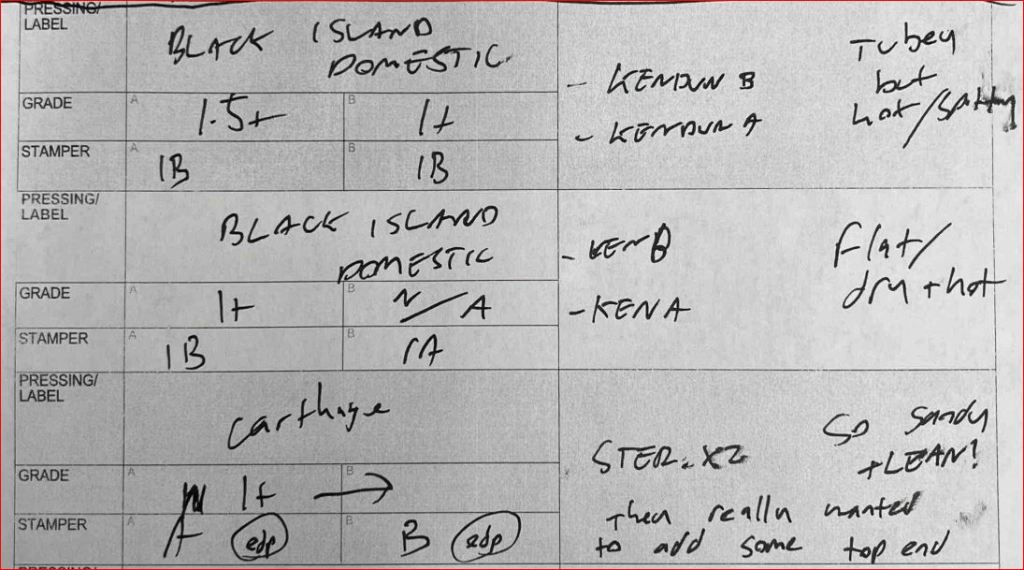
In spite of the fact that the domestic pressings of this Richard and Linda Thompson classic from 1974 were mastered by the likes of Kendun and Sterling — two of the greatest mastering houses of all time, — they have never impressed us with their sound quality.

The biggest problems with this record would be obvious to even the casual listener: gritty, spitty vocals; lack of richness; bright tonality; lack of bass; no real space or transparency, etc.

The domestic Island pressings did not do nearly as well in our shootout as the best Island imports, no surprise there as the early UK records were mastered by one of our favorite engineers.

Avoid the Carthage pressings mastered by Sterling. They came in last in our shootout.

The domestic breakdown follows:

Black Island Domestic #1

  • Tubey but hot and spitty.

Black Island Domestic #2

  • Flat, dry and hot (glary or bright)

Carthage Domestic recut from 1983, Sterling on both sides

  • So sandy and lean! They really wanted to add some top end (!)

Defending the Indefensible

(more…)

The Gayne Ballet on Mercury Can Be a Little Bright

Hot Stamper Pressings of Classical Masterpieces Available Now

UPDATE 2025

The review you see below was written more than ten years ago.

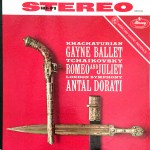
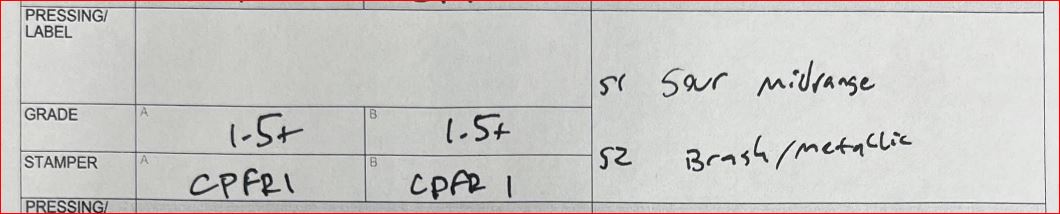
Having just done another shootout for SR 90209, Dorati’s recording of the two works, The Gayne Ballet and Romeo and Juliet, I can now confirm that there are some stampers that are indeed way too bright.

Side one of a recent copy had a sour midrange. Side two of the same copy was brash and metallic.

As for side two not sounding as good as side one in the older review before, seems we clearly got that wrong, the result, to some degree, of having an inadequate sample size.

Also,  we didn’t have as good a stereo as we do now, and we weren’t as good at doing shootouts back then either.


Our Old Review

This side one is truly DEMONSTRATION QUALITY, thanks to its superb low-distortion mastering. It’s yet another exciting Mercury recording. The quiet passages have unusually sweet sound.

This kind of sound is not easy to cut. This copy gets rid of the cutter head distortion and coloration and allows you to hear what the Mercury engineers accomplished.

(more…)

How Do the Early Pressings of this Mozart Piano Concerto Album Sound?

Hot Stamper Pressings of the Music of Mozart Available Now

About fifteen years ago (2010) we played an original pressing of this title that we really liked. It’s the one with the rare cover you see pictured, and might have actually been the first one we had ever found in audiophile playing condition. We had a devil of a time finding more copies, but we were convinced that the early pressings were clearly the best.

More recently we were able to acquire quite a variety of different pressings for an upcoming shootout and were fortunate to be able to include one of the stereo originals for the first time in many years.

We started out with high hopes, but once the early pressing began to play, our hopes were dashed fairly quickly.

Our notes for the original pressing read:

  • Overly rich and weighty
  • Dynamics/life are gone.
  • Side two has one of the most boomy sounding pianos I’ve ever heard.

In other words, it just sounded like an old record, and not a very good one at that. The world is full of them.

Only an old school audio system can hide the faults of a pressing such as this one. The world is full of those too, even though they might comprise all the latest and most expensive components.

Were we wrong years ago? Hard to say. That copy from many years ago is gone.

Three things we always keep in mind when a pressing doesn’t sound the way we remember it did, or think it should:

(more…)

Stick with Porky on East Side Story

More Hot Stamper Pressings We Only Offer on Import Vinyl Available Now

Porky cut the original British pressings of this Squeeze album, one of countless personal favorites of yours truly. They are records (and cassettes and CDs) I have played hundreds of times and still listen to regularly to this very day, in this case more than forty years after I purchased my first copy. (Good albums age well.)

I would have picked the record out of the bin at my local Tower Records, probably based on the radio play Tempted was getting.

That copy undoubtedly would have been domestic and made from a sub-generation tape, although I’m quite sure I could not have recognized what constituted dubby sound back then. In 1981, what I understood about the importance of different record pressings would have fit comfortably in a thimble.

I had my MoFi’s, and although I hate to admit it, that’s about as far as I had gotten in my quest for superior sounding pressings. You could add Nautilus and a few other Half-Speeds to the list of what pressing I thought were impressive, leaving plenty of room in that thimble unfilled.

Thankfully those bad old days are gone, and the music can now, finally, live and breath on the best of these imports from the UK. Of course they are the only ones we buy these days for our shootouts. The others are what are known around these parts as “mistakes.”

Sometimes the imported pressings are mastered by Porky and sometimes they are not. The ones that are not tend to have a lot of problems, as you can see from our stamper sheet below.

When Porky is not on side one, that side will tend to be hard, lean and bright. Side two of that copy had decent sound, earning a minimal Hot Stamper grade of 1.5+.

(more…)

These Are the Stampers to Avoid on With The Beatles

Hot Stamper Pressings of the Music of The Beatles Available Now

In our experience, the stereo pressings with -2/-2 stampers are terrible sounding. We do not have any on hand, but we doubt that -1/-1 — the original, the first, the one approved by George Martin himself! — is any better.

With -2 stampers this is a hall of shame pressing, as well as another early LP reviewed and found wanting.

That Old Canard

The early pressings are consistently grittier, edgier and more crude than the later pressings we’ve played. So much for the idea that the “original is better.” When it comes to With The Beatles it just ain’t so, and it doesn’t take a state of the art system or a pair of golden ears to hear it.

The audiophile and record collecting community seems to have failed to reckon with the faults of the early Beatles pressings, but we here at Better Records are doing our best to correct their misperceptions, one Hot Stamper pressing at a time.

It may be a lot of work, but we don’t mind — we love The Beatles! We want to find the best sounding copies of ALL their records, and there is simply no other way to do it than to play them by the dozens, as you can see from the picture below.

(more…)

Wild Things Run Fast – A Personal Favorite

Hot Stamper Pressing of the Music of Joni Mitchell Available Now

One of our favorite Joni Mitchell albums.

A Desert Island disc for me and one of the few good reasons to listen to new music in the 80s. 

My personal Must Own Joni Mitchell list includes:

  1. 1968 Song to a Seagull
  2. 1971 Blue
  3. 1974 Court and Spark
  4. 1982 Wild Things Run Fast

WTRF is a TAS list Super Disc with many good qualities, but you’d never know it from the typically lean, bass-shy pressing you might find on your turntable.

Also, since this record can be a little cold sounding — it’s a modern recording after all, and 1982 is sadly nothing like 1972  — filling it out and warming it up is just what the doctor ordered.

John Golden (JG) mastered the originals. The best of them prove that he did a great job at least some of the time. (To find “the best of them,” aka Hot Stampers, read on.)

You can count on the fact that our Hot Stamper pressings will be unusually rich and full-bodied, with lovely warmth and presence.

(more…)

Shootout Winning Stampers for Rhythms of the South Revealed

Hot Stamper Pressings of Exotica and Bachelor Pad Recordings Available Now

There are some records that, no matter how amazing the sound, and how good the music is, simply will not find favor with our customers. This is one of them. I happen to like the music, and the sound is shockingly good, a true Demo Disc for those of you with big speakers pulled well out from the back wall in a spacious, heavily treated room like the one you see below.

We are most likely not going to be doing shootouts for this title in the future, so we thought we would share with everyone what we know about the record, which boils down to which stampers have the potential to do well and which do not.

As you can see, Stan Goodall did a much better job mastering the early Blueback London pressings for Decca than Jack Law.

What information can you rely on when trying to find the best sounding pressings?

The originals all have the same Blueback cover.

In this case, the stamper numbers are the only way to separate the potential winners from the sure losers.

11/2023 Ros, Edmundo Rhythms of the South (PS 114 London) early Blueback 3 3 1E 1E other copies: 2.5/2, 2/2.5
11/2023 Ros, Edmundo Rhythms of the South (PS 114 London) early Blueback 1.5 1 2D 2D s1 dry, flat, trashy. s2 smeary, messy, boring
RE ABOVE: I FOUND THIS IN A BOX. THOUGHT IT SOUNDED REALLY GREAT, ESP. T1, S1

Jack Law’s cutting for side one was

(more…)