*Helpful Pressing Advice

The advice here should help you in your search for better sounding pressings.

At the very least it may help you avoid some of the worst ones.

Elvis Costello – An Overview

xxx

Hot Stamper Pressings of Elvis’s Albums Available Now

Note that the bulk of this commentary was written many years ago. I still feel the same way about Elvis’s albums and play them regularly to this day.


Trust is one of my three favorite Elvis Costello albums, along with his first and third, My Aim Is True and Armed Forces.

All three are Must Owns in my book.

I remember loving the sound of my old Brit copy from twenty years back [now 30], even to the point of agreeing with Michael Fremer when he put it on his top 40 rock album list. Now I know better: that most of them leave something to be desired, especially in the lower frequencies.

Did I have good one? Did he? Who can say? Everything is different, and revisiting old sonic favorites can sometimes be a bit of a shock.

Elvis: Still The King

By the way, we played a domestic copy of this album, just for fun you might say, and sure enough it was a real mess.

Boosted highs (Columbia had a habit of doing that for records mastered from dub tapes), poor bass definition and copious amounts of grit and grain — 70s Columbia at their best. What else is new?

The first album and Spike (far from the best but tolerable) are the only Elvis records I know of that work on domestic vinyl. Forget the rest.

If you love Elvis Costello as much as we do around here, we suggest you do yourself a favor and trash your domestic LPs — you need a British copy to even get in the ballpark on most of his albums, and even that’s far from a guarantee of good sound. Elvis is “Still the King,” but you will never know it without the right pressing.

Trust, along with Armed Forces, is one of the records that helped me make real progress in audio.
(more…)

How Good Are the UK Original Unboxed Deccas of Satanic Majesties?

Hot Stamper Pressings of the Music of The Rolling Stones Available Now

How good are the original Unboxed Deccas on Satanic Majesties?

They can be very good.

But they are never as good as the right later pressings with the Decca in a box label, the ones produced from about 1970 on.

The Unboxed Decca pressing earned a Super Hot Stamper grade (A++). The later pressing, with the right stamper, showed us just how good the album can sound.

Since the originals are pricey and hard to find, and, as a rule, noisier than the later pressings, we don’t pick them up unless we find them for cheap, which rarely happens. They have not won any shootouts, and that is very unlikely to change.

There is one set of stampers for this album that always wins, and those stampers are not found on the early label.

(more…)

Turned Up Good and Loud, Carnavalito Is Glorious

Records that Must Be Turned Up Good and Loud to Sound Their Best

UPDATE 2024

The commentary about Carnavalito you see below was written in 2016. With the 12 foot high ceiling in our new, bigger and quite a bit more spacious studio, I’ll bet this album sounds even more mind-blowing than it did back then.

Ken Perry mastered all the best early pressings — accept no substitutes.

Here in 2024 we’ve just done the shootout again, our first since 2016.

Sky Islands is not an easy record to find as it didn’t sell particularly well, but those of you who treasure the music of Weather Report or Return to Forever or The Mahavishnu Orchestra the way we do here at Better Record (or, to be clear, some of us do) will find much to like here.

Finding customers for music most audiophiles have never heard of, let alone heard, has always been the trick with well recorded, mostly unknown releases such as Sky Islands.

Which means that this is a woefully underrated album that should be more popular with audiophiles.

It’s also one of those difficult-to-reproduce records that I credit with helping me make real progress in audio (along with a great many others.).


Carnavalito is a track that really comes alive when you crank up the volume. I played it full blast on two different occasions for audiophile friends of mine just to show them what happens when a big speaker system meets a recording with absolutely amazing audiophile quality sound — big and bold, wall to wall and then some!

It’s my favorite track not only for the album as a whole but for the band’s entire recorded output. It just doesn’t get any better than this if you have the system for it.

Hearing the megawatt energy in the section when the soprano saxophonist jumps in, right into an ongoing orgy of wild percussion, who then proceeds to blow his brains out — now that is a thrill beyond belief. Played REALLY LOUD it’s about the closest to The Real Thing, the Live Event, that you will ever hear in your living room. (Unless you have a very large living room and lots of latin jazz musician friends.)

Even a year ago there was no way I could get that music to play that LOUD, that CLEANLY, and that CORRECTLY in terms of tonality, from the deepest bass to the highest highs, with the wild swings in dynamics that the recording captures so well.

The audio revolution is alive and well. It’s never too late to join in the fun.

(more…)

Thelonious Monk – Underground

More of the Music of Thelonious Monk

  • Boasting two KILLER Shootout Winning Triple Plus (A+++) sides or close to them, this vintage reissue pressing could not be beat
  • Charlie Rouse – featured on many of the tracks here – is particularly wonderful on sax. His saxophone is full-bodied and natural with breathy texture and just the right amount of honk
  • So many copies just sound like an old jazz record, but this one lets you feel like you are right there as the music happens
  • As is sometimes the nature of the beast with these vintage LPs, there are marks that play – those on “Easy Street” are especially bad – but if you can tough those out, this copy is going to blow your mind
  • 4 1/2 stars: “The instantly recognizable stride piano lines are delivered with the same urgency and precision that they possessed over two decades earlier…”

This is an outstanding Monk album from 1968. Thanks to Columbia’s state of the art engineering — still using tubes I’d wager, based on the sound — the recording really comes to life, or at least it does on a copy that sounds as good as this one does.

Monk’s piano has powerful dynamics and real weight, just like a real piano.

So many copies just sound like an old jazz record, but this one lets you feel like you are right there as the music happens. What more could you ask for?

(more…)

Reposted in Honor of Ozzy’s Passing — Import or Domestic on Paranoid?

Hot Stamper Pressings of the Music of Black Sabbath Available Now

The domestic copies we’ve played over the years for all the Black Sabbath titles are clearly better sounding than any import we’ve ever auditioned. It may be counterintuitive, but these are exactly the kinds of things you find out when doing blinded shootouts.

We have little use for intuitions (UK recording, UK pressing) and rules of thumb (original = better sound). We call that way of approaching the search for better sounding pressings mistaken audiophile thinking. 

Hard data — the kind you get from actually playing the records — trumps them all.

(We recently posted a lengthy commentary about conventional wisdom, attempting to make the case that, although the most common record collecting approaches are more often right than wrong, there is simply no way to know when any given approach will work for any given title.)

Want to find your own killer copy?

Consider taking our moderately helpful advice for how to find your own shootout winners.

(more…)

Which Side of this Pressing Lacked Space, and How on Earth Did You Spot It?

Hot Stamper Pressings of the Music of Thelonious Monk Available Now

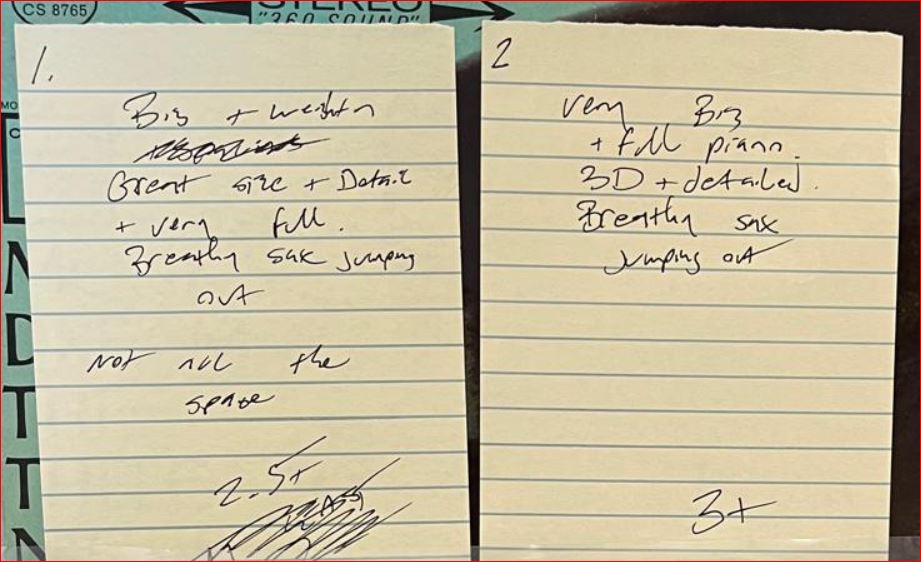
Our notes for a recent shootout winning copy read:

Monk’s Dream returns to the site for only the second time in over two years, here with INCREDIBLE Shootout Winning Triple Plus (A+++) grades or close to them throughout this black print Stereo 360 pressing.

These are just a few of the things we had to say about this killer copy in our notes: “big and weighty”…”great size and detail and very full”…”breathy sax jumping out of the speakers”…”very big and full piano”

In our notes you can see that side one fell short in one area, space, but how would anyone know that who hadn’t played a copy with even more space than this one? That’s why we do shootouts and you must do them too.

Both of these sides are rich, spacious, big and Tubey Magical, with less smear on the piano, a problem that holds many copies back. The sound found on these early Columbia 360 Label Stereo pressings is absolutely the right one for Monk’s music.

As you can see from the notes we took for this copy, we are not making any of this up!

This is why we do shootouts. If you really want to be able to recognize subtle (and sometimes not so subtle!) differences between pressings, you must learn to do them too.

And make sure to take notes about what you are hearing, good and bad.

One side falling short of the full Three Pluses happens all the time.

One out of five records that has one shootout winning side will have a matching shootout-winning other side.

(more…)

Our Four Plus Abbey Road Shootout Winner

Hot Stamper Pressings of Abbey Road Available Now

UPDATE 2026

This listing is from many years ago, possibly as early as 2010.

  • Our lengthy commentary entitled outliers and out-of-this-world sound talks about how rare these kinds of pressings are and how we go about finding them.
  • We no longer give Four Pluses out as a matter of policy, but that doesn’t mean we don’t come across records that deserve them from time to time.
  • Nowadays we most often place them under the general heading of breakthrough pressings. These are records that, out of nowhere, to the surprise of the listening panel, revealed to us sound of such high quality that it fundamentally changed our appreciation of the recording itself.
  • Breakthroughs often come about because the conventional wisdom we had been relying on up to that time turned out to be wrong. Regardless of how many original UK pressings of Abbey Road we might have cleaned and played, we would never have found one that sounds as good as this pressing does, simply because none of the originals ever came close to winning a shootout, and it’s very unlikely that one ever would.

An exceptional copy of The Beatles’ last and arguably greatest album with THE BEST SIDE TWO WE HAVE EVER HEARD — QUADRUPLE PLUS (A++++)!

If you’ve heard the disastrous new pressing, then you know how important it is to play a real, vintage, analog pressing. A copy this good might just give you a new appreciation for one of the Greatest Rock Albums of All Time.  A permanent member of the Better Records Top 100, and a Desert Island Disc if ever there was one.

Abbey Road checks off a number of important boxes for us here at Better Records. Here are three for starters:

The blog you are on now as well as our website are both devoted to very special records such as these.

Abbey Road is the very definition of a big speaker album. The better pressings have the kind of ENERGY in their grooves that are sure to leave most audiophile systems begging for mercy.

This is one of the The Beatles’ many audio challenges that await you. If you don’t have a system designed to play records with this kind of sonic power, don’t expect to hear them the way the band, Geoff Emerick, George Martin and everyone else involved in the production wanted you to.

It’s clear that The Beatles albums informed not only my taste in music, but the actual stereo I play that music on. It’s what progress in audio is all about. I’ve had large scale dynamic speakers for close to five decades, precisely in order to play demanding recordings such as Abbey Road, an album I fell in love with “all those years ago.”

(more…)

Face Value with Hugh Padgham’s Big Drum Sound

Hot Stamper Pressings of the Music of Phil Collins Available Now

There may be some hope for Hello, I Must Be Going! (1982), but Phil’s third album, 1985’s No Jacket Required, sounds digital and way too heavily processed.

I suppose not many albums from 1985 weren’t, but it’s still an unfortunate development for us audiophile types who might’ve wanted to enjoy these albums but are just not able to get past the ridiculously bad sound. (If we ever do a listing for it, you can be sure it will go right into our hall of shame.)

The recording of Face Value is still analog and the quality is excellent, thanks to hugely talented engineer and producer Hugh Padgham (Peter Gabriel, Genesis, The Police, Yes, Emerson, Lake & Palmer, etc.)

On the best copies, the sound is nothing short of superb.

Check out Phil’s take on Tomorrow Never Knows for some heavily reverbed vocal effects, complete with a slew of backwards psychedelic sounds. If anybody can play the weirdly syncopated rhythms of TNK, it’s Phil Collins.

Whomp!

Until we heard some of the better copies, we were never able to appreciate just how important bass definition and weight are to the sound of this record. When the bass is wooly or thin, as it is on so many copies — not clear, not deep, not full enough — it throws the rest of the mix off.

When the bass is huge and powerful, the music itself becomes huge and powerful.

The copies with the big bottom end are the only ones that really make you sit up and take notice of just how big the sound is. The best Hot Stamper pressings will be Demo Discs for bass on big speakers at loud levels. Here are some others you may enjoy reading about.

After moving into our new custom-built studio and spending a few months optimizing the room treatments, we now have even more transparency in the mids and highs, while improving the whomp factor (the formula goes like this: deep bass + mid bass + speed + dynamics + energy = whomp) at the listening position.

There’s always tons of bass being produced when you have three 12′ woofers firing away, but getting the bass out of the corners and into the center of the room is one of the toughest tricks in all of audio.

Transparency Is Key

Phil’s lead and harmony vocals are both breathy and present on the best copies, with natural, not hyped-up, texture, and harmonics. This is especially important for the love songs.

The many ballads on the album — This Must Be Love and If Leaving Me Is Easy are two of our favorites — don’t work unless the sound is intimate and immediate.

Only the best pressings have the high-resolution, full-bodied sound that allows both the rockers and the ballads to sound their best.

If you’re a fan of big drums in a big room, with jump out of the speakers sound, this is the album for you.

(more…)

English Settlement – A Sonic Tour de Force

More of the Music of XTC

This is an AMAZINGLY well-recorded album, with huge amounts of open studio space and that Tubey Magical, rich, fat, dense British Rock Sound. That sound isn’t easy to reproduce, but this copy absolutely nails it. Nothing else in our shootout came close to it!

If you have big speakers and the room to play them, this is quite the sonic tour de force. Credit Hugh Padgham, producer and engineer, who’s worked with the likes of Peter Gabriel, Genesis, The Police, Yes and Emerson, Lake and Palmer. Those bands make the kind of music that make good use of Padgham trademark sound: wall-to-wall, deep, layered, smooth, rich and stuffed to the gills. XTC with Padgham’s help have here produced a real steamroller of an album in English Settlement.

The big hit on this album is one that most audiophiles will probably know: Senses Working Overtime. Even over the radio you can hear how dense the production is. Imagine what it sounds like on an original British pressing with Hot Stampers, played on a modern audiophile rig. We can tell you: IT ROCKS. (more…)

Listening in Depth to The Royal Scam

Hot Stamper Pressings of the Music of Steely Dan Available Now

We really went overboard with the track commentary for this one many years ago. This should make it easy for you to compare what we say about the sound of these songs with what they sound like to you on your system, using the copy you own or, better yet, one of our Hot Stampers. 

If you end up with one of our pressings, listen carefully for the effects we describe below. This is a very tough record to reproduce — everything has to be working in tip-top form to even begin to get this complicated music sounding the way it should — but if you’ve done your homework and gotten your system really cooking, you are in for the time of your Steely Dan life.

Side One

Kid Charlemagne

By far the most sonically aggressive track on this album, Kid Charlemagne is a quick indicator of what you can expect from the rest of the side. The typical copy is an overly-compressed sonic assault on the ears. The glaring upper midrange and tizzy grit that passes for highs will have you jumping out of your easy chair to turn down the volume. Even my younger employees who grew up playing in loud punky rock bands were cringing at the sound.

However, the good copies take this aggressive energy and turn it into pure excitement. The boys are ready to rock, and they’ve got the pulsing bass, hammering drums, and screaming guitars to do it.

Without the grit and tizz and radio EQ — which could have been added during mastering or caused by the sound of some bad ABC vinyl, who can say which — the sound is actually quite good on the best copies.

It’s one of the toughest tests for side one. Sad to say, most copies earn a failing grade right out of the gate.

The Caves of Altamira

This is the best test for side one.

There are sweet cymbals at the beginning, and Fagen’s double tracked voice should be silky and smooth, but on the really hot copies it’s also big and alive.

When I was first doing these shootouts, I noted that the hi-hat is front and center in the mix of this song, and when that hi-hat sounds grainy or aggressive, it’s positively unlistenable.

That hi-hat needs to sound silky and sweet or this song is going to give you a headache, at least at the volume I play it at: GOOD and LOUD.

(more…)