*Pressing Advice

The advice here should help you in your search for better sounding pressings.

At the very least it may help you avoid some of the worst ones.

Straight Up – Porky Not So Prime Cut

Hot Stamper Pressings of the Music of Badfinger Available Now

UPDATE 2026

This commentary has been updated multiple times, most recently in 2025.


British band, British pressing… right?

Nope. It’s just another mistaken idea.

We evaluated an original British pressing in our shootout, unbeknownst to me as it was playing of course. And guess where it finished: dead last.

The most thick, congested, crude, distorted, compressed sound of ALL the copies we played.

We love the work of Porky, Pecko, et al. in general, but once again this is a case where a British Band recorded in England sounds best on domestic vinyl. (McCartney’s first album on Apple is the same way.)

Just saw this today (11/29/2021)

On November 18, 2019, a fellow on Discogs who goes by the name of Dodgerman had this to say referencing the original UK pressing of Straight Up, SAPCOR 19:

So Happy, to have a first UK press, of this lost gem. Porky/Pecko

Not sure what those two commas are doing there. Pausing for emphasis? Sure, why not? This is a big deal.

Like many record collectors, he is happy to have a mediocre-at-best, dubby-sounding original pressing, poorly mastered by a famous mastering engineer, George Peckham, a man we know from extensive experience to be responsible for cutting some of the best sounding records we’ve ever played. He is truly one of the greats.

Is Dodgerman an audiophile? He might be, or at least he might choose to describe himself as one.

Many audiophiles employ this kind of mistaken audiophile thinking, believing that a British band’s albums must sound their best on British vinyl for some reason, possibly a cosmic one.

(more…)

Botnick and Levine Knocked Equinox Out of the Park

Hot Stamper Pressings of the Music of Sergio Mendes Available Now

The music is of course wonderful, but what separates Sergio from practically all of his ’60s contemporaries is the AMAZING SOUND of his recordings. Like their debut, this one was engineered by the team of Bruce Botnick and Larry Levine.

Botnick is of course the man behind the superb recordings of The Doors, Love and others too numerous to mention. 

Levine is no slouch either, having engineered one of the best sounding albums on the planet, Sergio Mendes’ Stillness.

Just play the group’s amazing versions of Watch What Happens, Night and Day, or Jobim’s Wave to hear the kind of Mendes Magic that makes us swoon. For audiophiles it just doesn’t get any better. (Well, almost. Stillness is still the Ultimate, on the level of a Dark Side of the Moon or Tea for the Tillerman, but Equinox is right up there with it.)

Only the best copies are sufficiently transparent to let the listener hear all the elements laid out clearly, with each occupying a real three-dimensional space within the soundfield. When you hear one of those copies, you have to give Botnick and Levine their due. These guys knew what they were doing like few that have come along since.

(more…)

The Glorious Big Speaker Sound of Wind of Change

Hot Stamper Pressings of the Music of Peter Frampton Available Now

A while back we discussed the kind of sound that Glyn Johns managed to get for the likes of Humble Pie and The Who:

But oh what a glorious sound it is when it’s working. There’s not a trace of anything phony up top, down low or anywhere in-between. This means it has a quality sorely at odds with the vast majority of audiophile pressings, new and old, as well as practically anything recorded in the last twenty years, and it is simply this: The louder you play it, the better it sounds.

Chris Kimsey knew how to get the Big Rock Sound onto tape about as well as anybody who ever lived. His work on this album set me on a path I would would follow for the next fifty years.

Wind of Change is the very definition of a big speaker record, one that requires the highest-resolution, lowest-distortion components to bring out its best qualities. If you have a system like that, you should find much to like here.

I bought my first copy in 1972 while still in high school and it quickly became one of my favorite records.

All these years later it still is.

It’s records like this that shaped my audio purchases and pursuits. It takes a monster system to even begin to play this record right, and that’s the kind of stereo I’ve always been drawn to.

A stereo that can’t play this record, or The Beatles, or Ambrosia, or Yes, or the hundreds of other amazing recordings we put up on the site every year, is not one I would want to own.

This is Peter Frampton’s Masterpiece as well as a personal favorite of yours truly.

(more…)

Our Top Copy of Broken Barricades Was Amazing Sounding

Hot Stamper Pressings of Art Rock Albums Available Now

Our recent Shootout Winning early UK pressing was described this way:

Looking for some proggy music that falls somewhere between Jethro Tull and Supertramp, with sonic credentials to match the recordings of those two very well-recorded bands? Well, look no further.

This early UK press is full of the Tubey Magic and studio space that makes the band’s recordings the joy they are to play on a heavily-tweaked audiophile rig.

If you’re a Prog Rock or Art Rock fan, this is a classic from 1971 that belongs in your collection. This also just happens to be our pick for the best sounding recording by the band. Others of similar stature can be found here.

And here are the notes that back up everything we had to say about the copy that knocked us out.

We LOVED playing this album, both for the music and the sound. These guys don’t get the respect they deserve among audiophiles, but we’re doing our best to try to change that.

Side one kicks off with the hit track Simple Sister, and you won’t believe how hard it rocks. Some copies are overly clean — they have the kind of clarity you might hope to find, but lacked the richness and fullness that makes ’70s analog so involving. Those “clean” copies simply do not earn very high grades from us. We leave that sound to the Heavy Vinyl and CD crowd; they seem to like it.

Punter and Thomas

John Punter engineered and Chris Thomas produced. They have worked on many of our favorite — and best-sounding – albums by British artists.

(more…)

Helpful Stamper Information You Can Use – Episode 108

Hot Stamper Pressings of the Music of Genesis Available Now

British Pressing? Check.

Pink Label? Check.

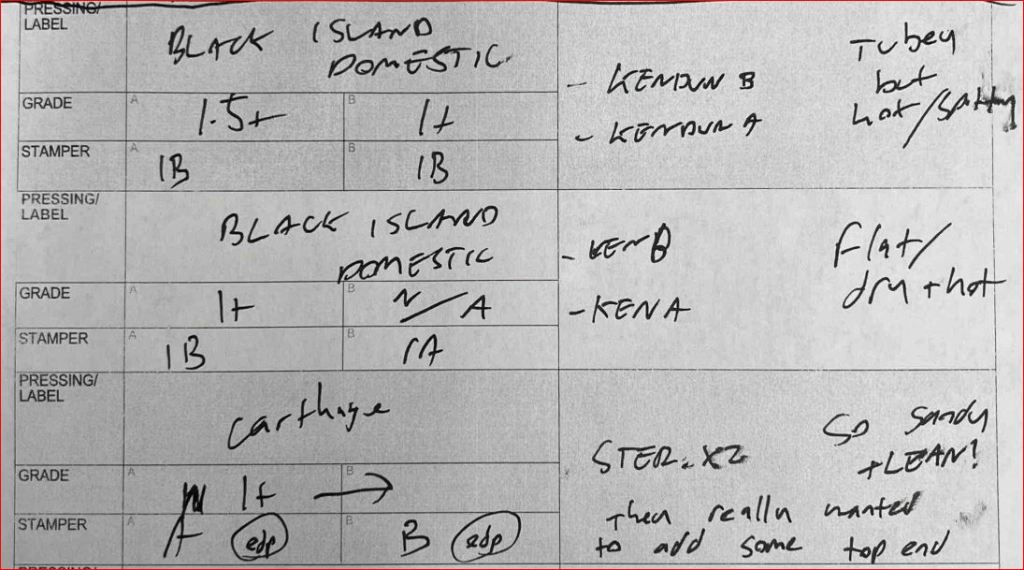
Sound Quality?  Side One:: 1+ (dubby). Side One of another copy: NFG (no good).

Apparently something went wrong, but exactly what, nobody really knows.

And if for some reason somebody actually believes they know what went wrong, we tell them that that kind of thinking is detrimental to whatever success they hope to achieve in finding better sounding records, if our experience over the last fifty years has any bearing.

We don’t know it all and we’ve never pretended to. All our knowledge is provisional. We may not be the smartest guys in the room, but we’re sure as hell smart enough to know that much.

If somehow we did know it all, there would be no need for the two hundred entries in our live and learn section about all the mistakes we’ve made over the years trying to understand record pressings at the sonic level.

We take a different approach to searching out better sounding pressings. Instead of reading about them — who made them, how they were made, where they were made, all that sort of thing — we instead devoted our efforts to cleaning and playing them, so that we could make our own judgments about the sound and the music we heard.

Our experiments, conducted using the shootout process we’ve painstakingly developed over the course of the last twenty years, produce all the data we need: the winners, the losers, and the rankings for all the records in-between.

Free Stamper Info

By my count this is the 108th stamper sheet we have posted on The Skeptical Audiophile.

In the case of this title, these are what we would call bad stampers for Genesis’s 1973 prog album Selling England by the Pound (a record we rarely have in stock because the best stampers are just too hard to find, at least they are on copies in audiophile playing condition).

If you are looking for top quality sound — and seriously, what else would you be looking for if you are reading this blog? —  then make sure not to buy just any old early Pink Label UK pressing of the album. You may end up with one that sounds as bad as this one did.

(more…)

What Track Here Would Be Right at Home on David Crosby’s First Album?

Hot Stamper Pressings of the Music of Graham Nash Available Now

Our last shootout for this album took place in 2021. I wish we could keep the record in stock but finding the right stampers these days is not easy.

Still, as a favorite album of mine, I listen to the album regularly, just not on vinyl. Both the standard CD and the cassette I have sound right to me, sounding very much like the original record.

Recently I was playing the album and heard a song that sounded an awful lot like it might have been produced by the same team that recorded David Crosby’s first album, If Only I Could Remember My Name.

If you’re up for it, listen to the Crosby, then play the Nash and see if you can spot it. Feel free to leave your impressions in the comments section below.

Digging Deeper

Songs for Beginners is one of those albums that made me want to dig deeper into audio. After every improvement I managed to make to the system, Songs for Beginners would be one of the records that I would play (at very high volume) to see what changes I had brought about.

All the best changes — the ones I kept — always made the album sound better than I had last heard it. Over the course of decades the sound became amazingly good, a true Demo Disc that belonged in the company of Tea for the Tillerman or Dark Side of the Moon.

Back in the 70s and the 80s, not so much later as I had found plenty of other tough test discs by then, it helped me dramatically improve the playback quality of my system, which, to be honest, had a very long way to go, although I sure didn’t know that at the time. I thought it sounded great.

Early on in the history of our track by track breakdowns, written in order to aid listeners in testing their stereos and the other copies of the record they might own, we did a breakdown for the album which you can read here.

If you can’t find a nice original, whatever you do, don’t buy the awful Classic Records pressing of the album. They ruined it.

(more…)

Room Treatments Bring Out The Big Speaker Whomp Factor

Hot Stamper Pressings of the Music of Sergio Mendes Available Now

UPDATE 2025

The first Sergio Mendes and Brasil ’66 album is one of those records that helped us dramatically improve the quality of our playback.


Only the best copies are sufficiently transparent to grant the listener the privilege of hearing all the elements laid out clearly, each occupying a real three-dimensional space within the soundfield. 

With recent changes to some of our room treatments, we now have even more transparency in the mids and highs, while improving the whomp factor (the formula goes like this: deep bass + mid bass + speed + dynamics + energy = whomp) at the listening position.

There’s always tons of bass being produced when you have three 12′ woofers firing away, but getting the bass out of the corners and into the center of the room is one of the toughest tricks in audio.

For a while we were quite enamored with some later pressings of this album — they were cut super clean, with extended highs and amazing transparency, with virtually none of the congestion in the loud parts you hear on practically every copy.

But that clarity comes at a price, and it’s a steep one. The best early pressings have whomp down below only hinted at by the “cleaner” reissues. It’s the same way super transparent half-speeds fool most audiophiles. For some reason audiophiles rarely seem to notice the lack of weight and solidity down below that they’ve sacrificed for this improved clarity. (Probably because it’s the rare audiophile speaker that can really move enough air to produce the whomp we are talking about here.)

But hey, look who’s talking! I was fooled too. You have to get huge amounts of garbage out of your system (and your room) before the trade-offs become obvious.

When you find that special early pressing, one with all the magic in the midrange and top without any loss of power down below, then my friend you have one of those “I Can’t Believe It’s A Record” records. We call them Hot Stampers here at Better Records, and they’re guaranteed to blow your mind. (more…)

Thick as a Brick Is a Top Test Disc for System Accuracy

Hot Stamper Pressings of the Music of Jethro Tull Available Now

From 2009 to 2010 this was our single go-to record for testing and tweaking our system.

Although we now use an amazing copy of Bob and Ray (the big band version of The Song of the Volga Boatmen located therein has to be one of the toughest tests we know of), we could easily go back to using TAAB.

Artificiality is the single greatest problem that every serious audiophile must guard against with every change and tweak to his stereo. cleaning system, room, electricity and everything else.

Since TAAB is absolutely ruthless at exposing the slightest hint of artificiality in the sound of the system, it is clearly one of the best recordings one can use to test and tune with. Here are just some of the reasons this was one of our favorite test records back in the day:

Dynamics

The better copies are shockingly dynamic. At about the three minute mark the band joins in the fun and really starts rocking. Set your volume for as loud as your system can play that section. The rest of the music, including the very quietest parts, will then play correctly for all of side one. For side two the same volume setting should be fine.

Bass

The recording can have exceptionally solid, deep punchy bass (just check out Barrie “Barriemore” Barlow’s drumming, especially his kick and floor toms. The guy is on fire).

Midrange

The midrange is usually transparent and the top end sweet and extended on the better pressings.

Tubey Magic

The recording was made in 1972, so there’s still plenty of Tubey Magic to be heard on the acoustic guitars and flutes.

(more…)

Sergio Mendes & Brasil ’66 – Self-Titled

  • Sergio Mendes and Brasil 66’s debut LP, here with solid Double Plus (A++) sound or close to it throughout this original A&M stereo pressing
  • This side one is rich, full, open, and spacious, conveying a sense of the amazing performances of these great musicians, and side two is not far behind in all those areas
  • The drums and percussion are powerful and punchy with lots of room around them, with plenty of WHOMP and good extension on the top end (particularly on side one)
  • The toughest of the band’s albums to find with audiophile sound and surfaces, which is why it’s been years since our last shootout
  • 4 1/2 stars: “The hit was Jorge Ben’s ‘Mas Que Nada,’ given a catchy, tight Bossa Nova arrangement with the voice of Lani Hall soaring above the swinging rhythm section. But other tracks leap out as well; the obvious rouser is the Brazilian go-go treatment of the Beatles’ ‘Day Tripper’…”

This is one of my favorite albums, one which certainly belongs in any audiophile’s collection. Better sound is hard to find — when you have the right pressing. Unfortunately those are pretty hard to come by. Most LPs are grainy, shrill, thin, veiled and full of compressor distortion in the louder parts: this is not a recipe for audiophile listening pleasure.

But we love this album here at Better Records, and have since day one. One of the first records I ever played for my good audio buddy Robert Pincus (Cisco Records) to demonstrate the sound of my system was Sergio’s syncopated version of “Day Tripper” off this album. That was decades ago, and I can honestly say I have never tired of this music in the intervening years.

(more…)

The Last Consistently Good Elvis Costello Album

Some reviewers think that this sprawling album with widely diverse musical styles lacks focus, but that’s precisely what makes it a work of genius.

On Spike, Elvis Costello tries his hand at every style of pop music he can think of and succeeds brilliantly with each and every one of them. This is one of the few compelling albums of the ’80s. I still play mine regularly on CD in the car.

Any King’s Shilling on side two with its authentic Irish instrumentation (fiddle, uilleann pipes, Irish harp, bodhran) has Demo Disc Quality sound of the highest order.

Another song on side two with top audiophile recording quality was Satellite. (For those of you who know Jellyfish, this has to be where they found some of the sound they would put to such good use on Bellybutton and Spilt Milk a few years later.

One side one God’s Comic is Demo Quality — so rich and natural. Where has this kind of sound gone? The way of the Dodo, baby, and it ain’t coming back. Mitchell Froom, the man who gave Crowded House such a polished pop sound, plays some wonderful keyboards here and elsewhere on the album. He’s joined by a slough of notables.

Elvis searched far and wide for this group and managed to find top players for every position on his team. The musicianship is top drawer all the way. Elvis clearly knows talent when he hears it.

(more…)