*Reviewing the Reviewers

These commentaries illustrate how following the advice of most reviewers will more than likely inhibit your progress in this hobby.

Following our advice, on the other hand, can take your enjoyment of recorded music to levels never before imagined.

To learn more, click on Start Here, found at the top of every page.

How Does the Heavy Vinyl Rubber Soul Sound?

Hot Stamper Pressings of Rubber Soul Available Now

This review was originally written in 2015.


We are so excited to tell you about the first of the Heavy Vinyl Beatles remasters we’ve played! As we cycle through our regular Hot Stamper shootouts for The Beatles’ albums we will be of course be reviewing more of them*. I specifically chose this one to start with, having spent a great deal of time over the last year testing the best vinyl pressings against three different CD versions of Rubber Soul.

The short version of our review of the new Rubber Soul vinyl would simply point out that it’s awful, and, unsurprisingly, it’s awful in most of the ways that practically all modern Heavy Vinyl records are: it’s opaque, airless, energy-less and just a drag.

I was looking forward to the opportunity to take Michael Fremer, the foremost champion of thicky vinyl, to task in expectation of his usual rave review, when to my surprise I found the rug had been pulled out from under me — he didn’t like it either. Damn!

MF could hear how bad it was. True to form, he thinks he knows why it doesn’t sound good:

As expected, Rubber Soul, sourced from George Martin’s 1987 16 bit, 44.1k remix sounds like a CD. Why should it sound like anything else? That’s from what it was essentially mastered. The sound is flattened against the speakers, hard, two-dimensional and generally hash on top, yet it does have a few good qualities as CDs often do: there’s good clarity and detail on some instruments. The strings are dreadful and the voices not far behind. The overall sound is dry and decay is unnaturally fast and falls into dead zone.

It strikes me as odd that the new vinyl should sound like a CD. I have listened to the newly remastered 2009 CD of Rubber Soul in stereo extensively and think it sounds quite good, clearly better than the Heavy Vinyl pressing that’s made from the very same 16 bit, 44.1k remixed digital source.

If the source makes the new vinyl sound bad, why doesn’t it make the new CD sound bad? I can tell you that the new CD sounds dramatically better than the 1987 CD I’ve owned for twenty years. They’re not even close. How could that be if, as MF seems to believe, the compromised digital source is the problem?

Lucky for me I didn’t know what the source for the new CD was when I was listening to it. I assumed it came from the carefully remastered hi-rez tapes that were being used to make the new series in its entirety, digital sources that are supposed to result in sound with more analog qualities.

Well, based on what I’ve heard, they do, and those more analog qualities obviously extend to the new Rubber Soul compact disc. At least to these ears they do.

It’s possible my ignorance of the source tape allowed me to avoid the kind of confirmation bias — hearing what you expect to hear — that is surely one of the biggest pitfalls in all of audio and a pit that Fremer falls into regularly.

(more…)

Got Nice Equipment? It’s a Good First Step, but Only a First Step

Revolutions in Audio, Anyone?

Nice equipment is only the first step on the long, long, long road to good sound.

The audio magazines that their reviewers write for are purveyors of what we consider to be one of the most pernicious falsehoods in all of audio — that buying more expensive equipment is the key to better sound. (Note that is is a falsehood, not a lie; they probably actually believe it.)

From the audiophile rags’ point of view, this makes perfect sense. They extoll the virtues of one piece of sexy hardware after another on page after page of their glossy magazines. The ten bucks a year you pony up to subscribe doesn’t even cover the cost of all that pretty paper. They make their real money by selling advertising to equipment manufacturers, who in turn advertise equipment they want you to buy. What are all the glossy pages of these magazines devoted to? The fawning and credulous discussion of the sexy equipment being advertised.

stereooldSee how that works? It ain’t rocket science. These magazines have a vested interest in convincing you that the Newer and More Expensive the equipment you own, the better will be the sound in your home.

Wrongheaded Thinking

It’s easily demonstrated how wrongheaded this way of thinking is. If you’ve been in audio for any length of time, you know that one bad interconnect can ruin the sound of a stereo. We’ve all been there. All it takes is one little wire — the wrong wire in the wrong place — to make all that expensive equipment sound like shit.

Or a bad room. Or the speakers on the wrong wall. Or VTA too high. Or too low. Or a mismatch between the arm and cartridge. Or a mismatch between the speaker and amp. Or about 68 million other things, any one of which can turn the sound of all that sexy equipment into musically unpleasant dreck.

(more…)

Suite Espanola – How Do the Remastered Pressings Sound?

Decca and London Hot Stamper Pressings Available Now

In 2011 we made the (usually pointless) effort to compare a London pressing to the 180 gram Speakers Corner reissue which we were carrying at the time. We noted simply that the Heavy Vinyl pressing “was a joke next to this copy.”

I wish I could tell you in what way it was a joke — we try to be specific about the shortcomings of these records, which is why we publish our notes for some of them — but the old notes are long gone.

Naturally, we don’t have the reissue to play this time around. Still, we are confident that the results of any comparison would be the same.

Mark Lehman in the Absolute Sound gave the ORG Heavy Vinyl remastering Five Stars, having this to say about the sound:

ORG’s 45rpm remastering is terrific (as indeed are all of the ORG vinyl reissues I’ve heard). Comparison with the late- 60s London LP on which the Suite first appeared reveals sharpened and clarified attacks and articulations, more tightly focused individual strands, fuller and warmer string choirs, more resonant brass, more pillowy air around flutes, clarinets, and oboes, and more nuance and opulence in the orchestral blends.

The total effect is to make Albeniz’s composition even more sweeping, rhapsodic, richly hued, evocative, and involving—and that’s saying something, considering how good the sonics are on this recording’s first incarnation.

If only any of this were true!

We readily admit we have never played the ORG pressing and have no plans to, but when has a Heavy Vinyl pressing ever had any of the qualities described above, let alone in such abundance?

Never in our experience, and our experience extends to more than four hundred of them.

Enough Already

Enough about records we’ve never played. Let’s discuss some of the pressings of this very recording that we actually have played, it being a favorite of ours for which we have done a number of shootouts.

The Super Analogue remaster from the 90s was awful. I would give it an F if I were grading it today.

The Speakers Corner pressing earned a B grade from us, which makes it one of the better releases on that label. I would guess that one or two out of ten would rate a B. I don’t know of any record of theirs that rates a grade higher than B.

Using letter grades, our grading system of White Hot, Super Hot and Hot would translate to something like A Plus, A and A Minus.

Which means that there is no Heavy Vinyl pressing, from any era, on any label, that should be able to beat any Hot Stamper pressing on our site, and we back that up with a 100% money back guarantee.


UPDATE 2024

Stop the presses and hold your horses.

As of 2024 we actually know of more than one Shootout Winning title pressed on modern Heavy Vinyl. You can read about one of them here.

There is another one as well and we will be writing about that one soon.

We now return you to our old commentary.

(more…)

Thinking Inside the Box

Hot Stamper Pressings of Jethro Tull Albums Available Now

The concepts we discuss below were hashed over in a 2023 letter written to us about a video interview with Michael Fremer, a video, I confess, I’ve never watched.

For background purposes, you should know that Steve Westman and Michael Fremer really like Heavy Vinyl records. Because of this shared interest, they naturally get along well.

I was invited on Steve’s show for a couple of episodes myself, as was Robert Brook, but because neither I nor Robert care much for Heavy Vinyl pressings, we had little in common with Steve or his roundtable. There was no reason for either one of us to be there, and it is unlikely we will be invited back. What would we talk about? How bad the sound quality is on the new records you guys talk about endlessly to the exclusion of everything else? You can imagine what they thought of my views, and vice-versa.

Back to the letter. As I explained to my customer, making generalizations about records is rarely of much use. The devil is in the details. Let’s take a look at what Michael Fremer has written recently about originals.

(more…)

Has This Person Ever Heard a Good Sounding Scheherazade?

Hot Stamper Pressings of Orchestral Spectaculars Available Now
May I refer you to the review Jonathin Valin wrote in 2013 for the Analogue Productions Scheherazade. (Emphasis added.)

LSC 2446 Rimsky-Korsakov: Scheherazade. Grade: A+.

Another one of HP’s favorites, this LP (at least in its earliest pressings) is famously wonderful sounding, and the Analogue Productions version certainly lives up to the hype.

Once again string tone—and this disc is celebrated for its string tone—is ravishingly beautiful. The bass is astonishing, deep and authoritative. And dynamics are tremendous.

We Beg to Differ

The bass is not authoratative, it is overblown and annoying.

The dynamics are not tremendous, they are, in fact, lacking.

The string tone is at best passable – ravishingly beautiful is hopelessly off the mark.

A properly-mastered, properly-pressed vintage RCA should sound more or less like this one.

Worlds better in every way.

If I were in charge of the TAS Super Disc list, obviously I would not have put this record on it.

It’s not a Super Disc. It’s not even a Very Good disc.

To be honest, it’s actually a pretty Bad Disc. The TAS List is full of them these days.

Granted, it always had some bad records on it, but now it has a great many, with more being added every year, most of them pressed on Heavy Vinyl.

(more…)

The Thrill of Discovering Great Recordings

Hot Stamper Pressings of Percussion Recordings Available Now

Robert Fine was one of the greatest audio engineers who ever lived. He is the man responsible for recording this audiophile gem for Command, as well as much of the Mercury catalog.

Unfortunately, we rarely have any Command records in stock, but we do make an effort to have a good selection of the most amazing sounding Mercury titles available in the form of Hot Stamper pressings.

If you have the system for it, it’s very possible you have never heard most of these instruments sound this real on any other recording. It’s as if you were standing right in the studio with them. Yes, it’s that crazy good.

Let Me Ask You This

Here’s a question no one seems to be asking:

Who is finding incredible Demo Discs like this Command from 1961 nowadays?

Harry Pearson used to.

Sid Marks reviewed plenty back in the day (reviews which I mostly disagreed with, but still, at least he wrote them).

Jim Mitchell (now long-forgotten) wrote about them back in the 80s.

Moon and Gray published a book full of the best sounding Deccas and Londons.

Anybody else?

Are the audiophile reviewers of today picking up the baton that the giants of the past have dropped at their feet?

I see little evidence of it. [1]

Not to worry. Better Records has taken on the job that no one else seems to want to do. For example, here are 200+ records we’ve discovered with (potentially) excellent sound.

And that’s not all. Not only have we set a higher standard for audiophile-quality records with our vintage vinyl Hot Stamper pressings, but we’ve endeavored to provide a great many other benefits to the audiophile community as well.

(more…)

How to Avoid Making this Rookie Record Collecting Mistake

Record Shopping Day Video!

Not sure how much of this video you can stand — nothing could interest me less than watching a couple of vinyl enthusiasts spouting off on what they think about some random records sitting in a local store’s bins.

But one or two bits caught my eye. I thought I might take the opportunity to share my take on them with you.

Is there any value to the comments of these two collectors? If you care about what music they like, perhaps.  Anything about what to look for on the label or jacket that might correspond to better sound?  If it’s there I sure didn’t see it, but I admit to speeding through most of it, so I can’t say for sure.

The first bit I refer to above is at 18:42.  The album in question is the legendary Kind of Blue. At this point the unseen helmet-cammed audiophile picks up the record, recognizes the cover, and proceeds to pull the record out to see what era the pressing is from.

Drat! The disappointment in this audiophile’s voice is palpable as he drops the record back in the bin with his dismissive comment that  “it’s a later pressing.”

But we here at Better Records would be falling all over ourselves to get our hands on that later pressing.

Those late pressings can and often do win shootouts. We would never look down our noses at a Red Label Columbia jazz LP, and neither should you.


UPDATE 2025

As good as the best pressings on the Red Label can sound, it has been years since one won a shootout. Here is our commentary for a recent 70s copy that went up on the site, one that earned a Super Hot grade on both sides.

They tend to sell for four or five hundred dollars these days. Why so much you ask? Because they beat the pants off of every so-called audiophile pressing of the album ever made. The testimony of one of our customers does a good job of describing the differences.

In addition, it turns out that at least nine out of ten of the copies with the red label are not remotely as good as the ones that earn Super Hot grades. The good ones are so rare that we only pick them up locally since practically none of the ones we find on the web have the right stampers. Trying to find the right red label needle in the haystack is more trouble than it’s worth, so don’t expect to see many coming to the site.


Our intrepid audiophile explorer does much the same thing about 23 minutes in. It seems pretty clear to us that he has no respect for such reissues, another example of one of the most common myths in record collecting land, the myth that the  original pressing is always, or to be fair, usually better.

This is simply not true, and those of our customers who have purchased White Hot Stamper pressings from us that turned out to be reissues know exactly what I am talking about. This is especially true for the records we sell by The Beatles. No original pressing has every won a shootout. [With one exception.]

Let’s get back to Kind of Blue.

Is the 50s original always better, is the 70s reissue always better, is the 60s 360 pressing always better?

No to one, two and three.

Why? Because no pressing is always better. All pressings are unique and should only be judged on their merits, and you do that by playing them, not by looking at their labels. For us this truth is practically axiomatic. It is in fact the premise of our entire business. Over the course of the 28 years we have been selling records we have never found any compelling evidence to invalidate it.

The day that someone can accurately predict the sound quality of a specific record by looking at the label or cover is a day I do not expect to come, ever.


UPDATE 2025

The above is somewhat misleading. With enough clean 6-Eye pressings on hand to play in a shooout, one of them will win.

That being the case, we have created two lists for those who would like to know which Columbia labels win shootouts — one for 6-Eye winners and one for 360 Label winners.


(more…)

Venerable or Execrable? If It’s Athena the Chances Are Good It’s the Latter

Hot Stamper Pressings of the Music of Rachmaninoff Available Now

I spied an interesting quote on the Acoustic Sounds site many years ago:

“…Analogue Productions’ 45rpm remastering improves upon the venerable Athena LP release from the late 80s, with better dynamics and a fuller ‘middle’ to the orchestral sonority.” – Andrew Quint, The Absolute Sound, October 2010

For some reason Andrew uses the word “venerable” when a better, certainly more accurate term would have been “execrable.” Having played the record in question this strikes us as the kind of mistake that would not be easy to make.

Athena was a godawful audiophile label that managed to put out all of five records before going under, only one of which was any good, and it’s definitely not this one.

It was in fact the Debussy piano recording with Moravec, mastered by the venerable Robert Ludwig himself, a man who knows his classical music, having cut scores if not hundreds of records for Nonesuch and other labels in the 60s and 70s.

From the jacket:

Analogue Master Recording™

Unlike other remastering companies, Athena Records always uses the ORIGINAL ANALOG MASTER SESSION TAPES. In this case, The Master Lacquers were cut directly by Doug Sax at The Mastering Lab so you know it will sound superb.

Our Hot Stamper listing for the Vox pressing:

This famously good sounding Vox pressing os Symphonic Dances has been remastered a number of times, but you can be sure that the Hot Stamper we are offering here will beat any of those modern pressings by a wide margin in any area that has to do with sound (surfaces being another matter and one we won’t go into here).

The sound of this recording on the best pressings is dynamic, lively and BIG. The music just jumps out of the speakers, bringing the power and vibrant colors of a symphony orchestra right into your listening room. Guaranteed to put to shame 95% or more of all the classical records you own, even if you own lots of our Hot Stampers. [Can’t say I would agree with that in 2023.]

The bass is phenomenal on this recording, assuming you have a copy that has the bass cut and pressed right. This one sure does! Few Golden Age classical recordings from the 50s will have the kind of bass that’s found on this record.

(more…)

How Not to Conduct a Proper Shootout for Aqualung

UPDATE 2023

This commentary was probably written in 2010 or thereabouts, since that’s the date on Fremer’s Aqualung review, which, for those with much more tolerance for audiophile BS than I am able to muster, can be found here. I’ve made a few changes to the commentary below, but most of the original text is intact.


We recently put up a Hot Stamper Aqualung that just BLEW THE DOORS OFF the CLASSIC 200g pressing. Michael Fremer may think the new reissue is the ultimate pressing, but we sure don’t. 

The Aqualung shootout on his site is priceless. He has so many silly things to say about it, let’s not waste any more time and get right to them.

His Shootout Begins

He says he “… compared Classic’s new 200g reissue with: 1) an original UK Chrysalis 2) an original American Chrysalis/Warner Brothers, 3) an original French Pink Label Island, 4) The Mobile Fidelity ½ speed mastered edition and 5) DCC’s 180g issue mastered by the team of Hoffman and Gray.”

How many of each? One, right? (All the articles in front of the nouns are singular. Assuming MF is using good grammar, how many could there be?)

Mikey, that’s your first mistake.

When it comes to the domestic release, one is a wholly inadequate sample size for pressings that were pumped out by the millions and therefore mastered multiple times. Go to Discogs if you want to see just how many different stamper numbers can be found in the original Reprise pressings. Hint: it’s a lot. Some of them are known to us to be awful, some fall into the middle of the pack, and some we like. Figuring out which are which has taken us a lifetime of work and is well beyond the ability of any single person to decode for more than a few dozen records.

Maybe you got hold of a bad sounding “original American Chrysalis/Warner Brothers,” did you ever think of that? The record bins are full of them.

If you did get hold of a bad one — and all the evidence points in that direction — the time and effort you put into your shootout just went flying out the window, defenestrated as they say.

Shootouts using only a small number of pressings have very little value. Anybody who claims to know anything about records ought to know that.

This next line just floors me.

Now rather than make value judgments, let’s just compare without prejudice.

This guy may not be good for much, but he sure is good for a laugh.

Does he really expect us to believe that the comments that follow are not biased in any way, that they are The Truth, that he is able to measure “intimacy and warmth” and tell us precisely how much of each there is on any given pressing? Who in his right mind thinks like that?  (At this rate he may end up wandering about a park with snot running down his nose, greasy fingers smearing shabby clothes, but let’s hope it doesn’t come to that. Help is available; perhaps Stereophile has a mental health plan under which he could be covered.)

Soon enough he goes on to give his opinion as to the merits of each of the pressings noted above. I’m sorry, did I say opinion? I meant comparisons without prejudice. Sorry, my bad.

The Big Truth

And of course he is more than welcome to make any and all the comparisons he deems fit, each from that lovely sample size of one. And if he wants to add another sample (size = 1) to the mix by playing the DCC gold CD, he’s welcome to do that too, which he did. I’m guessing that his CD player is every bit as accurate as his front end (comprising turntable/ arm/ cartridge/ phono stage/ cables), which, if he were to ascribe a percentage to the accuracy of all the pieces that make up this chain, would have to be in the range of 100% or thereabouts. Or as the late John McLaughlin might say, on a scale of one to ten: ten, meaning Metaphysically Accurate.

No colorations. No imperfections. Pure Truth, and nothing but.

(more…)

Our Guide to Legrand Jazz on Impex

Hot Stamper Pressings of 30th St. Recordings Available Now

Years ago I wrote about how important the Legrand Jazz album was in my growth as a critical listener.

It’s yet another example of an album that helped make me a better audiophile by showing me the error of my tweaking and tuning ways.

Now there is a new pressing of it. Well, new to us anyway. (We readily admit to being behind the times and make no apologies for it. With records like these, we often find ourselves wondering why we bother.)

Two new pressings in fact. One on a single disc at 33 RPM as of 2017, and one mastered at 45 RPM on 2 LPs as of 2019, still in print and available for $59.99.

Production details can be found at the end of this review, along with some favorable comments, some from none other than Steve Hoffman himself.

But first let’s hear from the personification of the well-meaning audiophile reviewer, Michael Fremer. He gives the Impex pressings an 11 for sound. He writes (emphasis added):

This IMPEX reissue is sourced from an “analog mix-down transfer of the original 1958 work tape by Mark Wilder at Battery Studios” and cut by Chris Bellman and Bob Donnelly at Bernie Grundman Mastering on Grundman’s all-tube mastering system. I have a clean, original 6-Eye pressing that this superbly pressed reissue betters in every way. This will make both your stereo and your heart sing. Some of the greatest jazz musicians of that or any era wailing and clearly having a Legrand time. Limited to 3000 copies. Don’t miss it!

Who are you going to believe, the Self-Appointed Vinyl Experts of the World or some guy like me who thinks he knows a thing or two about the sound of records, especially, as in this case, a record I have been playing since 1990 or thereabouts.

(Back in those early days I also had the standard CD, which is excellent and highly recommended. Since I couldn’t clean or play my original vinyl pressing properly, my guess would be that the CD had the better sound at the time.)

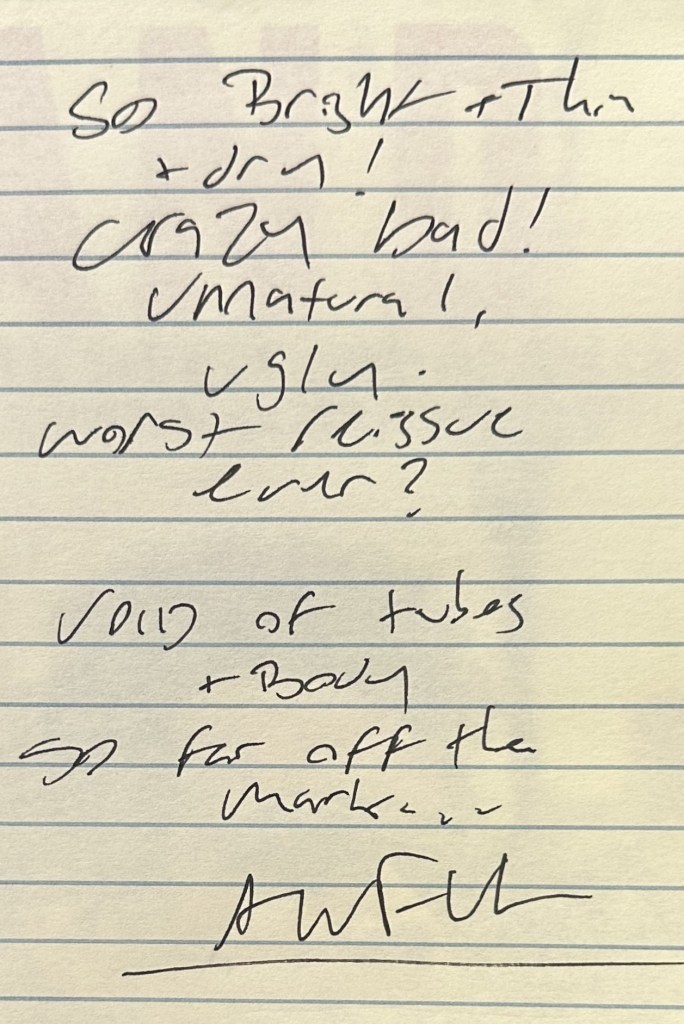
Our notes (for those who have trouble reading our scratch)

So bright and thin and dry.

Crazy bad!

Unnatural, ugly.

Worst reissue ever?

Void of tubes and body.

So far off the mark.

Awful.

A second opinion

Robert Brook reviewed this pressing a while back. He does his best to remain positive when choosing the words that he thinks will help the reader bette understand the experience of playing the Impex release of Legrand Jazz that we had loaned him. In the end he goes with the spoken word over the written one.

(more…)