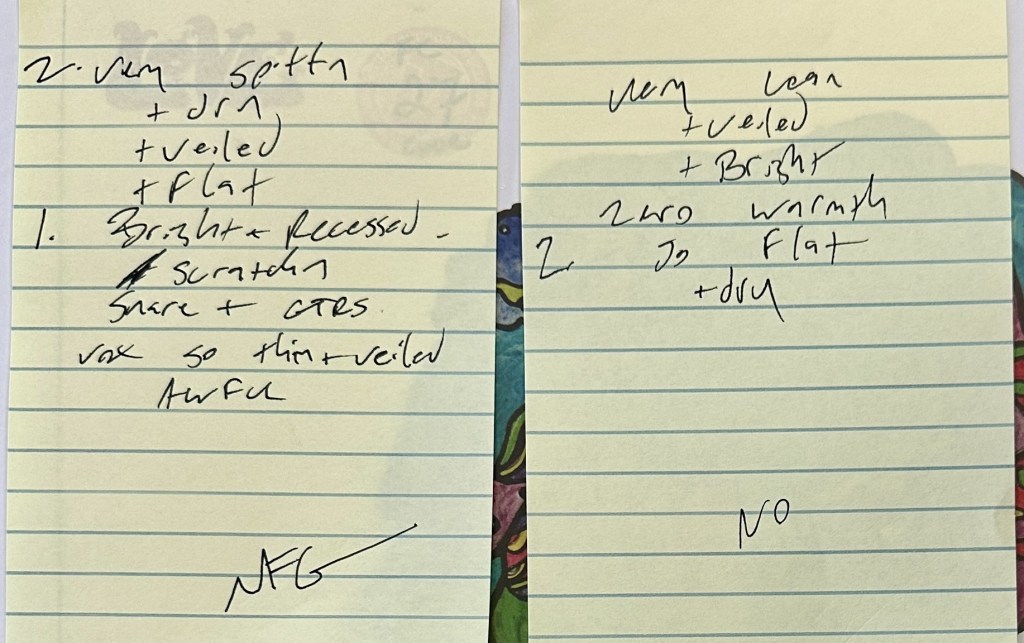
TAS List Commentaries

Commentaries about records on the TAS Super Disc list.

Time Further Out on Impex – You Could Do a Whole Lot Better

Hot Stamper Pressings of the Music of Dave Brubeck Available Now

The Impex pressing of this classic album was mastered by the late and formerly great George Marino at Sterling Sound. It was released in 2013. We did a big shootout for the album at the end of 2023 and somehow found a copy of the Impex to include.

(My guess is that we probably picked it up locally for cheap. We never pay good money for these pressings. We do these reviews as a public service, so keeping out costs down is baked in to the deal. Now that we’ve played it, we will trade it back to the store we bought it from for whatever they are willing to give us. We sure don’t have any use for it.)

Here it is 2025 and we are just now getting around to publishing the notes  for the Impex LP you see below.

We rarely put much effort into detailing the shortcomings of these Heavy Vinyl reissues. The people that buy them don’t care what we think, and, to be honest, probably cannot hear the sonic flaws we expose or they would long ago have given up buying such markedly inferior pressings, perhaps about the time Classic Records starting pressing their ersatz Living Stereo LPs in the mid-90s.

The fact that some of Classic’s pressing are still on the so-called TAS Super Disc list (renamed the TAS Super LP List for 2023), along with scores of other Heavy Vinyl duds, does not speak well for the magazine or its readers.

The typical audiophile record buyer can be forgiven for not finding much fault in the sound of this Impex pressing. It’s not awful the way so many of their releases are. But up against the real thing it leaves a lot to be desired, and what it lacks can be found in abundance on our admittedly-expensive Hot Stamper pressings.

In our world, the world of truly high-fidelity pressings, you get what you pay for, and if you ever feel otherwise, you get your money back, no questions asked.
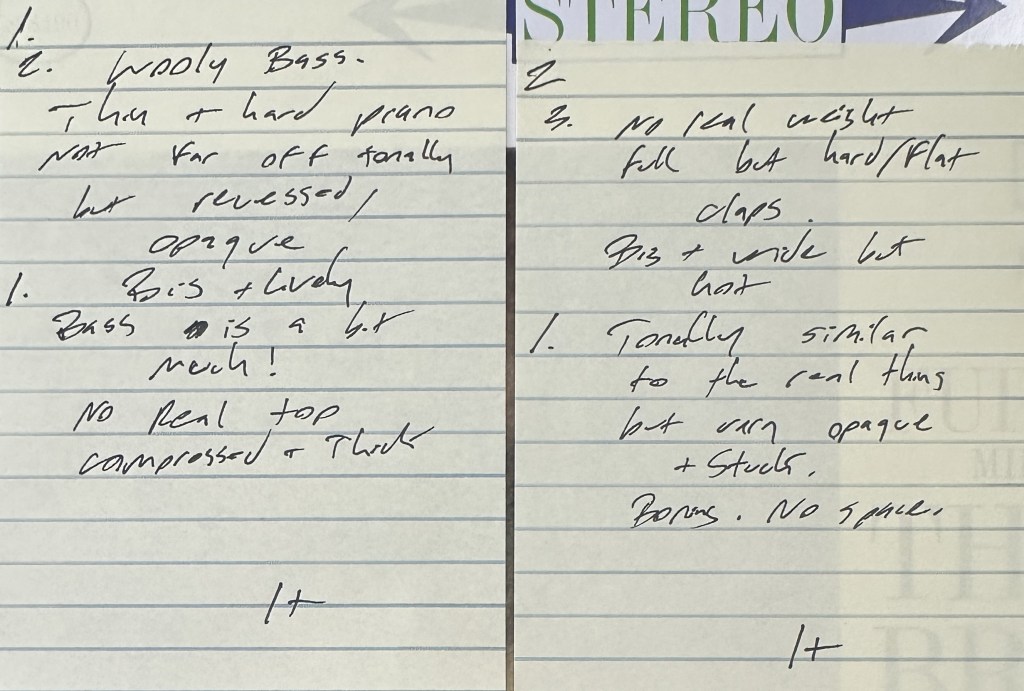
With grades of one plus on both sides, the sound was not good enough to compete with even the lowliest of our Hot Stamper pressings. Those must earn a grade of 1.5+ or better to make it to our site.

The notes for side one read:

Track two

  • Wooly bass
  • Thin and hard piano
  • Not far off tonally but recessed and opaque

Track one

  • Big and lively
  • Bass is a bit much!
  • No real top
  • Compressed and thick

The notes for side two read:

Track three

  • No real weight
  • Full but hard/flat handclaps
  • Big and wide but hot

Track one

  • Tonally similar to the real thing but very opaque and stuck (in the speakers)
  • Boring
  • No space

Reminds me in some ways of a George Marino-mastered title that we spent a great deal of time evaluating a few years back, this one.

Either way, it’s not terrible, but it’s not all that good either.

Any Six-Eye and probably any 360 Columbia label pressing (but probably not your average 70s Red Label LP —  we stopped buying them years ago) will be better sounding.

Noisier for sure, but clearly better sounding.

If you own this modern reissue and want to hear just how good the album can sound, we would be honored to make that happen.

(more…)

Heavy Vinyl Super Discs – “Nobody should have to listen to sound like that.”

More of the music of Sergei Rachmaninoff (1873-1943)

This entry links up a few of the commentaries I wrote as I went back through the Classic catalog, comparing their pressings to both originals and reissues.

We take to task Classic Records, The Absolute Sound, and Chesky, as you will see below.

This commentary was written in 2005, prompted at the time by a rave review in TAS for one of the new Speakers Corners Mercury reissues. I detested the sound of the first one I heard, and subsequent releases only confirmed that the mastering of the Mercury catalog for Speakers Corner was an abomination — an affront, in my none-too-humble opinion, to all right-thinking audiophiles.

As for my commentary, it should be obvious that these awful remastering labels have not gone out of business, but instead have prospered, making millions of dollars from audiophiles eager to lay down their hard earned money for one Heavy Vinyl pressing after another, often of the same title even.

When Harry Pearson — of all people! This is the guy who started the Living Stereo craze by putting those forgotten old records on the TAS list in the first place — gave a rave review to the Classic Records reissue of LSC 1806, I had to stand up (in print anyway) and say that the emperor clearly had removed all his clothing, if he ever had any to begin with. (And now he has a CD List? Ugh.)

This got me kicked out of TAS by the way, as Harry does not take criticism well. I make a lot of enemies in this business with my commentary and reviews, but I see no way to avoid the fallout for calling a spade a spade.

Is anybody insane enough to stand up for LSC 1806 today?

Considering that there is a die-hard contingent of people who still think Mobile Fidelity is the greatest label of all time, there may well be “audiophiles” with substandard audio equipment or weakened powers of observation and discrimination, or both (probably both, as the two go hand in hand), that still find the sound of that steely stringed Classic pressing somehow pleasing to the ear. Hey, anything is possible.

(more…)

These Are the Stampers to Avoid on The Doors’ Debut

Hot Stamper Pressings of the Music of The Doors Available Now

In our experience, the Gold Label stereo originals with 1B/1B stampers are terrible sounding.

With 1B stampers it’s bad enough to go into our hall of shame for vintage pressings.

(Bad sounding audiophile records, being so plentiful, especially these days, have their own hall of shame.)

No surprise there; it’s just another bad sounding original pressing that ended up doing poorly in one of our shootouts.

We’ve auditioned countless pressings like this one in the 37 years we’ve been in business — buying, cleaning and playing them by the thousands. This is how we find the best sounding vinyl pressings ever made.

Not the ones that should sound the best. The ones that actually do sound the best.

If you’re an audiophile looking for top quality sound on vintage vinyl, we’d be happy to send you the Hot Stamper pressing guaranteed to beat anything and everything you’ve heard, especially if you have any pressing marketed as suitable for an audiophile. Those, with very few exceptions, are the worst.

(more…)

Discovering Reversed Polarity on Music for Bang, Baaroom and Harp Was a Breakthrough

schorymusic

Percussion Recordings with Hot Stampers Available Now

Music for Bang Baaroom and Harp is yet another one of the pressings we’ve discovered with reversed polarity on some copies. This happened many years ago, and as you can see from the commentary we wrote back then, it came as quite a shock to us at the time.

Are audiophile reviewers or audiophiles in general listening critically to records like this?

I wonder; I could not find word one about any polarity issues with this title, and yet we’ve played four or five copies with reversed polarity on side two. How come nobody is hearing it, apart from us?

We leave you, dear reader, to answer that question for yourself.

This listing has the latest information on the stamper numbers to avoid.

More stamper and pressing information can be found here.

(more…)

This Sibelius Violin Concerto Was Big and Lush but…

Hot Stamper Pressings Featuring the Violin Available Now
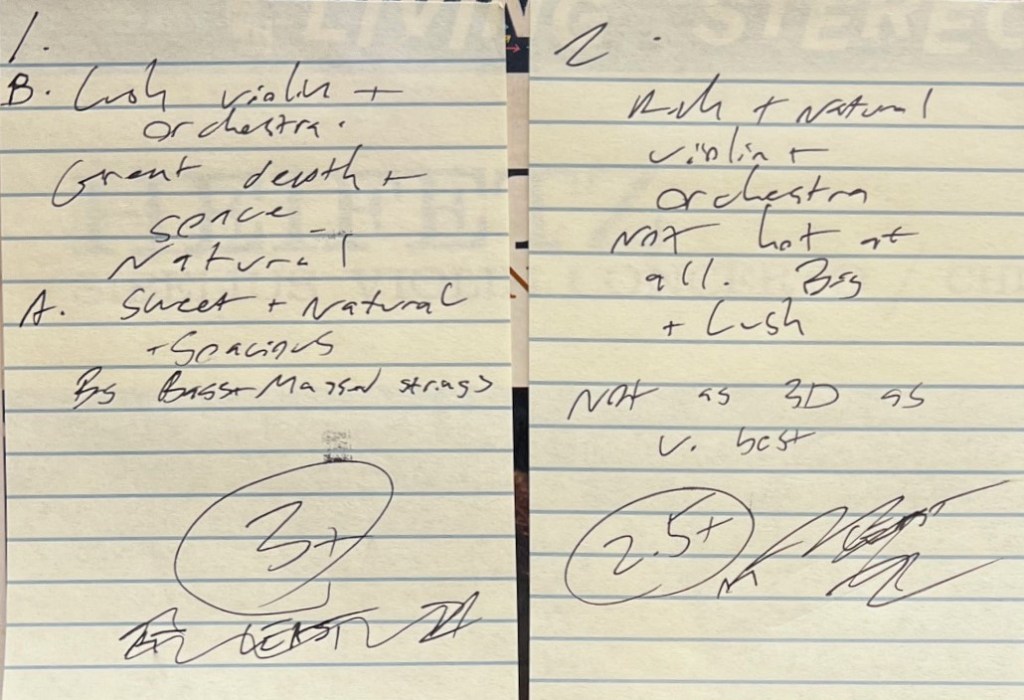
We love the way RCA recorded Heifetz back in the day, the day in this case being 1960. We usually have a good supply of vintage Heifetz titles on the site at all times. They often have our favorite performances, and the best copies, as the notes for the one below make clear, can have absolutely amazing sound.

As you can see from the notes, side one of a recent shootout winning copy was doing everything right.

However, we had a side two that was slightly better than the side two you see here. When we played the two best copies back to back, this side one came out on top, earning a grade of 3+, but the side two of another copy showed us there was even more three-dimensionality to be discovered in the recording than we thought. Consequently this side two was dropped a half grade to 2.5+.

This is exactly why we do shootouts. If you really want to be able to recognize subtle (and not so subtle!) differences between pressings, you must learn to do them too.

(more…)

The Absolute Sound Was Half Right about Desperado

Hot Stamper Pressings of the Music of The Eagles Available Now

As we all know, the best sound on an Eagles record is found on the first album. For whatever reason, that record was left off the TAS Super Disc list, even though we feel that sonically it beats this one by a bit, and musically it beats it by a mile.

On the TAS Super Disc list, Harry Pearson recommends the British SYL pressings for this album. SYL pressings can sound very good; we’ve previously found one that rated a Double Plus on both sides.

But our champions for both sides were domestic, both this time and last time.

Does that mean the best domestics will always beat the best SYL pressings? Not at all. Only critical listening can separate the better pressings from the more typical ones. After playing more than a dozen copies of this album this week, we can definitively tell you that there are FAR more mediocre copies of this record — both domestic and import — than truly exceptional ones.

The typical pressing of this album, whether the domestic or SYL, falls far short of belonging on a Super Disc List.

There are killer domestic copies AND killer SYL imports out there, and the only way to know which ones sound good is to collect ’em, clean ’em, and play ’em.

Remember: TAS List doesn’t guarantee great sound, but Better Records does.

If you don’t think a record sounds as good as we’ve stated, we’ll always happily take that record back and refund your money. Good luck getting ol’ Harry to send you a check when the TAS-approved pressings you pick up don’t deliver.

Want to find your own killer copy?

(more…)

Our Pines of Rome Shootout Was Twenty Years in the Making

Hot Stamper Pressings of Classical and Orchestral Music Available Now

We did a monster shootout for this music in 2021, one we had been planning for more than twenty years. On hand were quite a few copies of the Reiner on RCA; the Ansermet on London; the Maazel on Decca and London (the Decca being on the TAS List), the Kempe on Readers Digest, and quite a few others we felt had at least the potential to sound good.

Allow me to back up a bit.

When I first started paying attention to the TAS Super Disc list in the late-70s,  I read about the famous Pines of Rome RCA pressing with 1S stampers that was so dynamic that it had to be recut so that it would play on all turntables. I could never find one, and the Shaded Dogs and Red Seals that I did find never sounded all that good to me.

I know now that I did not have the stereo system back then (equipment, room, etc.) that could reproduce a recording of such difficulty.

In the 80s, the Mobile Fidelity pressing of the Pines of Rome came out, and it never sounded right to me either. This was true of all their classical releases, without exception. To me they epitomized the kind of bright, phony, “audiophile” sound commonly found in audio showrooms but rarely if ever heard in concert halls.

The Classic Records release from 1995 of the Reiner Pines was no better. That record was just too harsh sounding, with the shrill strings that Bernie Grundman was cutting on practically every title put out by that awful label.

I fell for some of them — I actually raved about Witches’ Brew on Classic back then, an endorsement that mortifies me to this day — but most of their classical records were junk that I was selling for cheap to the audiophiles who bought into the reviews written about them in the audio mags.

(more…)

We Were Way Off the Mark with this Rodrigo Recording in 2010

More of the music of Joaquín Rodrigo (1901-1999)

In 2010 we did a shootout for this title and thought we had found a good one. We wrote:

A good side one backed with a lovely side two! We shot out a stack of these recently and side two of this copy was one of the few sides that really impressed us. The sound is transparent and full of energy. Side one is pretty good but a bit crude in the louder passages.

This is a wonderful record. The performance here by the first family of guitar is legendary. More importantly, the music is delightful and belongs in any serious classical collection.

RFR-1 stampers. What the best originals like this one give you is immediacy. The attack of the guitar is more real.

Comparing this with the Golden Import shows you that some of the transients are smoothed over on that pressing.

If you’ve got the front end that can deal with the Mercury upper midrange and transient attack, the strings will sound textured and clear, not harsh or shrill. (A badly mastered version of this record would make your ears bleed.)

More importantly, this copy captures the sounds of the guitars perfectly. I doubt if anybody could do it as well as Mercury.

Recently we did the shootout again and came up with very different findings:

Now those same stampers are tubey and weighty, but the strings are too hot (bright and shrill) and flat (lacking richness).

We can sum up the sound of these stampers — on a different copy of course, something to keep in mind — in one word:

Ouch.

Please allow us to help you avoid making the same mistakes we did:

  • More records with bright sound can be found here
  • More records with flat sound can be found here

What’s So Golden About These Imports Anyway?

And by the way, we would never even bother to reserve the studio time to play a Golden Import pressing these days. I can count on one hand the titles that actually sound good to me and it’s just not worth the labor to find the one out of fifty that has hi-fidelity sound as we currently define it.

This commentary gets at our disappointed feelings about the label.

(more…)

Robert Fine Does It Again

Hot Stamper Pressings of Mercury Classical Recordings Available Now

The notes you see below are for our Shootout Winner, which earned our top grade of at least 3+ on side one with its Hard to Fault (HTF) sound.

If you are interested in a record with the kind of sound described below, please contact us and we will be happy to put you on the waiting list for the next killer copy that comes along and blows our minds.

As you may well imagine, shootouts for this album are exceedingly rare. For a sought-after TAS List title such as this, we’re lucky to be able to do one every five years or so. Until the next one comes around, please consider trying some of our other classical and orchestral Hot Stamper pressings.

Robert Fine’s recordings for Mercury are some of the most amazing sounding we have ever played. To see what might be available, please click here.

(more…)

What to Think When a New Version of Graceland Is Completely Unrecognizable?

Hot Stamper Pressings of the Music of Paul Simon Available Now

Where did this thick, dull, bloated, opaque turd come from?

Having played at least 50-75 copies of the album over the last ten years, I can honestly say I have never heard one that sounded like this new version (maybe some record club copy we picked up by accident did, can’t say it never happened).

Can that possibly be a good thing?

Well, in favor of that proposition, I guess you could say it sounds less like a CD now.

On the other side of the ledger, it now sounds a great deal more like a bad LP.

We listen to piles of pressings of Graceland regularly. We know what the album generally sounds like, the range from bad to good, and we know what qualities the very best copies must have in order to win one of our shootouts.

Above all the one thing Graceland has going for it sonically is CLARITY. It can be open and spacious, tonally correct, with punchy, tight bass and present, breathy vocals. The best of the best copies have all these qualities, but the one quality any good copy must have is clarity, because that’s what’s good about the sound of the record. Without clarity the music doesn’t even work.

The new version has been “fixed.” It got rid of all that pesky grit and grain and CD-like sound from the original digital mix by simply equalizing them away.

Cut the top, cut the upper mids, boost the lower mids and upper bass and voila – now it’s what Graceland would have sounded like had it been all analog from the start, AAA baby!

Or at least analog for those who don’t know what good analog sounds like.

But it never was all analog, and trying to make it sound that way just ruins the one quality that it actually had going for it — clarity.

VTA

You can adjust your VTA and other table settings until you’re blue in the face, you’ll never get this pressing to sound right, and you’ll certainly never get it to sound very much like any Sterling original pressing I’ve ever heard.

The digital spit and grit is still there, under the darker EQ. And now it’s even worse — Simon’s voice has a thick, dull blanket over it, but you can still hear the spit underneath it.

You could probably take the CD and equalize it to sound like this record. But what would be the point?

The Bright Side

Well, perhaps there is a point to this equalization madness.

The CD already exists. It has a sound.

The original record has a sound too, and it’s a fairly common LP in the used bins. You could buy two or three for not that much money and try to find one you like better than the vinyl version you probably already own.

(more…)