Record Labels with Shortcomings

Classic Records 45 RPM Recut – This Is Your Idea of a Great Firebird?

Hot Stamper Pressings of the Music of Igor Stravinsky Available Now

Many years ago, a customer alerted me to a review Wayne Garcia wrote about various VPI platters and the rim drive, and this is what I wrote back to him:

Steve, after starting to read Wayne’s take on the platters, I came across this:

That mind-blowing epiphany that I hadn’t quite reached with the Rim Drive/Super Platter happened within seconds after I lowered the stylus onto the “Infernal Dance” episode of Stravinsky’s Firebird (45 rpm single-sided Classic Records reissue of the incomparable Dorati/LSO Mercury Living Presence recording).

That is one of my half-dozen or so favorite orchestral recordings, and I have played it countless times.

This is why I have so little faith in reviewers. I played that very record not two weeks ago (04/2010) against a good original and the recut was at best passable in comparison. If a reviewer cannot hear such an obvious difference in quality, why believe anything he has to say?

The reason we say that no reviewer can be trusted is that you cannot find a reviewer who does not say good things about demonstrably mediocre and even just plain awful records. It’s the only real evidence we have for their credibility, and the evidence is almost always damning.

I want a reviewer who knows better than to play such an underwhelming pressing and then waste my time telling me about it. He should tell us what a good record sounds like with this equipment mod. Then I might give more credence to what he has to say.

Reviewer malpractice? We’ve been writing about it for more than 25 years.

P.S.

This is one of the Classic Records titles on Harry Pearson’s TAS List of Super Discs(!)

P.P.S.

Allow me to quote a writer with his own website devoted to explaining and judging classical recordings of all kinds. His initials are A.S. for those of you who have been to his site.

Classic Records Reissues (both 33 and 45 RPM) – These are, by far, the best sounding Mercury pressings. Unfortunately, only six records were ever released by Classic. Three of them (Ravel, Prokofiev and Stravinsky) are among the very finest sounding records ever made by anyone. Every audiophile (with a turntable) should have these “big three”.

Obviously we could not disagree more. I’ve played all six of the Classic Mercury’s. The Chabrier, Ravel and Prokofiev titles are actually even worse than the Stravinsky we reviewed.

This same reviewer raved about a record we thought had godawful sound, Romantic Russia on MoFi, a label that never met an orchestral string section it didn’t think needed brightening.

Find me a Mobile Fidelity classical record with that little SR/2 in the dead wax that does not have bright string tone. I have yet to hear one.

What is it with audiophile record reviewers? They seem to be taken in by the most unnatural sounding pressings. The world is full of wonderful vintage pressings that have no such problems. If you are an audiophile who feels himself qualified to write about records, shouldn’t you at least be able to hear the difference between a phony audiophile pressing and the vintage pressings it supposedly improved?

(more…)

An Insult to Aaron Copland on Reference Records

Hot Stamper Pressings of Orchestral Music Available Now

Yet another Reference Record we’ve reviewed and found wanting.

In all the years I was selling audiophile records, one of the labels whose appeal made no sense to me whatsoever (along with their long-forgotten TAS list brethren, American Gramaphone and Telarc) was Reference Records.

Back then, when I would hear one of their orchestral or classical recordings, I was always left thinking, “Why do audiophiles like these records?”

I was confused, because at that time, back in the 80s, I had simply not developed the listening skills that today make it so easy to recognize the faults of their recordings.

I made the mistake of thinking that other audiophiles with more advanced equipment and more refined listening skills must be hearing something I was not.

I had trouble putting my finger on what I didn’t like about them, but now, having worked full time (and then some!) for more than twenty years to develop better critical listening skills, the shortcomings of their records, or, to be more accurate, the shortcomings of this particular copy of this particular title, took no time at all to work out.

My transcribed notes for RR-22:

  • Lean tonality
  • No real weight
  • No Tubey Magic
  • Blurry imaging when loud
  • No real depth
  • Bright tonal balance

Is this the sound you are looking for in an audiophile record?

Shouldn’t you be looking for audiophile quality sound?

Well, you sure won’t find it here.

On our current playback system, this Reference Record is nothing but a joke, a joke played on a much-too-credulous audiophile public by the ridiculously inept and misguided engineers and producers who worked for Reference Records.

This is a reference for something? For what?

As I wrote about another one of their awful releases, if this is your idea of a reference record, you are in real trouble.

It would be hard to imagine that anyone who has ever heard a good vintage classical recording — here are some of our favorites — could ever confuse this piece of audiophile trash with actual hi-fidelity orchestral sound.

(more…)

Sounds Unheard Of! – Another Analogue Productions Disaster

Hot Stamper Pressings Featuring Shelly Manne Available Now

Remember the 90s Acoustic Sounds Analog Revival series mastered by Stan Ricker? This was one of the titles they did, and completely ruined of course, as was the case with all the titles from that series that we played.

Ricker boosted the hell out of the top end, as is his wont, so all the percussion had the phony MoFi exaggerated sizzle and tizziness that we dislike so much around here at Better Records.

Yes, it’s the very same phony top that many audiophiles do not seem bothered by to this day. 

The whole series was an audio disaster, but oddly enough, I cannot remember reading a single word of criticism in the audiophile press discussing the shortcomings of that series of (badly) Half-Speed mastered LPs — outside of my own reviews of course. Has anything in audio really changed?

If I were to try to “reverse engineer” the sound of a system that could play this record and hide its many faults, I would look for a system that was thick, dark and overly smooth, with no real extension on the top end to speak of. Stan’s 10k boost — along with other the colorations he favors — is just what the doctor ordered for such a system.

I know that sound. I had a system in the 90s with many of the same shortcomings, but of course I didn’t know any of that.

I didn’t know what I didn’t know back then.

(more…)

Tchaikovsky on Classic Records and the TAS List

Hot Stamper Pressings of the Music of Tchaikovsky Available Now

We used to like the Classic Records pressing of LSC 2241 a lot more than we do now, a case of live and learn.

Our tube system from the 90s was very different from the one we are using now.

That system was noticeably darker and by all accounts far less revealing when we had auditioned the Classic sometime in the 90s, and those two qualities did most of the heavy lifting needed to disguise its shortcomings. We mistakenly noted:

HP put the Shaded Dog pressing (the only way it comes; there is no RCA reissue to my knowledge) on his TAS List of Super Discs, and with good reason: it’s wonderful!

The rest of our commentary still holds up though:

But for some reason he also put the Classic Records Heavy Vinyl reissue on the list, and that record’s not even passable, let alone wonderful. It’s far too lean and modern sounding, and no original Living Stereo record would ever sound that way, thank goodness. 

(more…)

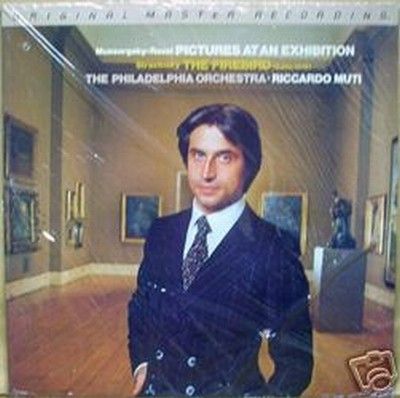
MoFi’s Pictures at an Exhibition Is as Wrong as Wrong Can Be

moussmofiHot Stamper Pressings of the Music of Mussorgsky Available Now

If you like orchestral spectaculars, have we got the record for you.

It’s the same recording of the works, but the one you want is on the real EMI label and pressed on UK import vinyl, not this awful Half-Speed recut from Japan.

The record you see pictured is awful sounding, a true hall of shame pressing.

And why are the colors of the album jacket so washed out? Compare their cover to the real thing below. As we often find ourselves asking after reviewing one of these MoFi records: What were they thinking?

The MoFi mastering of Pictures at an Exhibition and The Firebird here are a bad joke played on credulous audiophiles. And yes, I bought them both back when they came out. I was as credulous as everybody else buying these so-called superior pressings.

All that phony boosted top end makes the strings sound funny and causes mischief in virtually every other part of the orchestra as well. Not surprisingly, those boosted highs are missing from the real EMIs.

These appear to be the unbearably bright strings that Stan Ricker favors — why, we have no idea.

The proof? Find me a Mobile Fidelity classical record with that little SR/2 in the dead wax that does not have bright string tone. I have yet to hear one.

The last time I played a copy of the MFSL I found the sound so hi-fi-ish I couldn’t stand to be in the room with it for more than a minute. Of course the bass is jello as well.

The EMI with the right stampers is worlds better.

(Warning: The domestic Angel regular version and the 45 are both awful.)

MoFi had a bad habit of making bright classical records. (More reviews here.) I suppose you could say they had a bad habit of making bright records in general. A few are dull, some are just right, but most of them are bright in one way or another.

(more…)

Time Further Out on Impex – You Could Do a Whole Lot Better

Hot Stamper Pressings of the Music of Dave Brubeck Available Now

The Impex pressing of this classic album was mastered by the late and formerly great George Marino at Sterling Sound. It was released in 2013. We did a big shootout for the album at the end of 2023 and somehow found a copy of the Impex to include.

(My guess is that we probably picked it up locally for cheap. We never pay good money for these pressings. We do these reviews as a public service, so keeping out costs down is baked in to the deal. Now that we’ve played it, we will trade it back to the store we bought it from for whatever they are willing to give us. We sure don’t have any use for it.)

Here it is 2025 and we are just now getting around to publishing the notes  for the Impex LP you see below.

We rarely put much effort into detailing the shortcomings of these Heavy Vinyl reissues. The people that buy them don’t care what we think, and, to be honest, probably cannot hear the sonic flaws we expose or they would long ago have given up buying such markedly inferior pressings, perhaps about the time Classic Records starting pressing their ersatz Living Stereo LPs in the mid-90s.

The fact that some of Classic’s pressing are still on the so-called TAS Super Disc list (renamed the TAS Super LP List for 2023), along with scores of other Heavy Vinyl duds, does not speak well for the magazine or its readers.

The typical audiophile record buyer can be forgiven for not finding much fault in the sound of this Impex pressing. It’s not awful the way so many of their releases are. But up against the real thing it leaves a lot to be desired, and what it lacks can be found in abundance on our admittedly-expensive Hot Stamper pressings.

In our world, the world of truly high-fidelity pressings, you get what you pay for, and if you ever feel otherwise, you get your money back, no questions asked.

With grades of one plus on both sides, the sound was not good enough to compete with even the lowliest of our Hot Stamper pressings. Those must earn a grade of 1.5+ or better to make it to our site.

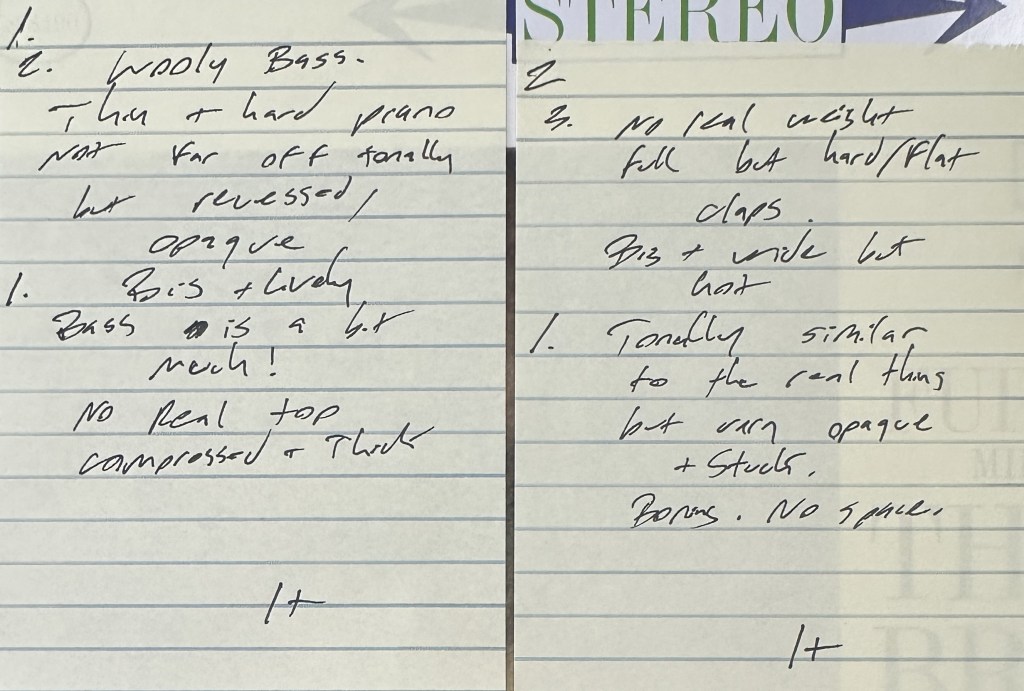
The notes for side one read:

Track two

  • Wooly bass
  • Thin and hard piano
  • Not far off tonally but recessed and opaque

Track one

  • Big and lively
  • Bass is a bit much!
  • No real top
  • Compressed and thick

The notes for side two read:

Track three

  • No real weight
  • Full but hard/flat handclaps
  • Big and wide but hot

Track one

  • Tonally similar to the real thing but very opaque and stuck (in the speakers)
  • Boring
  • No space

Reminds me in some ways of a George Marino-mastered title that we spent a great deal of time evaluating a few years back, this one.

Either way, it’s not terrible, but it’s not all that good either.

Any Six-Eye and probably any 360 Columbia label pressing (but probably not your average 70s Red Label LP —  we stopped buying them years ago) will be better sounding.

Noisier for sure, but clearly better sounding.

If you own this modern reissue and want to hear just how good the album can sound, we would be honored to make that happen.

(more…)

Heavy Vinyl Super Discs – “Nobody should have to listen to sound like that.”

More of the music of Sergei Rachmaninoff (1873-1943)

This entry links up a few of the commentaries I wrote as I went back through the Classic catalog, comparing their pressings to both originals and reissues.

We take to task Classic Records, The Absolute Sound, and Chesky, as you will see below.

This commentary was written in 2005, prompted at the time by a rave review in TAS for one of the new Speakers Corners Mercury reissues. I detested the sound of the first one I heard, and subsequent releases only confirmed that the mastering of the Mercury catalog for Speakers Corner was an abomination — an affront, in my none-too-humble opinion, to all right-thinking audiophiles.

As for my commentary, it should be obvious that these awful remastering labels have not gone out of business, but instead have prospered, making millions of dollars from audiophiles eager to lay down their hard earned money for one Heavy Vinyl pressing after another, often of the same title even.

When Harry Pearson — of all people! This is the guy who started the Living Stereo craze by putting those forgotten old records on the TAS list in the first place — gave a rave review to the Classic Records reissue of LSC 1806, I had to stand up (in print anyway) and say that the emperor clearly had removed all his clothing, if he ever had any to begin with. (And now he has a CD List? Ugh.)

This got me kicked out of TAS by the way, as Harry does not take criticism well. I make a lot of enemies in this business with my commentary and reviews, but I see no way to avoid the fallout for calling a spade a spade.

Is anybody insane enough to stand up for LSC 1806 today?

Considering that there is a die-hard contingent of people who still think Mobile Fidelity is the greatest label of all time, there may well be “audiophiles” with substandard audio equipment or weakened powers of observation and discrimination, or both (probably both, as the two go hand in hand), that still find the sound of that steely stringed Classic pressing somehow pleasing to the ear. Hey, anything is possible.

(more…)

Letter of the Week – “Much more vibrance and tonal nuances making for a much more engaging listening experience.”

Hot Stamper Pressings of the Music of John Coltrane Available Now

One of our good customers had this to say about a copy of Lush Life he purchased not long ago.

Hi Tom,

Even a 2+ [Super Hot] was enough to eliminate the 2021 Concord/AP [Analogue Productions] 33 RPM KPG [Kevin Gray] LP on 180 gram which was my copy until this Hot Stamper.

I listened to side 1 first. Well shit … it sounds clean, it sounds nice, a bit flat but that’s how I thought it was supposed to be, and sounds quite audiophile.

Simply put, the BR copy truly brings the music to life.

Much more vibrance and tonal nuances making for a much more engaging listening experience.

All I know is the BR LP destroyed the above to smithereens.

As always, many thanks!

Michel

Dear Michel,

You are more than welcome.  When you mention that you thought the album sounded clean, nice, a bit flat, you were in the same boat as all the other audiophiles who own these modern remasterings who have been putting up with their mediocre sound. Why?

Because they thought the recordings were at fault.

After all, Chad must know what he’s doing, he’s the biggest guy in the business.

(more…)

Pat Metheny – American Garage

More Pat Metheny

More Jazz Fusion

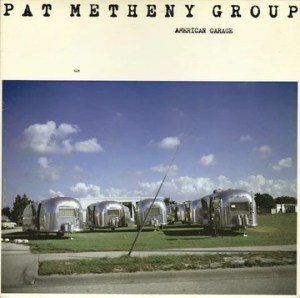
  • You’ll find superb Double Plus (A++) sound or close to it throughout this original ECM pressing – exceptionally quiet vinyl too
  • This side two is open and transparent throughout, with wonderfully full-bodied guitars, solid bass and huge amounts of swingin’ jazz energy, and side one is not far behind in all those areas
  • 4 1/2 stars: “The arrangements are more structured, the playing often more intense and searching, with a more pronounced rock influence. [T]his is…high-quality jazz-rock for its time.”

(more…)

The Timekeepers Is Probably Bad on Heavy Vinyl, But Who Can Be Bothered to Find Out?

More of the Music of Count Basie

Analogue Productions remastered this longtime favorite of ours, The Timekeepers, on 45 RPM vinyl. Considering their dismal track record — an unbroken string of failures, scoring not a single winner that I am aware of — I’m guessing the Hot Stamper we offered here would have blown the doors off their version, as well as any other Basie album they have done or ever will do on vinyl.

A good customer emailed us back in 2012 with the quote below, authenticating our rather negative disposition at the time concerning the AP releases from the ’90s:

Recently I unearthed a pile of “The Tracking Angle” magazines, MF’s short-lived venture in publishing, that I’d kept all these years (this may damn me in your eyes, but at the time he was one of the more animated [animated but consistently wrong, not a good tradeoff] writers on audio). I dutifully reread the very first issue (Jan. 1995) for the first time in many years, even a review of “Tea for the Tillerman,”… I was flabbergasted to come across this:

So what does Mr. “Better Records” think? In a newsletter where he says a digital remastered OJC vinyl title sounds better than Acoustic Sounds’ all analogue version and says the whole lot of them “suck” and “simply cannot sound good on a good stereo,” he calls this Cat Stevens reissue “Fabulous. Very dynamic with plenty of presence in the midrange, unlike the ‘audiophile’ records of today.”

We proudly stand behind every word. If the comparable OJC title sounds better than the remastered one Acoustic Sounds is peddling, then it sounds better, digital remastering or no digital remastering.

We don’t pay any attention to who makes the records, how they make them or why they make them.

We just play them and let the chips fall will they may. Mr. Fremer thinks that making records the “right” way should result in better sounding records, but we have found precious little evidence to back up that theory, and volumes of evidence which utterly refute it.

Yes, those Analogue Productions records sucked, they continue to suck, and they will always suck. The “audiophile” records of that day did lack presence, and the passage of time is not going to change that fact.

Play practically any Reference, Chesky or Classic title from 1995 to the present day and listen for the veiled midrange, the opacity, the smeary transients, and the generally constricted, compressed, lifeless quality of its sound, a sound that has been boring us to tears for decades as well as fundamentally undermining the very rationale for the expense and hassle of analog itself in the modern digital age, a much more serious charge.

Ask yourself, where are those records now?

Piled on the ash heap of analog history, that’s where (apologies to Leon Trotsky). Nobody writes about them anymore, and it’s not because they were so good, no matter what any audiophile-type reviewer thought or may think about them.

As long as Analogue Productions is around, at least no one can say that Mobile Fidelity makes the worst sounding audiophile records in the world. They are certainly some of the worst, but not so hopeless that they have never made a single good sounding record, which is the title that Chad Kassem holds.

To the best of our knowledge. Obviously we have only played a small fraction of the records released on his godawful label. In our defense let me say that a small fraction was all we could take.