Half-Speed Mediocrities

Boston Hot Stamper Testimonial – Shooting Out the Big Three

Hot Stamper Pressings of the Music of Boston Available Now

This letter probably came in around 2010 or so, early days in the world of Hot Stampers, which explains the price for the top copy being $250.


This week’s letter comes from our good customer Roger, who did a little shootout of his own among three very different sounding pressings: two Half-Speeds, one by MoFi and one by CBS, probably the two most popular pressings among audiophiles, and our very own Hot Stamper LP.

Here are his findings. Keep in mind that Roger bought a copy priced at $125, half the price of the best copy in our shootout.

Hi Tom,

I got your Boston hot stamper today and enjoyed comparing it to MFSL and CBS half-speed versions in a shootout. I had long since given up on listening to this record since it became part of a communist ploy to brainwash us by playing Boston repeatedly on the radio until we would give up any information they desired. “Deep Purple Lite” was what my college buddies and I used to derisively call it. Now I only wish we had this type of music still around. So I had fun reliving my college days and listening to this LP.

For a pop recording, it is a pretty good recording soundwise, and all 3 pressings were indeed good, if not interesting. I tried the CBS half-speed first, and it was tonally lean with good speed and detail, and bass was extended and quick. However, its Achilles heel was that it had too much energy on top and excessive brightness, something that couldn’t hide from my speakers’ ion tweeters.

Roger, you seem to be using the phrase “tonally lean” unpejoratively (if I can make up such a word), whereas for us here at Better Records, that is the kiss of death for Half-Speeds, and in fact Audiophile Records of All Kinds. Lack of weight down below, lack of Whomp Factor, is the main reason half-speed mastered records are so consistently and ridiculously bad. If not bad, certainly wrong. You can be very sure that Boston would not want, nor would they put up with, that kind of anemic sound for a minute.

The CBS is cut clean from a good tape, so it easily beats the bad domestic pressings, of which there are many. But it can’t rock. What good is a Boston record that doesn’t rock? It’s a contradiction in terms; the band, as well as their debut album, have no other reason to exist.

So the MFSL was somewhat of a relief in that regard, being more sweet and rolled-off on top. However, it sounded bland, blah, slow and murky by comparison. It was still OK sonically with a fuller midband, but didn’t have the midrange energy or dynamics of the CBS and it just seemed slow and plodding, no other way to put it. Bass on the MFSL copy was weightier but more midbass than the quick and extended bass on the CBS.

(more…)

With The Beatles on Mobile Fidelity

Sonic Grade: C+

The MoFi pressing of With the Beatles has so many problems it would take an hour to describe them all. Suffice it to say, it’s thinner and brighter, with voices that are grittier and grainier. The overall effect is the sinking feeling that you are listening to a cheap reissue and not the real thing. Don’t the Beatles sound better than this? To be fair, some tracks are okay, others a disaster.

If you own the MoFi, play it. Listen to it carefully. Make notes of which songs sound better than others and why. That’s how we spend our days, evaluating the relative merits of various pressings, and it’s that and that alone that has given us the critical listening skills necessary to recognize and appreciate the differences among the records we play.

One of the biggest problems with the average Parlophone copy is just the reverse of the MOFI. They tend to have rolled off highs, which emphasizes the harshness in the upper midrange and causes a loss of transparency. (The best Hot Stamper copies are of course as smooth, sweet, and transparent as they come.) Even with those shortcomings though, I would still rather listen to a typical Parlophone pressing. I wouldn’t be frustrated by the sound of somebody fooling with the EQ and screwing it up.  (more…)

I Was Wrong about a Half-Speed Mastered Record – Not for the First Time, But I Hope for the Last

dixiedregsdd

Hot Stamper Pressings of Jazz Rock Fusion Albums Available Now

A classic case of live and learn.

I’d always preferred the famously rare Half-Speed to the domestic copies I had auditioned back in the day, the day being the 80s and 90s. That’s all changed now of course.

Now, with changes to the stereo and better cleaning techniques and all the rest, that Half-Speed’s weaknesses are hard to ignore.

Where is the rock ’em, sock ’em bottom end that the best originals have?

Gone without a trace.

Yes, the smeary, veiled quality of the typical original pressing is gone too, which is why I used to like the DD Labs version better. It’s simply another case of a reasonably good Half-Speed beating a bad domestic pressing, and in turn being beaten (soundly) by The Real Thing, the kind of record we like to call a Hot Stamper.

(more…)

Please Please Me on MoFi – Another Disgracefully Spitty Half-Speed

Hot Stamper Pressings of the Music of The Beatles Available Now

Sonic Grade: C

If you own the Mobile Fidelity LP, do yourself a favor and buy one of our Hot Stamper pressings. (Actually any good British import pressing will do.)

What’s the first thing you will notice other than correct tonality, better bass and a lot more “life” overall?

No spit!

As we’ve commented elsewhere, because of the wacky cutting system they used, Mobile Fidelity pressings are full of sibilance. 

As I was playing a British pressing of this record many years ago, maybe by about the fifth or sixth song it occurred to me that I hadn’t been hearing the spit that I was used to from my MoFi LP. You don’t notice it when it’s not there.

But your MoFi sure has a bad case of spitty vocals. If you never noticed them before, you will now.

We discuss the sibilance problems of MoFi records all the time. Have you ever read Word One about this problem elsewhere? Of course not.

Audiophiles and audiophile reviewers just seem to put up with these problems, or ignore them, or — even worse — fail to recognize them at all.

Play around with your table setup for a few hours and you will no doubt be able to reduce the severity of the sibilance on your favorite test and demo discs. All your other records will thank you for it too.

Especially your Beatles records. Many Beatles pressings are spitty, and the MoFi Beatles pressings are REALLY spitty. Of course MoFi fans never seem to notice this fact. Critical listening skills and a collection of MoFi pressings are rarely if ever found together. For reasons that should be obvious to anyone spending time on this site, you either have one or the other.

(more…)

We Review the MoFi Pressing of Let It Be

Hot Stamper Pressings of the Music of The Beatles Available Now

This review was probably written about fifteen years ago, so we can’t say we would agree with the grade we awarded the album at the time.

Sonic Grade: B or B-

Although I haven’t played my copy in quite a while — it might have been as far back as 2007 or 2008 that I last listened to it if memory serves — I recall that it struck me as one of their better titles.

All things considered, it’s actually pretty good, assuming your copy sounds like mine (an assumption we really can’t make of course — no two records sound the same — but for the purposes of this review we’re going to assume it anyway). I would give it a “B” or “B-“.

It can’t hold a candle to the real thing, but at least MoFi didn’t ruin it like they did with so many of the other Beatles albums, especially this ridiculously phony, bright and compressed one.

(more…)

Mobile Fidelity – The Ultimate Pretender

Hot Stamper Pressings of the Music of Jackson Browne Available Now
During the recording of The Pretender, a newly invented piece of electronics was used called the Aphex Aural Exciter. It harmonically “richened” the sound in interesting and, most would say, pleasing ways.

It was designed to have a euphonic effect, and it succeeded in that aim, beguiling its listeners for a while, especially those at the lo- and mid-fi level, the obvious if unspoken target market these days (although the thought of admitting such a thing would surely cause the sky to fall) for the Heavy Vinyl reissue.

The Aphex was clearly creating distortions, but they were the kinds of distortions that many folks of the audiophile persuasion seemed to like. Which is the very definition of euphonic colorations.

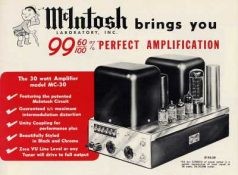
The poster boy for euphonic colorations is our friend here, the famous Mac 30, an amp that came on the market in 1954 and one that still has adherents to this day, some of them quite famous. I had a pair and learned some lessons — as I did with every piece of equipment I owned — in the time I spent listening to them.

If you like old school tubey colorations, the kind we’ve found to be antithetical to the proper reproduction of music in the home, this is the amp for you.

How Much Is Too Much of a Good Thing?

When you play the MoFi pressing of The Pretender, it just seems to have more of that Aphex Aural Excitement.

Here’s the $64,000 question: is MoFi’s supposedly superior mastering technology revealing more of the “aphexy” sound already present on the tapes, or is it adding its own distortions that mimic the Aphex distortions?

It seems to me that in the case of The Pretender it’s clearly the latter.

Deja Vu on MoFi has that same too rich, too smooth sound. Where on earth did that extra richness and smoothness come from? No vintage pressings we have ever played has ever had that sound.

Obviously MoFi preferred The Pretender to sound the way they preferred it to sound, or perhaps it’s more accurate to say that they wanted it to sound the way they thought their customers would prefer it to sound.

Or maybe they have no idea what they’re doing and never did. That strikes me as the most likely explanation for a label that should have gone out of business a long time ago.

Is it just EQ? I’m not expert enough to know, but I do know this: Hot Stamper pressings of The Pretender have much more transparency and clarity, while at the same time offering a good balance of of sweetness and smoothness, with less of that thick, blurry, overly-rich quality that you find on the MoFi pressings of the album.

More on the Aphex

Owen Penglis on the Happymag.tv site describes the Aphex Aural effect this way:

The Aural Exciter brought presence, intelligibility, ‘air’ without hiss, and renewed clarity through its arbitrary process of adding phase shift, harmonics, compression, and intermodular distortion.

(more…)

Sgt. Pepper’s and Mistaken Audiophile Thinking (Hint: the UHQR Is Wrong)

Hot Stamper Pressings of Sgt. Peppers Available Now

This commentary was probably written between 2005 when we did our first shootout for the album and 2008, by which time it would have been a regular feature on the site. 

We charge hundreds of dollars for a Hot Stamper Sgt. Pepper, which is a lot to pay for a record. But consider this: the UHQR typically sells for a great deal more than the price we charge and doesn’t sound remotely as good. 

Of course the people that buy UHQRs would never find themselves in a position to recognize how much better one of our Hot Stampers sounds in a head to head shootout with their precious and oh-so-collectible UHQR.

They assume that they’ve already purchased the Ultimate Pressing and see no reason to try another.

I was guilty of the same mistaken audiophile thinking myself in 1982. I remember buying the UHQR of Sgt. Pepper and thinking how amazing it sounded and how lucky I was to have the world’s best version of Sgt. Pepper.

If I were to play that record now it most likely would be positively painful. All I would hear would be the famous MoFi 10K Boost on the top end (the one that MoFi lovers never seem to notice), and the flabby Half-Speed mastered bass (ditto).

Having heard really good copies of Sgt. Pepper, like the wonderful Hot Stampers we put on the site from time to time, now the MoFi UHQR sounds so phony to me that I wouldn’t be able to sit through it with a gun to my head.


UPDATE 2025

If you are still buying these remastered pressings, making the same mistakes that I was making before I knew better, take the advice of some of our customers and stop throwing your money away on Heavy Vinyl and Half-Speed mastered LPs.

At the very least let us send you a Hot Stamper pressing — of any album you choose — that can show you what is lacking on your copy of the album.

And if for some reason you disagree with us that our record sounds better than yours, we will happily give you all your money back and wish you the very best.

To learn more about records that sound dramatically better than any Half-Speed mastered title ever made (with one exception, John Klemmer’s Touch), please go to our Half-Speed mastering main page .

(more…)

Driving My Car into a Ditch

Hot Stamper Pressings of the Music of The Beatles Available Now

Mobile Fidelity made a mess of Drive My Car on their Half-Speed mastered release of Rubber Soul in 1982.

Perhaps it’s more accurate to say Stan Ricker, MoFi’s go-to mastering engineer, did.

He equalized out far too much upper midrange and top end.

What fuels the energy of the song are the cow bell, the drums and other percussion. Instead of a scalpel, Mobile Fidelity took a hatchet to this slightly bright track, leaving a dull, lifeless, boring mess.

Some Parlophone copies may be a little bright and lack bass, but at least they manage to convey the musical momentum of the song.

Even the purple label Capitol reissues can be quite good. A bit harsher and spittier, yes, but in spite of these shortcomings they communicate the music, which ought to count for something.

As much as I might like some of the MoFi Beatles records [not so much anymore], and even what MoFi did with some of the other tracks on Rubber Soul, they sure sucked the life out of Drive My Car.

We all remember how much fun that song was when it would come on the radio. Playing it on a very high quality stereo should make it more fun, not less.

If you’ve got a Rubber Soul with a Drive My Car that’s no fun, it’s time to get another one.

By The Way

The best $250 — to the penny! — I ever spent on records is the price I paid for my brand new, still-in-the-shipping-carton MoFi Beatles Box. I ordered it in 1982 when I first learned of it, and it finally came the next year. I already owned all The Beatles albums MoFi had done to date, including the UHQR of Sgt. Pepper, which, like a fool, I got rid of once the set came out.

(more…)

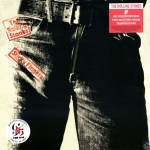
How Does the Abbey Road Half-Speed of Sticky Fingers Sound?

Hot Stamper Pressings of the Music of The Rolling Stones Available Now

A listing for an early domestic Hot Stamper pressing for Sticky Fingers will typically be introduced this way:

If you have never heard one of our Hot Stamper pressings of the album, you (probably) cannot begin to appreciate just how amazingly well-recorded an album it is.

It is truly a landmark Glyn Johns / Andy Johns / Chris Kimsey recording, as well as our favorite by the Stones, a Top 100 Title (of course) and one that earned 5 stars on Allmusic (ditto).

5 stars: “With its offhand mixture of decadence, roots music, and outright malevolence, Sticky Fingers set the tone for the rest of the decade for the Stones.”

However, we found the new Half-Speed Heavy Vinyl pressing mastered by Miles Showell at Abbey Road to be seriously lacking in “outright malevolence.” It’s so tame that even at high volume it would be unlikely to disturb the most innocuous afternoon tea in the back garden of a country estate.

Brown Sugar is:

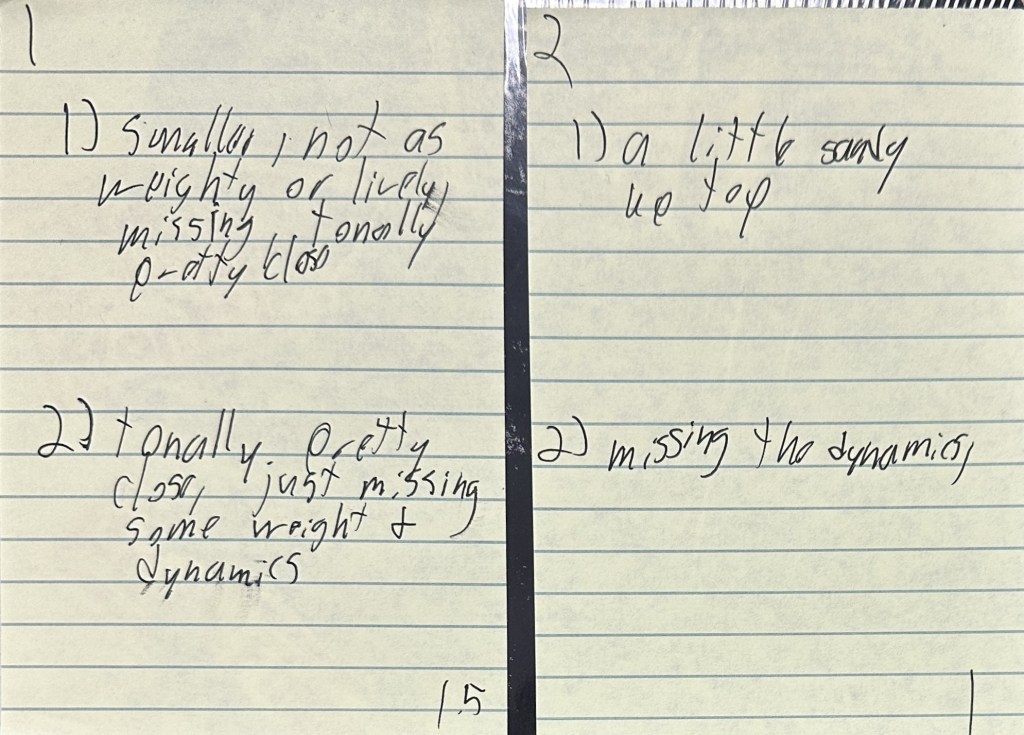
  • It’s smaller
  • Not as weighty or lively
  • Tonally pretty close

Sway is:

  • Tonally pretty close
  • Just missing some weight and dynamics

Oh, is that all? Well then, not as bad as it could have been, right?

1.5+, which means it would qualify for our lowest Hot Stamper grade. But no record that does not earn at least that grade on both sides can make it to our site, and when we flipped the album over, side two let us down even more than side one.

Bitch is:

  • A little sandy up top

I Got the Blues is:

  • Missing the dynamics

Grade for side two: 1+. Substandard. Not good enough to sell.

Usually our notes are filled with disgust about how awful sounding the current crop of remastered pressings tends to be.

Those interested in reading such notes have plenty to choose from. Here are some from 2024 through 2025. (At some point this year the number of awful sounding Heavy Vinyl pressings we’ve reviewed will hit 200!)

But this version isn’t awful. It’s just not very good. The sound quality is middling.

The sound of other audiophile pressings of Sticky Fingers, including one mastered by the venerable Robert Ludwig, was much, much worse.

As far as audiophiles are concerned, this new release should be regarded as nothing more than a waste of money.

The Question Before the House

We’ve asked this question before, but it’s worth asking again:

Can this really be the sound audiophiles are clamoring for?

It shouldn’t be, but apparently it is.

However, it’s not as though we haven’t run into this issue hundreds and hundreds of times before. Audiophiles and the reviewers who write for them regularly rave about one Heavy Vinyl pressing after another being The Greatest of All Time, yet we have never found a single instance in which this was true for any of the modern reissues they have seen fit to crown.

Except for this one.

Three Little Words

Our explanation for the mistaken judgments audiophiles and reviewers make so consistently has never been all that complicated. As you may have read elsewhere on this blog:

More evidence, if any were needed, that the three most important words in the world of audio are compared to what?

No matter how good a particular copy of a record may sound to you, when you clean and play enough of them you will almost always find one that’s better, and often surprisingly better.

You must keep testing all the reissues you can find, and you must keep testing all the originals you can find.

Shootouts are the only way to find these kinds of very special records. That’s why you must do them.

Nothing else works. If you’re not doing shootouts (or buying the winners of shootouts from us), you simply don’t have top quality copies in your collection, except in the rare instances where you just got lucky. In the world of records luck can only take you so far. The rest of the journey requires effort.

If you would like to hear what you’ve been missing, there’s a small chance we have a Hot Stamper pressing of the album in stock.

(more…)

Ziggy Stardust – MoFi Reviewed

Hot Stamper Pressings of the Music of David Bowie Available Now

Sonic Grade: C-

The MoFi pressing is decent, probably better than the average domestic copy I suppose, since those are clearly made from dubbed tapes.

The colorations and limitations of their cutting system would make it far too painful for me to listen to it though, especially the sloppy bass and dynamic compression.

You can do worse but you sure can do a whole lot better, hence the C grade.

MoFi did two of the greatest Bowie albums of all time, Ziggy and Let’s Dance, and neither one of them can hold a candle to the real thing. If you want to settle for a mediocre imitation of either or both of those albums, stick with Mobile Fidelity.

If you want to hear the kind of Demo Disc sound that Bowie’s records are capable of, try a Hot Stamper pressing. It’s guaranteed to blow your mind or your money back.

(more…)