Half-Speed Commentaries

A couple dozen commentaries on Half-Speed mastering.

How Does the MoFi Dixie Chicken Sound?

Little Feat Albums We’ve Reviewed

How does the MoFi pressing sound?

We have no idea; we’ve never bothered to order one, for at least one very good reason.

This is an album about rhythm.

Half-Speed mastered records have sloppy bass and, consequently, lack rhythmic drive.

Who is his right mind would want to half-speed master an album by Little Feat, one of the most rhythmically accomplished bands in rock and roll history?

The obvious answer is that it was a bad idea. But, if you’re Mobile Fidelity, and that’s the only idea you’ve ever had because you are in the half-speed mastering business, then what else can you do?

As the old saying goes, to a hammer everything looks like a nail.

OUR PREVIOUS HOT STAMPER COMMENTARY

Folks, this is no demo disc by any means, but the later pressings strip away the two qualities that really make this music work and bring it to life: Tubey Magic and Big Bass. This side two has both in SPADES.

Listen to how breathy and transparent the chorus is on the first track. Now layer that sound on top of a fat and punchy bottom end and you have the formula for Little Feat Magic at its funky best. This is the sound they heard in the control room, of that I have no doubt, and it is all over this side two. No side of any copy we played was better.

Personally

The All Music Guide (and lots of other critics) think this is Little Feat at their best. With tracks such as Two Trains, Dixie Chicken, Fat Man in the Bathtub and Roll Um Easy, who’s gonna disagree!? (I guess I am. I prefer Waiting for Columbus and The Last Record Album but cannot deny that Dixie Chicken is probably the best of the albums that came before them.)


Head to Head It’s No Contest

Visit our Hall of Shame (300+ strong) to see what, in our opinion, are some of the worst sounding records ever made.

Note that most of the entries are audiophile remasterings of one kind or another.

The reason for this is simple: we’ve gone through the all-too-often unpleasant experience of comparing them head to head with our best Hot Stamper pressings.

When you can hear them that way, up against an exceptionally good record, their flaws become that much more obvious and, frankly, that much more intolerable.

Foreigner – What’s Good About the Sound of Their Albums?

Hot Stamper Pressings of the Music of Foreigner Available Now

Mobile Fidelity Half-Speed mastered this album back in the day when their records were pressed in Japan (#1-052).

We haven’t played it in years. As I recall it was as lifeless and sucked-out in the midrange as most of the other MoFis of that period, notably The Doors (#051) and Trick of the Tail (#062).

What’s key to the sound of Foreigner’s records?

Obviously, the big one would have to be energy, a subject we have discussed at length here on the site.

Next would be punchy bass, followed by clear, present vocals.

Those would be the big three.

But those are qualities that are almost never found on Half-Speed mastered records!

The remastering of those records usually leaves them lifeless and compressed, with sloppy bass and recessed vocals.

For some reason, audiophiles — including the audiophiles who produce them — like that sound.

We do not. In fact we can’t stand it. Which is why we will not be auditioning MoFi’s newest remastered pressing. If you are feeling adventurous (and have $30 to throw away) and want to do the shootout for yourself, please let us know how it went.

The sound of the best pressings were jumping out of our speakers. Have you ever heard a Half-Speed do that?

Almost never, and we’ve played them by the hundreds.

Who’s Next – An Overview

More of the Music of The Who

The following was written in the early 2000s. Some of the commentary has been added or modified.


Who’s Next has been remastered for audiophiles many, many times, more often than not quite badly in our opinion.

To be fair, we should point out that our opinion has changed quite a few times over the course of the last twenty years.

This then is our story.

MCA MASTERPHILE

Back in the days when I was foolishly in the thrall of half-speed mastered audiophile pressings, I thought that the MCA Masterphile was king. That was probably the mid to late ’80s.

BRITISH TRACK LABEL ORIGINALS

By the early 90s I had discovered how good the Black Label Original British Track pressings could be and started preferring those. A bit murky but Tubey Magical, full and rich, precisely the way a good British Rock recording (Faces, Jethro Tull) should be.

JAPANESE AND GERMAN

Of course by then I had played numerous Japanese and German pressings, none of which sounded right to my ears, then or now. The Japanese did what they like to do to most of the records they master, from whatever dub tapes are sent to them: they brighten up the sound.

When I had much darker, less-revealing system, the Japanese pressing did better than most of the other pressings I played.

But it was wrong, and the better my stereo got the more wrong it sounded. This process comes under the general heading of audio progress 

MCA HEAVY VINYL

In 1995 the MCA Heavy Vinyl version came out, mastered by Kevin Gray. I quite liked it at the time but no longer do; it’s brightened up, opaque, airless and much of the fine detail of the recording is missing, all due to the crude cutting system Kevin employed at the time. It’s also notoriously badly pressed, resulting in stitches in the vinyl that are audible on practically every copy. (more…)

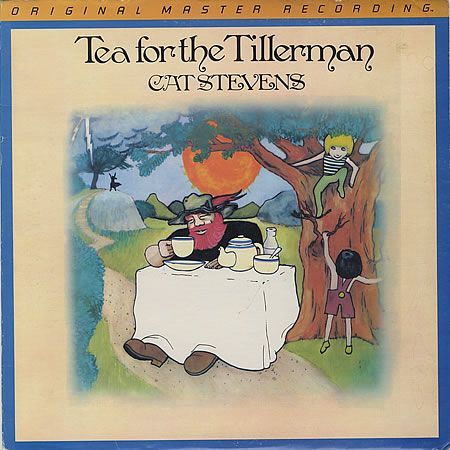
Cat Stevens and His Sparkling Acoustic Guitars?

More of the Music of Cat Stevens

In the commentary for America’s first album we noted that:

The guitars on this record are a true test of stereo fidelity. … most of the pressings of this record do not get the guitars to sound right. … on a copy with a bit too much top end they will have an unnatural hi-fi-ish sparkle. 

This kind of sparkle can be heard on many records Mobile Fidelity made in the ’70s and ’80s. Tea for the Tillerman, Sundown, Year of the Cat, Finger Paintings, Byrd at the Gate, Quarter Moon in a 10 Cent Town — the list of MoFis with sparkling acoustic guitars would be very long indeed, and these are just the records with prominent acoustic guitars!

(On a side note, if you want a very different sounding Mobile Fidelity record, try anything mastered by Jack Hunt. They are every bit as wrong, but in the tonally opposite direction: murky, fat and way too smooth. This is the sound favored by another audiophile label, this one, and the fact that audiophiles actually buy into this kind of third-rate sound is confounding to say the least.)

Next time you drop the needle on a Mobile Fidelity record — one of the ones pressed in Japan and mastered by Stan Ricker; the Anadisq series tends to have the opposite problem, no top end at all — listen carefully to the acoustic guitars and tell me if you don’t think they sound a tad sparkly.

We’ve all heard acoustic guitars up close, at parties and coffee shops and what-have-you. They don’t really sound like that, do they? I should hope not.

(more…)

Letter of the Week – “Meanwhile I sold out near all my pseudo-audiophile LPs – they are useless.”

What Exactly Are Hot Stamper Pressings?

One of our good customers had this to say about some Hot Stampers he has been buying lately [emphasis added].

Hey Tom, 

I want to express my gratitude to your long-lasting efforts with regard to music.

It has fully changed my whole life as a listener of music. 

It’s a great pleasure and I reached a complete different level of enjoyment and listening habits. To hear a Hot Stamper it’s also often a physical and emotional experience (sensation of heat, tears in the eyes, palpitations etc.). Thanks to your great Hot Stampers I might experience with so much pleasure.

Meanwhile I sold out near all my pseudo-audiophile LP’s (i.e. MFSL, Nautilus, DCC, Simply Vinyl etc.) – they are useless.

And last but not least it’s very important to buy these hot LPs now and here, before deafness, tinnitus (my greatest fear) and dementia are going to kill us. All LPs are worth their price, because I can imagine how much effort it takes to do the shootouts. (I did some.) (more…)

Chicago Transit Authority on MoFi – Or Is It The Glade Spray Mist Septet?

More of the Music of Chicago

UPDATE 2020

The last time I played a copy of the MoFi Chicago debut was about twenty years ago. My all tube system was much darker and dramatically less resolving than the one I have now, having made score upon score of improvements since then.

I suspect I would not be so kind to the MoFi today, and in that way I would surely be much more in agreement with Roger than I was about ten years ago when his letter arrived.


Our good customer Roger wrote to tell us of his Chicago shootout which included the MoFi, some later pressings and our Hot Stamper. Here is his story.

HI Tom

Got a chance to listen to your Chicago Transit Authority hot stamper and compare it to regular US and MFSL pressings. It has been a while since I last listened to this recording, but I listened to a lot of Chicago; Blood, Sweat, and Tears; and The Ides of March when I was in high school and college. I loved this music back then, as short-lived as it was, unfortunately.

Maybe this was because my two brothers played horns in concert bands, as does my youngest son now. A real shame that Chicago, at least, morphed into a whiny, wimpy, sappy Top 40 radio ballad band after their first two records. Anyway, it was fun listening to it again.

I recently picked up a couple of US copies of CTA to compare against my Mobile Fidelity version and the hot stamper. Both regular US copies had later Columbia labels, and had I only heard these, I might never have listened to this record again. Dull, compressed, murky, detail-challenged would be descriptive words for both copies. Muddy bass and absolutely no highs, I mean none.

The MFSL version did not have this lack-of-highs problem. In fact, it sounds like a lot of MoFi’s, the treble completely overcooked, sounding like cans of spray mist being actuated and overwhelming the rest of the music. This has to be one of the most hideous recordings in existence. With the MFSL version, Chicago has been transformed into the Glade Spray Mist Septet, with a psst psst here, a psst psst there, here a psst, there a psst, everywhere a psst psst. Arrggg! I was getting more and more psst off listening to this sonic detritus. Unless you have a Mattel Close-And-Play record player, how can anyone listen to this thing? Did MFSL engineers moonlight as gunnery sergeants on the artillery range? And the MoFi’s complete lack of bass left the overwhelming treble out to hang and dry. Unreal.

So the Hot Stamper was next, and you know what, it sounds like my son’s high school concert band (only a lot better but don’t tell him). After the MoFi, the highs sounded somewhat recessed, but more in line with the rest of the sonic spectrum. There was real bass weight, maybe not the lowest bass, but good just the same, and the midrange was much more full and weighty, something this recording needs. Trombones sounded like trombones and saxes like saxes. So perhaps the hot stamper will make my new regular record rotation now and my listening room won’t smell like a Glade pine forest. (more…)